I ran NVIDIA’s open-source Auto Ontology on a sample sales database and put five models through the same business questions with it and without it. Built from the database’s metadata alone, it did no better than simply handing the model the whole schema. When I added the 19 hand-written analyses NVIDIA ships with its test data, three of the models went from nine to eleven questions right to thirteen or fourteen, and most of that gain came from questions those analyses already answered.
What Auto Ontology is
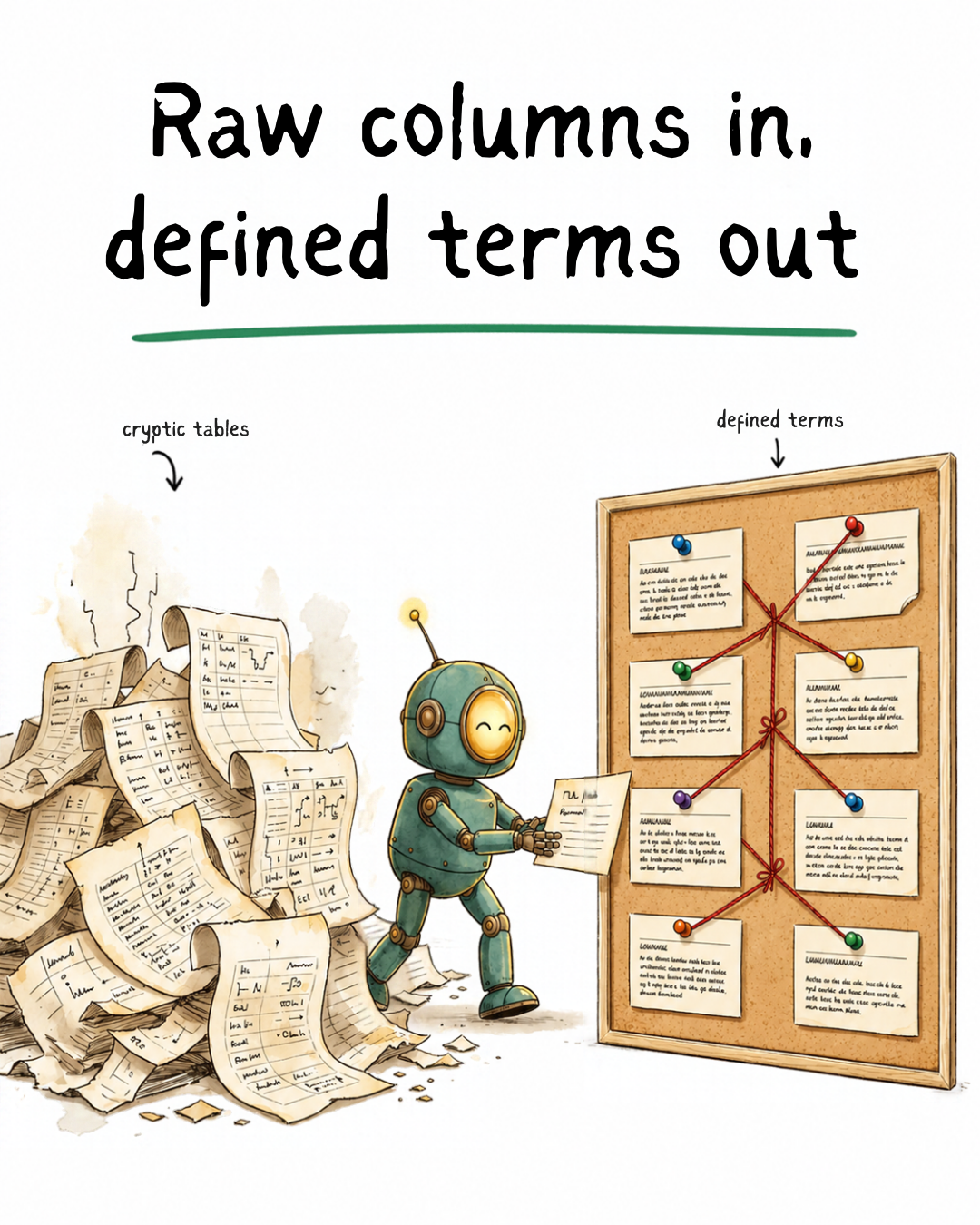
Auto Ontology is an Apache-2.0 library from NVIDIA that reads a database’s metadata and builds a governed layer of business meaning on top of it: terms, the columns they map to, joins between concepts, metrics defined as SQL, lineage and a certification state. An agent then queries that layer instead of guessing from raw table and column names. The repository ships a Next.js front end, a FastAPI backend, an ingestion service and a FastMCP server over Postgres with pgvector, and it serves the layer through a REST API, a command line and MCP tools such as search_terms, get_term, check_answerable and ask_question. We covered the first announcement in a short brief.
The language-model work is split into four roles: reasoning, non-reasoning, embedding and reranking, and the defaults point at NVIDIA’s Nemotron models on build.nvidia.com. The README says the project is number one on the BEAVER and BIRD-Interact leaderboards. I did not check either leaderboard. It also says an ontology matters most when questions are ambiguous, data spans many sources with conflicting definitions, or meanings must be governed across teams, and that with one well-modelled source “direct SQL may be enough”. That last line turned out to describe my results.
What it builds
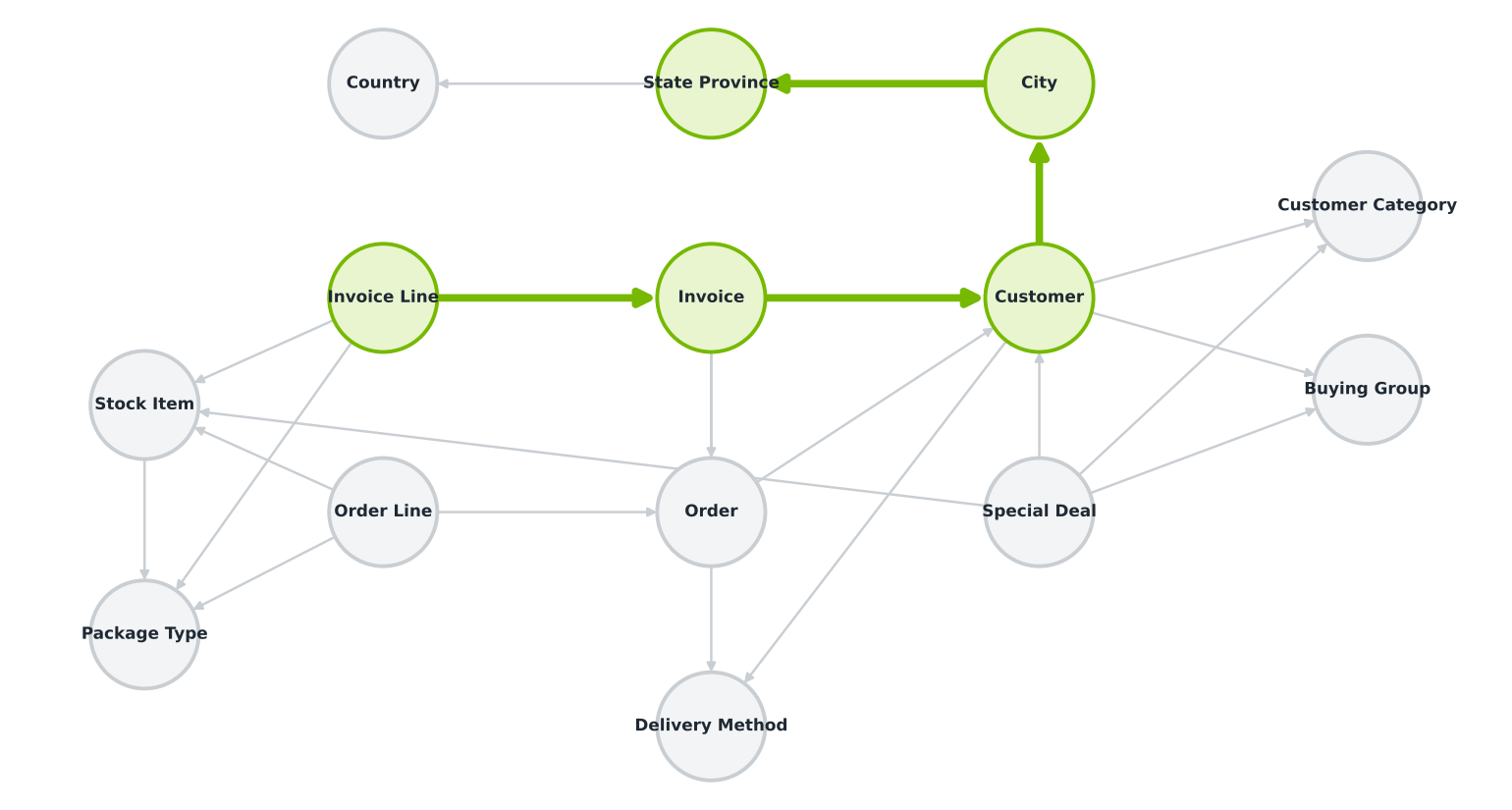
For Wide World Importers, Microsoft’s sample trading company database, the build read 50 tables and wrote column descriptions and semantic join links between them. The build took about half an hour with DeepSeek V4.1 Flash doing the describing. The graph below is a slice of the term graph, redrawn from the join links it stored.
One thing the cold build did not produce is metrics. It found no SQL-defined attributes, because there was nothing in the metadata to define them from. Those come from people.
How I tested it
NVIDIA publishes a companion evaluation repository for Wide World Importers on Postgres. It holds 41 business questions with gold SQL, and a “control” arm that gives the model the question plus a dump of the whole schema and asks for one query. The “treatment” arm gives the Auto Ontology agent only the question. Both are graded the same way, by running the answer and the gold query and requiring identical rows. The gold query for two of the questions does not run on Postgres, so I score out of 39. The repository also ships 19 human-written “custom analyses”, saved queries with a name and a description, which its own pipeline feeds into the ontology when it is built.
That gave me three setups: schema only, Auto Ontology built cold (no custom analyses), and Auto Ontology built with the 19 analyses. I built each ontology once, then ran every model’s agent against it. The models were Kimi K3.1 Pro through Synthetic, DeepSeek V4.1 Flash through Morph, Claude Opus 5.5, GPT-6.1 Terra and Gemini 4 Neon, each over its own API. I ran Terra with reasoning off, because the agent uses function tools through the chat completions interface. Control calls allowed up to 16,000 output tokens, raised for DeepSeek and Neon, whose thinking ate the budget at first. Everything was one run per model per setup.
I changed a few things to make it run in my environment, and they matter:
- There was no Docker, so I ran Postgres 16 natively and built pgvector 0.8 from source.
- I pointed the embedding and reranking roles at OpenAI’s text-embedding-3-large through a small local shim, and reranking is plain cosine similarity. That is not NVIDIA’s retrieval stack, so retrieval quality may differ from what NVIDIA reports.
- I pointed every language-model role in the agent at the model under test.
- NVIDIA’s harness runs on its NeMo Gym framework, which would not install here, so I wrote a small runner that reuses the repository’s own task builder, SQL extractor, executor and row comparison.
- A small local proxy removes a parameter Opus rejects. Morph’s DeepSeek sometimes returned an empty message, so the control runner retries on empty output.
I used my own runner rather than OpenCode, since this is a Python evaluation harness with no coding-agent loop. These are the exact prompts. The control arm sends this system message:
Please reason step by step, and put your final answer within the tags "```sql" and "```".
Return exactly the requested output fields and NO others.
and this user message, with the schema dump (tables, views and sequences, roughly 60,000 characters) pasted in:
### Question
{question}

Write a single postgres query that answers the question.

The following is a SQL dump that describes the database and the tables in it.
{schema dump}
The treatment arm sends the bare question, with these settings from NVIDIA’s own request builder. The agent loop retrieves from the ontology, runs SQL and submits an answer:
question: {question}
calculation_only: true     # every question is answered by running SQL
shorten_answer: true       # "Return exactly the requested output fields and NO others"
validate_sql_values: true  # check filter literals against the database
Both ontology builds used NVIDIA’s own ingest script. For the cold one I took the custom analyses file out of the dataset folder first, and for the other I left it in:
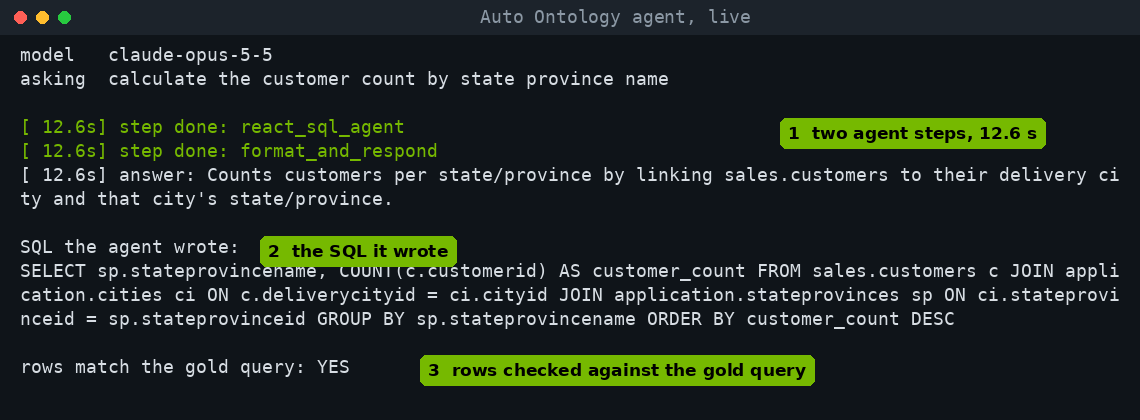
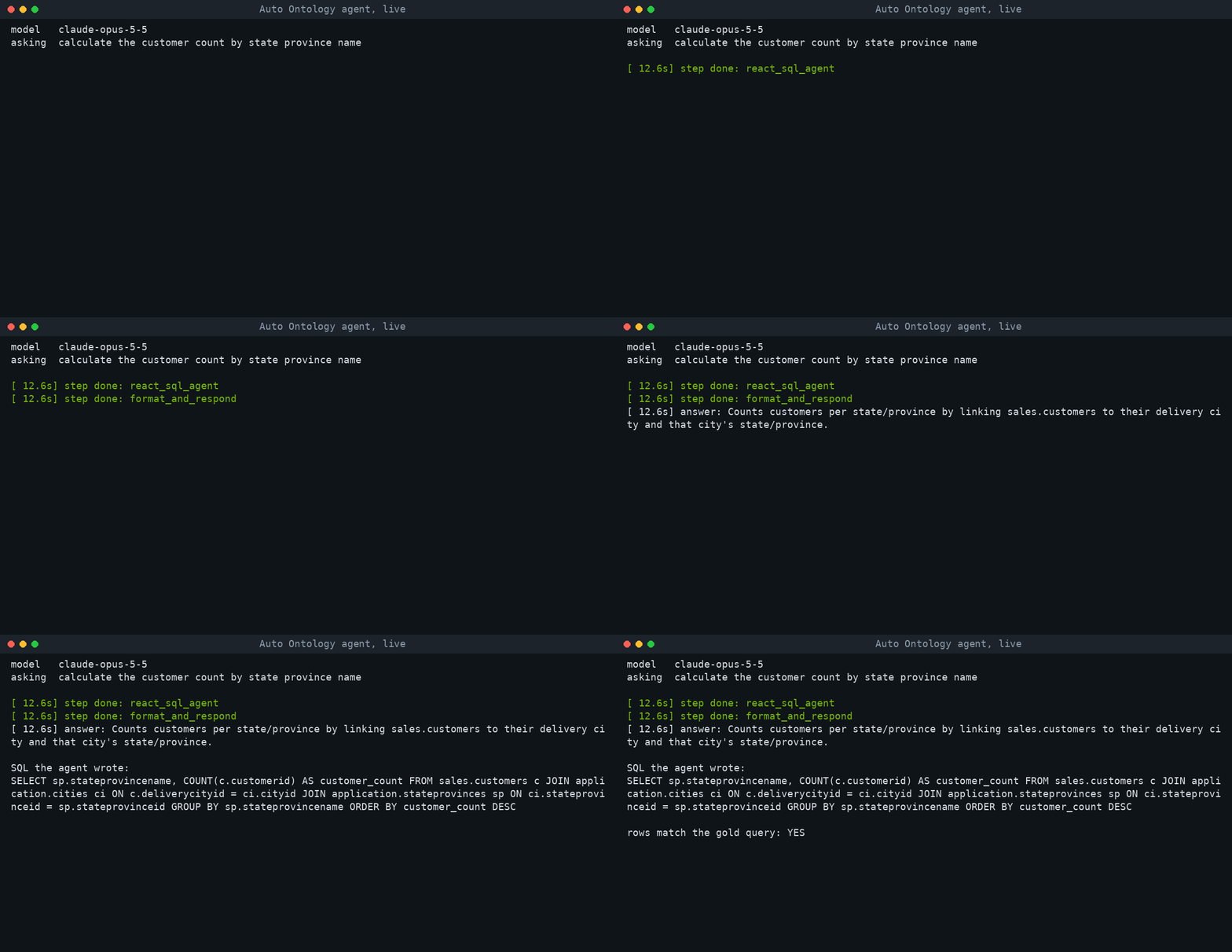
uv run python main.py --database-name wideworldimporters --skip-evalHere is one question going through the agent, annotated, and then as it played out in my terminal.
What came back
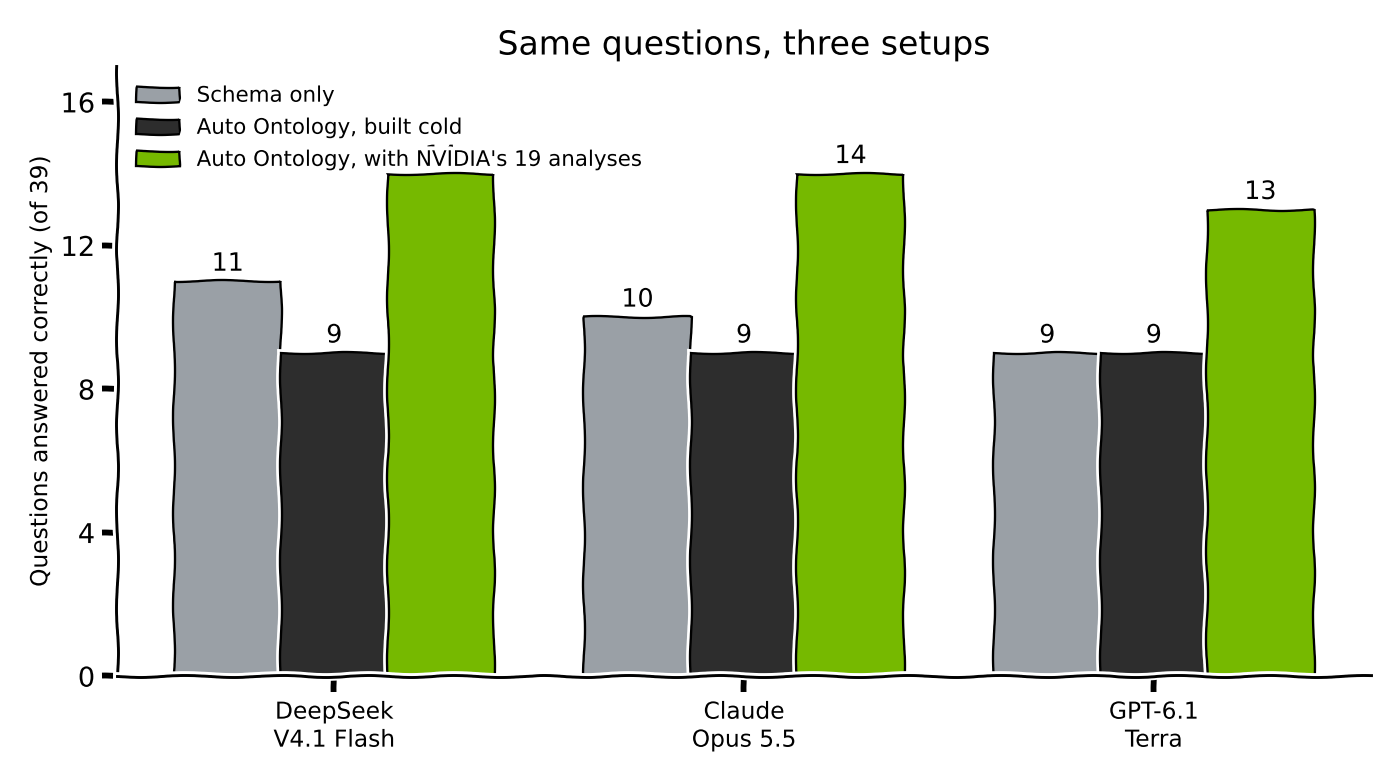
Counts are questions answered correctly out of 39. Times are rough averages per question.
| Model | Schema only | Built cold | With NVIDIA’s 19 analyses | Time, schema only | Time, agent |
|---|---|---|---|---|---|
| DeepSeek V4.1 Flash | 11 | 9 | 14 | about 20 s | about 20 s |
| Claude Opus 5.5 | 10 | 9 | 14 | about 5 s | about 13 s |
| GPT-6.1 Terra | 9 | 9 | 13 | about 2 s | about 10 s |
| Gemini 4 Neon | 10 | 8 | not run | about 70 s | about 2 min |
Kimi K3.1 Pro answered 9 questions with schema only. My Synthetic quota ran out before a full agent run, so I ran it on 13 questions and it matched schema-only on those: 9 of 13 each way.
Built cold, it did not beat the schema dump
Across the models that ran in full, the cold agent answered 8 or 9 questions where schema-only answered 9 to 11. Not one question flipped from wrong to right under the agent for any model, and a few flipped the other way. Differences that small are within the noise of a single run, so I read this as a tie at best. The agent was also slower for most models, because it retrieves, writes SQL, checks filter values and then answers, where the control makes one call.
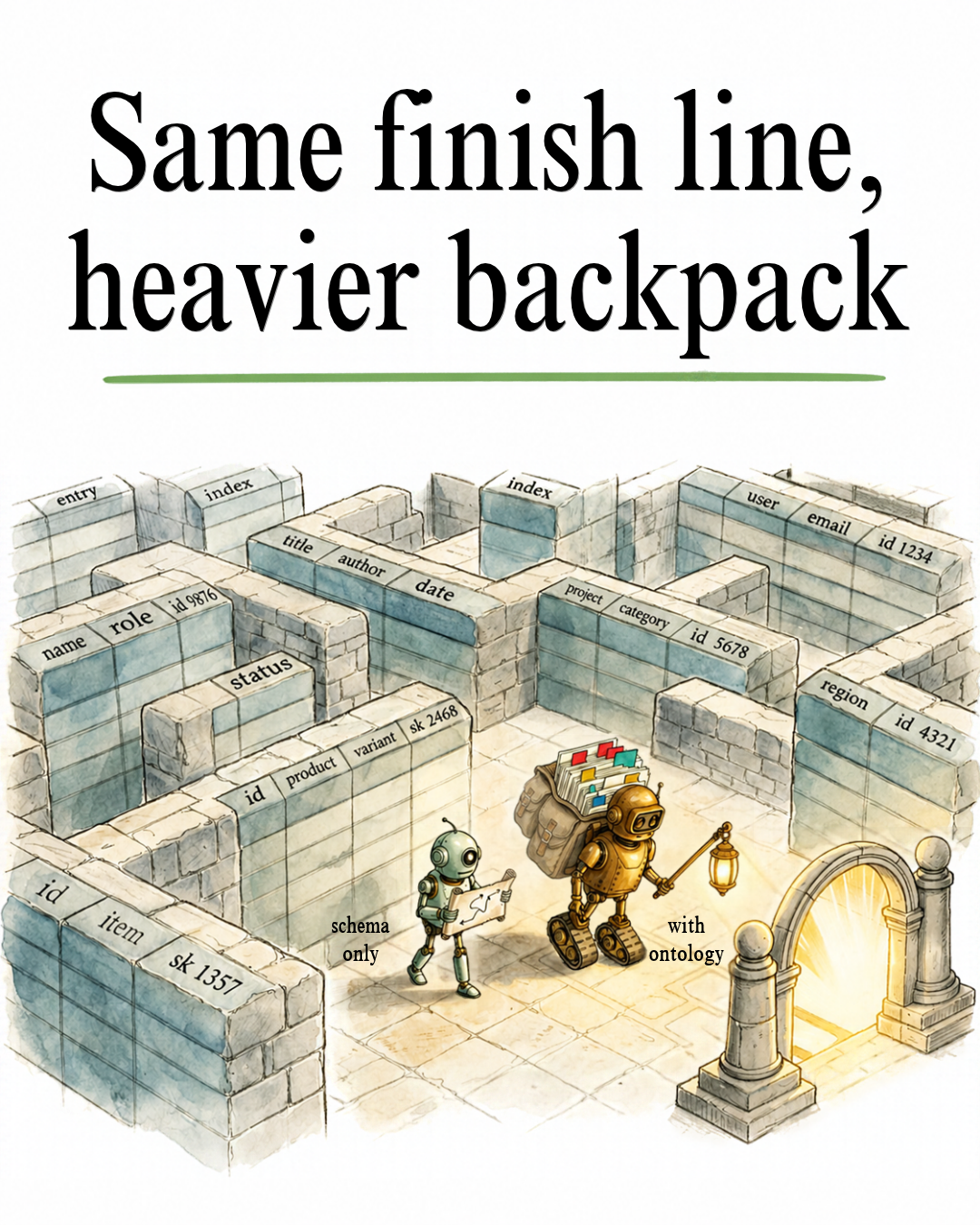
With NVIDIA’s analyses, three models gained
Rebuilding the ontology with the 19 analyses lifted DeepSeek and Opus to 14 and Terra to 13. Four questions flipped for all three of those models, and none of the five models had answered any of them under schema-only or the cold build. Each one lines up with an analysis NVIDIA wrote:
| Question | Closest of the 19 analyses | Schema only or cold | With the analyses |
|---|---|---|---|
| List the order details with customer names | Order Details With Customer Names | none of five models | DeepSeek, Opus, Terra |
| List the supplier transactions with supplier names | Supplier Transactions With Supplier Names | none of five models | DeepSeek, Opus, Terra |
| List the order details with stock item names | Order Details with Stock Item Names | none of five models | DeepSeek, Opus, Terra |
| Monthly sales summary of chiller and dry items | Monthly Sales Summary By Invoice Date | none of five models | DeepSeek, Opus, Terra |
Opus also gained a fifth question, annual supplier purchase totals, which has a matching analysis too. DeepSeek gained two more and lost one, which I put down to noise.
This is the part I would not oversell. A curated, human-written analysis that retrieves cleanly is the feature working as designed: it is the “certified definition” the project is built around. But it means the lift here shows what an expert-written answer is worth when the test questions are close to it. It is not evidence that the ontology makes a model better at questions nobody wrote down. Most of the questions were not answered under any setup, and because grading demands an exact row match, I did not audit how many of those are strictness rather than real mistakes.
Where it fits
Semantic layers are not new. Tools such as dbt’s Semantic Layer and Cube have long let teams define a metric once and reuse it, and Databricks leans on curated context in Genie, whose benchmark claims we looked at earlier this month. What Auto Ontology adds is a first draft generated from metadata, a certification loop, and an MCP, API and command-line surface so any agent can use the same definitions. It also reads and writes Apache Ossie YAML, the open format for exchanging semantic models, so work done there is not locked in. If you are weighing graph-based agent memory instead, HydraDB’s SelfGraph is a different approach to a nearby problem.
The case NVIDIA makes is many sources, conflicting definitions and shared governance. A single tidy sample database, which is what I tested, is the case its own README says may not need it.
What I couldn’t test
I did not run the web app, the MCP server, the skills or NVIDIA’s Nemotron models, and I did not test the certification and learning loop that is meant to improve the ontology with use. I never tried a database with many sources and clashing definitions, which is where NVIDIA says it pays off, so I cannot say whether the BEAVER and BIRD-Interact claims hold up. Every number is one run, so a swing of a question or two means little. My retrieval models differ from NVIDIA’s, Kimi’s agent run covers only part of the set, and I ran the shipped ontology on three models rather than all five.
Where that leaves Auto Ontology
It works as advertised: it builds a catalogue and join graph from a database, and the agent answers real questions through it. On one clean database it did not beat a model that could see the whole schema, and it cost more time per answer. What moved the score was human knowledge fed into it. If you try it, budget for writing the analyses and definitions, and test it on your own questions before trusting any leaderboard.
Disclosure: I’m an OpenAI, Firecrawl and Devin ambassador.