AI news runs on a small set of words that rarely get explained. Business Insider’s glossary of AI terms prompted this guide, but I built mine a different way. Every entry below comes from a primary source: a lab’s own documentation, the original research paper or a standards body. I’ve kept to the words that turn up in our coverage every day, and I link each one to a story here where it matters.
Disclosure: I’m an OpenAI, Firecrawl and Devin ambassador.
How models work
- Token
- The unit a model reads and writes. A token can be a character, part of a word, a whole word or a piece of punctuation, and the same text can give a different count on a different model. OpenAI’s rule of thumb for English is that 100 tokens is about 75 words. Tokens are also how you get billed, which is why prices are quoted per million of them.
- Context window
- Everything a model can look at when it writes a reply, including the reply itself. Anthropic’s docs call it the model’s working memory. The system prompt, every message, tool results, tool definitions and any thinking all count against it. A bigger window isn’t automatically better: Anthropic says accuracy and recall degrade as the token count grows, a problem it calls context rot. See our report on Nvidia’s long-context paper and on OpenCode’s HungerG, a stealth model with a 1M-token window.
- Compaction
- Summarising the older part of a conversation so it can carry on past the context limit. Anthropic offers it on the server side, so the API does the summarising for you.
- Pretraining
- The first stage of building a language model, where it learns by predicting the next word across huge amounts of text, as OpenAI describes it.
- Weights
- The final weights and biases of a trained neural network. They’re the numbers that decide how the model turns an input into an output.
- Open weights
- A lab publishes those final weights so others can run and adapt the model. The Open Source Initiative says that isn’t the same as open source AI, because open weights leave out the training code and the training data. Examples in our coverage: Tencent’s Hy4 release and the House report on Chinese open-weight models.
- Mixture of experts
- A design that splits a network into many sub-networks called experts, with a gating network that picks a few of them for each input. The model can hold far more capacity without using all of it every time. The idea was set out in a 2017 paper that built the layer with up to thousands of experts. Our piece on Kolibri shows it in practice.
- Distillation
- Compressing what a large model, or a group of models, knows into one smaller model that’s easier to deploy. The method is laid out in a 2015 paper on distilling the knowledge in a neural network. It’s behind Google’s distillation guide for open models and Together AI’s Lao model, and labs now guard against it: see OpenAI’s safeguards for GPT-6.2 Astra.
- Fine-tuning
- Training an existing model further on narrower examples so it does one job better. See Google’s hub for fine-tuning Gemma 4.
- Reasoning model
- A model that produces internal reasoning tokens before it answers, so it can plan, try alternatives and handle multi-step tasks, per OpenAI’s docs. Those tokens aren’t shown through the API, but they take up space in the context window and are billed as output tokens. An effort setting controls how much the model thinks. See Claude Code’s subagent effort setting and ARC Prize’s DeepSeek Flash scores with and without reasoning.
- Hallucination
- A plausible but false statement that a model states with confidence. OpenAI’s research argues models hallucinate partly because standard training and scoring reward guessing over saying “I don’t know”.
- RAG
- Retrieval-augmented generation. The model looks up passages from an index of documents, then writes its answer from them, instead of relying only on what’s stored in its weights. The term comes from a 2020 paper that used a Wikipedia index.
Agents and their tools
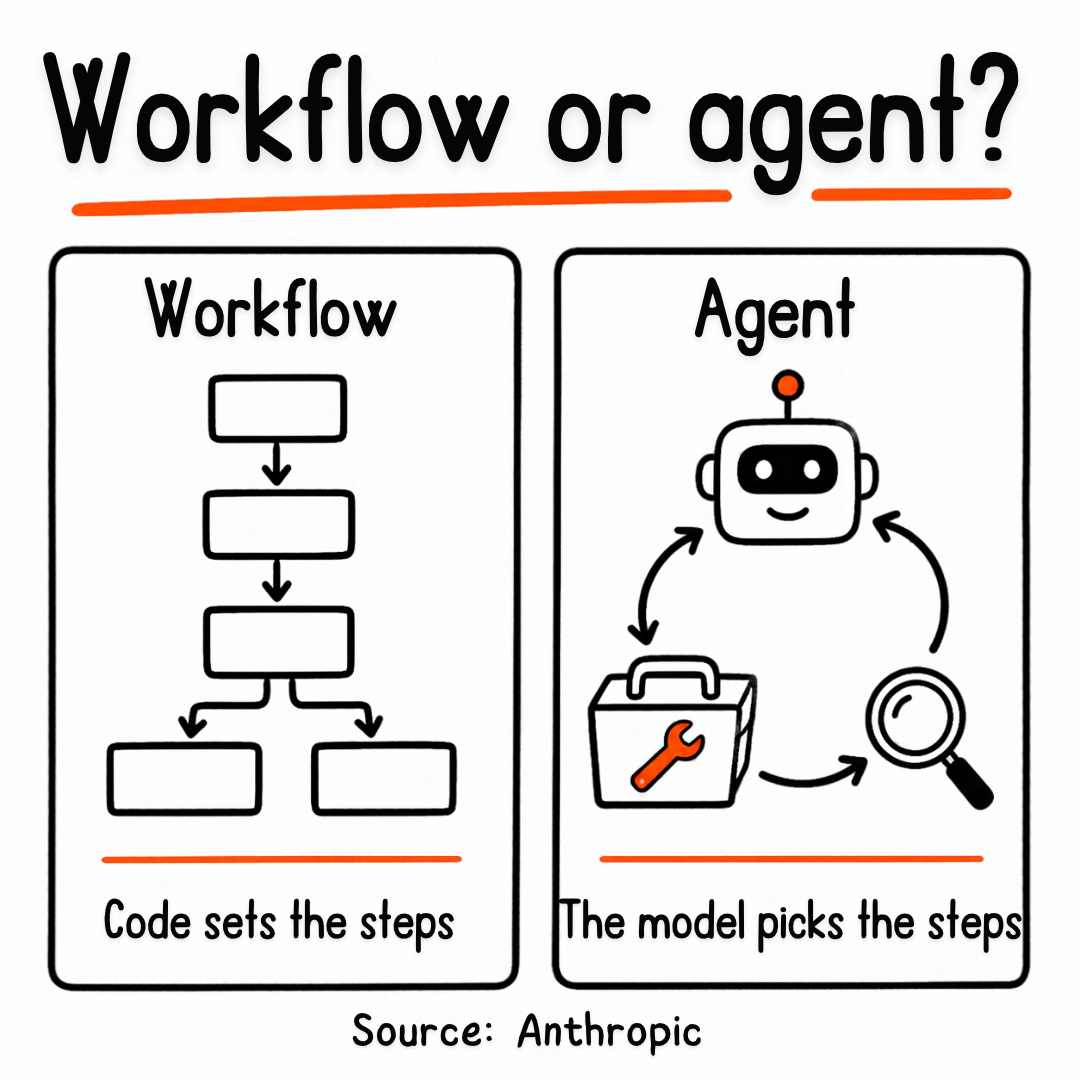
This is where the vocabulary moves fastest, and where people mix words up most. The split between a workflow and an agent comes from Anthropic’s guide to building effective agents.
- Agent
- A system where the model dynamically directs its own process and its use of tools. Anthropic’s shorthand is that agents are typically just models using tools, based on feedback from their environment, in a loop. For habits to avoid, see Thorsten Ball’s list of 14, and for what goes wrong with several agents at once, Anthropic’s Lesse on multiagent problems.
- Workflow
- A system where models and tools are orchestrated through predefined code paths. The code decides the order of the steps, not the model.
- Tool call
- The model asks for an action by name, such as a search, and the software around it runs the action and hands back the result. In Anthropic’s API, the reply includes a tool use block when the model plans to invoke a tool. See Gemini API’s Tool Retrieval, which loads tool schemas on demand.
- Harness
- The software around a model that gives it instructions, makes tools available and lets it inspect what comes back, as Earendil explains. The same model can behave very differently in different harnesses: Runta and Baseten found the cost per task varies widely, and Nvidia used Factory’s Droid harness to fix a model’s tool-use mistakes.
- MCP
- The Model Context Protocol, an open-source standard for connecting AI applications to external systems: data sources, tools and workflows. Its own docs compare it to a USB-C port for AI applications. Read Anthropic’s code execution with MCP post, explained, and our reports on Google’s Workspace MCP requirement and Claude Code loading skills from MCP servers.
- Skill
- A reusable, filesystem-based package of instructions, scripts and reference files, built around a
SKILL.mdfile. Anthropic’s docs say that until a skill is triggered, only its name and description sit in context. Loading the rest in stages is called progressive disclosure. See NestJS’s six official skills. - Prompt injection
- An input that alters a model’s behaviour in ways its builder didn’t intend. OWASP splits it into direct injection, typed by the user, and indirect injection, hidden in external content such as a web page or a file the model reads. A jailbreak is a form of prompt injection that gets a model to drop its safety rules. See Perplexity’s page scoring for prompt injection and Gemini’s Mac app risk list.
Money words
- Price per million tokens
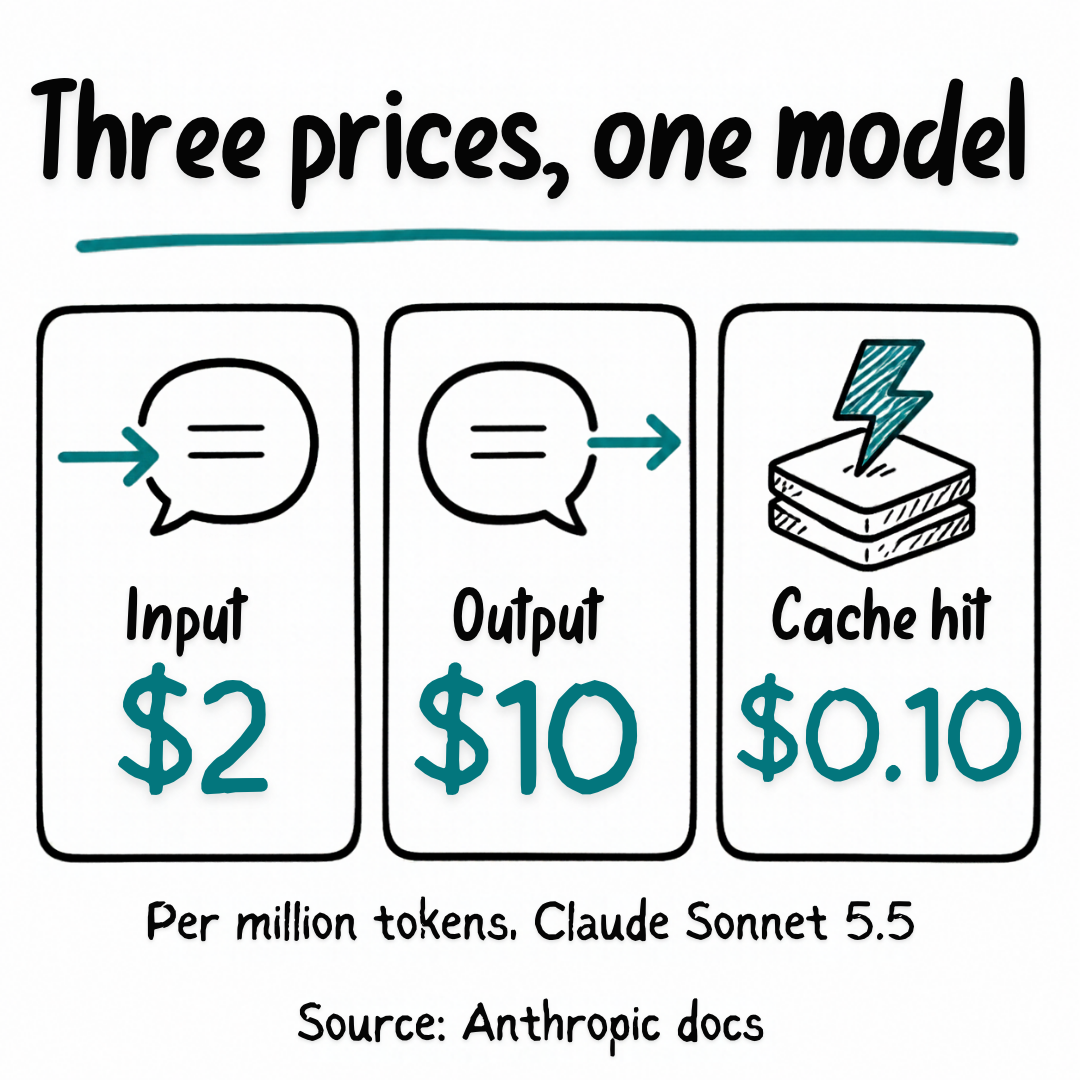
- How API models are priced. Input and output are billed separately, and output costs more. Anthropic lists Claude Opus 5.5 at US$4 per million input tokens and US$20 per million output tokens. Cheaper models go much lower: see Tencent’s Hy4 flash launch.
- Prompt caching
- Reusing a prompt prefix the provider has already processed, so repeated input costs less. Anthropic’s cache lasts five minutes by default and is refreshed each time it’s used. A cache read costs 10% of the base input price on most Claude models and 5% on Opus 5.5 and Sonnet 5.5, while a five-minute cache write costs 1.25 times the base price. The prompt has to match exactly, so changing anything before the cached block means a miss. Related reading: Google’s Antigravity cache hit rate, OpenAI’s 12-hour prompt cache and Gergely Orosz on cheap cache reads.
Tests and scores
- Benchmark
- A fixed set of tasks used to score models. The standard coding example is SWE-bench, which hands a model a codebase and a real GitHub issue and asks it to edit the code so the issue is fixed. Treat the headline score with care: OpenAI’s research says scoreboards that rank on accuracy alone reward lucky guesses over admitting uncertainty. A newer take is Ramp’s SWE-Bench v2, which grades coding agents on production tasks.
- Eval harness
- The code that runs a model through the tasks and scores the answers. Two teams can report different results for the same model because their harnesses differ. See Parallel’s open-sourced eval harness.
Release words
- Stealth model
- A model offered for testing without naming its maker. OpenRouter describes its cloaked models as provided to the community to gather feedback, free to use, with prompts and completions logged by the model’s creator. OpenCode lists its stealth models the same way, as free for a limited time while the team collects feedback, and says collected data may be used to improve the model. That makes them poor places for private code. Our tests and reports: Seaglass, OpenCode’s free coding model with no named maker, Seaglass Alpha and HungerG.
Terms people mix up
| Pair | The difference |
|---|---|
| Context window vs training data | The context window is the working memory for one request. The training data is the large body of text the model learned from beforehand. |
| Open weights vs open source AI | Open weights release the final numbers. Open source AI also releases the training code and details of the data. |
| Skill vs MCP | A skill is a package of instructions that loads on demand. MCP is a standard for connecting a model to outside systems. The two can work together. |
| Workflow vs agent | In a workflow, code sets the steps. In an agent, the model picks them. |
| Prompt injection vs jailbreak | Prompt injection is any input that changes a model’s behaviour. A jailbreak is the kind that makes it ignore its safety rules. |
Where the definitions come from
Each entry above links to its source. The main ones are Anthropic’s documentation on context windows, prompt caching and skills, OpenAI’s guides on reasoning and hallucination, the MCP introduction and the OWASP page on prompt injection. The research terms come from the papers on distillation, retrieval-augmented generation, mixture of experts and SWE-bench.