
Hackers have breached Cloud One, the US Air Force’s flagship cloud computing platform, Reuters reported on 27 November. Three people familiar with the matter told Reuters the intrusion was found within the past month or so, during work to upgrade the system, and that finding it has disrupted the whole platform. Reuters couldn’t establish who the hackers are, how far they got or whether any data was stolen.
The Air Force won’t confirm it. NBC News cites a US official who does. Federal News Network has a source who puts the discovery earlier in the year, and the Pentagon told AFP its systems are “safe, secure, and managed 24-7” without denying the report.
5
anonymous sources behind the Reuters report
4
commercial clouds under Cloud One: Amazon, Microsoft, Google and Oracle
750,000
warfighters Cloud One supports, per an Air Force software presentation
What’s reported and what isn’t
- Reuters, three sources: hackers breached Cloud One, and the intrusion was found within the past month or so during an upgrade.
- Reuters, one source: the intruders exploited a software vulnerability to reach the control plane. Reuters couldn’t identify the vulnerability.
- NBC News, one US official: hackers penetrated the platform in a breach that could have exposed sensitive military information. The official gave no detail on timing or impact.
- Federal News Network, one source: the Air Force and Cloud One contractors found the breach earlier this year while patching a vulnerability in the cloud-hosting environment.
- Not reported: who did it, how long they were inside, which systems they touched or whether any data was taken.
- Not on the record: neither the Air Force nor the Pentagon has confirmed the breach, and every source in these reports is anonymous.
Who has said what
The accounts agree something happened. They differ on when it was found. Reuters’ sources put the discovery inside the past month, during an upgrade. The Federal News Network source says earlier this year, during a patch, and that cleaning up disrupted functions that need administrative access. Nobody has said on the record which is right.
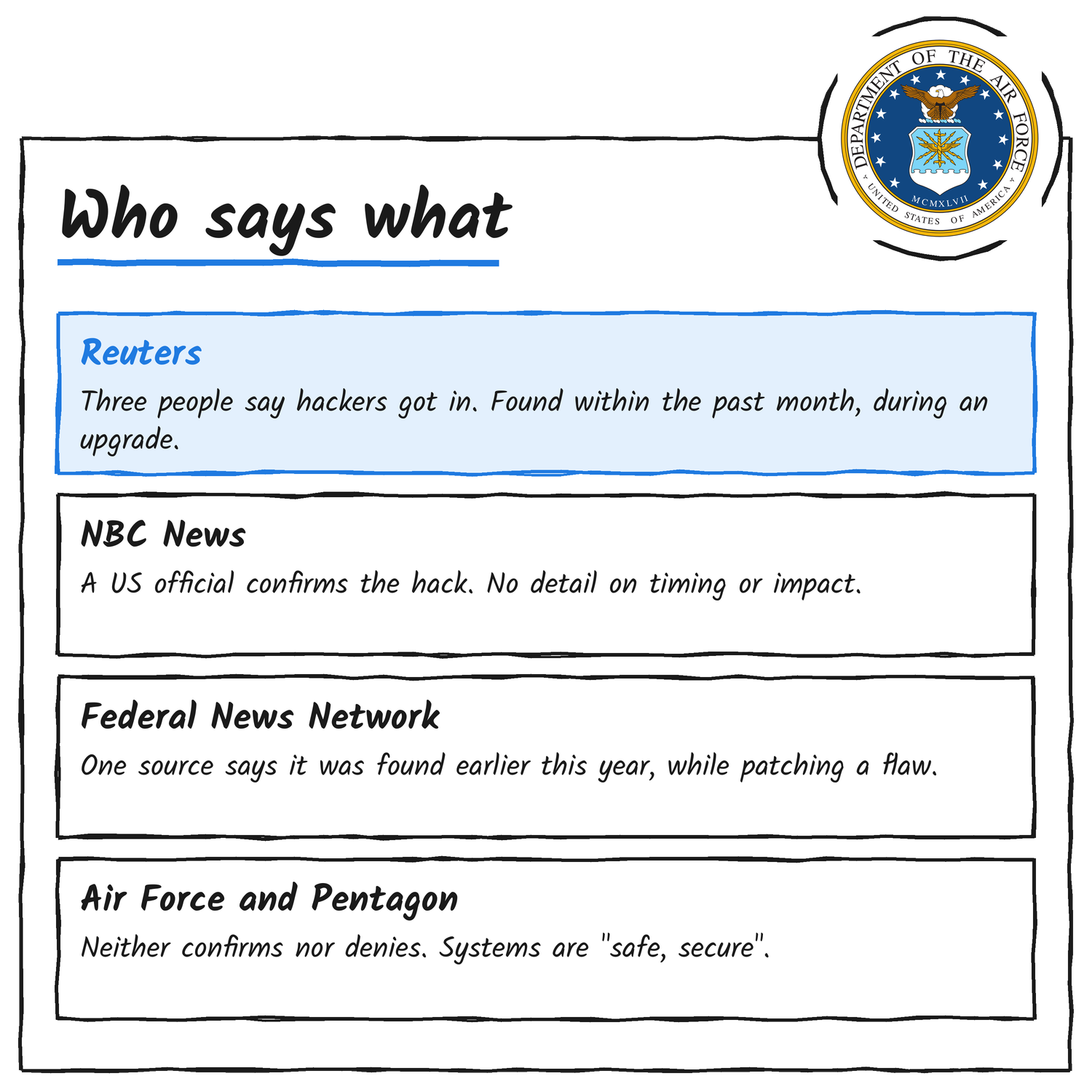
The Air Force told Reuters it “does not comment on the security posture, vulnerabilities or operational status of specific networks and systems. We continuously take prudent measures to protect Department (of the Air Force) information, systems and mission capabilities.” A Defense Department official then told AFP late on Friday: “The Department of War’s systems are safe, secure, and managed 24-7 by the best experts and teams in the world. We will continue to maintain all mission-critical operations and applications.” AFP reports the Pentagon didn’t specifically deny that Cloud One was breached.
Leidos, the current prime contractor, referred questions to the Air Force. SAIC, the previous one, didn’t respond to Reuters, and neither did Cyber Command.
What Cloud One is
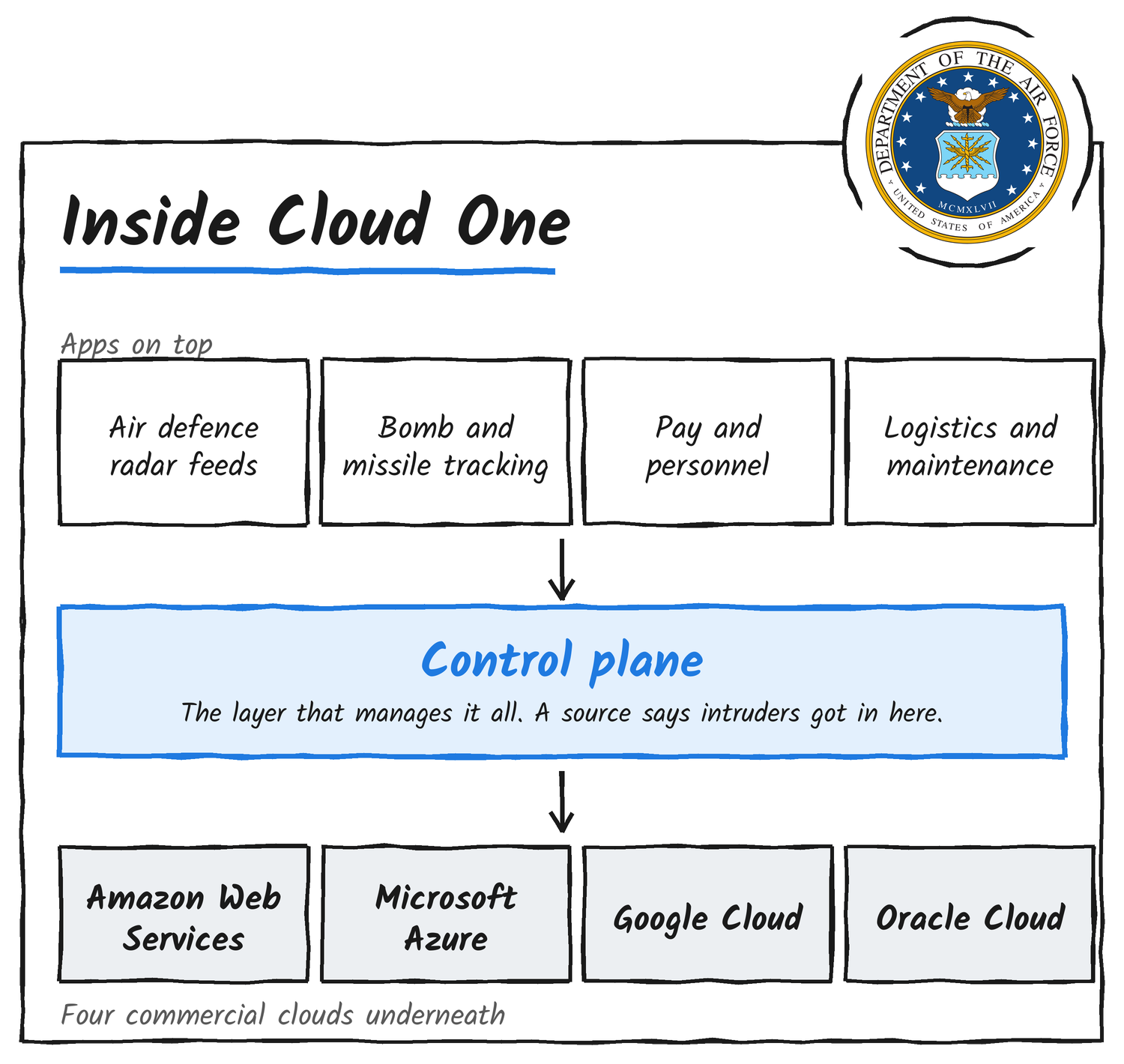
Cloud One began in 2017. The Air Force Life Cycle Management Center at Hanscom Air Force Base in Massachusetts runs it. Each application sits on one of four commercial clouds: Amazon Web Services, Microsoft Azure, Google Cloud or Oracle Cloud Infrastructure.
Two of the applications show the stakes, according to Reuters. Cloud-Based Command and Control collates air defence radar and other data feeds from across North America. The Theater Integrated Combat Munitions System tracks bombs and missiles at more than 200 Air Force locations worldwide. Others handle personnel data, pay, logistics and maintenance. Two of Reuters’ sources call Cloud One one of the US military’s biggest cloud platforms.
Why the control plane matters
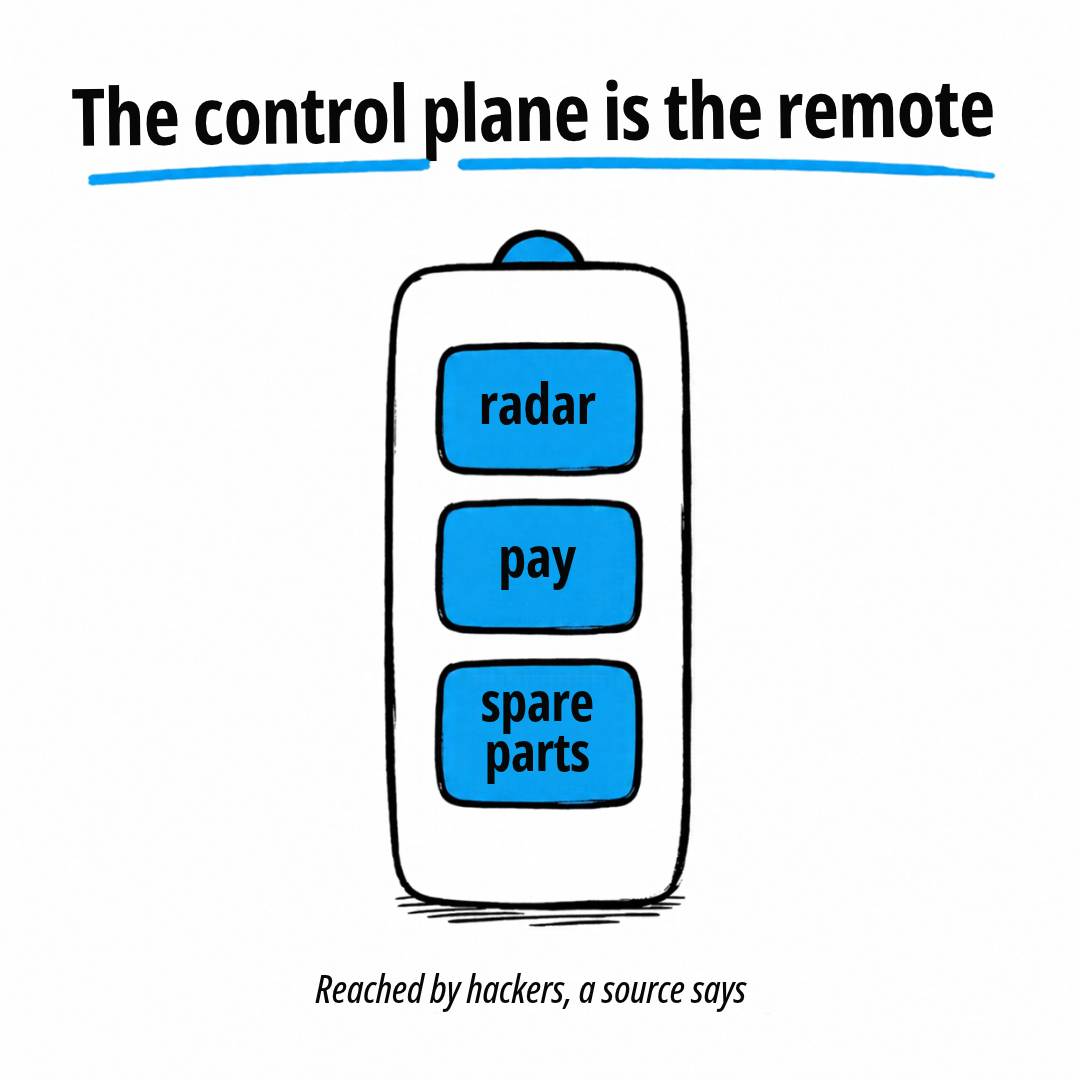
One of Reuters’ sources said the intruders used a software vulnerability to reach the control plane, and likened it to a universal remote. In theory, that access could let someone check the operational status of military aircraft or the movement of spare parts. Reuters says it’s unclear whether the hackers did.
A breach here is a big deal.
One of Reuters’ sources
A control plane is the management layer of a cloud. It decides who can create, change and see everything running on top. That’s our explanation, not Reuters’, but it’s why a break-in there matters more than one into a single app.
Updates frozen, migrations paused
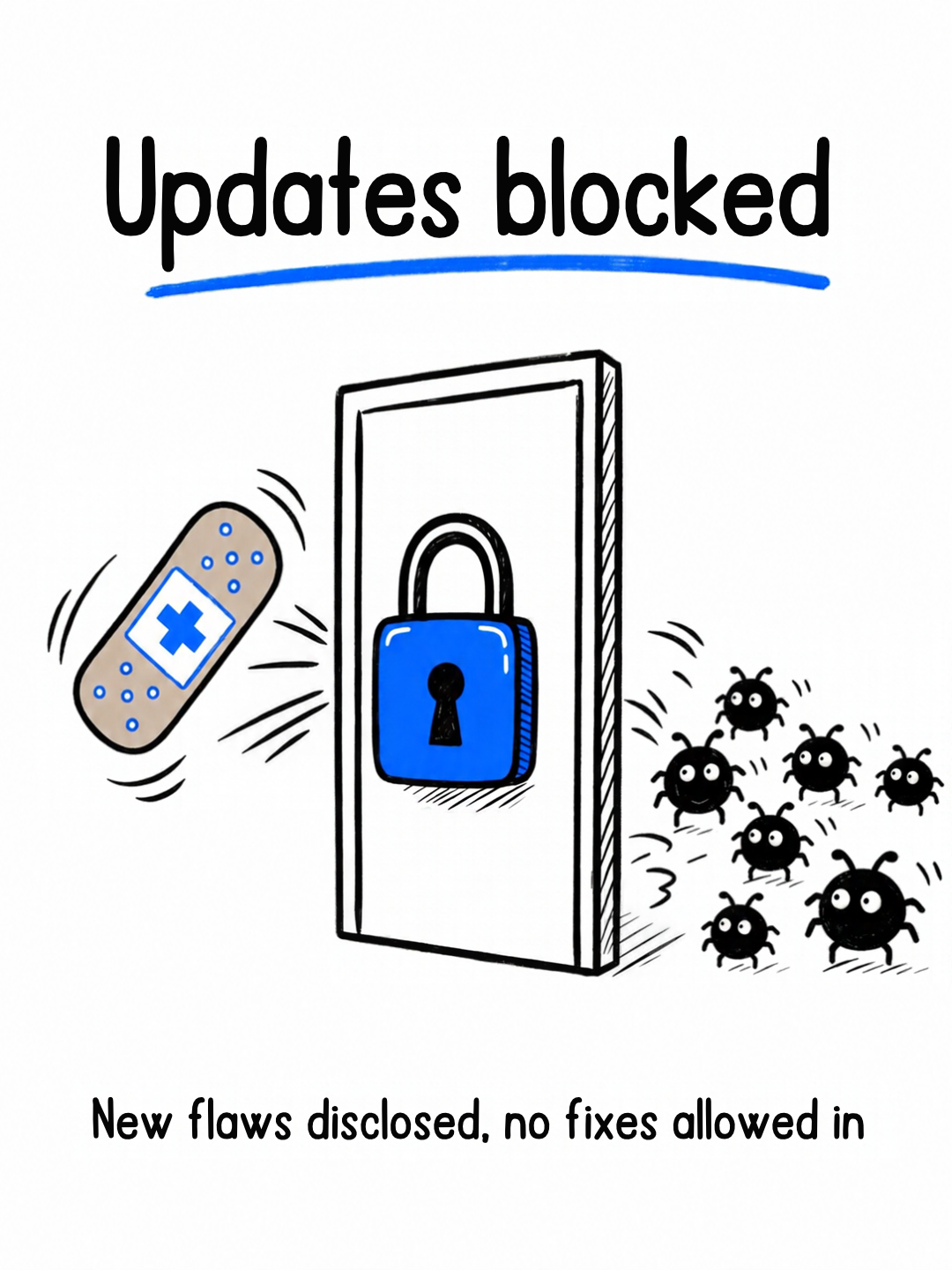
Finding the intrusion has caused a range of disruption, Reuters reports. Efforts to move back-office applications onto Cloud One, a longstanding military priority, are paused, according to two sources and a fourth person. Updates to applications already running there were blocked. That left Air Force personnel unable to apply fixes just as a new batch of serious software vulnerabilities was disclosed across the technology industry. A fifth source said some users lost their administrator rights.
The security record Cloud One has claimed
Cloud One’s own leadership has talked up its defences. In a 2023 FedScoop commentary, Reuters reports, they claimed a “100% success rate” against a “staggering” number of attempts to break in, and wrote: “There is no room for error when it comes to security.” A 2024 Air Force Life Cycle Management Center article quoted the programme’s lead engineer, Lt. Col. Beau Brantley: “We have a 100% success rate.”
Nicolas Chaillan, the Air Force’s first chief software officer, left the role in 2021. He has argued on LinkedIn that the service “failed to keep up with my vision and requirements,” and alleged that the Air Force lets users reach Cloud One through a less secure method than the one he recommended. “The platform never moved at the speed of the threat,” he said. “Attackers move at machine speed while defenders patch by hand, or right now, not at all.” The Air Force spokesperson declined to respond to his claims, Federal News Network reports.
A contractor change months earlier
Leidos launched Cloud One as its first prime contractor in 2017 and lost it to SAIC in 2020, Federal News Network reports. On 10 December 2025 the Defense Department announced a Leidos task order for Cloud One architecture and common shared services, with a ceiling of US$454.9 million. SAIC protested, then withdrew in late January. Federal News Network says Leidos officially took over in May. Reuters says SAIC was prime until 2025, when Leidos took over.
In March, Leidos said its Cloud One work would “boost security, increase automation and simplify day-to-day operations.” No source ties the intrusion to the handover.
A run of federal breaches
Reuters says the US government is already dealing with at least six other recently disclosed incidents: two at the FBI, a previous hack of Pentagon data, a recent leak of Department of Homeland Security personnel information, a breach affecting at least two spy agencies and a hack at the Treasury Department. BleepingComputer says it’s unclear whether any of them are connected.
| Incident | What’s reported | Source |
|---|---|---|
| FBI recruitment site | The ShinyHunters extortion group breached FBIJobs.gov by exploiting an unpatched Oracle PeopleSoft vulnerability, about two months before the NCIC report. | BleepingComputer |
| Pentagon Defense Manpower Data Center, October 2025 to 16 July 2026 | A small number of unauthorised users reached unencrypted files on a file-sharing system. A US defence official put the toll at 2.76 million living people and 294,000 deceased. | Federal News Network |
| DHS personnel information | Reuters lists “a recent leak of Department of Homeland Security personnel information”. | Reuters |
| FBI NCIC database | CNN reported the FBI is investigating an apparent breach of the police database. | Our report |
| CIA open-source analysis system | BleepingComputer reports the breach also affected the Office of the Director of National Intelligence and the National Geospatial-Intelligence Agency. | Our report |
| Treasury’s FinCEN | FinCEN said unauthorised access reached a limited subset of its systems. | Our report |
The NCIC case is the closest parallel, a federal system reported breached days earlier with the agency staying quiet:

The AI question
Reuters ties the news to heightened anxiety over AI-powered intrusions, especially for cloud networks. The background is the FBI’s warning about ARTEX, an open-source AI penetration-testing framework that multiple threat actors have used since at least August; we covered it here. BleepingComputer says the CIA breach was reportedly carried out with ARTEX. It also says it remains unknown whether ARTEX or other AI hacking tools were used against the Air Force, the FBI or FinCEN. For Cloud One, no source has said how the intruders found the flaw.
Open questions to watch
- Do the Air Force or the Pentagon confirm the breach on the record, and say what was reached?
- Which vulnerability gave access to the control plane, and was it already public when the upgrade began?
- Was the intrusion found last month, or earlier this year?
- Did the hackers use that access to reach aircraft status, logistics or personnel data?
- What does Cyber Command’s damage assessment find, and when do updates and migrations restart?
Terms used here
- Control plane
- The management layer of a cloud platform. It handles access and the creation and change of resources.
- Prime contractor
- The company that runs a programme and manages its subcontractors.
- Cyber Command
- The US military’s cyber force.
Sources
I read the Reuters report through syndicated copies, which carry the full text. Background comes from the sources below.
- Reuters, 27 November 2026
- NBC News, 27 November 2026
- Federal News Network, 27 November 2026
- AFP via Arab News, 28 November 2026
- BleepingComputer, 27 November 2026
- Air Force Cloud One and the Life Cycle Management Center’s 2024 article
- Defense Department contracts, 10 December 2025 and Leidos, 11 March 2026