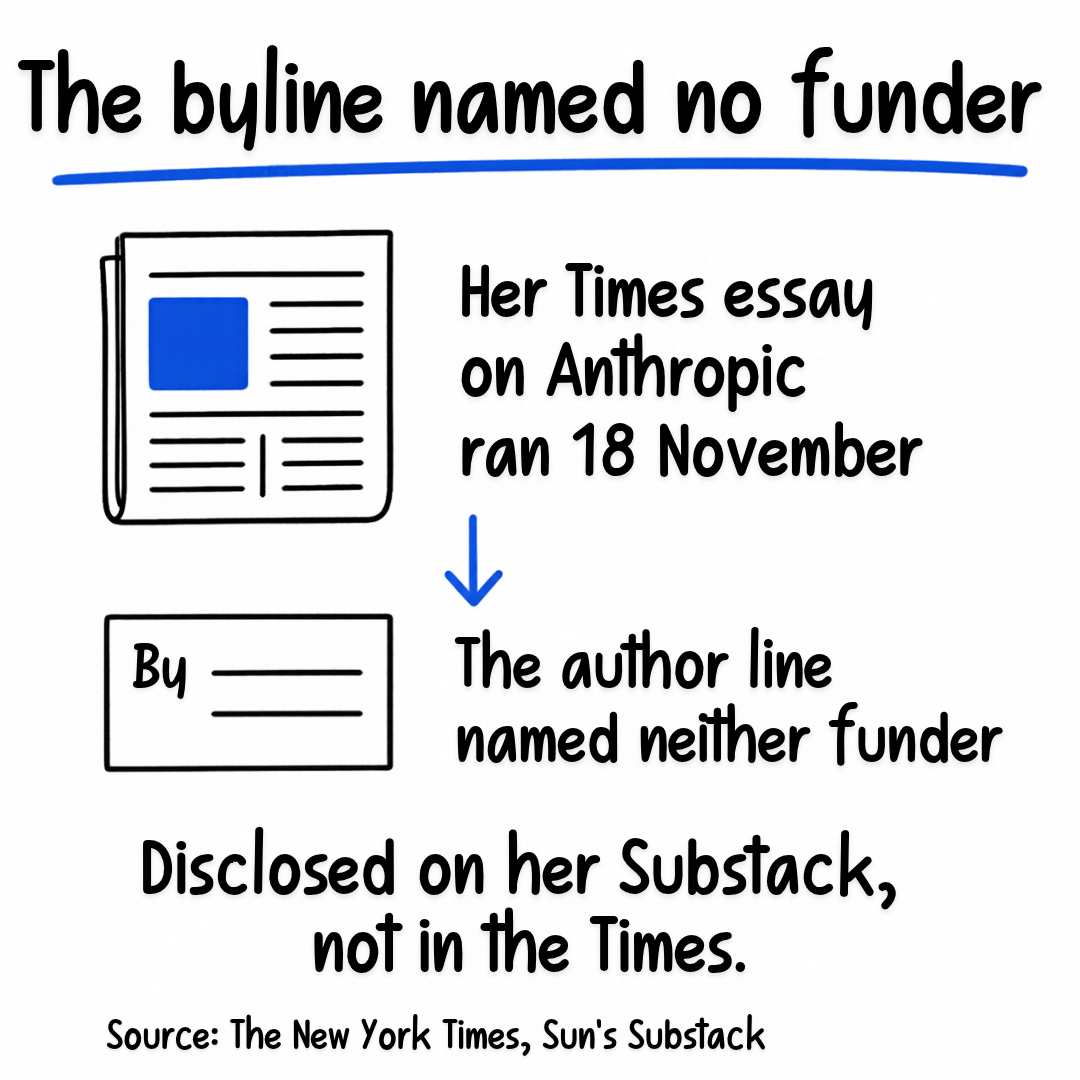
The New York Times ran an essay about Anthropic on the day the company priced its IPO. The author, Jasmine Sun, had been announced as a Times Opinion writer the day before. For the first half of 2026 she was one of nine writers in Omidyar Network’s Reporters in Residence programme, and Omidyar has held Anthropic shares since 2024. The author line on the essay named neither funder.
ZeroHedge raised it on 27 November, building on research an independent X user, Leo Underwood, posted the day before. I treated that as a lead and went to the primary pages. Most of it holds. Some of it is thinner than the headlines make it sound, and I’ve marked which is which.
In this piece
- What happened
- The Omidyar money
- The Tarbell grant
- What Sun’s own pages say
- The Guardian precedent
- The wider Tarbell argument
- What the Times has said
- What the record shows and doesn’t
- How I checked
What happened
The Times announced Sun’s hire in a staff note on 17 November. Her essay on Anthropic ran the next day, the same day Anthropic priced its IPO. The essay sits behind the Times paywall, so I can describe its framing and author line but not quote its body. Its author line reads, as reported, “Ms. Sun writes about A.I. and Silicon Valley for Opinion.”
Anthropic’s shares then debuted on Nasdaq the following day. I covered the listing and the cap table earlier: the first trade, the oversubscribed book and the Amazon and Google stakes.
The Omidyar money
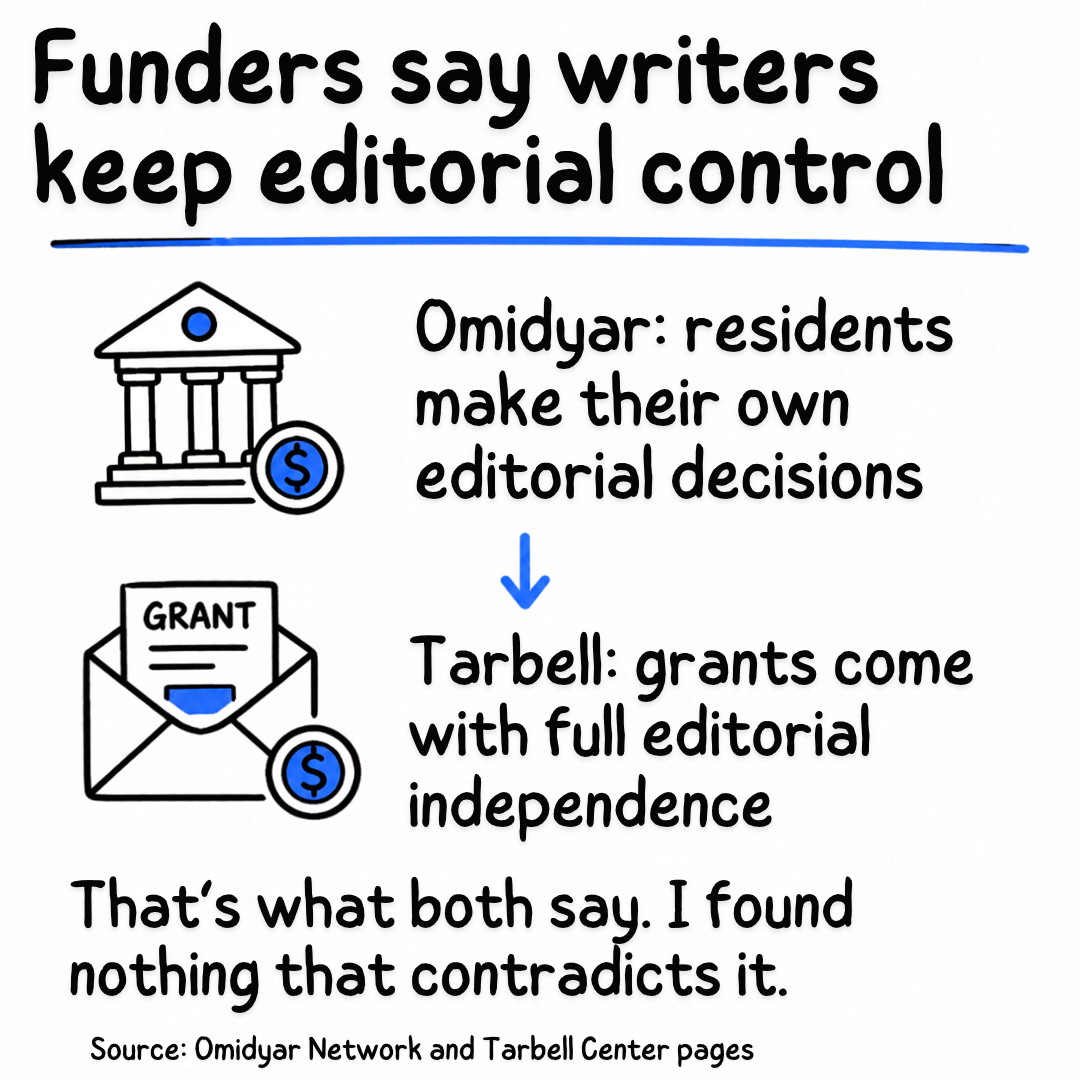
Omidyar Network named its 2026 Reporters in Residence on 15 January, with Sun among the nine. Its programme page says residents make their own editorial decisions. The page doesn’t give a payment figure.
The figure in circulation comes from a recruitment listing that ZeroHedge and others cite: US$8,000 a month plus a US$2,000 travel budget across a term running from mid-January to mid-July, about US$50,000 in all. I tried to open that listing and it’s gone, so I can’t confirm the amount. It’s consistent with the programme’s shape, but treat it as reported.
The Anthropic side is documented. Omidyar announced in April 2024 that it had bought Anthropic shares. ImpactAlpha covered it at the time, and Forbes reported the stake came from shares sold out of the FTX bankruptcy estate and valued it at more than US$55 million after the listing. Those two numbers are Forbes’s, not Omidyar’s.
US$83
Anthropic’s IPO price
US$111.50
First trade on Nasdaq
US$1.5m
Omidyar’s buy, per Forbes
US$55m+
The stake’s value, per Forbes
The Tarbell grant
Sun also took a grant from the Tarbell Center for AI Journalism for a data centre piece she published on her Substack in August. Tarbell’s own page names its major funders, including Coefficient Giving, the philanthropy formerly called Open Philanthropy that works for Dustin Moskovitz and Cari Tuna’s Good Ventures, and the Survival and Flourishing Fund, which traces its money to Jaan Tallinn. Both men appear among the investors in Anthropic’s 2021 Series A.
Tarbell’s executive director, Cillian Crosson, replied to ZeroHedge on X. His position is that Tarbell requires every journalist it funds to disclose it, that the August post did, and that the Times essay carries no Tarbell disclosure because Tarbell didn’t fund it.
That’s a fair answer to a claim nobody has actually made. ZeroHedge’s own update says as much. The critics’ counter is about timing and overlap: the August grant falls inside the year Sun says she spent talking to Anthropic staff, and Tarbell’s backers are Anthropic investors. Both are true as far as the public record goes. Neither shows the grant touched the essay.
Tarbell is also a bigger player than one grant suggests. It launched a US$10 million institutional grants programme, and ZeroHedge, citing Underwood, puts US$480,000 of it into the Machine Gods podcast hosted by the Times’s Kevin Roose. I haven’t verified that figure. Crosson has also invited applications of US$50,000 to US$500,000 for reporting that holds AI labs, Anthropic, OpenAI and Nvidia among them, to account, with full editorial independence. That call closes on 11 December.
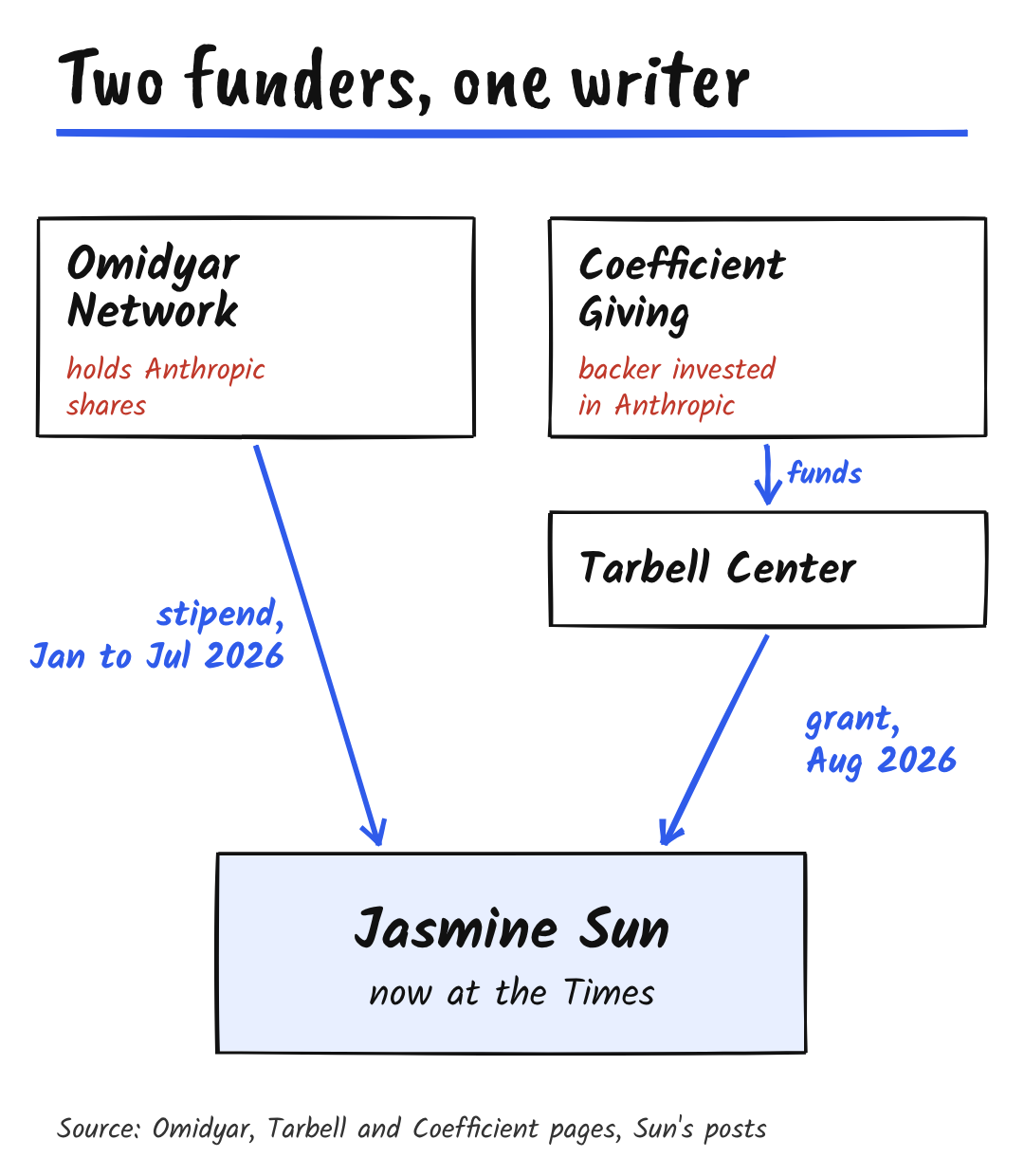
| Funder | Link to Anthropic | Money to Sun | Where it was disclosed |
|---|---|---|---|
| Omidyar Network | Has held shares since 2024 | Residency stipend, January to July 2026 (about US$50,000, as reported) | Sun’s Substack About page; not in the Times author line |
| Tarbell Center | Funded by Coefficient Giving and the Survival and Flourishing Fund | Grant for an August data centre post | In that post; Tarbell says it did not fund the Times essay |
What Sun’s own pages say
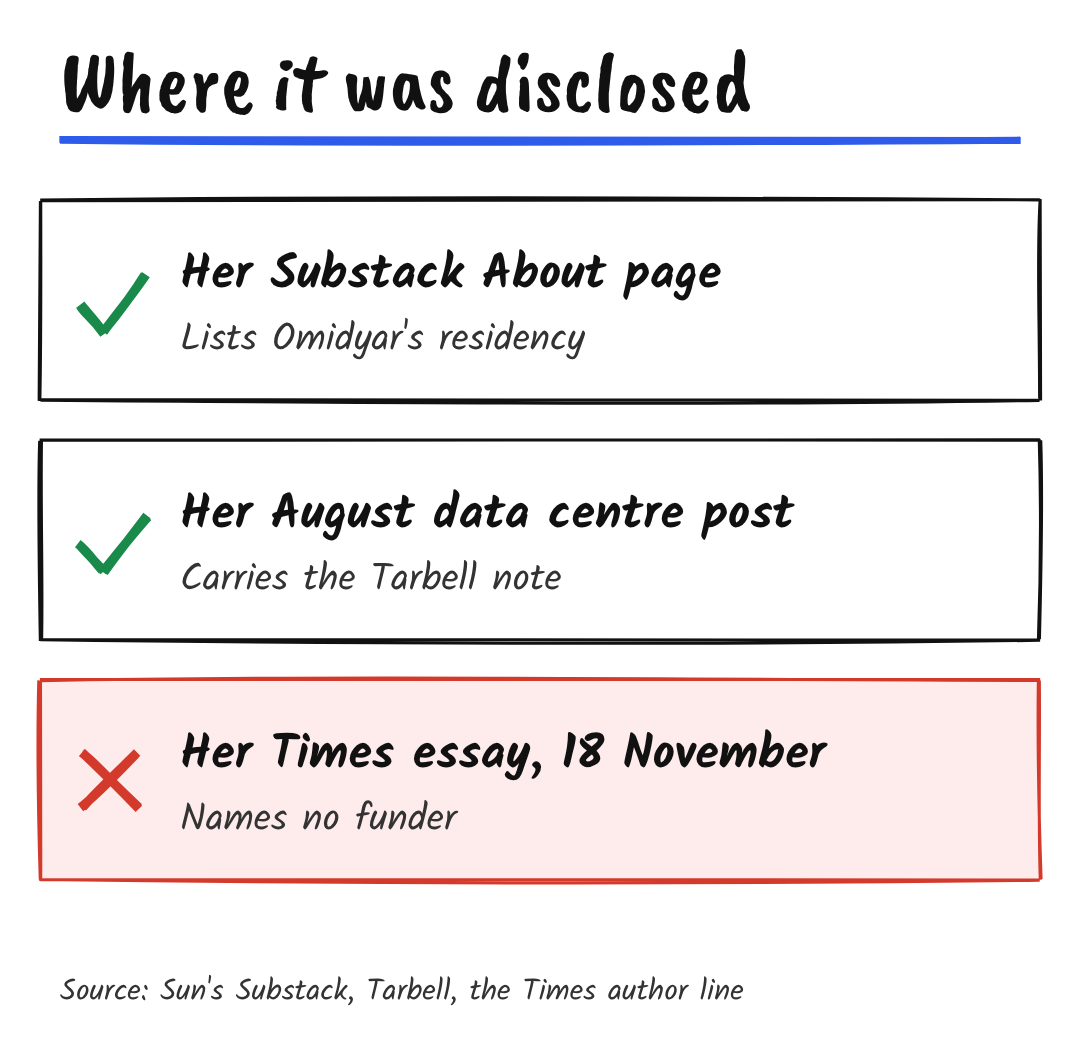
Sun’s Substack About page lists Omidyar Network’s Reporters in Residence programme among the newsletter’s supporters. So the relationship was written down publicly, just not where Times readers would see it.
The individual posts I opened are another matter. Her late February post on the Pentagon dispute with Anthropic ends with “I do fully independent journalism about AI and politics.” It carries no Omidyar line in the text I read. Her August data centre post does carry the Tarbell disclosure, and the same note says its travel costs were supported by Emergent Ventures. ZeroHedge also quotes a passage from her newsletter where an AI-themed happy hour she ran shared a bar with a Coefficient Giving team retreat and “the lines got blurry”. I haven’t read that passage in context, so I’m leaving it as ZeroHedge’s quote.
The Guardian precedent
This isn’t the first time an Omidyar-linked AI project has raised the question. In February the Guardian added a note to its Reworked series, and in April the Daily Caller News Foundation reported that the series was funded by Omidyar Network and asked whether that was a conflict given the Anthropic holding. That’s a partisan outlet’s framing, so I’ve taken only the funding fact from it.
The wider Tarbell argument
After the first reports, the fight moved from Sun to Tarbell itself. Brian Chau, who runs the newsletter Effort, posted on 27 November that Tarbell is “much worse than the NYT scandal suggests” and linked an Effort investigation.
I read the Effort piece. It’s dated early September, so it predates the Sun story, and it doesn’t mention her or the Times. Its subject is a Guardian article on AI risk. Effort says the six parties to that article, the Guardian, its reporter, the project the article was about and three quoted experts, are all funded by a handful of effective altruism-linked donors, and that Coefficient Giving pays the reporter’s salary through the Tarbell Fellowship.
Some of the plumbing is confirmed by Tarbell itself. Its fellowship page says fellows are placed as reporters at partner newsrooms on Tarbell-paid salaries, its About page points to its donor list, and its editorial independence policy says donors don’t review or influence the stories it funds and that supported journalists must disclose the support. Semafor reported the fellowship model in December 2025 and quoted Crosson saying Tarbell never directs coverage, assignments or angles. Sun wasn’t a fellow. Crosson describes hers as a grant for one piece.
I couldn’t confirm the dollar amounts in Effort’s graphic, or the claim that the Guardian article’s contents were fabricated. Chau’s post calls AI risk “all fake” and its proponents a “doomsday cult”. That’s advocacy from a party to the dispute, and neither the post nor the piece shows a funder changing what was written. The documented point is narrower, and it’s the same one as the Times case: money that sits close to the subject is worth telling readers about.
What the Times has said
I couldn’t find a Times statement. TFTC reported that the Times, Sun, Omidyar and Tarbell didn’t answer its requests for comment, though Crosson did reply publicly. The open questions are specific. Did the editors know about the residency when they hired her? Did anyone weigh a note on the essay, given the IPO timing and Omidyar’s holding? The Times publishes its own ethical journalism standards, and only the paper can say how they applied here.
Omidyar has also moved on from part of this. According to ZeroHedge, it wound down its separate Tech Journalism Fund on 1 November and says applications for the next Reporters in Residence class open in early 2027.
What the record shows and doesn’t
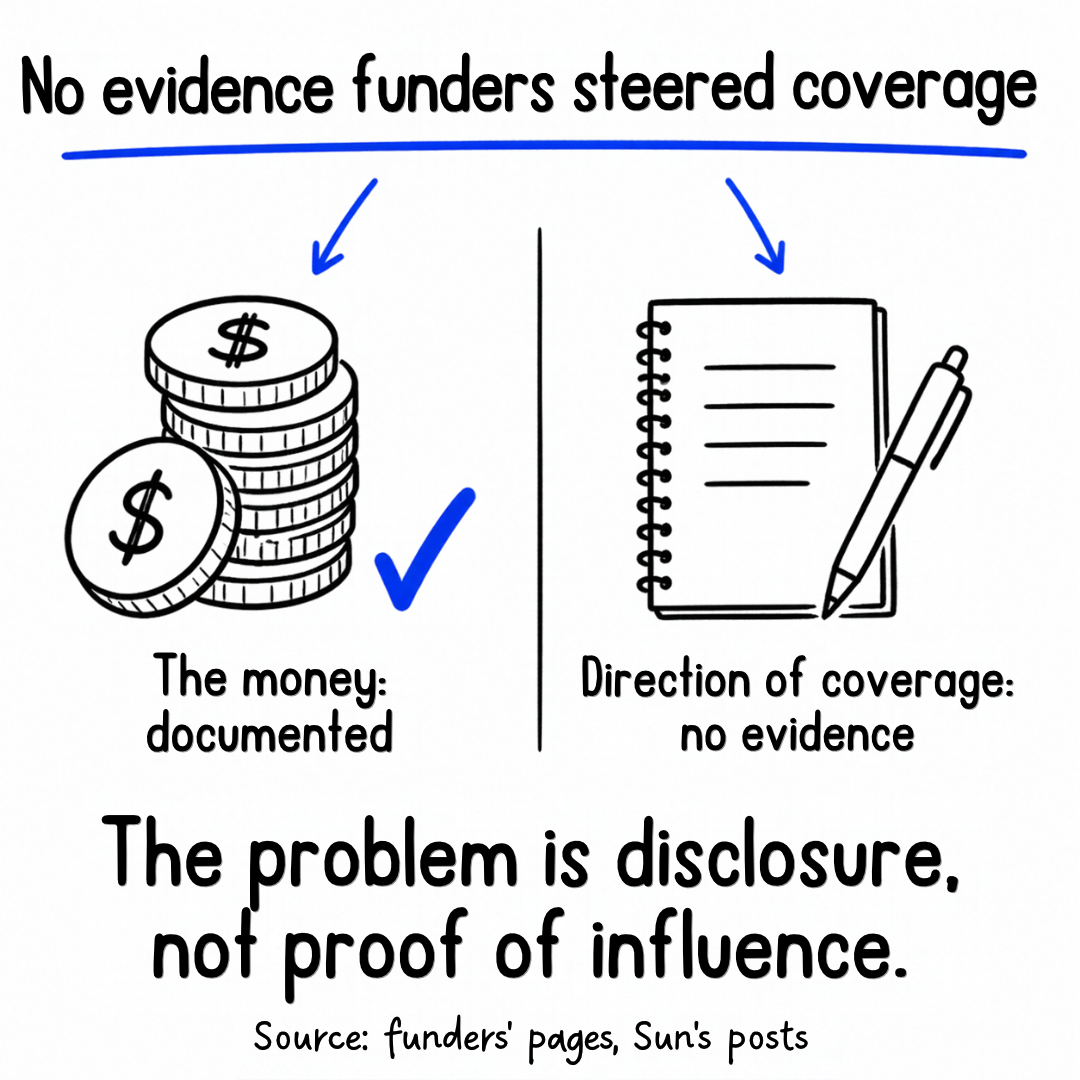
It shows an Opinion writer paid for six months by a philanthropy that owns shares in the company she then wrote about, in an essay that didn’t tell readers. It also shows a second funder with Anthropic-investor backing that paid her for an earlier piece. Both relationships were disclosed somewhere, and neither was disclosed in the Times.
It doesn’t show that either funder asked for coverage, saw the essay, or that Sun’s reporting changed because of the money. Omidyar and Tarbell both say recipients keep editorial control, and I found nothing contradicting that. My read is that the problem is disclosure, not proof of influence. Readers of an essay about Anthropic on IPO day could reasonably have wanted a one-line note, and the cost of adding one was close to nothing.
How I checked
What I confirmed, and what I couldn’t
Confirmed against primary pages: the Times hire note, Omidyar’s January announcement and its 2024 share purchase, Anthropic’s pricing and Nasdaq debut, Tarbell’s and Coefficient’s descriptions of themselves, Sun’s About page and the posts named above, Crosson’s reply on X, and Tarbell’s fellowship, independence and donor pages.
Not confirmed: the residency payment figure, because the listing is gone; the Machine Gods amount; Effort’s per-person dollar figures; the passage ZeroHedge quotes about the happy hour; and anything inside the paywalled essay beyond its author line and framing. ZeroHedge was a lead throughout, and I don’t rely on it for any fact I couldn’t check elsewhere.