
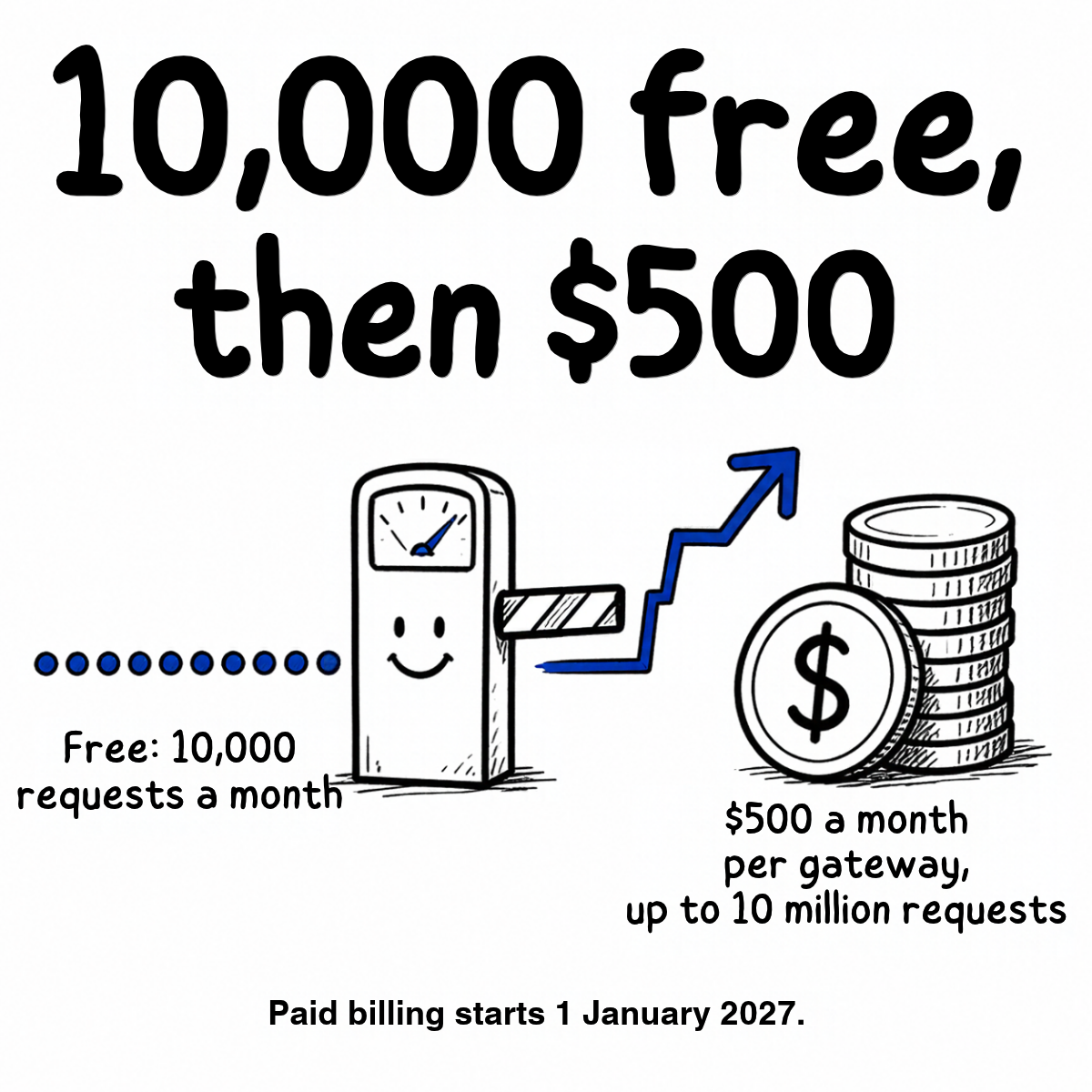
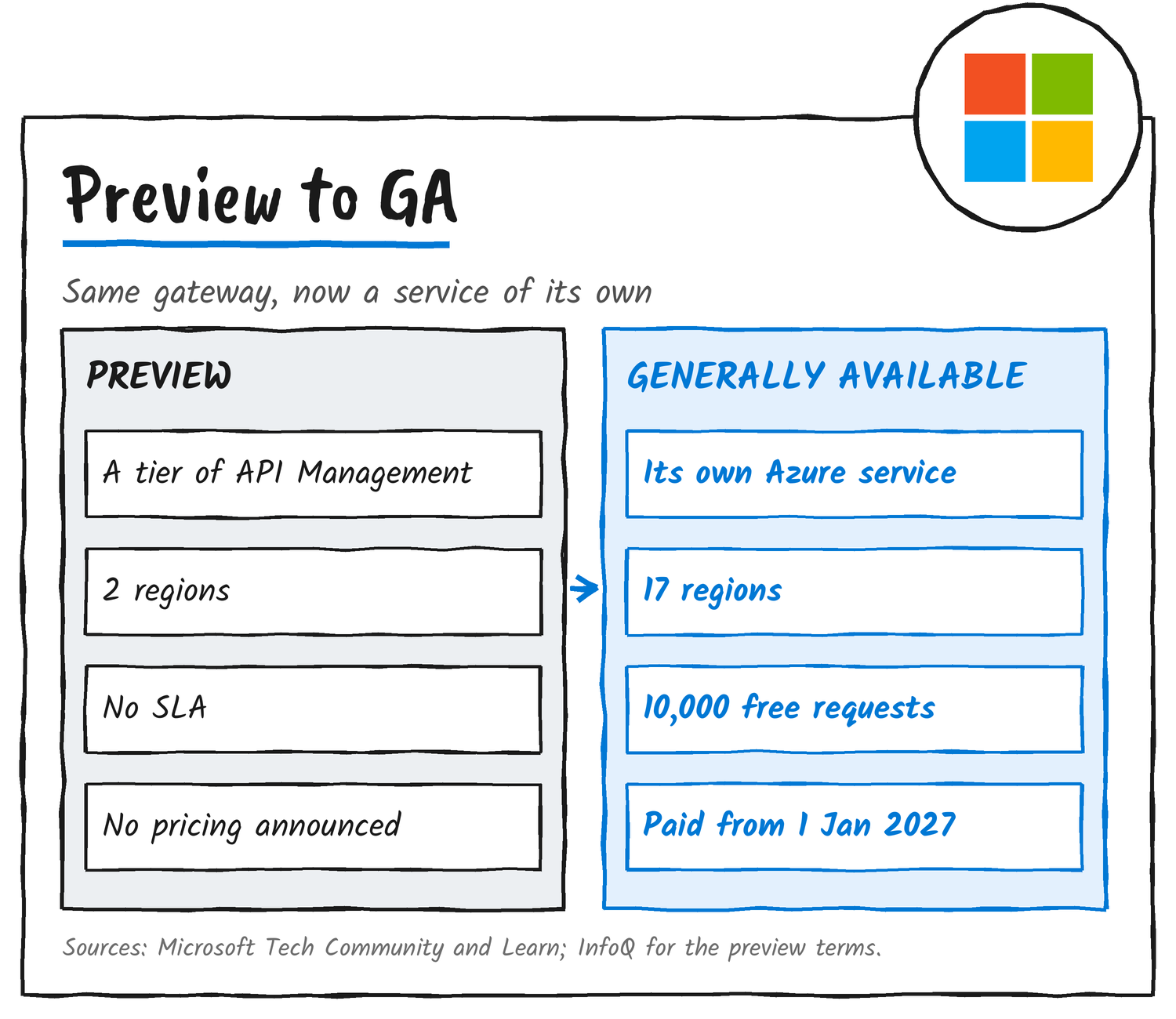
Microsoft has made Azure AI Gateway generally available as a standalone Azure service for connecting apps and agents to AI models and MCP tools across providers. Each gateway gets 10,000 free requests a month, and paid billing starts on 1 January 2027 at US$500 a month per gateway for up to 10 million requests.
Microsoft announced it at Ignite on 17 November. The gateway began as the AI Gateway tier of Azure API Management, which went into public preview in July. InfoQ reports that the preview ran in two regions, East US 2 and Sweden Central, with no SLA and no announced pricing. With general availability it becomes a separate product with an AI-only roadmap, and it has a price list.
10,000
free requests per gateway each month
US$500
a month per gateway for up to 10 million requests
17
Azure regions at launch, up from two in preview
What it does
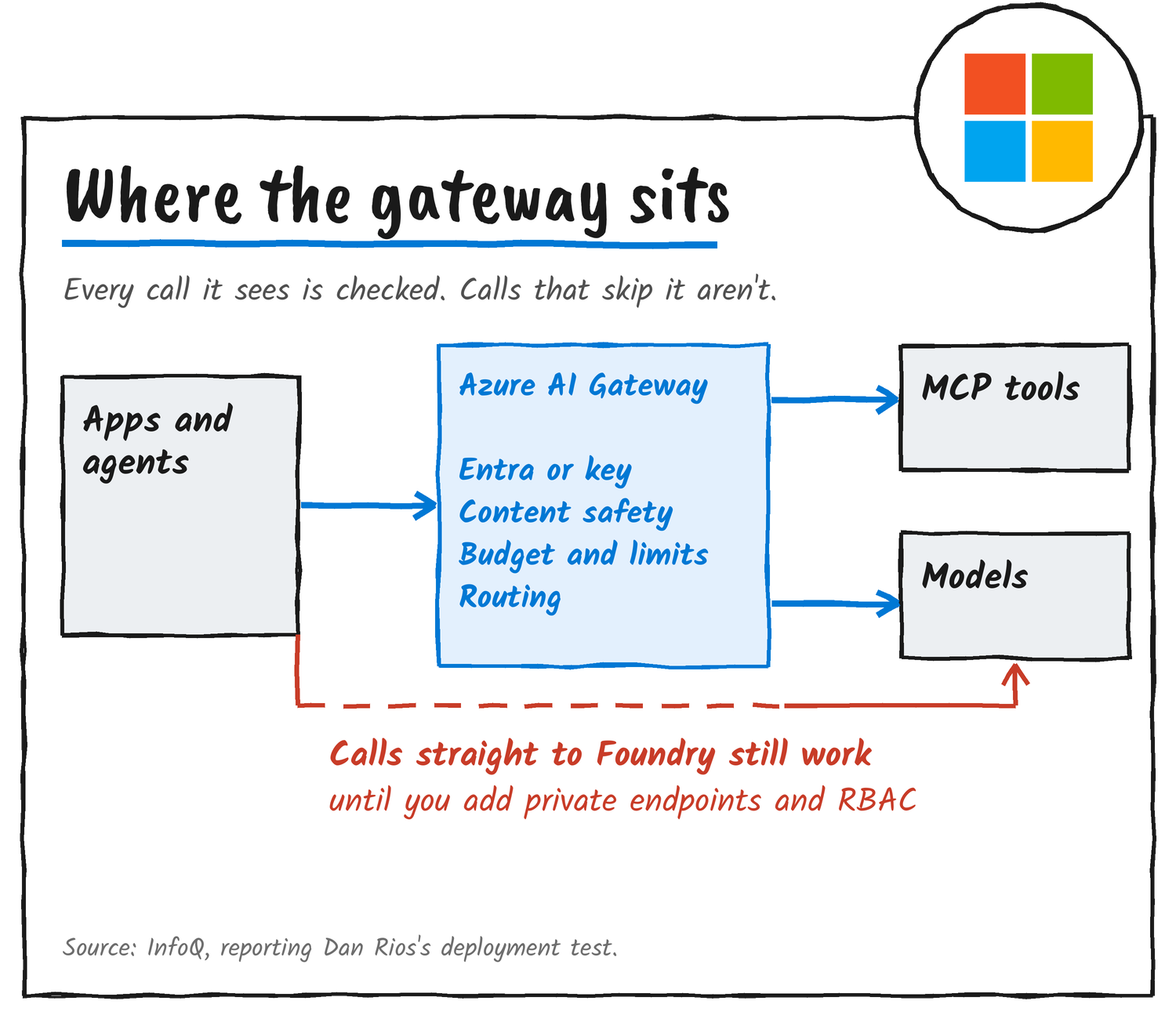
Apps and agents call the gateway instead of calling each model or tool directly. On every request, Microsoft says, the gateway authenticates the caller with Microsoft Entra ID or a gateway access key, enforces access rules and policies, routes the call to the right model or tool, and records telemetry. Apps reach models through an OpenAI-compatible API or the Anthropic Messages API, and agents reach tools from any MCP client.
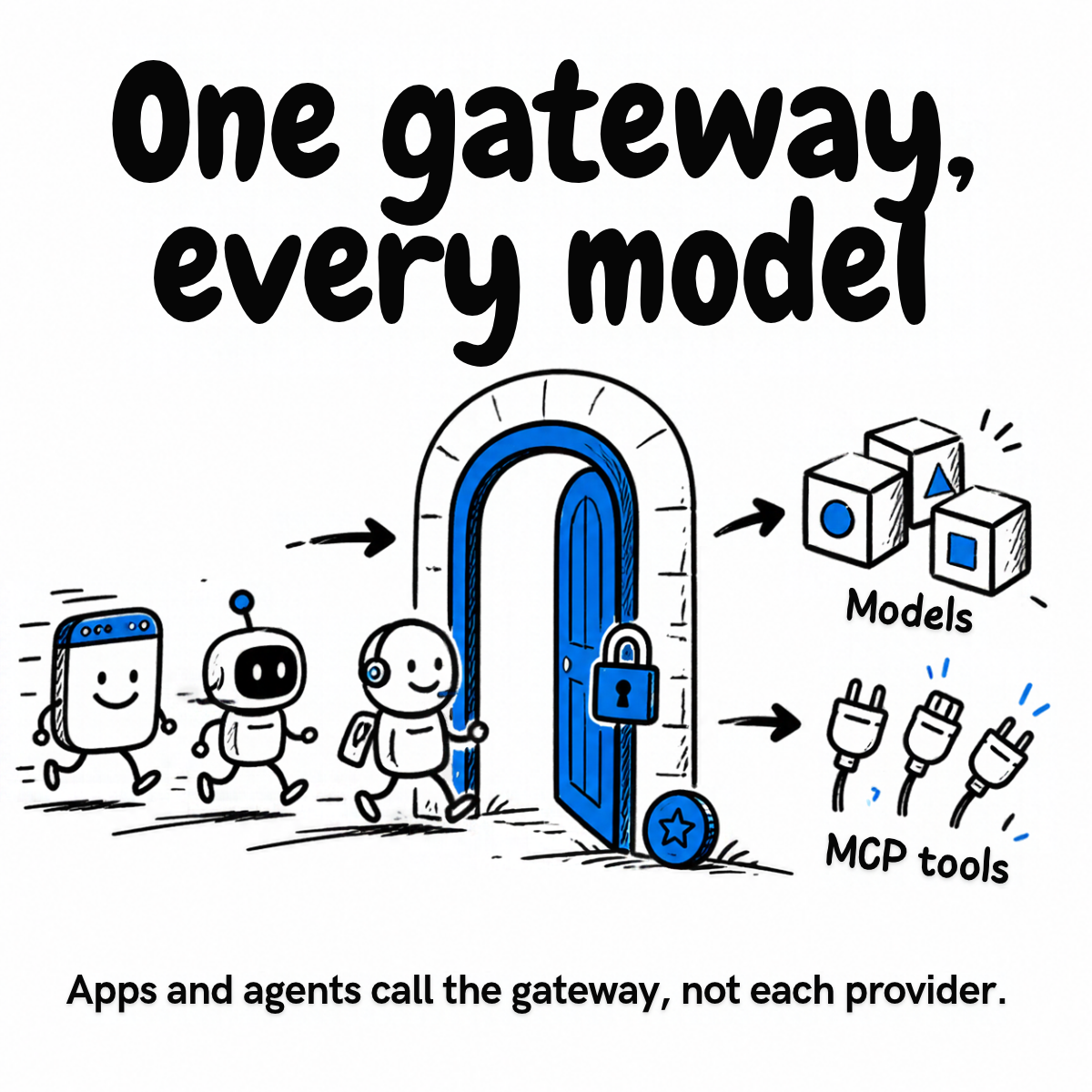
- Models. The gateway fronts Microsoft Foundry, Azure OpenAI, OpenAI, Anthropic, Amazon Bedrock, Google Vertex AI and any OpenAI-compatible endpoint. Apps call each model by an alias, so a team can swap the model behind it without touching app code. Routing runs by priority, weight or custom conditions, with failover.
- Tools. It federates MCP servers and turns OpenAPI specs, connectors and API Management APIs into MCP tools. Microsoft says it supports several MCP spec versions, including the July 2026 one.
- Governance. Entra roles control who can use which models and tools, provider keys and tool credentials never reach app code, and Azure AI Content Safety screens prompts and responses. Telemetry exports over OpenTelemetry to Application Insights, Datadog, Splunk, Grafana Cloud or any OTLP endpoint.
- Spend. It tracks tokens and estimated cost by user, team, app, agent and provider. Cost limits stop new requests once estimated spend reaches a budget, and token and request limits stop one caller crowding out the rest.
- Setup. A gateway is configured in the portal or the Azure CLI, then deployed as code with Bicep or the REST API. There’s also a coding agent plugin that finds approved models and tools and wires an app to them.
Pricing and regions
| Monthly gateway requests | Service fee | Extra request charges |
|---|---|---|
| Up to 10,000 | Free | None |
| 10,000 to 10 million | US$500 a month per gateway, billed hourly | None, 10 million requests included |
| Over 10 million | US$500 a month per gateway, billed hourly | US$20 per extra million, billed in blocks of 10,000 |
The table has no step between the free tier and the flat fee. A gateway that goes past 10,000 requests in a month lands on the US$500 fee. At the top of that band, 10 million requests, the fee works out to US$0.05 per 1,000 requests, and requests beyond it cost US$0.02 per 1,000. The table prices gateway requests only. Prices are in US dollars and may vary by region, and Microsoft says exact regional prices will be published when billing begins.
One wording difference: Microsoft’s launch blog and InfoQ say the 10,000 free requests apply per gateway, while the Azure Updates entry for the launch says per subscription.
The gateway is available in 17 Azure regions: East US, East US 2, East US 2 EUAP, West US, West US 2, Central US, North Central US, South Central US, Canada East, West Europe, North Europe, UK South, France Central, Sweden Central, Australia East, Japan East and Southeast Asia. Australia East is the nearest to New Zealand.
What’s still in preview
| Feature | Status |
|---|---|
| Private Link for inbound calls | Preview |
| VNet integration for private backends | Preview |
| Defender and Purview threat protection for tool calls | Preview |
| Model Router, which picks a model by cost or quality | Preview |
| Foundry prompt agents using gateway models through a model connection | Preview |
Private Link and VNet integration are the two networking pieces still in preview, so locking a gateway’s inbound traffic and its private backends down relies on preview features for now.
Where it sits next to API Management, Foundry and Agent 365
Microsoft Learn describes AI Gateway as a dedicated product for AI traffic. It shares the Microsoft.ApiManagement resource provider with API Management but uses different resource types. AI workloads on other API Management SKUs remain supported, and Microsoft’s advice is to keep business APIs in API Management and send model and tool traffic through AI Gateway. There’s a documented migration path from the AIGateway SKU.
Foundry already has governance built in for its own resources and projects, Microsoft says. The gateway adds a shared layer above them in a hub-and-spoke model: a platform team sets the rules once at the hub, and developers keep working in Foundry projects, the spokes. Projects can share one deployment, including provisioned throughput, and fail over to another Foundry resource or another provider. Microsoft Agent 365 can discover the gateway’s MCP servers and set tool policies, which the gateway enforces on every tool call alongside its own.
What an early tester found
InfoQ reports that Dan Rios, a principal architect at Howden Insurance and a Microsoft MVP, deployed the gateway with Bicep against a Foundry model and the Microsoft Learn MCP server. He named the per-caller spend policy as the biggest differentiator, noting that API Management’s documented policy catalog has no equivalent monetary budget policy.
He also found that associating a gateway with Foundry doesn’t block direct calls to Foundry, so teams need private endpoints and RBAC to force traffic through the gateway. A gateway only governs the calls that reach it.
Microsoft describes the budget as enforced before a request reaches the model, but the limit is based on estimated spend, not invoiced spend. InfoQ also quotes Darthick Somu, who advises starting with a pilot and says the gateway “does not eliminate the need for application-level safety checks, downstream authorization or model evaluation.”
How the pricing compares
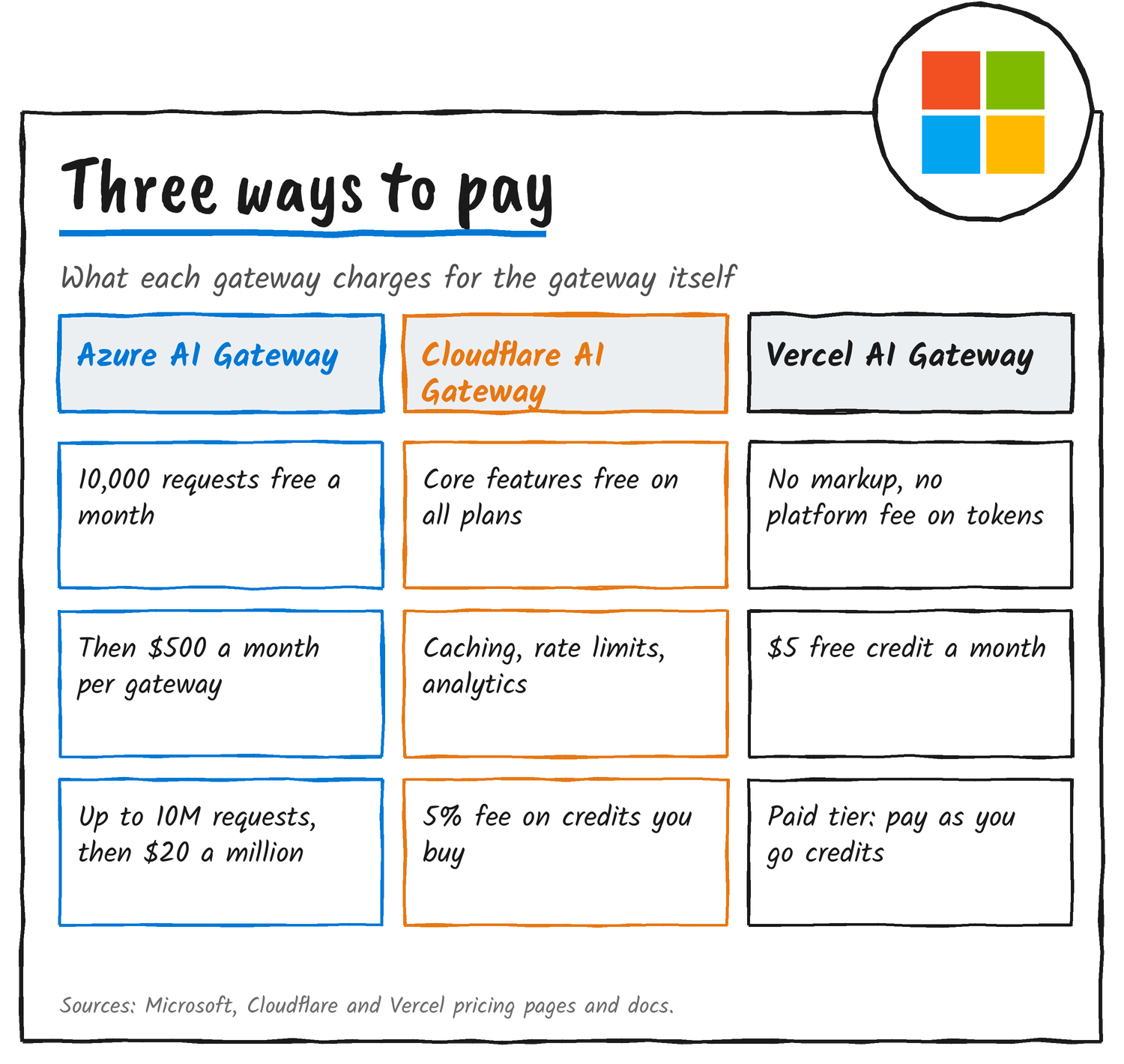
Azure’s closest peers charge in a different way. Cloudflare’s AI Gateway offers its core features, dashboard analytics, caching and rate limiting, free on every plan. Its Unified Billing adds a 5% fee on credits you buy and passes provider token prices through with no markup. Vercel’s AI Gateway charges no markup and no platform fee on tokens, gives every team US$5 of free credit a month, and moves to pay-as-you-go credits on its paid tier.
Neither lists a per-request fee for the gateway itself in its pricing docs. Azure’s flat fee comes with the integrations Microsoft lists: Foundry, Agent 365, Entra ID and Application Insights.
Trying it
I haven’t run a gateway myself. It needs an Azure subscription, and everything above comes from Microsoft’s announcement and documentation and from InfoQ’s reporting. Microsoft’s steps are:
- Create a gateway at ai.gateway.azure.com. Microsoft says it’s ready in about a minute and free to start.
- Connect an existing model and give it an alias.
- Expose the MCP tools your agents need.
- Give your team access with an AI Gateway role.
- Set a cost limit.
- Point your app or agent at the gateway.
Applications keep their standard SDKs and point them at the gateway. InfoQ reproduces the first-model-call lab from Microsoft’s Azure/aigateway repository, which puts the gateway alias in the model field and uses a gateway runtime key in place of a Foundry credential:
import os
from openai import OpenAI

gateway_url = os.environ["AI_GATEWAY_URL"].rstrip("/")
model = os.environ["AI_GATEWAY_MODEL"]

client = OpenAI(
    base_url=f"{gateway_url}/default/models/openai/v1",
    api_key=os.environ["AI_GATEWAY_API_KEY"],
)

response = client.responses.create(model=model, input="Write a one-sentence status update.")
print(f"Responses API: {response.output_text}")
The repository holds 26 labs, an Azure CLI extension, a coding agent plugin and a migration tool, according to InfoQ.
Sources
- Microsoft Tech Community: Azure AI Gateway is now generally available
- Microsoft Learn: What is AI Gateway?
- Azure Updates AZ580080: Generally Available: Azure AI Gateway
- InfoQ: Azure AI Gateway Reaches General Availability as a Standalone Service
- Cloudflare AI Gateway pricing and Vercel AI Gateway pricing
Disclosure: I’m an OpenAI, Firecrawl and Devin ambassador.