
Clem Delangue, the chief executive of Hugging Face, has publicly backed Google Cloud’s guide to distilling open models. “Distillation is good and healthy in AI,” he wrote on X. He called it “one of the few things limiting extreme concentration of power, capabilities and wealth” and “very similar to how AI companies got successful distilling the web.” His last line: “Great to see @Google promoting it!”
The post carries a screenshot of the page behind it, “Supervised and distillation fine-tuning for open models”, from the documentation for Google’s Gemini Enterprise Agent Platform. It describes a managed job. You supply prompts, a teacher model writes the answers, and a smaller student model is tuned on them. The only teacher Google lists is GLM 5.2 MaaS, an MIT-licensed model from Z.AI. The students are four sizes of Alibaba’s Qwen 3 and four of Google’s own Gemma 3.
I read the page, Google’s service terms and the reports around them. I haven’t run a distillation job on Google Cloud, so everything below comes from those documents.
Disclosure: I’m an OpenAI, Firecrawl and Devin ambassador.
- What the job does
- Who’s on the menu
- The Gemini version is separate
- Same method, two ways in
- What the terms say
- Who else offers it
- Before you run one
1
teacher on Google’s list, GLM 5.2 MaaS
8
student models, four Qwen 3 and four Gemma 3
0
Gemini models in the open-model distillation job
What the job does
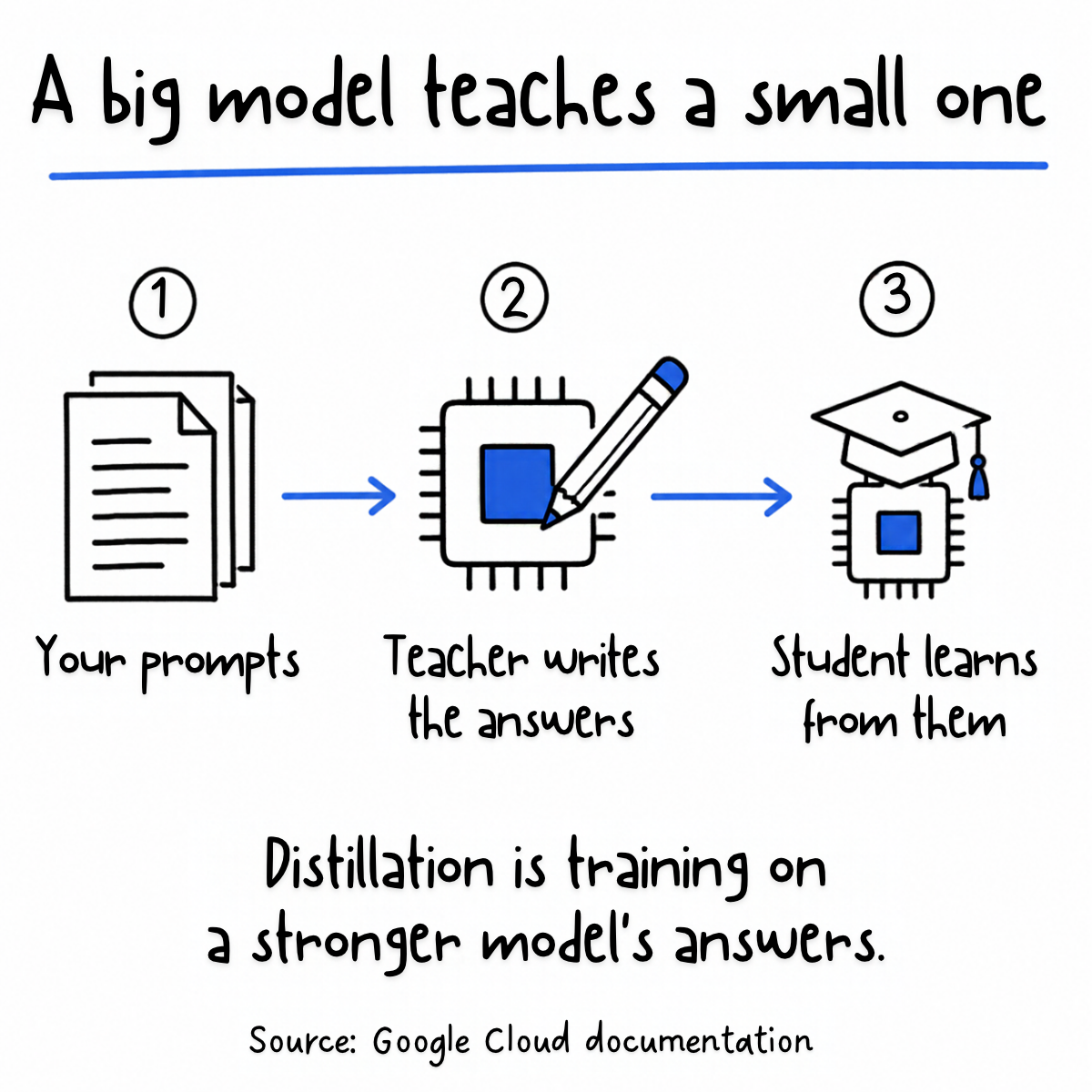
Google’s page is a how-to, not a launch post. A distillation job takes a text-only file of prompts in Cloud Storage. The teacher fills in the completions, so you don’t write answers yourself. The validation file is the exception: it needs prompts and ground-truth answers, because tuning uses it to score the student on held-out examples.
You start the job through the GenAI SDK, setting the method to DISTILLATION and naming the teacher. This is Google’s example, split across lines:
tuning_job = client.tunings.tune(
    base_model="qwen/qwen3@qwen3-4b",
    training_dataset=types.TuningDataset(gcs_uri="gs://{STORAGE-URI}"),
    config=types.CreateTuningJobConfig(
        method="DISTILLATION",
        base_teacher_model="zai-org/glm-5.2-maas",
        epoch_count=3,
        validation_dataset=types.TuningValidationDataset(gcs_uri="gs://{STORAGE-URI}"),
        output_uri="gs://{STORAGE-URI}",
    ),
)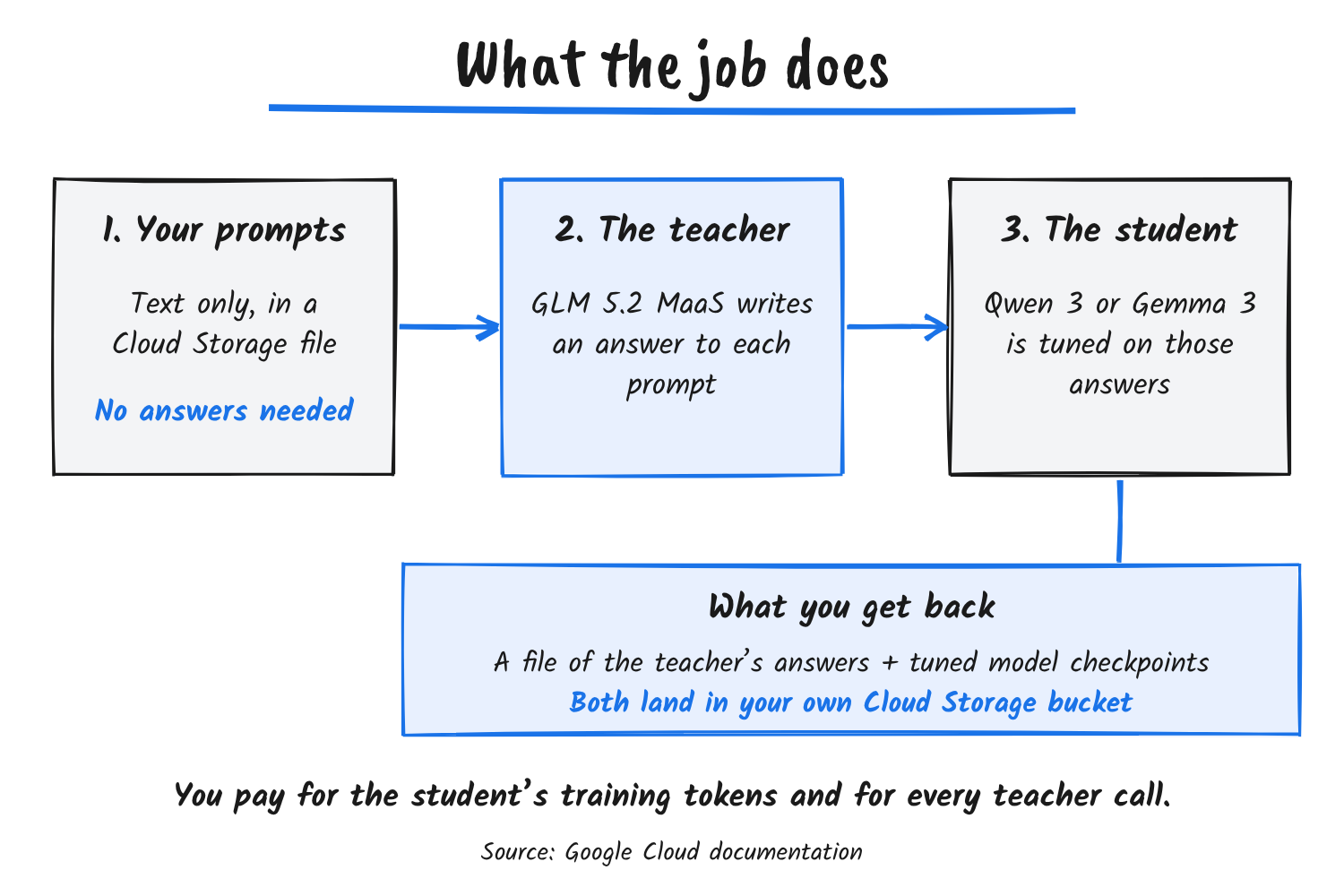
When the job finishes, the output folder in your bucket holds distillation_labelled_dataset.jsonl, which is the teacher’s answers, along with the final checkpoint as safetensors files and up to 10 intermediate checkpoints.
Google recommends distillation for reasoning work: maths, science and medical question answering, and anything else where a strong teacher that thinks step by step beats the student. It says gains are smaller when the student already performs close to the teacher, and on short retrieval-style tasks. All eight students top out at 8,192 tokens of sequence length and take text only.
The bill has two halves. Google charges for tuning at its model-tuning prices, and also for the API calls the job makes to the teacher. Those calls draw on the project’s shared quota for the teacher model, so the project needs headroom there as well as for the tuning job itself.
Who’s on the menu
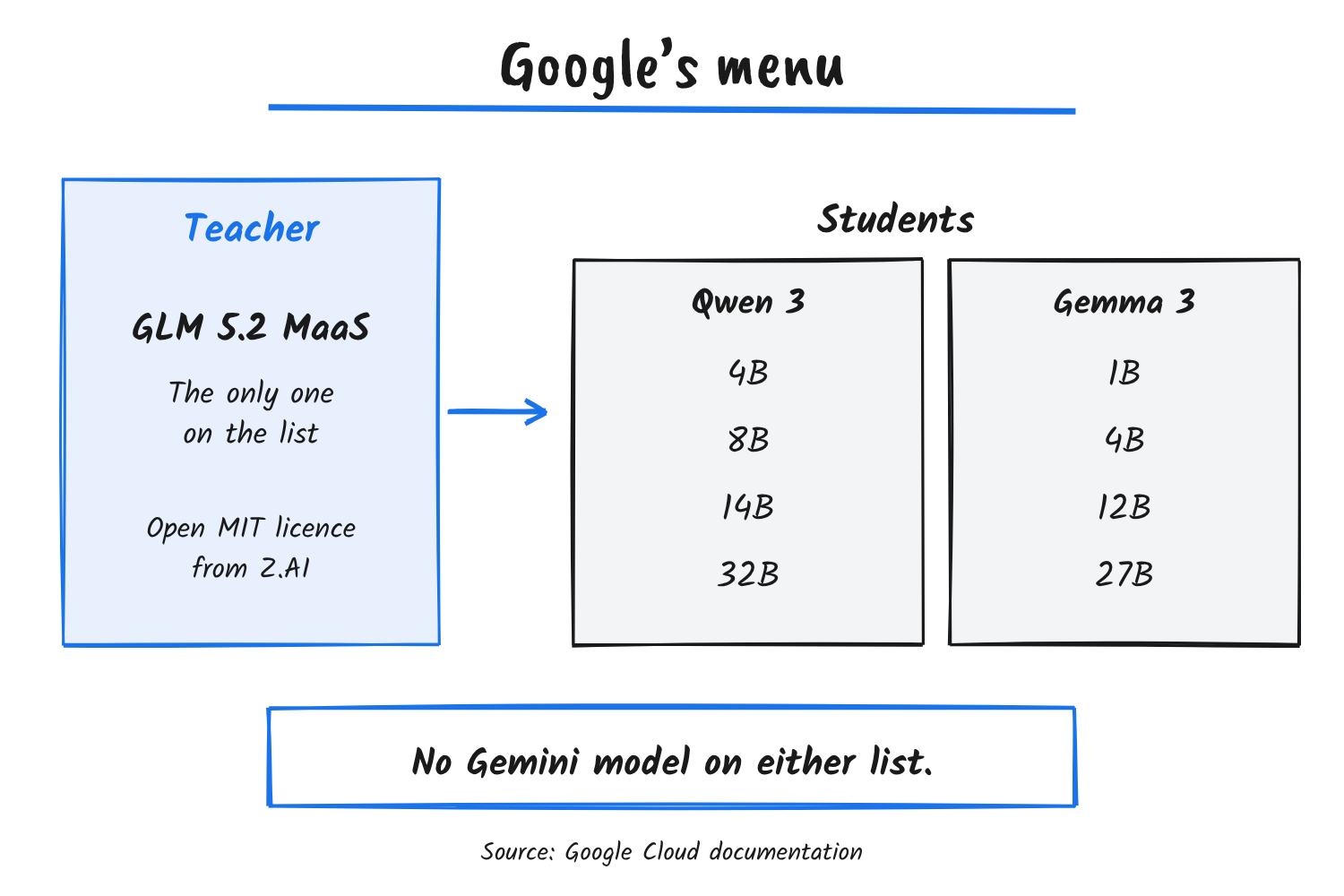
The list is short. GLM 5.2 is Z.AI’s flagship, released with a 1M-token context and an MIT licence that its Hugging Face card describes as “no regional limits, technical access without borders”. The students are Qwen 3 at 4B, 8B, 14B and 32B, and Gemma 3 at 1B, 4B, 12B and 27B. Google’s own smaller models appear as students. Its own frontier models don’t appear at all.
The teacher is a Chinese lab’s open-weight model, the category that a House report in November urged removing from federal systems. It’s also a lab that US agencies have named in this fight. CISA’s September advisory on industrial-scale distillation campaigns lists Z.AI among the China-based companies involved, and Anthropic has said Zhipu, now Z.AI, distilled the cyber capabilities of leading US models while building GLM-5.3. Google’s page doesn’t mention any of it.
The Gemini version is separate
Google does sell distillation from its own frontier model, but as a different product and only in early access. The Gemini Distillation Service names gemini-3.1-pro as the teacher and gemini-2.5-flash as the student. Access is by allowlist through a Google sales representative, for an initial 30 days. Google says the service is for experimentation and development only: “Don’t use models distilled during this phase in production environments.”
It also learns from more than the answer. The student trains on the teacher’s final text and its raw reasoning paths. Training sets are capped at 50,000 examples, each entry at 8,000 input tokens, and jobs run in us-central1.
Same method, two ways in
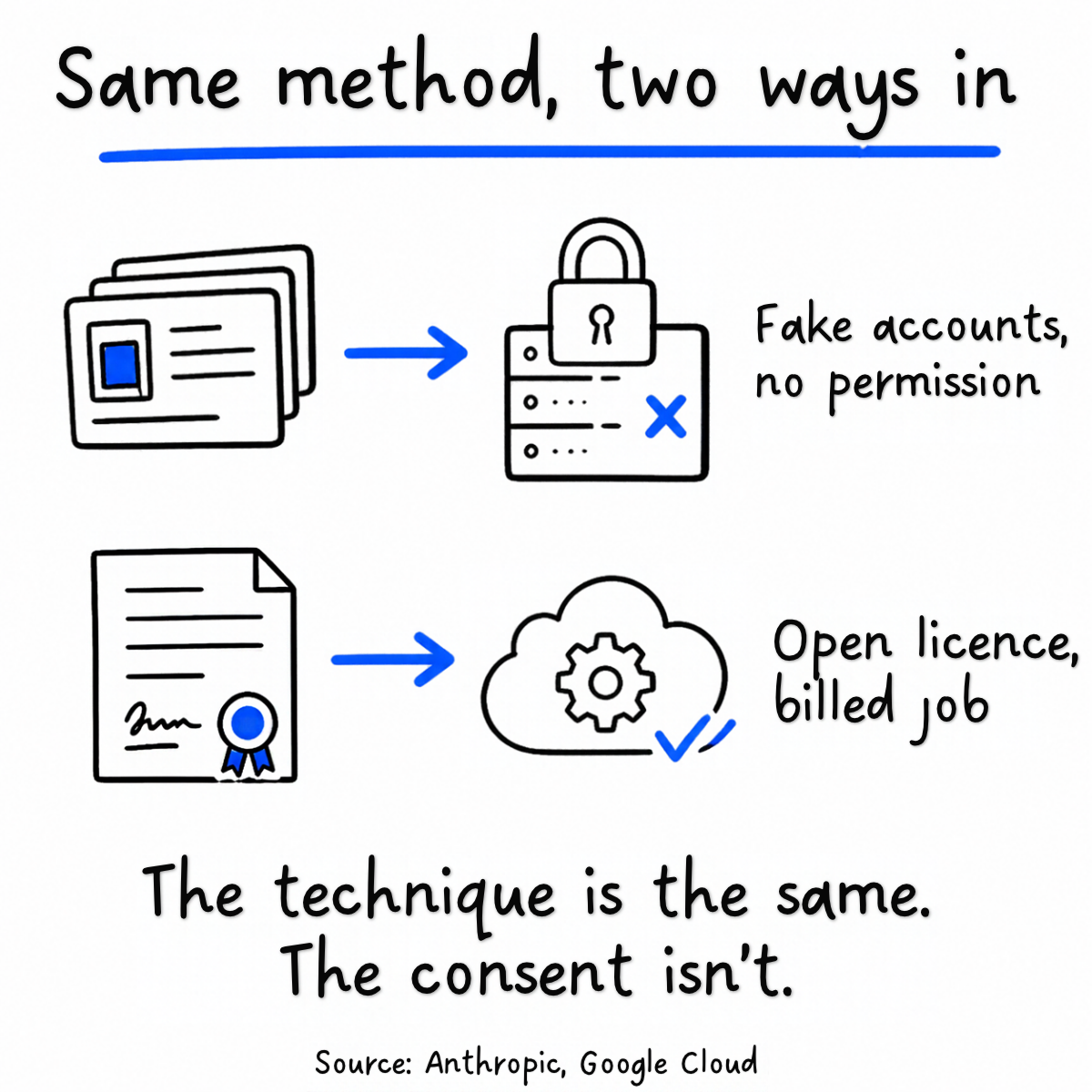
Anthropic and OpenAI don’t object to distillation as such. Anthropic’s own write-up calls it “a widely used and legitimate training method”. What they object to is covert extraction through fraudulent accounts. Anthropic’s February report named DeepSeek, Moonshot and MiniMax for more than 16 million exchanges with Claude through about 24,000 fraudulent accounts. Its September report went further, and CNBC reported that the largest campaign, attributed to Alibaba, ran to more than 151 million exchanges. In October Anthropic said new defences had cut what distillers harvest from Claude by around 90% to 99%, calling that early evidence.
OpenAI’s 20 November post says updated safeguards cut the success rate of reasoning-extraction attacks on GPT-6.2 Astra from 54.0% to 0.2% in an internal adaptive evaluation. It says weekly enforcement against distillation campaigns has ranged from thousands to tens of thousands of accounts, and it attributes a core part of one campaign to individuals associated with Moonshot AI. I covered that post when it came out.
The pressure is showing on the other side. Reuters reported, citing people familiar with the plans, that Z.AI’s GLM-5.5 has slipped partly because of distillation safeguards, and that Moonshot has begun distilling from Google and Meta models as Anthropic and OpenAI data got harder to get. My piece on that report has the detail.
Delangue’s argument is about the technique, and on the technique the two camps agree: it’s the same in both cases. What differs is consent. Google’s guide shows the sanctioned version, an openly licensed teacher, a billed job and a student stored in your own bucket.
What the terms say
The terms are where the two sides meet in writing. OpenAI’s Terms of Use bar users from using Output to develop models that compete with OpenAI. Google Cloud’s Service Specific Terms, section 17(b), bar customers from using output from an AI/ML service to substitute for a Google Model or to create or improve models similar to one. There is a carve-out: if the service offers fine-tuning or model distillation, a customer can use its output to modify and use a Modified Google Model.
Google applies the same logic to its own data. Its terms for the Workspace MCP access tools, which I covered earlier this week, bar using Google Technical Information for model training, fine-tuning, evaluation dataset building or model distillation. A teacher under an MIT licence carries no such restriction.
Who else offers it
| Offer | Teacher | Student | Status |
|---|---|---|---|
| Google Cloud, open models | GLM 5.2 MaaS | Qwen 3 (4B to 32B), Gemma 3 (1B to 27B) | SDK job, billed for tuning and teacher calls |
| Google Cloud, Gemini Distillation Service | gemini-3.1-pro | gemini-2.5-flash | Early access by allowlist, not for production |
| Amazon Bedrock Model Distillation | Nova Premier, Nova Pro, Llama 3.1 405B and 70B, Llama 3.3 70B | Nova Micro, Lite and Pro, Llama 3.1, 3.2 and 3.3 | AWS says distillation isn’t currently available for Anthropic models and gives no timeline |
| Together AI post-training | Any model you choose to sample | Open models such as Qwen3.8-27B | A recipe and cookbook, not a one-click job |
Amazon’s version asks for prompts too, or your existing invocation logs, and says only you can access the distilled model. Together AI’s recipe, which I covered, used Kimi-K3.1-Pro as the teacher and cost US$7.46 in teacher calls to translate 4,000 sentences. Google’s open-model job sits between the two: a managed pipeline like Amazon’s, with an open-weight teacher like Together’s.
Before you run one
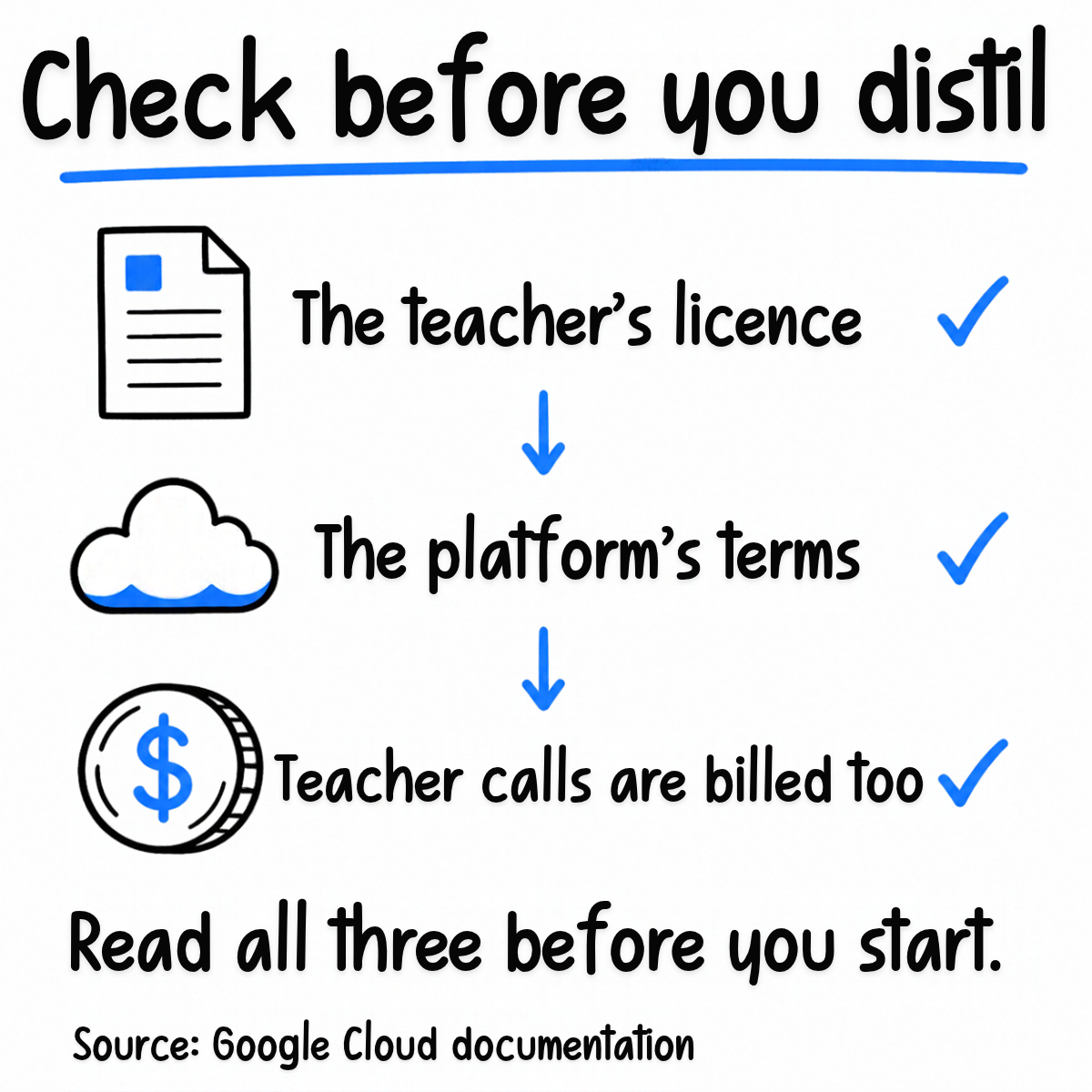
- Read the teacher’s licence. GLM 5.2 is MIT-licensed.
- Read the platform’s terms, including section 17(b) if you’re on Google Cloud.
- Price both halves, tuning tokens and teacher calls, and check the project’s quota for the teacher.
- Keep prompts and answers inside 8,192 tokens, and stay with text.
- Pick a task where the teacher clearly beats the student. Google says gains shrink when it doesn’t.
Google’s page names no rival and takes no side in the argument. It shows where a platform draws the line when it sells distillation: an openly licensed teacher, a job you pay for, and a student you keep.
Sources
- Post on distillation, Clem Delangue on X
- Supervised and distillation fine-tuning for open models, Google Cloud
- Gemini Distillation Service, Google Cloud
- Service Specific Terms, Google Cloud
- GLM-5.2 model card, Z.ai on Hugging Face
- Detecting and preventing distillation attacks, Anthropic
- Strengthening our defenses against distillation attacks, Anthropic
- Chinese AI labs secretly used millions of Claude exchanges to train their models, CNBC
- Combatting adversarial distillation, OpenAI
- Terms of Use, OpenAI
- Industrial-scale distillation campaigns advisory AA26-251A, CISA
- Prerequisites for model distillation, Amazon Bedrock