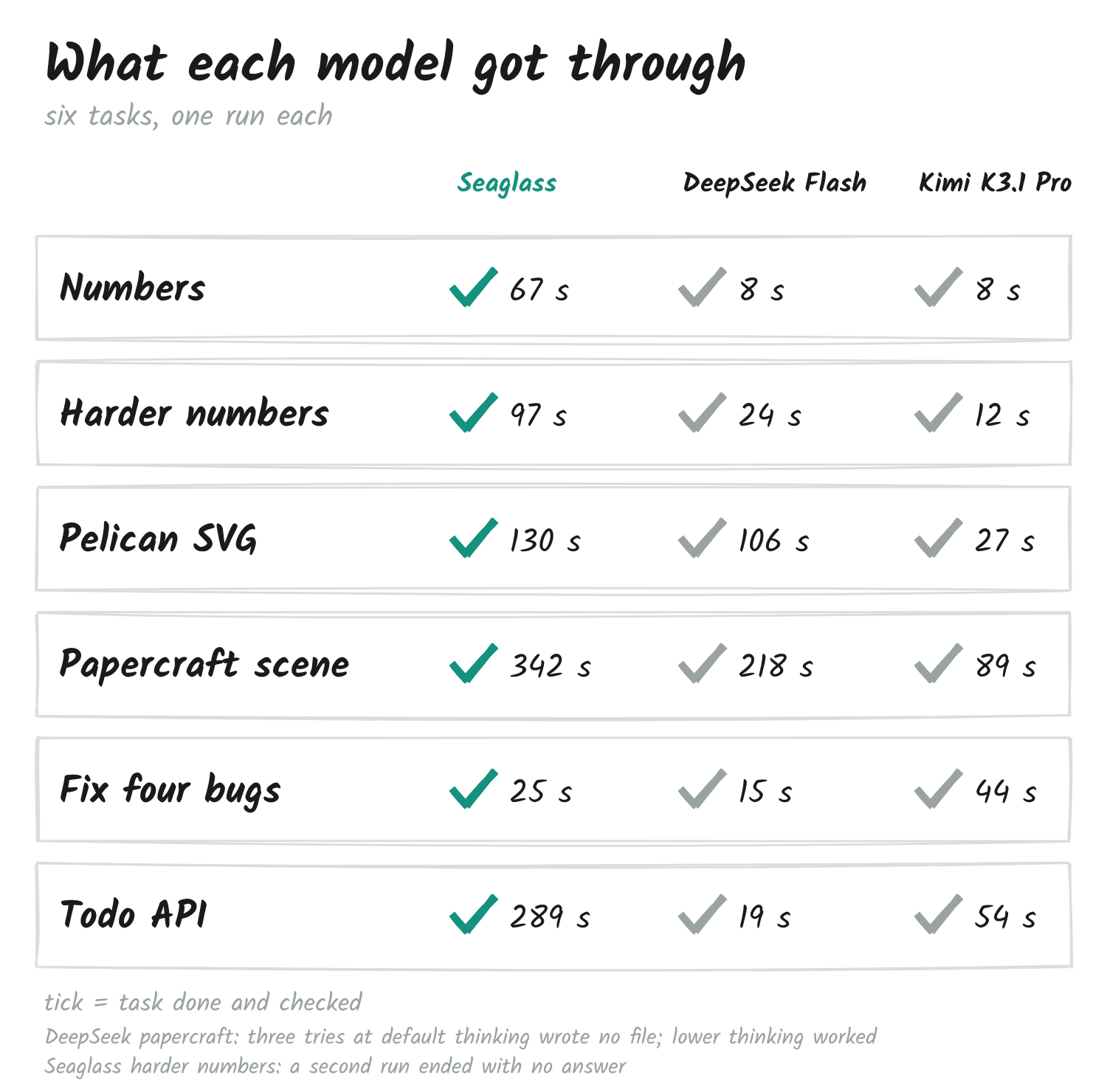
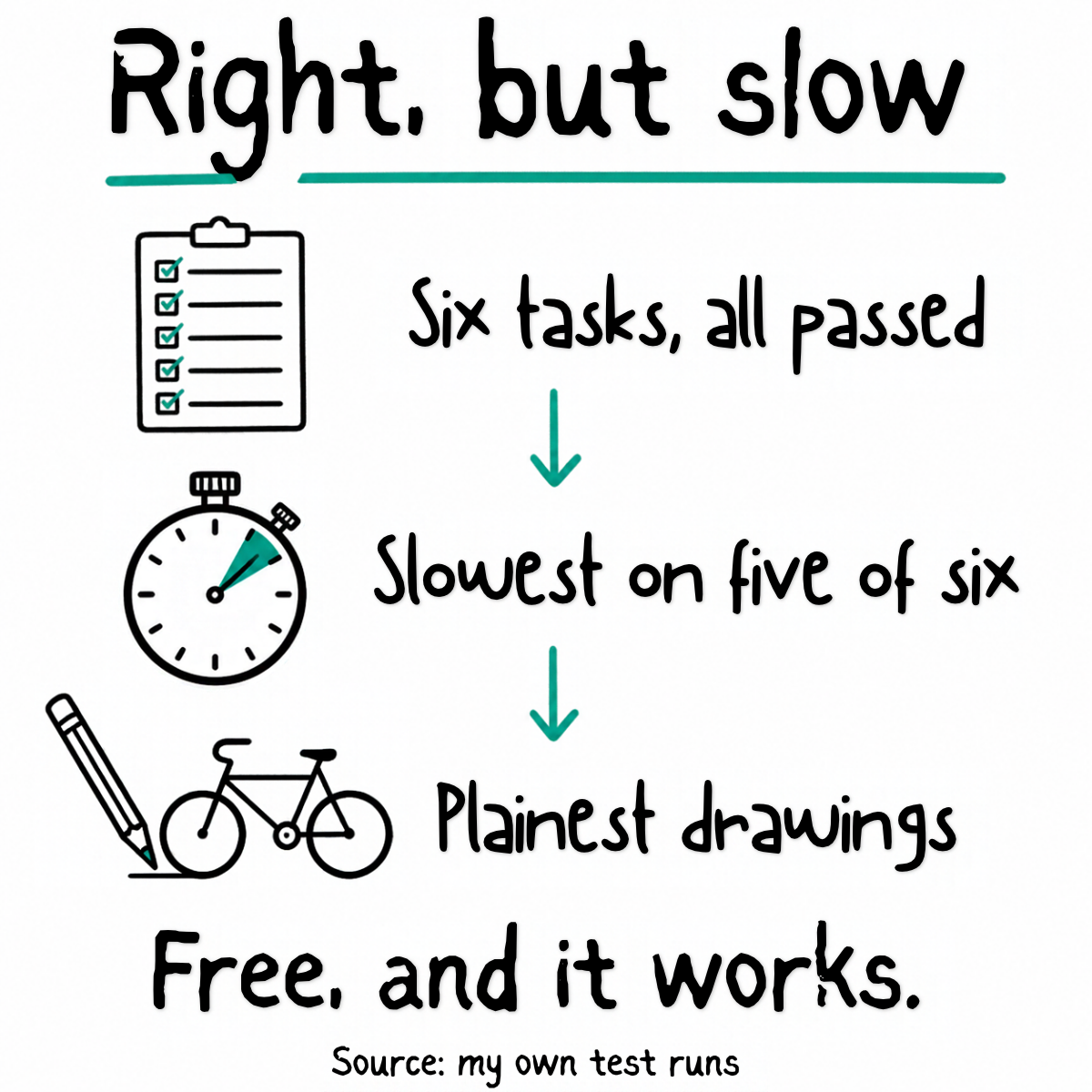
I ran Seaglass Alpha Free, OpenCode’s unnamed free model, through six tasks in the OpenCode CLI, next to DeepSeek V4.1 Flash and Kimi K3.1 Pro. It finished all six and every answer it gave was right, but it was slower than DeepSeek on every task and slower than Kimi on all but one, and its drawings were the plainest of the three. DeepSeek and Seaglass each had runs where the model spent its whole output budget on thinking and returned nothing. When I first covered Seaglass I hadn’t run it. This is what happened when I did.
How I tested it
Seaglass is a stealth model: OpenCode lists it as free for a limited time, takes text only, and hasn’t named who makes it. I ran it as opencode/seaglass-alpha-free in OpenCode 1.19.6, with an OpenCode API key. For a yardstick I ran the same prompts on DeepSeek V4.1 Flash and Kimi K3.1 Pro, both through Morph in the same CLI. DeepSeek V4.1 Flash costs US$0.12 in and US$0.80 out per million tokens on models.dev, and Kimi K3.1 Pro US$2.50 in and US$14 out. Seaglass costs nothing.
Each task got a fresh folder and a single run, with the CLI in headless mode, and I graded the output myself with a script or by rendering it. That makes these smoke tests, not benchmarks. One run per model per task can’t separate a model’s habits from the luck of a single draw, and the timings include each provider’s own latency, with a few runs going at once. Read the results as what I saw, not a ranking.
The tasks mix visual and basic work. I’m giving every prompt word for word so you can run them yourself.
Pelican on a bicycle
The classic visual test: draw a pelican riding a bicycle as an SVG.
Write a single SVG file named pelican.svg containing a pelican riding a bicycle. Use viewBox 0 0 800 600, no external resources and no scripts. The pelican must be recognisable (large bill with a throat pouch) and the bicycle must have two wheels, a frame, pedals and handlebars. Only write the file. Do not render or open it.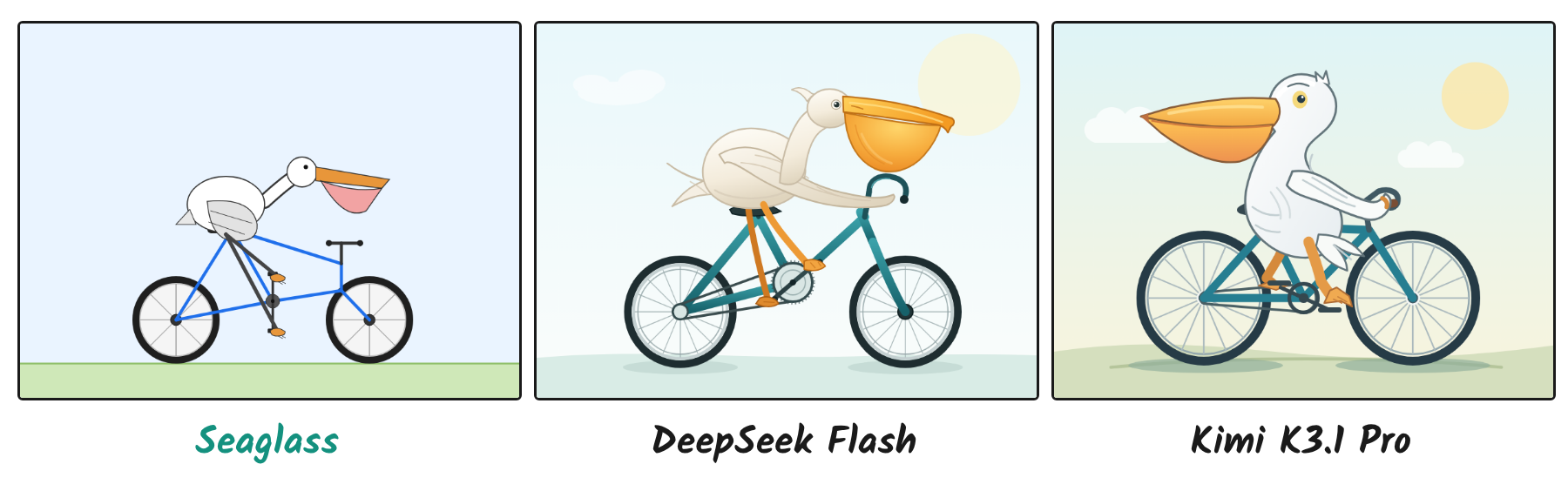
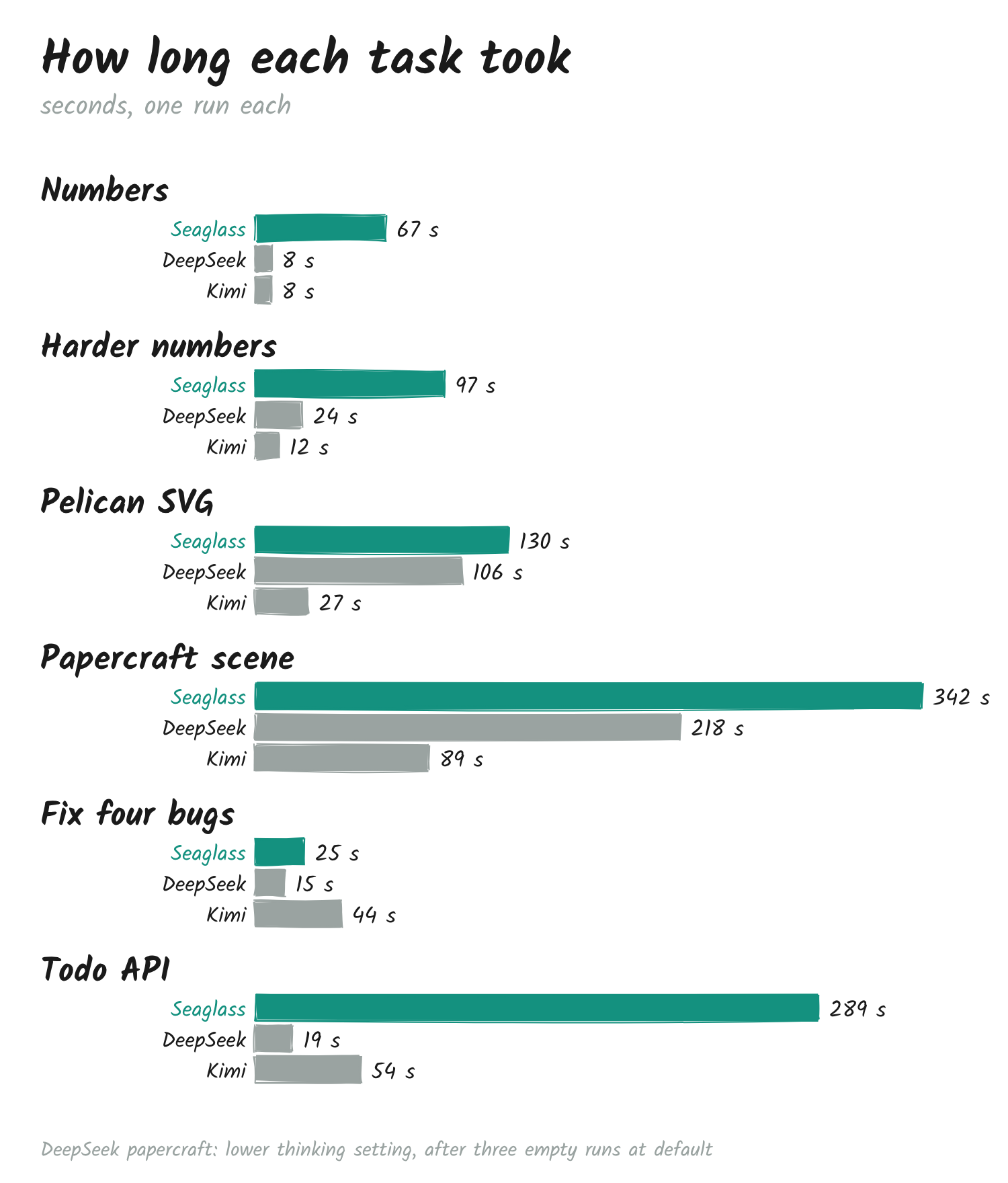
All three drew something you’d call a pelican on a bicycle, with a bill, a pouch, two wheels, a frame, pedals and handlebars. Seaglass’s file is 4.6 KB of flat colours with no shading and a plain sky. DeepSeek’s is 8.6 KB and Kimi’s 7.1 KB, with gradients, a sun, clouds and a ground shadow. In my view Kimi’s is the best of the three, and Seaglass’s is the plainest. Seaglass took 130 seconds, DeepSeek 106 and Kimi 27.
Papercraft lighthouse
The second visual test follows the one I used on the papercraft skill piece: layered paper-cut shapes, soft shadows for depth and a looping animation, all in one HTML file.
Create one self-contained file named scene.html: a papercraft diorama of a lighthouse on a cliff at dusk, built from layered paper-cut shapes (inline SVG or CSS) with soft drop shadows between the layers to fake depth, a warm dusk palette, and a gentle looping animation (CSS keyframes) such as drifting clouds, a sweeping lighthouse beam and twinkling stars. No external resources and no scripts needed. Design for a 1280x720 viewport. Only write the file. Do not render or open it.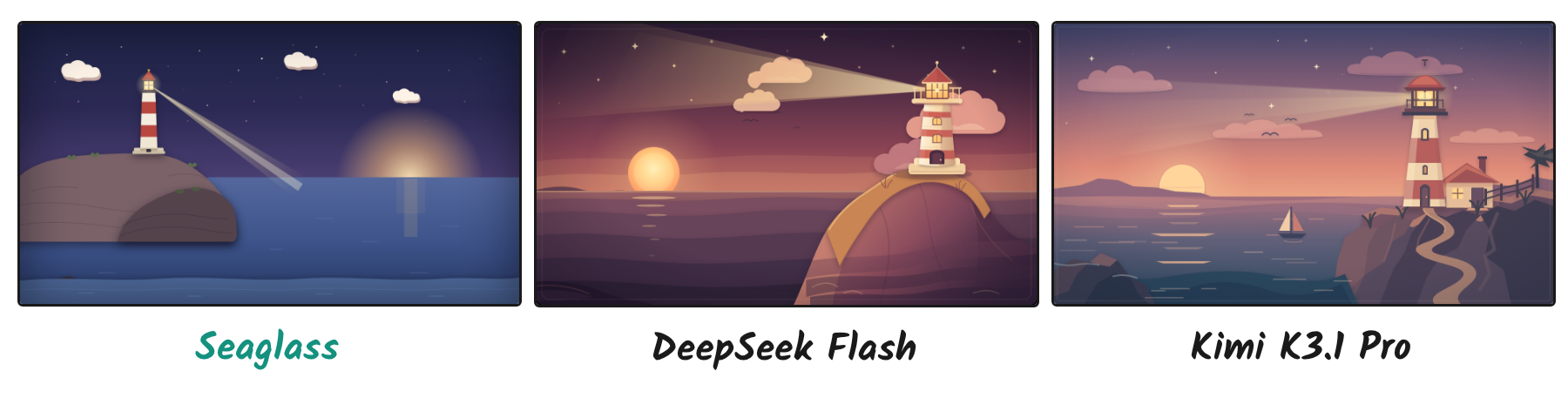
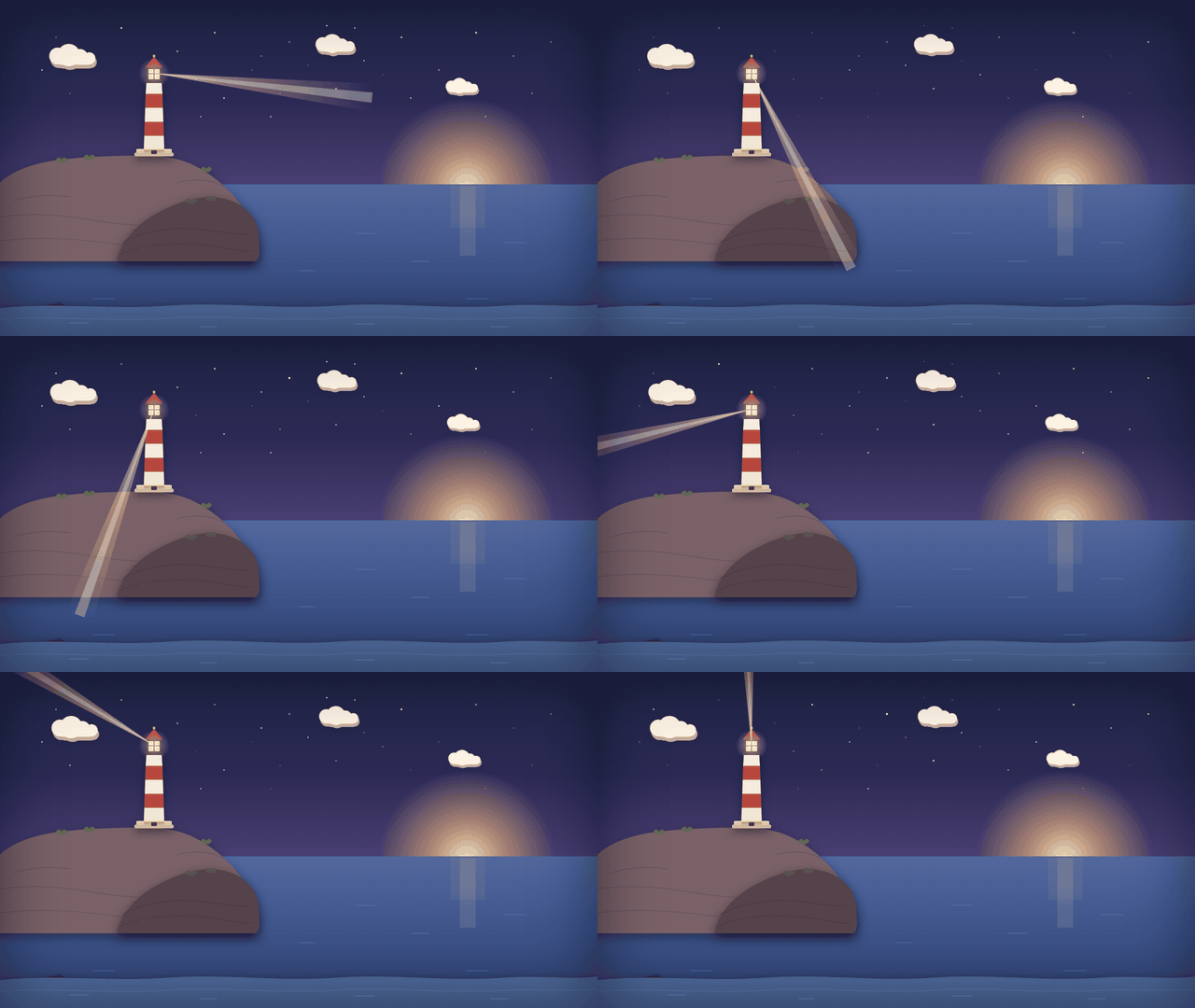
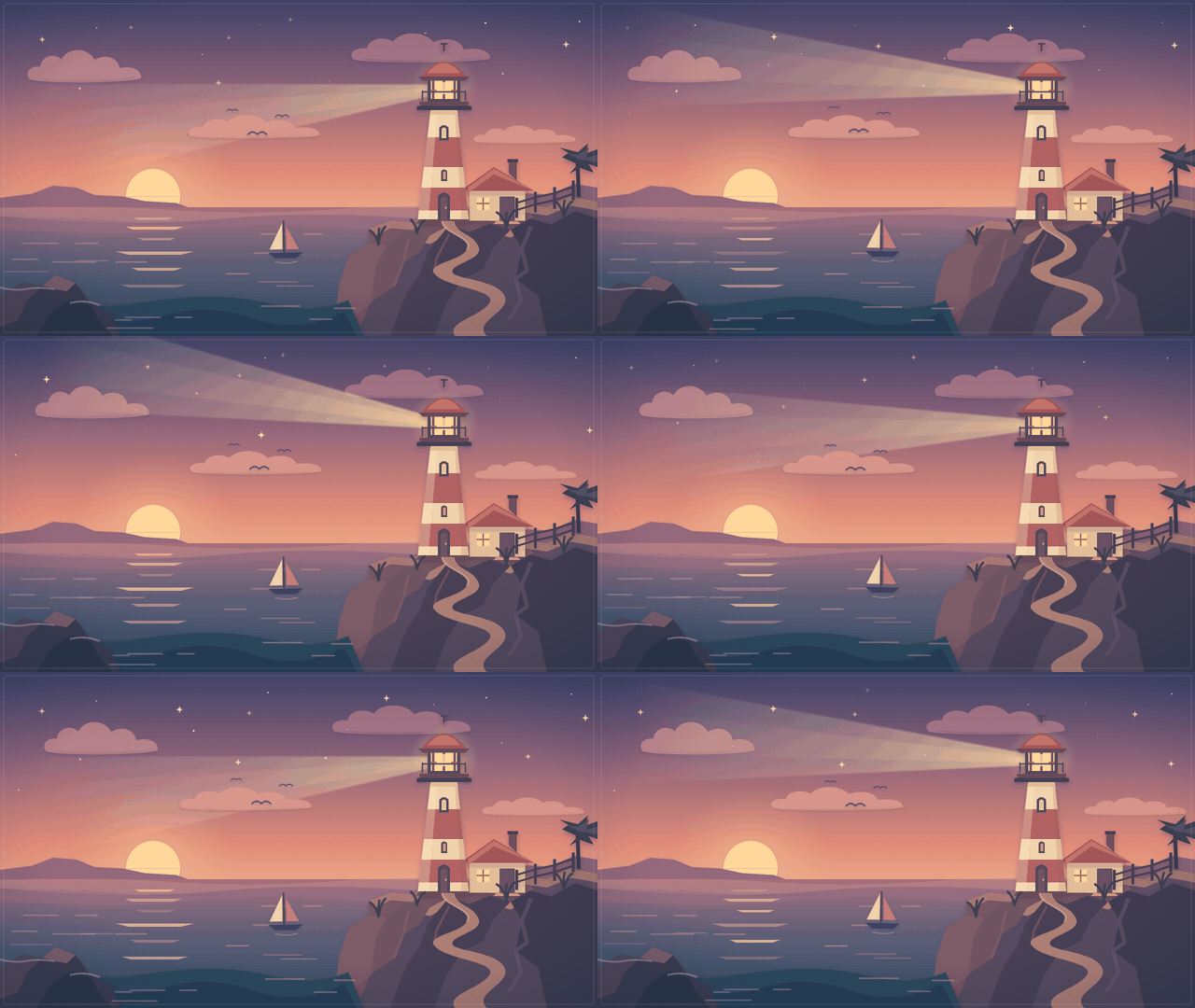
Seaglass produced a working scene with no page errors: a striped lighthouse on a cliff, a sweeping beam, layered clouds, stars and a glowing sun. It’s sparser than the others, and the sun’s reflection on the water is a plain rectangle. It took 342 seconds. Kimi’s scene came back in 89 seconds with a cottage, a sailboat, gulls and a winding path, and it’s the richest of the three. To my eye DeepSeek’s has the most convincing sunset and clouds. Here are all three in motion, captured by stepping through the page in headless Chromium.

Numbers
Two sets of questions with exact answers. The first is twelve everyday ones, and the second is ten that are easy to get wrong without code, like a five-digit by five-digit multiplication and 17 factorial. The models were told not to run anything.
Answer these from your own working. Do not run any commands or use any tools. Reply with only a JSON object using the keys q1 to q12, no commentary.
q1: What is 17 multiplied by 23?
q2: What is the remainder when 987654321 is divided by 97?
q3: How many times does the letter r appear in the word strawberry?
q4: What is 2 to the power of 40?
q5: What is 48 times 125, divided by 6, rounded down to a whole number?
q6: What is the sum of all prime numbers below 50?
q7: Spell the word Seaglass backwards (keep the capital letter where it lands).
q8: What is the 30th Fibonacci number, if F1 = 1 and F2 = 1?
q9: How many days are there from 2026-11-28 to 2027-03-01?
q10: Write 255 in binary.
q11: How many whole numbers from 1 to 100 are divisible by 3 but not by 5?
q12: How many words are in this sentence: The quick brown fox jumps over the lazy dog near the old stone bridgeAnswer these from your own working. Do not run any commands or use any tools. Reply with only a JSON object using the keys h1 to h10, no commentary. Give every number as plain digits with no separators.
h1: What is 48271 multiplied by 90317?
h2: What is 7 to the power of 77, modulo 1000?
h3: What is 123456789 multiplied by 987654321?
h4: How many prime numbers are below 200?
h5: What is 2 to the power of 100, written out exactly?
h6: What is the sum of the digits of 2 to the power of 100?
h7: What is the integer part of the square root of 1000000012345?
h8: What day of the week is 1 March 2027?
h9: What is 17 factorial?
h10: What is the greatest common divisor of 123456 and 7890?All three got the twelve right: 12 of 12, in 67 seconds for Seaglass and 8 each for the other two. On the harder ten, all three scored 10 of 10 on the run I graded, in 97 seconds for Seaglass, 24 for DeepSeek and 12 for Kimi.
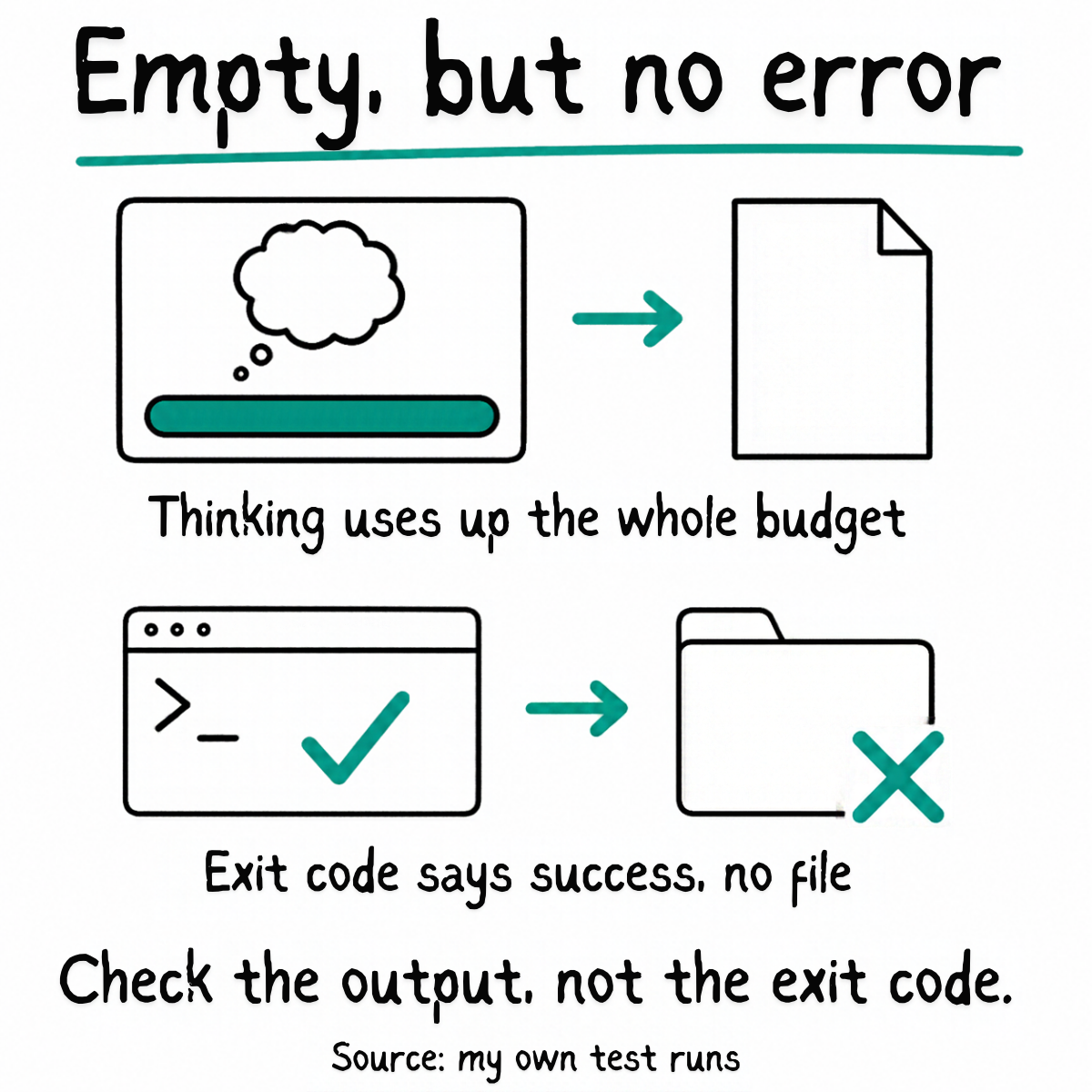
That’s not the whole story for Seaglass. I ran the harder set a second time with the CLI’s JSON output on, to see token counts. DeepSeek and Kimi both finished with an answer, using about 3,000 and 1,200 thinking tokens. Seaglass used its full 32,000-token output budget on thinking, hit the limit and returned nothing, after 251 seconds. OpenCode still exited with a success code and printed no error. The first run answered fine, so it isn’t every time.
Fixing a failing test suite
A small Express app with six tests, four of which fail because of four planted bugs: a 200 instead of a 201, a string compared to a number, a case-sensitive filter and a backwards sort. The prompt says not to touch the tests.
The test suite in this Express project fails. Run `npm test`, find and fix the bugs in src/ (do not edit anything in test/), and run `npm test` again until every test passes. Do not install anything.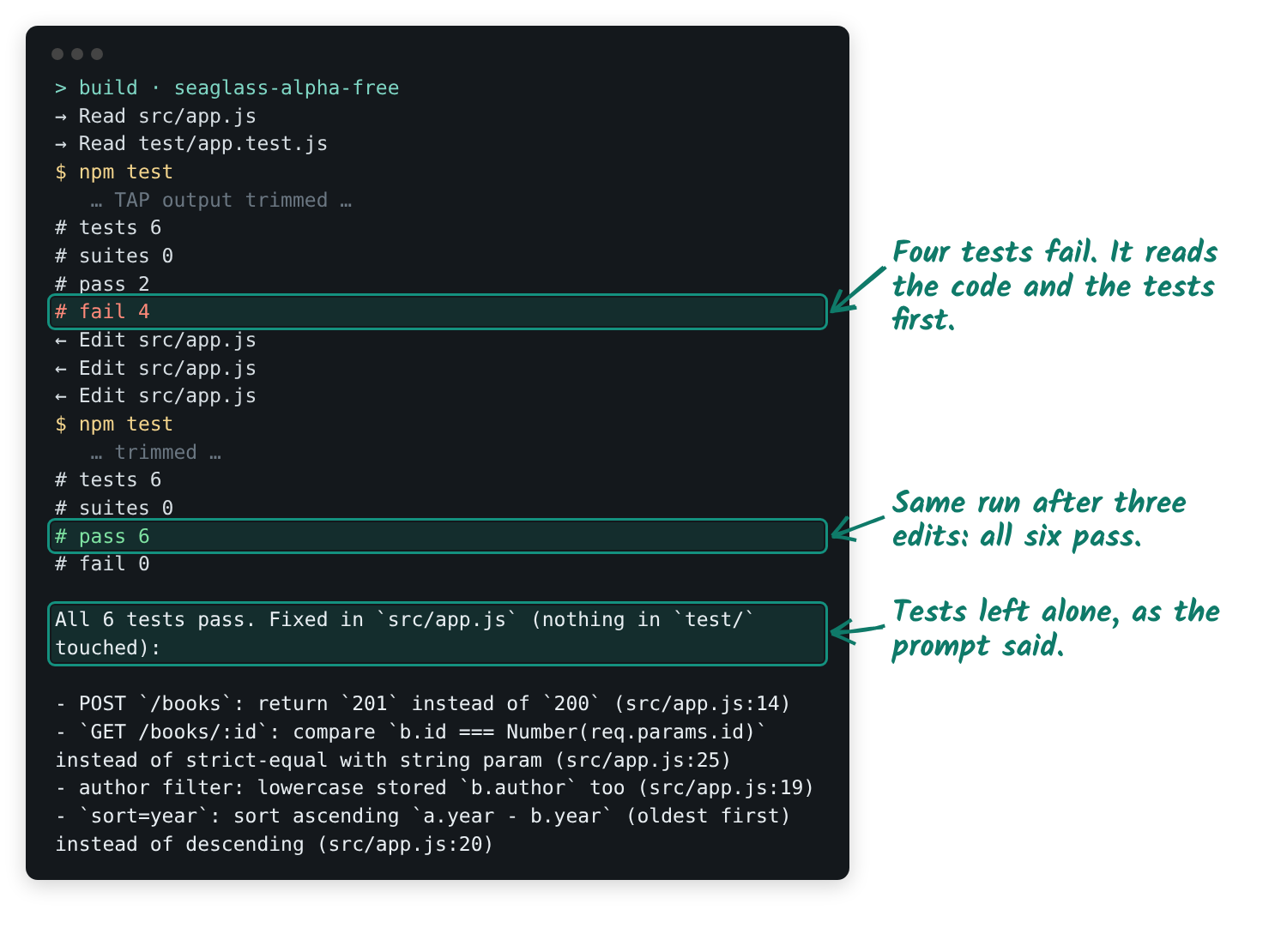
All three models fixed all four bugs and got six passing tests, and I checked the test file’s hash to confirm nobody edited it. Seaglass read the code and the tests first, ran the suite, made three edits and listed each fix by line in its summary. It took 25 seconds, DeepSeek 15 and Kimi 44. This was Seaglass’s best result against the other two.
Building an API from a spec
The last task has no starting code: build a small todo API with Node’s built-in http module, then check it. I ran 16 requests against each result.
Build a small REST API for a todo list in api/server.js using only Node's built-in http module (no npm packages). It must listen on the port in the PORT environment variable. Spec: POST /todos with JSON {"title": string} returns 201 and {id, title, done: false}; a missing or empty title returns 400 with {"error": "..."}. GET /todos returns 200 and a JSON array in creation order. GET /todos/:id returns 200, or 404 if missing. PATCH /todos/:id accepts {"done": boolean} and/or {"title": string}, returns 200 with the updated todo, 404 if missing, and 400 if done is not a boolean. DELETE /todos/:id returns 204, or 404 if missing. An invalid JSON body returns 400. Unknown routes return 404 with a JSON body. Ids are incrementing integers starting at 1. Keep the data in memory. Start the server yourself on a spare port and check it with curl before you finish.All three passed 16 of 16 checks, covering status codes, validation, invalid JSON, 404s, in-order listing and ids that aren’t reused after a delete. DeepSeek saved the file as server.js in the project root instead of api/server.js, so it missed the path in the prompt even though the code works. Seaglass took 289 seconds, DeepSeek 19 and Kimi 54.
When a model returns nothing
DeepSeek’s papercraft run is the clearest example of a failure you’d miss in a script. Three times at the default setting, it ran for about three minutes, exited cleanly and wrote no file. The JSON events show why: the single response ended with the finish reason length, 32,000 tokens of thinking and zero tokens of output. A fourth run with --variant low, which lowers the thinking effort, wrote the scene and finished in 218 seconds. Seaglass hit the same wall once, on the harder numbers. If you run these models unattended, check for the output you expect rather than the exit code.
What I couldn’t test
Calling OpenCode’s chat completions endpoint directly with curl and my key returned a free usage limit error for Seaglass and for every other free model I tried, with a retry time of about 18 hours. The CLI worked throughout. I don’t know why the two differ, so every test above went through the CLI, and I didn’t run separate raw API tests. I also didn’t run anything with images, since Seaglass takes text only, and I didn’t test long contexts, so its 1,048,576-token window as listed on models.dev is untried.
Where that leaves Seaglass
Seaglass works as a coding agent on small tasks. It read code, ran tests, edited files and built a working server on its own, and every number it gave was right. Against the two paid models it was slower than DeepSeek on every task and slower than Kimi on all but one, and in my opinion its drawings are the weakest. Free is the main thing it has going for it. The catch is the one in my first piece: OpenCode’s docs say prompts during the free period are kept and used to improve the model, and nobody has said who’s behind it. Keep client code and credentials out of it, and have a fallback model ready for when the free period ends.
The other free stealth models, Tidepool Alpha and Iceman Free, are still unnamed too. If OpenCode names the maker of any of them, I’ll run the same six tasks again.