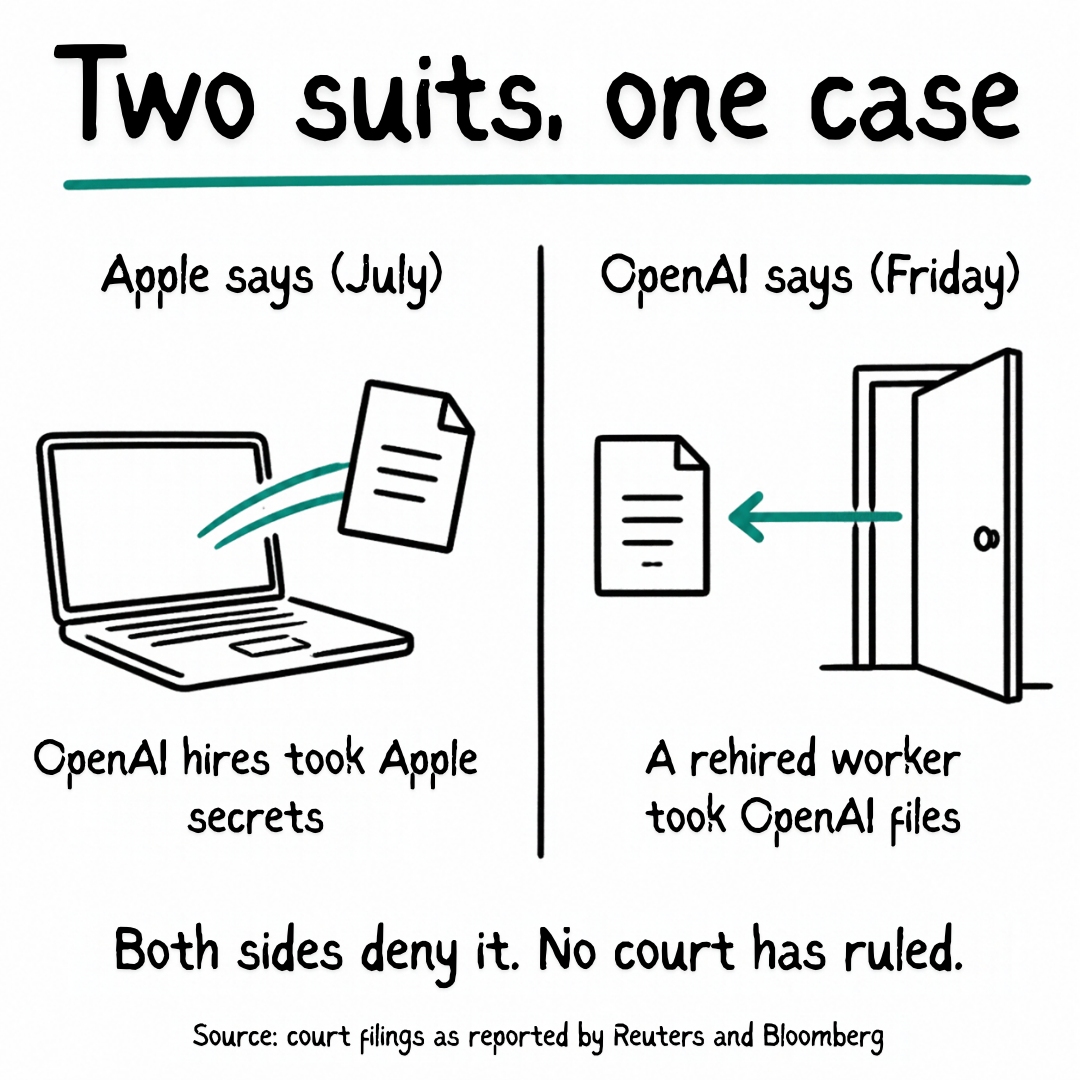
OpenAI has hit back in the trade secrets case Apple brought against it in July. In counterclaims filed in federal court in San Jose, California, on Friday, OpenAI alleges that Apple stole its trade secrets through a rehired employee, pressured suppliers that work for both companies not to work on OpenAI’s devices, and used its staff contracts to stop engineers leaving. Apple calls the counterclaims “a transparent attempt to distract from the substance of Apple’s lawsuit.” No court has ruled on either side’s claims. I went through the reporting from Reuters, Bloomberg, the BBC, the Financial Times, TechCrunch, Engadget and The Next Web, which between them carry both companies’ statements and extracts from the filing.
What OpenAI alleges
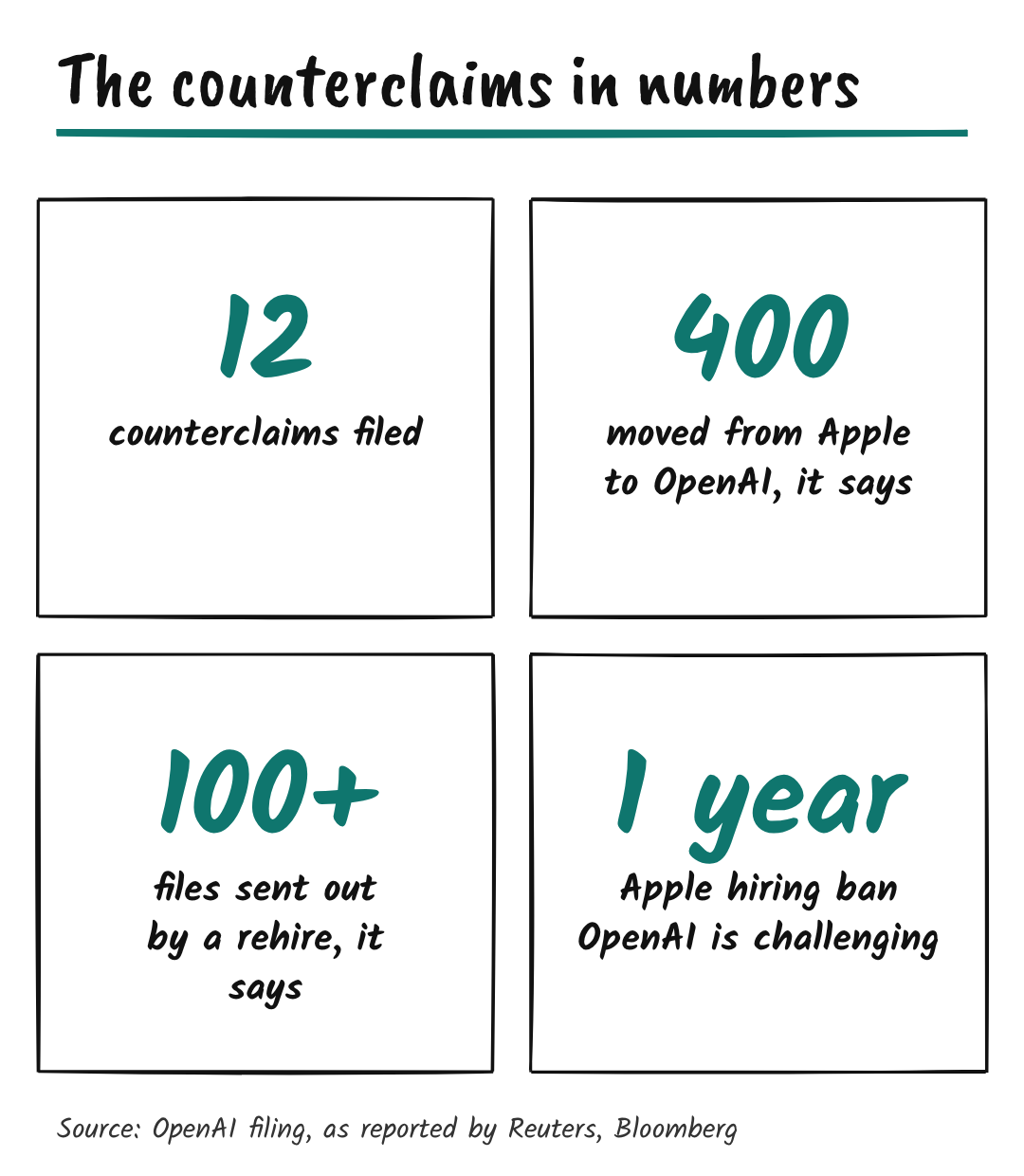
The case is Apple v. Liu, in the Northern District of California. A summary of the docket says OpenAI’s pleading runs to 81 pages and brings 12 counterclaims: four from OpenAI and its hardware unit io Products, five from former Apple engineer Chang Liu and three from Tang Tan, OpenAI’s chief hardware officer. The OpenAI and io claims are trade secret misappropriation under the federal Defend Trade Secrets Act, interference with existing contracts and two unfair competition claims under California law.
The filing’s pitch is that OpenAI’s device plans threaten Apple on its home ground. Reuters reports that OpenAI says its devices could “outcompete Apple on what Apple views as its own turf.” Bloomberg quotes the filing: “Apple has responded to OpenAI’s anticipated entry into the hardware market by unlawfully pressuring vendors not to work with OpenAI and using expansive employment restraints to limit OpenAI’s access to talented engineers. Apple’s power over suppliers and engineers cannot lawfully be used to exclude competing purchasers and employers from the market.”
The suppliers
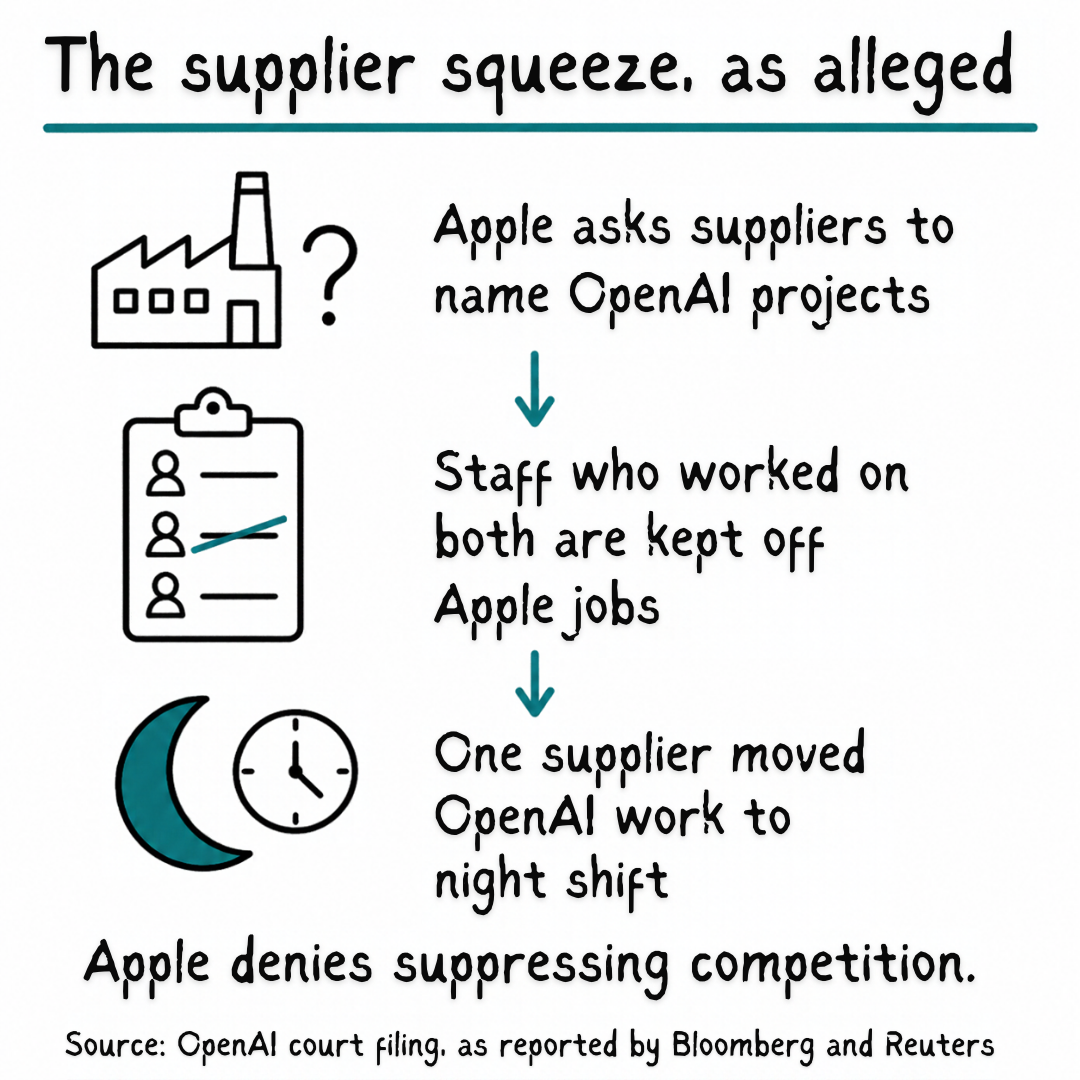
OpenAI says Apple asks suppliers to name their OpenAI projects and any staff on them who once worked for Apple, then tries to keep anyone who has worked on OpenAI products off Apple jobs. The result, OpenAI says, is that suppliers get wary of putting people on OpenAI work. One supplier moved its OpenAI work to the night shift so it wouldn’t overlap with Apple work, which pushed OpenAI’s costs up, and others have shifted meetings with OpenAI so Apple wouldn’t see them, according to The Next Web’s reading of the filing. The Financial Times reports that OpenAI accuses Apple of “coercing and threatening” suppliers that work with both companies.
The rehired employee
OpenAI says Apple got confidential information by rehiring a former employee who’d spent six months at OpenAI. In that time he had access to details of a new device and OpenAI’s roadmap for future hardware. The filing says over a hundred highly confidential files about at least one unreleased OpenAI device went to personal accounts, among them images of unreleased hardware, engineering and manufacturing data and supplier information. The BBC adds that OpenAI says he sent “dozens of OpenAI documents” to his personal phone numbers and presented OpenAI’s plans to senior Apple staff “at Apple’s request.” The filing puts it this way: “Given the timing, it now appears that stealing those documents may have been his reason for joining OpenAI in the first place.” OpenAI had raised the claim before the counterclaims.
The staff contracts
The third plank is the intellectual property agreement Apple employees sign. OpenAI says it defines Apple’s private information so broadly that it covers nearly everything staff learn, even what isn’t a trade secret, and it includes a one-year ban on former employees recruiting Apple workers. OpenAI also says Apple encourages staff to mix work files with personal iCloud accounts, then keeps access to those accounts once they’ve left so it can “monitor and ensnare departing employees.” Engadget quotes the complaint on the effect: “bright young minds thought they would work in Cupertino. Instead they were joining Hotel California: you can check out any time you like, but you can never leave.” OpenAI says 400 employees have left Apple for OpenAI so far.
What Apple says
Apple’s Friday statement called the counterclaims “a transparent attempt to distract from the substance of Apple’s lawsuit, in which OpenAI has already been ordered to stop using Apple’s confidential information.” It went on: “This case is about OpenAI employees deliberately stealing, accessing, and using Apple’s secret and confidential information regarding our unreleased technologies, processes and products, not about inadvertent retention of Apple information.”
On the rehired employee, Apple says it has policies to stop confidential information from former employers being used, and it found no evidence to back OpenAI’s claim. It denied using him to reach OpenAI’s confidential information, and it denied trying to suppress competition in AI device manufacturing.
The suit Apple filed in July
Apple sued on 10 July. The defendants are OpenAI, io Products, Tan and Liu. Tan spent 24 years at Apple, finishing as a vice president of product design for iPhone and Apple Watch, and was part of the group that started io Products before OpenAI bought it. Liu is a former iPhone engineer who joined OpenAI in January.
Apple alleges a campaign to get its secrets through job candidates and hires. As Bloomberg and TechCrunch report its claims, OpenAI leaders asked candidates to bring Apple hardware components to interviews and coached them on dodging security, and Liu used a rare authentication bug to reach Apple files over several weeks while he was building devices for OpenAI. The Next Web adds that Apple says a shared supplier was made to copy an Apple metal-finishing method.
OpenAI and the engineers deny it. OpenAI told the BBC it has “no interest in other companies’ trade secrets,” and it and the engineers say Apple’s suit leans on unauthorised monitoring of Liu’s personal messages after he left. OpenAI has asked the court to throw the suit out. In October, with a judge signalling an order was likely, OpenAI voluntarily agreed not to use the files Apple says were taken while the case goes on. Apple’s request for a preliminary injunction is still pending.
| Point | Apple’s suit, 10 July | OpenAI’s counterclaims, 27 November |
|---|---|---|
| Who is accused | OpenAI, io Products, Tang Tan and Chang Liu | Apple |
| Core claim | OpenAI took Apple trade secrets through hires and candidates | Apple took OpenAI trade secrets through a rehired employee |
| Person at the centre | Chang Liu, who joined OpenAI in January | A former Apple employee who spent six months at OpenAI, then returned to Apple |
| Wider conduct | Interview practices and a shared supplier | Pressure on shared suppliers and staff contracts |
| Reply | OpenAI denies it and has asked for dismissal | Apple calls it a distraction and says it found no evidence |
Why the devices are the point
The fight sits on top of OpenAI’s move into hardware. OpenAI bought Jony Ive’s design startup io Products in 2025, in a deal Reuters reported at about US$6.5 billion, and Ive is helping it build a family of devices, starting with what Bloomberg describes as an expected doughnut-shaped smart speaker. The suppliers matter because, as the Financial Times puts it, some of them work with both companies, so what Apple asks of them lands on OpenAI’s product plans too.
The two companies were partners not long ago. In 2024 they announced ChatGPT’s integration into Siri and Apple’s software, and TechCrunch calls the dueling lawsuits a dramatic souring of that relationship.
Apple has sued over departing engineers before
Apple has gone after the new employers of departing staff more than once. What’s different here is that the defendant is arguing Apple’s own employment terms and supplier conduct are unlawful, not only denying the claims.
| Case | Filed | What Apple alleged | Outcome |
|---|---|---|---|
| Apple v. Rivos | April 2022 | The chip startup hired over 40 former Apple engineers, and at least two took gigabytes of confidential data | Apple agreed to settle in February 2024, Reuters reported |
| Apple v. Chen Shi and Oppo | August 2025 | A former Apple Watch sensor architect took Apple Watch files to Oppo | Oppo said it found no evidence linking the allegations to his time at Oppo |
| Apple v. Liu, OpenAI and io Products | July 2026 | OpenAI used hires and candidates to get Apple hardware secrets | Counterclaims filed 27 November |
What happens next
Apple has to answer the counterclaims, and the court has Apple’s preliminary injunction request and OpenAI’s request to dismiss in front of it. The counterclaims also challenge a clause in Apple’s staff contracts, so a ruling on them would matter beyond these two companies, to any engineer weighing a move from Apple to a competitor.
Disclosure: I’m an OpenAI, Firecrawl and Devin ambassador.