More than half of US teens who use AI chatbots use one every day, and their parents say the same. The Family Online Safety Institute (FOSI), a US non-profit, presented Coming of Age at its 19 November conference. FOSI surveyed 1,003 US teens aged 13 to 17 who had used an AI chatbot in the previous three months. A separate survey included 1,002 parents who said their teen had used one in that period.
51%
of teen chatbot users go daily or more
84%
of teens have used ChatGPT
90%
of teens say their parents trust them to use chatbots safely
44%
of parents say they use chatbot parental controls
How FOSI ran the study
Touchstone Research fielded both surveys in July and August 2026, and FOSI weighted the data to US Census estimates for gender, race and ethnicity, household income, household makeup and region. The teen and parent samples were recruited separately, so they aren’t pairs from the same households.
Before the surveys, FOSI ran four focus groups with 18 teens and four with 25 parents in May. It also held three reflection sessions with 16 teens, who reviewed the questionnaire and helped interpret the results. The report authors are Alanna Powers-O’Brien, Lyonne Zhu and Sarah Bean, and the teen sessions were run with research platform In Tandem.
About half of teen chatbot users use one daily
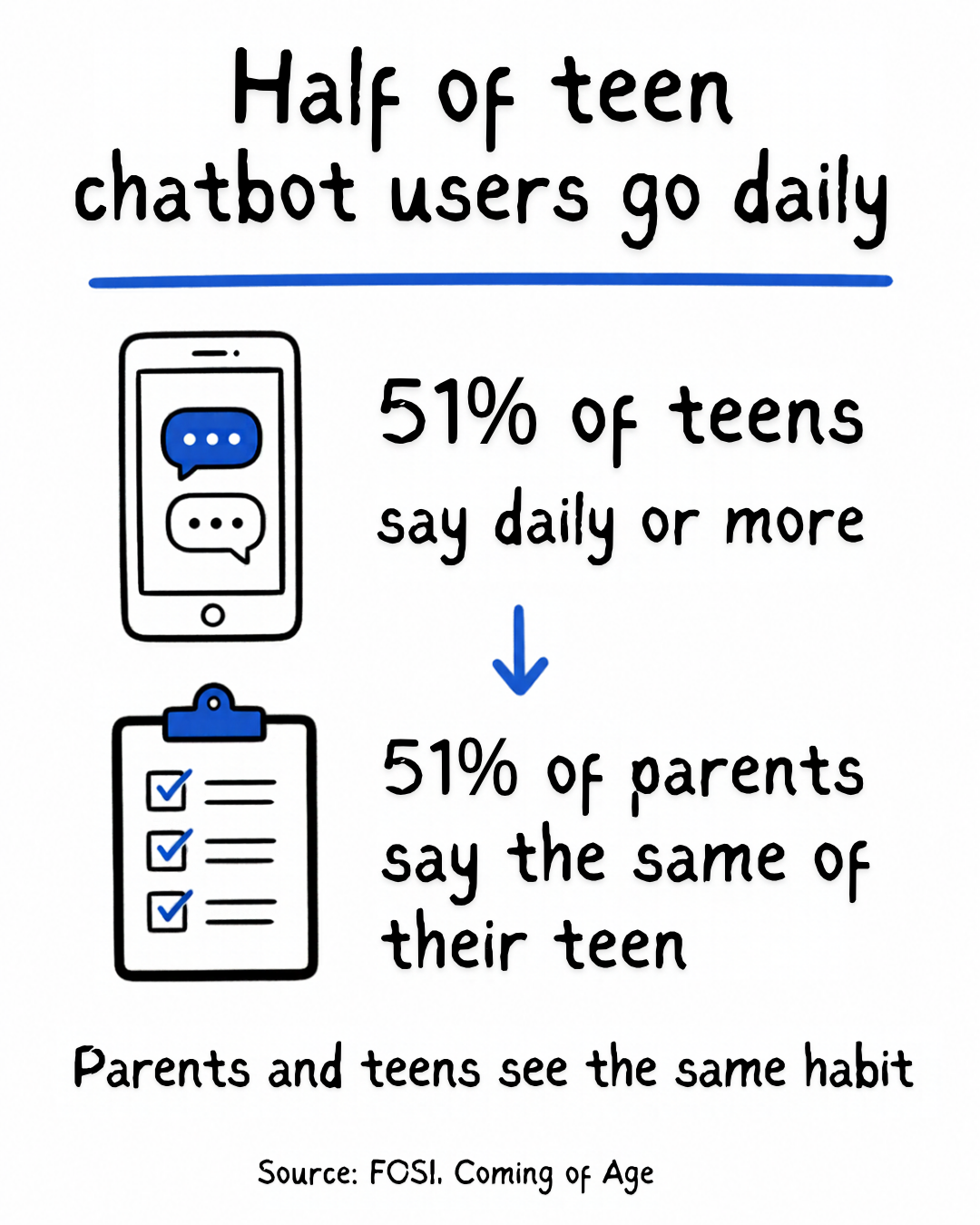
In the teen-user sample, 51% said they used a chatbot at least daily. In the separate parent sample, 51% said their teen did. Thirty-four per cent of teens use one several times a day, 29% a few times a week, and 9% almost constantly. Parents put the “almost constantly” figure at 8%.
Pew Research Center measured the wider teen population in late 2025 and found 64% of US teens use chatbots, with about three in ten using them daily. FOSI only surveyed teens who already use chatbots, so its daily share sits higher.
ChatGPT is the clear leader
Of the 13 chatbots FOSI listed, ChatGPT is the one teens have used most: 84% of teens and 82% of parents say so. Gemini is the only other chatbot more than half of teens have used, at 60%. Meta AI follows at 45% and Copilot at 36%.
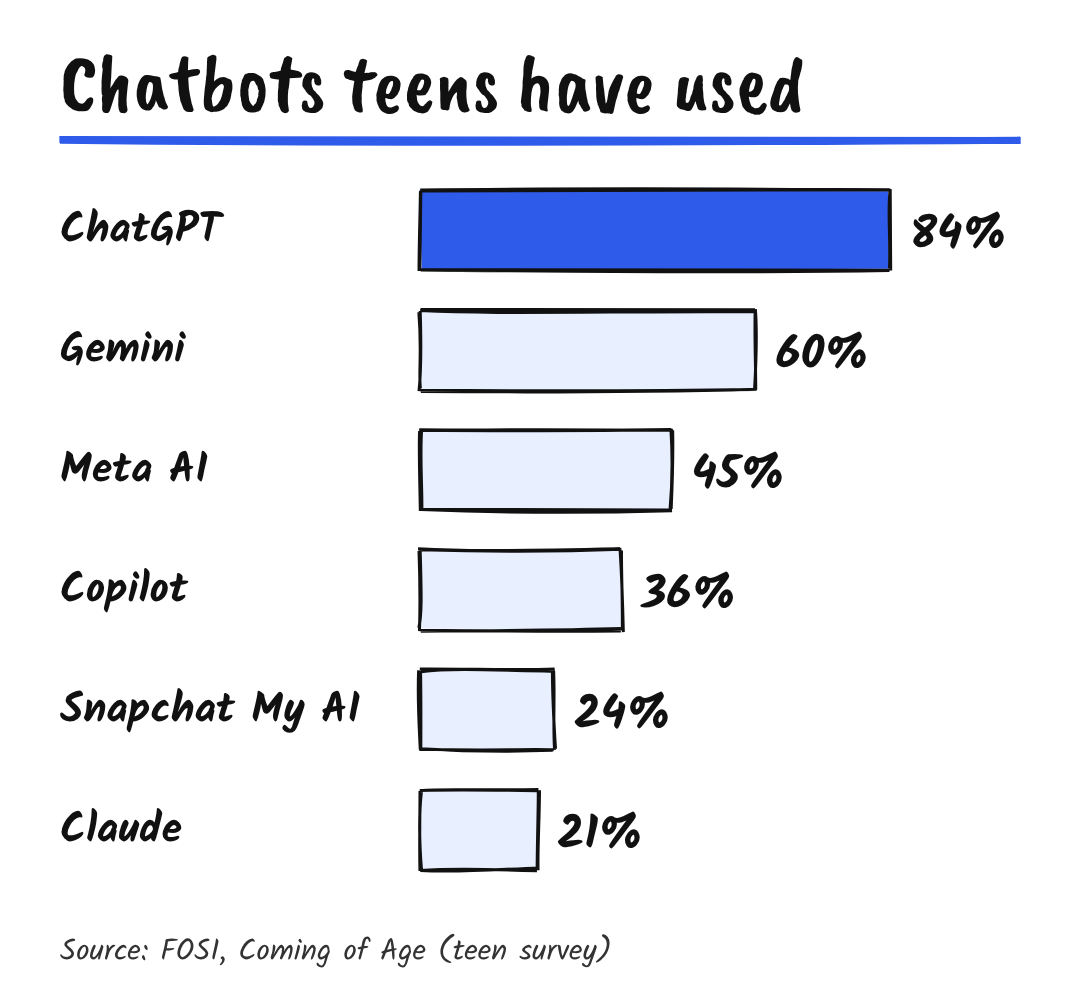
Parents and teens line up closely on the whole list, even though they weren’t matched. Parents put Gemini at 55%, Meta AI at 39% and Copilot at 29%. Snapchat My AI is at 24% in both surveys, Claude at 21% of teens and 17% of parents, Grok at 18% and 13%, Perplexity at 13% and 11%, and Character.AI at 10% and 9%. Study apps built for schoolwork sit at the bottom: MathGPT at 6%, Photomath at 3% and Gauth at 2%.
Pew’s December 2025 survey put the same top three in the same order among all US teens: ChatGPT at 59%, Gemini at 23% and Meta AI at 20%.
“Most of the time, like 90% of the AI you see are AI chatbots … for example Instagram. Instagram’s Meta AI is embedded inside … your messages and DMs.”
A 17-year-old boy in a FOSI reflection session
What teens use them for
Looking things up comes first: 71% of teens and 78% of parents say teens use chatbots to search for facts. Understanding schoolwork like a tutor is next at 66% of teens. After that come creative projects (51%), brainstorming (49%) and entertainment (43%). Planning trips or meals is at 30% and professional tasks such as drafting an email at 23%.
Social and emotional uses are smaller. Twenty-three per cent of teens practise social skills with a chatbot or chat to it when bored, 16% talk about feelings and 13% use it for friendship or companionship.
Teens name schoolwork as the top benefit (70%), followed by getting tasks done quickly (61%) and creativity (53%). Their most-picked drawback is also about school: 42% worry about being accused of cheating. Thirty-five per cent say it’s hard to know whether an answer is correct. Parents’ top drawback is not knowing where users’ information goes or who can see it.
Forty-six per cent of teens say using a chatbot feels like talking to a human. That rises to 58% of daily users, against 34% of teens who use one less often. FOSI says the study can’t show whether heavy use creates that feeling or whether teens who feel it use chatbots more.
Trust runs high on both sides
Ninety per cent of teens say their parents trust them to use chatbots safely, and 87% of parents say they trust their teen. Teens trust the answers more than their parents do: 75% of teens trust accuracy most or all of the time, against 62% of parents, and 74% trust the answers to be age-appropriate, against 60%. On data, 69% of teens trust platforms to keep their information safe, against 55% of parents.
Talking is already common: 90% of parents say they’ve spoken to their teen about using chatbots safely in the past year, and 85% of teens agree. Eighty-four per cent of teens say they’d be fine with a parent checking their chat history.
Families lean on rules and conversations over controls
Fifty-nine per cent of parents say they’ve set house rules for chatbot use, such as using one for assignments but not to do the work, against 53% of teens. Forty-four per cent of parents say they use built-in safety features or parental controls, and 35% of teens say their parents do. Fifty-two per cent of parents and 48% of teens say no controls are set up.
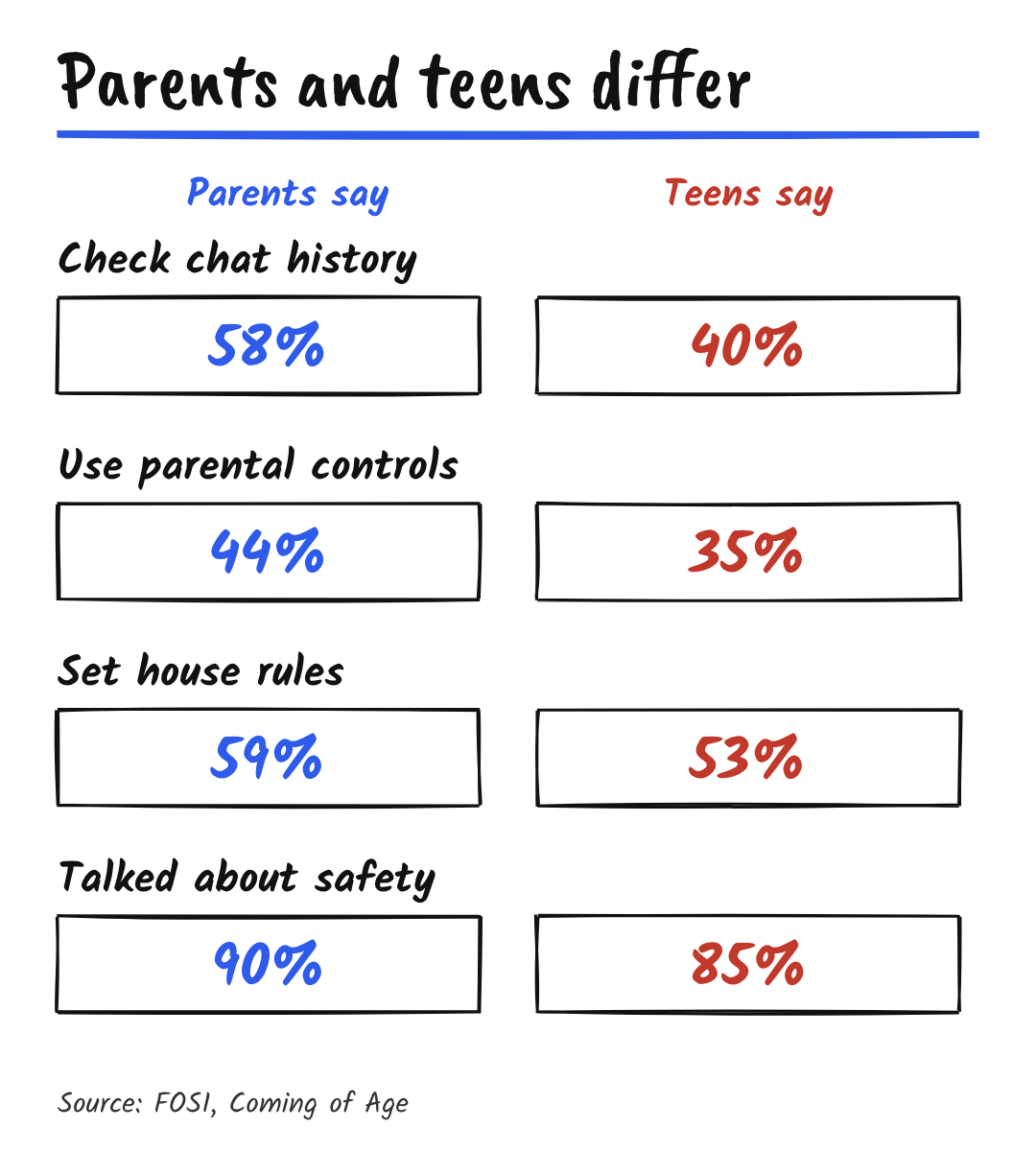
Parents of 13 and 14-year-olds are more likely to use controls (53%) than parents of 15 to 17-year-olds (39%), and Gen Z and Millennial parents (50%) more than Gen X and Baby Boomer parents (38%). FOSI notes the control figure may include broader tools such as Google Family Link, which carries time limits across many apps, chatbots included.
Plenty of parents also look. Fifty-eight per cent say they check their teen’s chat history, while 40% of teens say their parents do. It’s 67% for parents of 13 and 14-year-olds and 51% for parents of older teens. Thirty-nine per cent of teens share at least one chatbot account with a parent.
Who is responsible for chatbot safety
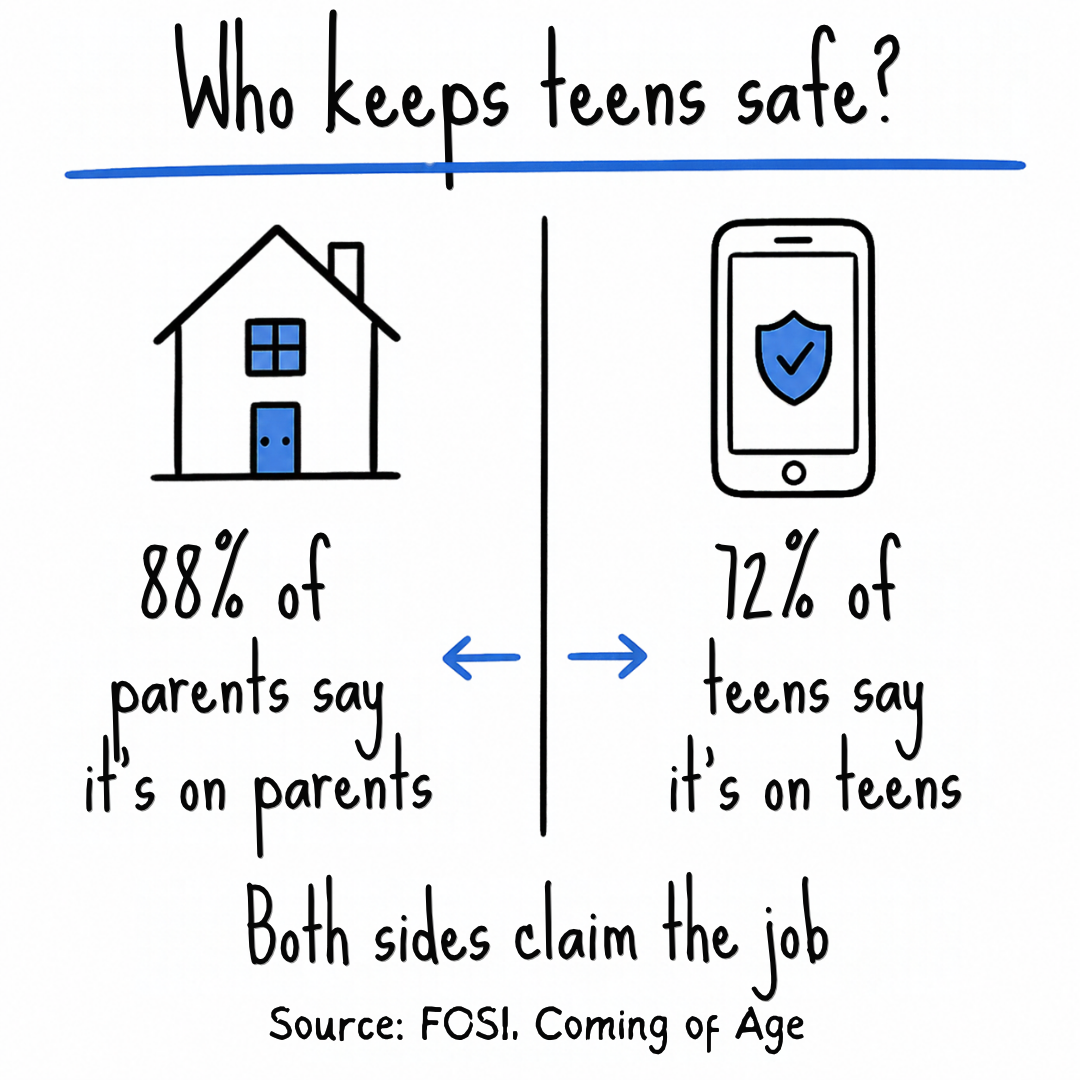
Both sides claim the job. Eighty-eight per cent of parents say parents are responsible for their teen’s chatbot safety, and 68% of teens agree. Seventy-two per cent of teens say they’re responsible themselves, and 53% of parents agree. Forty-three per cent of parents and 32% of teens say chatbot or tech companies are responsible.
The safety tools both sides want
FOSI listed six possible tools and asked parents whether each would help them and their teen, and teens whether each would help people their age. Majorities of both said yes to all six.
| Tool | Parents say helpful | Teens say helpful |
|---|---|---|
| Red flag alerts to parents on a concerning question | 89% | 81% |
| Content filters on chatbot answers | 86% | 78% |
| Monthly usage report for teen and parent | 85% | 72% |
| Helpline referrals on a concerning question | 82% | 79% |
| Reminders that a chatbot is a computer | 82% | 73% |
| Time limits like screen time | 77% | 66% |
FOSI says the ratings show where families want tools built, not that the tools work.
What the chatbot makers already offer
Teen settings vary across the chatbots in the survey.
- OpenAI. Parental controls launched on 29 September 2025, letting a parent link an account to their teen’s, set quiet hours and receive safety notifications. Age prediction began rolling out in January 2026 to place likely under-18 accounts in a teen experience. ChatGPT for Teens, introduced on 18 August 2026, applies the protections by default and adds break reminders. Parental controls don’t give parents access to a teen’s conversations.
- Meta. Meta announced parental controls for teen AI chats in October 2025. It has since paused teens’ access to its AI characters while it builds a new version, and teens still have Meta’s AI assistant with age-appropriate protections.
- Character.AI. It began removing open-ended chat for under-18 users in the US from 24 November 2025.
- Anthropic. Claude is only available to people over 18, and Anthropic disables accounts that show signs of minor use. FOSI found 21% of teens in its survey had used Claude anyway, and lists it among platforms not designed for under-18s.
FOSI says teens who sign up with their real age get teen protections that a teen borrowing an adult’s account doesn’t, which matters when so many families share accounts.
What FOSI recommends
For parents, the report says to talk early and often, set clear house rules for schoolwork, learn the school’s AI policy, check which platforms allow under-18s and what teen tools they have, and look at the controls already available. Sarah Bean, FOSI’s director of research and programmes, said in the release:
“As AI begins to impact teens’ schoolwork, everyday activities, and future careers, it’s important for parents to keep the lines of communication open and educate themselves on the benefits and limitations of this new technology.”
Sarah Bean, FOSI
For industry, it asks for safety tools that don’t lean on parents’ sense of responsibility, clear reminders that a chatbot isn’t human, answers that acknowledge uncertainty, and protections that work for teens without a parent involved. It also asks companies to test whether alerts produce false alarms or miss real concerns.
Sources: FOSI, Coming of Age (2026), Pew Research Center, Teens, Social Media and AI Chatbots 2025, OpenAI, Meta, Character.AI, Anthropic.
Disclosure: I’m an OpenAI, Firecrawl and Devin ambassador.
Correction, 29 November 2026: An earlier version described the parents surveyed as chatbot users. Parents qualified by reporting their teen’s recent chatbot use. The 51% daily-use figure refers to the study’s teen chatbot users, not all US teens.