Huawei has launched a second driving brand, Xingchi, for plain Level 2 assisted driving, and says more than 10 cars will carry it in 2027. Jin Yuzhi, a Huawei senior vice president and chief executive of Yinwang, which sells Huawei’s Qiankun driving technology, announced it at the Huawei Qiankun ecosystem conference in Guangzhou (see Huawei’s release).
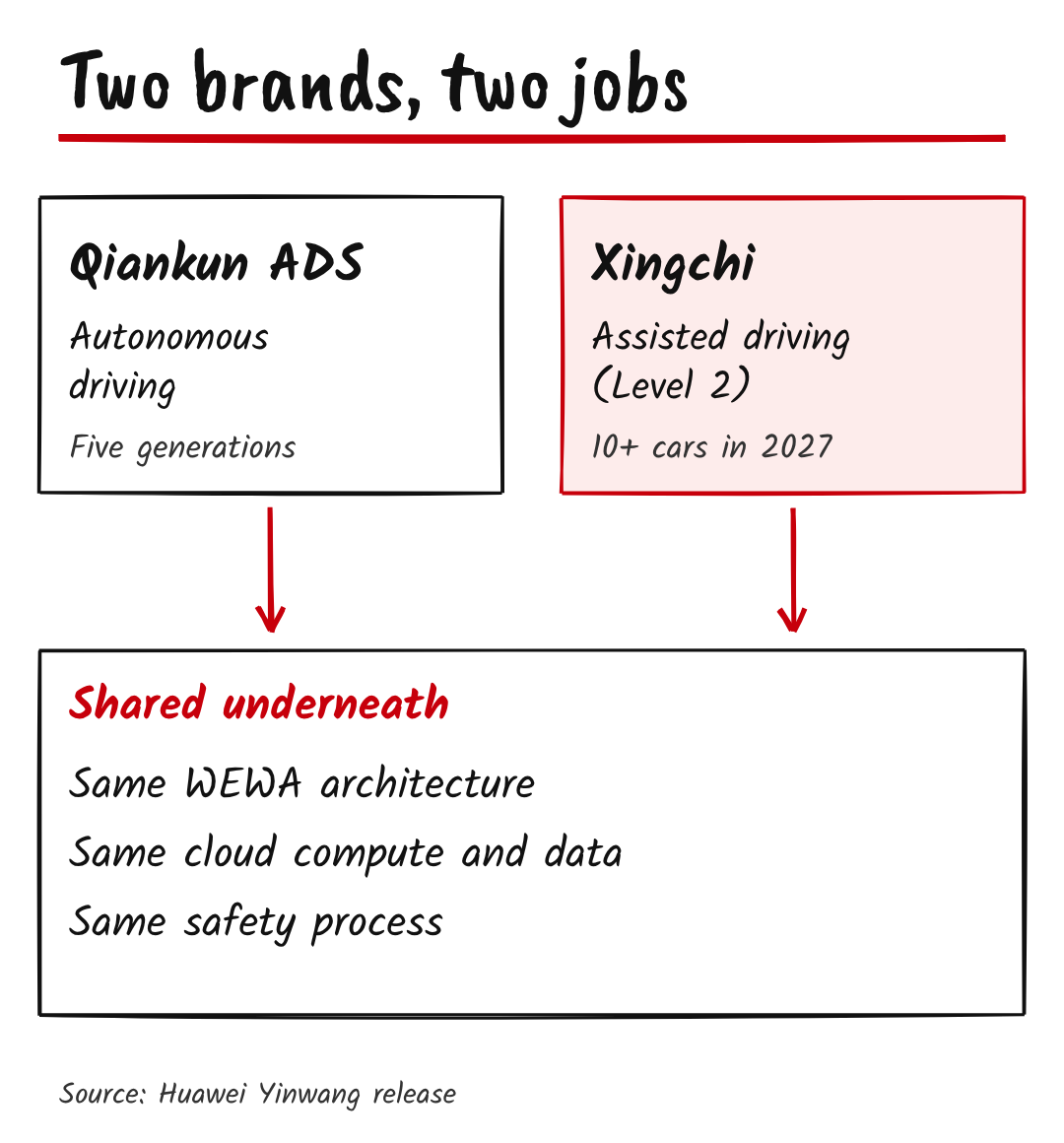
Qiankun ADS, the name behind Huawei’s city-driving systems since 2022, now points toward autonomous driving. Xingchi takes the assisted driving that Huawei expects people to keep buying, and it runs on the same architecture, cloud compute and data.
What Huawei announced
Huawei says demand for L2 assisted driving will last, and Xingchi is its answer to it. Both use the WEWA architecture, a world engine in the cloud plus a world behaviour model in the car, and share cloud training compute, data, the development process and the automotive-grade quality system. Huawei says the two will differ in features and experience, while safety algorithms, stability and reliability stay the same.
Gasgoo reports that the first Xingchi partners are Deepal, SAIC-GM-Wuling, GAC Trumpchi, Arcfox and Dongfeng eπ, and that specific parameters arrive in 2027. Huawei’s own release doesn’t name partners.
Huawei backs the launch with its own numbers. Qiankun ADS is in more than 2 million cars from 26 brands and over 60 models, and those cars have covered more than 18.3 billion kilometres of assisted driving. Citing the China Association of Automobile Manufacturers it says ADS went into more than 500,000 new cars in the first three quarters, the biggest share of city navigation-assisted driving. Huawei also publishes monthly safety figures. Its October report, covered by Gasgoo, put the average at 10.8 million kilometres under ADS control between severe collisions, against its estimate of 1.8 million for human drivers in China. Those are Huawei’s own measures, not an independent test.
Why assisted driving is now ordinary
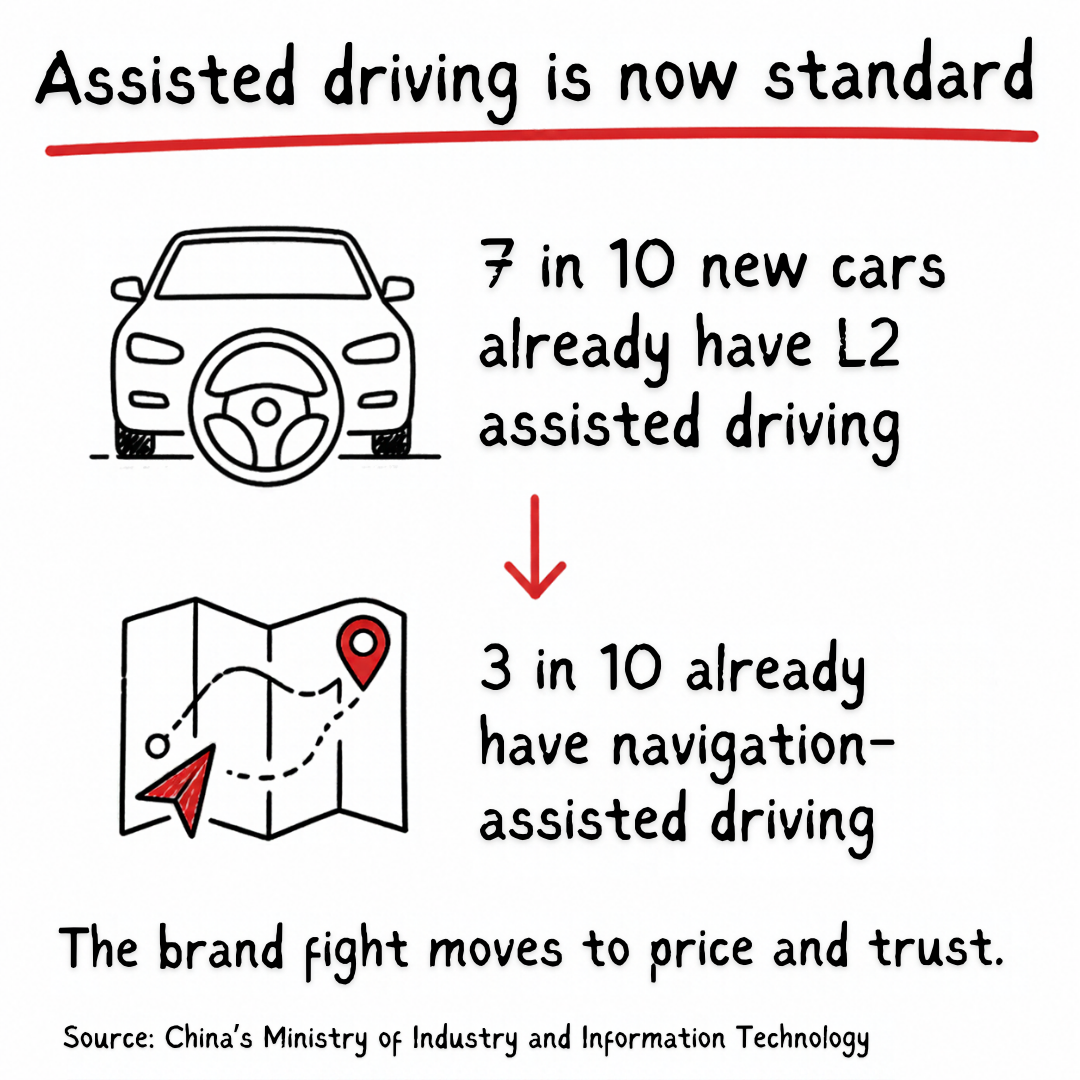
China’s industry ministry says about 70% of new passenger cars sold this year have combined driver assistance and more than 30% have navigation-assisted driving (Xinhua). Gasgoo Research counts 73.6% penetration of L2 and above in August, with the L2++ cars that handle highway and city navigation at 545,000 for the month. Its user survey found drivers largely unfamiliar with the newer features (Gasgoo).
Rules are tightening. China’s first mandatory standard for combined driver assistance, GB 47955-2026, covers basic single-lane, basic multi-lane and navigation-assisted systems, and takes effect on 1 January 2027 (Xinhua). Huawei says Yinwang was a core drafter (Huawei). A second mandatory standard, for L3 and L4 automated driving systems, takes effect on 1 July 2027, which is the date Huawei ties to Qiankun ADS moving toward autonomous driving.
Where Huawei sits against its rivals
| Player | What it is | Scale, by its own report |
|---|---|---|
| Huawei | Supplier to carmakers, Qiankun ADS and now Xingchi | More than 2 million cars, 26 brands, 60+ models |
| BYD | Carmaker’s own God’s Eye system | More than 3.3 million assisted-driving cars on the road at the end of June |
| Momenta | Independent software supplier | 26 carmaker customers, 105 models, over 1 million cumulative installs |
| Horizon Robotics | Chips plus its HSD driving software | Nearly 130 advanced navigation-assist design wins |
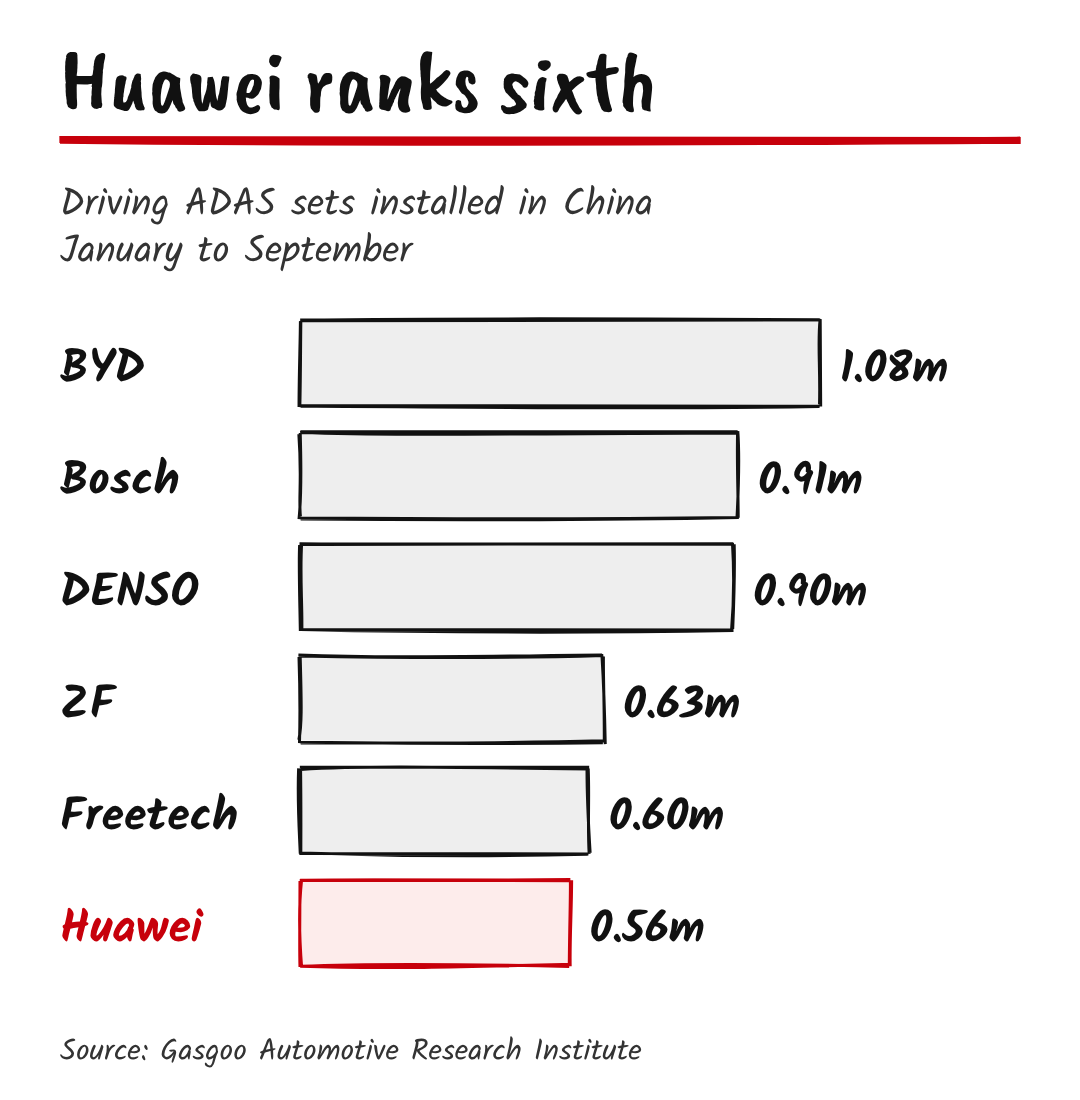
Gasgoo Automotive Research Institute’s January to September ranking of driving ADAS suppliers in China puts BYD first at about 1.08 million sets installed, then Bosch, DENSO, ZF and Freetech, with Huawei sixth at about 564,000 sets and a 5.5% share. Gasgoo takes BYD’s lead as a sign that carmakers’ in-house systems are getting stronger.
BYD’s God’s Eye system has more than 3.3 million assisted-driving cars on the road, and in May BYD said its whole lineup could be ordered with the lidar version (BYD). Momenta, which listed in Hong Kong in July, reports 26 carmaker customers, 105 models, 321,000 new installs in the first half, up 83.7%, and revenue of about RMB1.6 billion, up 75.9% (interim report). Horizon Robotics, which sells chips and its HSD software, reports nearly 130 design wins in advanced navigation assist and more than 88% of HSD users active (interim report).
Gasgoo’s view is that Xingchi sets Yinwang against Horizon and Momenta in the bigger assisted-driving market.
How Huawei got here
In Huawei’s own account, ADS 1 brought commercial city assisted driving in 2022, ADS 2 went nationwide in 2023, ADS 3 added parking-to-parking in 2024, ADS 4 introduced WEWA in 2025, and ADS 5 this year improved complex-scene and defensive driving. Gasgoo notes the first million cars took 44 months and the second took 12. Jin has said repeatedly that Yinwang is an “electronic screw” supplier and not a carmaker, and Xingchi extends that pitch to cars in more price segments.
What Huawei hasn’t said
Huawei hasn’t published Xingchi’s hardware, feature list or price. Gasgoo reports the details arrive in 2027, when the first of the more than 10 cars launch.