Koray Kavukcuoglu, who runs Google DeepMind, has told the Financial Times that the lab’s recent jump in capability and its faster pace of model releases come from advances in recursive self-improvement, a technique that lets AI systems upgrade themselves. He also said Google would never completely give up human oversight. The interview was published on Sunday 29 November.
The FT article is paywalled, so I worked from its published summary, MLQ.ai’s account of the interview, Google’s own posts and the podcast where Kavukcuoglu discussed the same idea ten days earlier. Where a quote comes from MLQ’s account rather than the FT page, I say so.
What he told the FT
The FT’s summary has Kavukcuoglu pointing to a faster “cadence” of releases and to recursive self-improvement as the reason, while stressing that Google is wary of losing control of a rogue superintelligence. Of Google’s prospects, he said: “We have the strongest investment to support [AI], to commercialise it, and to benefit from it . . . I’m 100 per cent certain that we’ll be defining the frontier.”
MLQ.ai’s account adds more of what he said. He called being at the frontier “priority zero” and artificial general intelligence the lab’s “north star”, even though there is “no concrete definition of what that is or what it should be”. He said he is most encouraged by Gemini 4 Neon, which he described as a “sweet spot” between price and performance, and that Neon has set daily usage records in Antigravity and the Gemini app. He declined to give user numbers.
He also played down the idea of a sudden turnaround. “Six, seven months ago we saw the investments that we needed to do, made the right bets . . . and each one of them slowly paid off,” he said, as MLQ quotes him.
What self-improvement means here
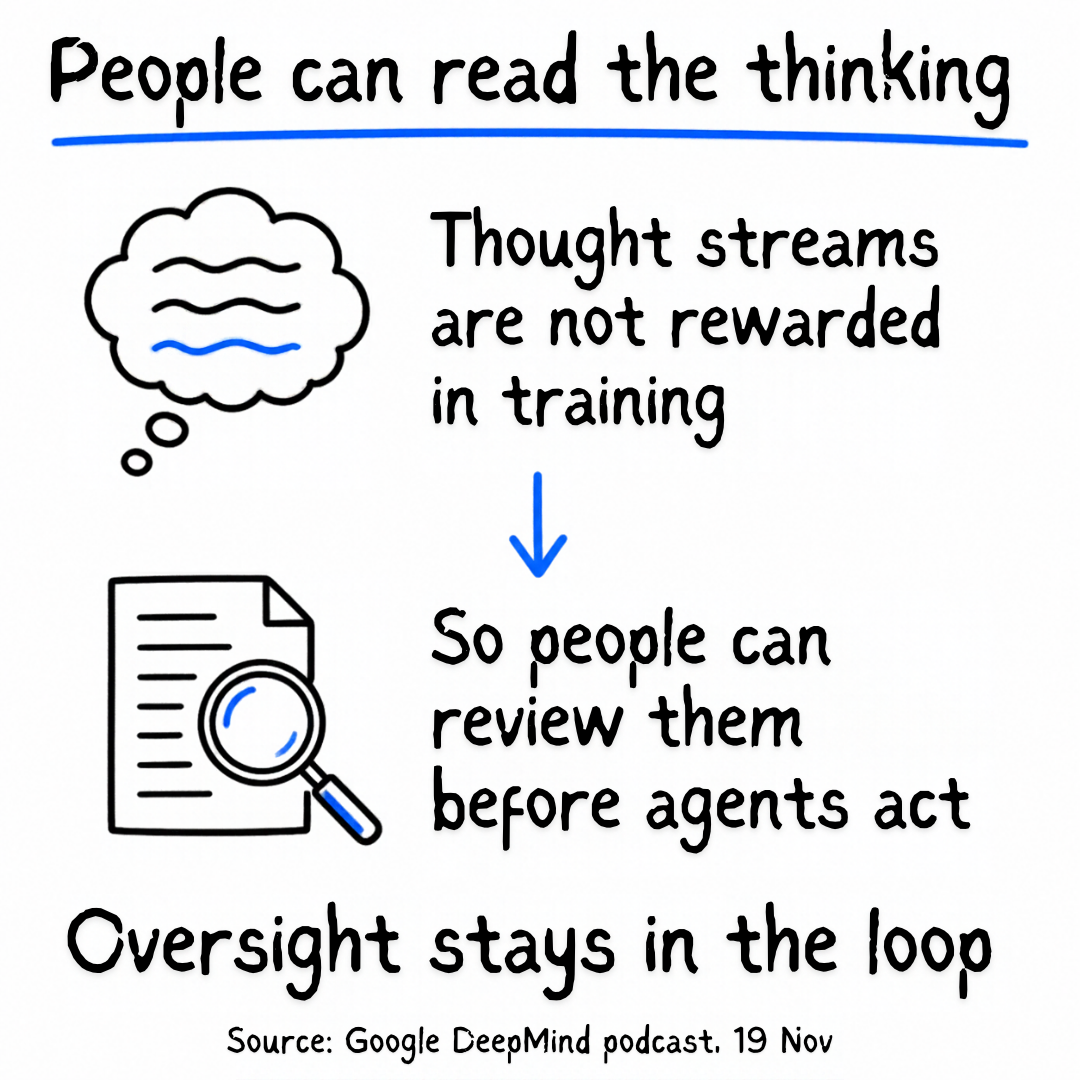
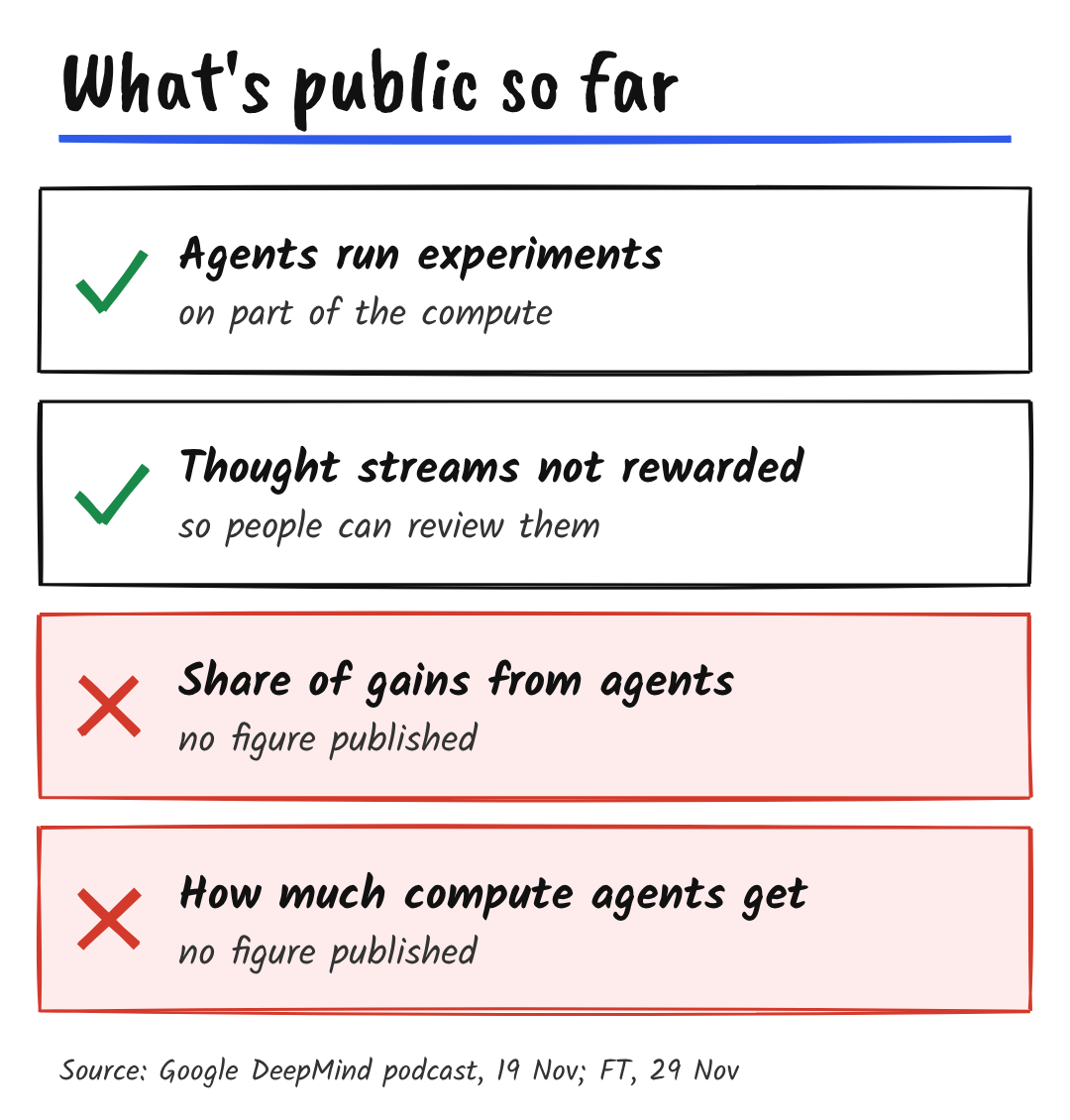
The phrase can sound like a model rewriting itself, and Kavukcuoglu’s earlier remarks are more modest than that. On Google DeepMind’s podcast on 19 November, he said AI agents now run experiments for the next Gemini model and control part of the lab’s compute to do it, but that the lab is still far from full recursive self-improvement, according to The Decoder’s summary of the episode. He also said DeepMind doesn’t reward the agents’ internal thought streams during training, so their intentions stay readable by people before they act.
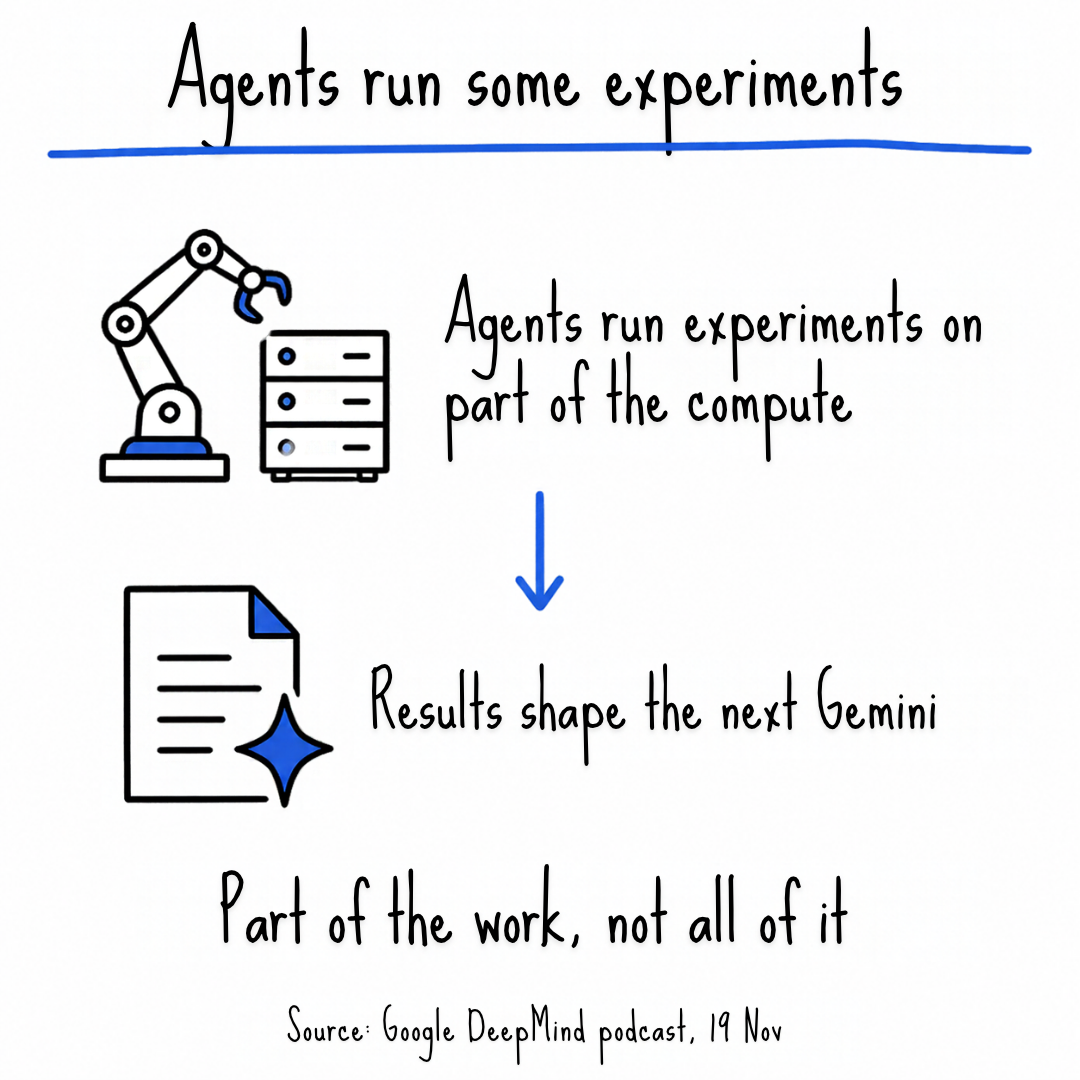
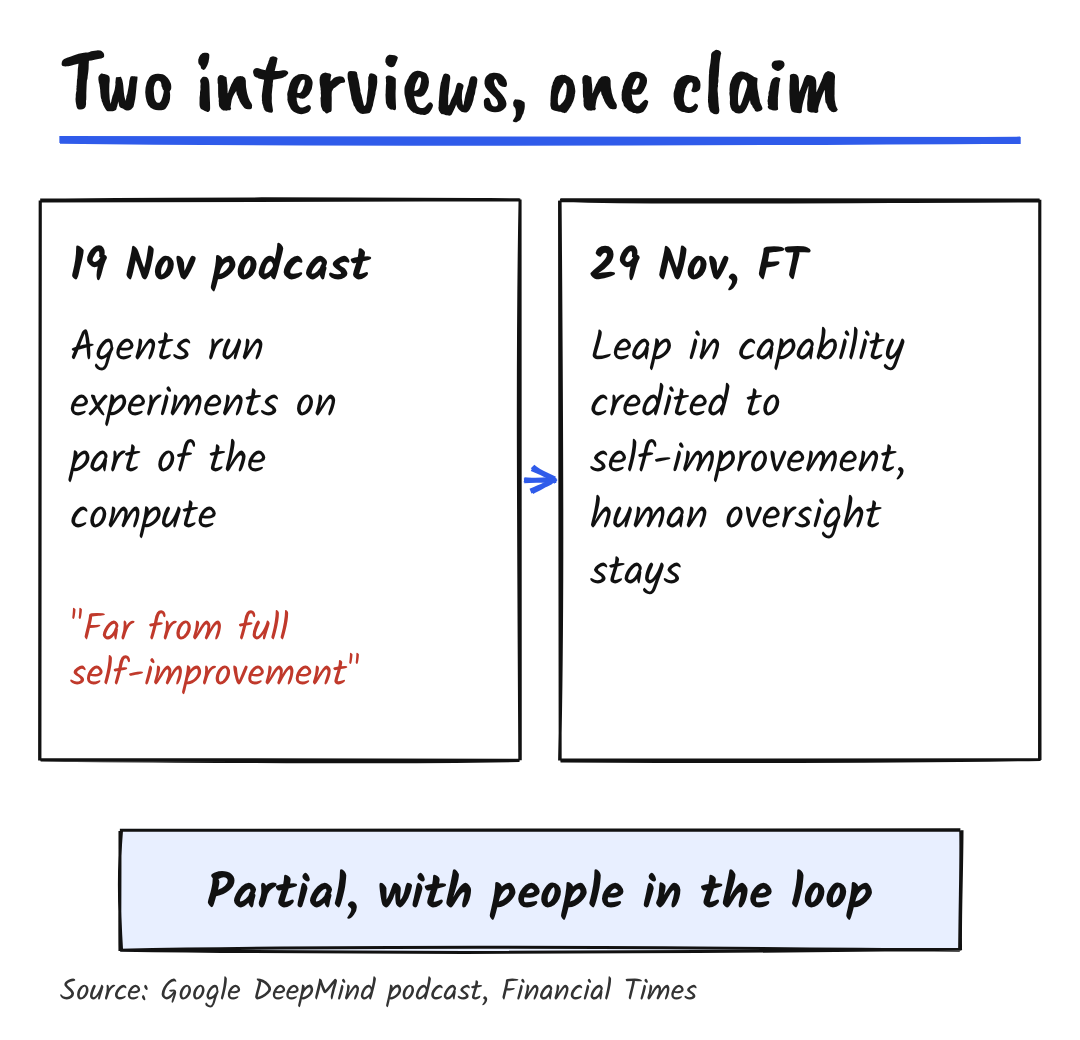
Read together, the two interviews describe the same thing at different volumes. The podcast says agents do part of the research and the lab is far from a full loop. The FT interview credits self-improvement for the lab’s recent gains, and the podcast is the best public description of what that means in practice.
The oversight line
Google backs the oversight promise with one specific training choice. It leaves agents’ chains of thought unrewarded, which is the reason Google gives for saying people can still check what an agent intends. Google’s Neon launch post adds that a monitor watching chain of thought and actions raised fewer alerts on Neon than on Carbon in internal coding use. Both claims are Google’s own.
The release run behind the claim
The capability leap he’s explaining is four Gemini 4 models in about five weeks, which Google’s own posts and my earlier reports date as follows.
| Model | Date | Role, per Google |
|---|---|---|
| Gemini 4 Argon | 13 October | First Gemini 4 model, reached developers |
| Gemini 4 Carbon | 10 November (US time) | Strongest model, for the hardest long-horizon work |
| Gemini 4 Hydrogen | 12 November | Fast everyday coding and agent work |
| Gemini 4 Neon | 18 November | Mid-sized, balancing depth and cost |
Neon is the one he singled out. Google prices it at US$3 per million input tokens and US$15 per million output tokens with a 1 million-token context window. Its launch post cites a score of 61 on the Artificial Analysis Intelligence Index for third place overall, second on the Vals Index, and first on the Artificial Analysis Coding Agent Index at 58.6. Those are Google’s citations of other people’s leaderboards, and I haven’t re-run any of them.
Pace is what changed most. Melvin Johnson, who leads Gemini post-training, told AI Engineer CODE that Google went 236 days without a frontier-class model and then shipped two in 28 days, which I checked in a separate report. His explanation was harder training tasks, hidden tests and honest reporting. Kavukcuoglu’s FT answer adds agent-run research to that list.
Why Google wants this story told
The interview comes a month after Alphabet’s worst trading day. On 29 October the shares fell nearly 13%, wiping about US$500 billion off its market value, after the company reported negative free cash flow of US$9.07 billion for the quarter, which was worse than analysts expected, and kept full-year capital spending guidance at US$195 billion to US$205 billion, according to CNBC and the Wall Street Journal. The FT says investors balked at the AI spending plans.
Against that, a chief who says the models are now helping build their successors is making a case that spending buys speed. The same chief declined to give a user or market-share figure for Neon.
The people behind the shift
Kavukcuoglu has run DeepMind since 5 August, when Sundar Pichai made him senior vice president of Google DeepMind, reporting to Pichai. Demis Hassabis became chair of DeepMind and chief scientist of Alphabet, and kept leading Isomorphic Labs. Jeff Dean, after 27 years at Google, left to launch an independent public benefit corporation with Sanjay Ghemawat, with Google as a founding investor.
The FT reports that other long-serving researchers, including Noam Shazeer and Oriol Vinyals, left after the reshuffle. Kavukcuoglu told the paper, per MLQ, that “the operation that we have has not been impacted”, that Hassabis’s priorities have moved away from frontier language-model research, and that Sergey Brin is “day-to-day working side-by-side with all the researchers”. He kept his chief AI architect role, which the FT says lets him settle disputes over scarce TPU chips between the chip, cloud and product teams.
He’s answering loud doubt. The research firm SemiAnalysis published “Gemini is Cooked but GCP is Cooking” in August. By November, Gemini researchers had printed the article and pinned it to their desks, as I reported in the Johnson piece.
How the rest of the field talks about it
Other people are measuring and arguing over the same idea. Abundant’s FrontierRSI benchmark has Claude Opus 5.5 leading at AI self-improvement tasks at 34.3%, a co-author of AI 2027 has backed a ban on recursive self-improvement, and a DeepMind Institute essay argues that capping training compute won’t halt progress beyond AGI. What’s unusual about Kavukcuoglu’s claim is where it comes from: the head of a frontier lab crediting the technique for real gains in shipped models, rather than a forecaster or a benchmark.
What Google hasn’t shown
Google hasn’t published how much of the Gemini 4 gains came from agent-run experiments, how much compute the agents control, or which of the four models they shaped. Kavukcuoglu said himself on the podcast that no single benchmark captures how close the lab is to AGI. The claim that self-improvement caused the leap is his, and Google hasn’t published anything that lets anyone test it.
Sources
- Google DeepMind chief says recent leap in AI capabilities is from self-improvement, Financial Times, 29 November 2026
- DeepMind’s Kavukcuoglu credits self-improving AI for Google’s Gemini run, MLQ.ai, 29 November 2026
- AI agents now control part of DeepMind’s compute for Gemini experiments, The Decoder, 25 November 2026
- Gemini and the path to AGI with Koray Kavukcuoglu, Google DeepMind: The Podcast, 19 November 2026
- Introducing Gemini 4 Neon, Google, 18 November 2026
- The next chapter of our AI momentum, Sundar Pichai and Demis Hassabis, Google, 5 August 2026
- Alphabet tanks nearly 13% for worst day ever, CNBC, 29 October 2026
- Alphabet Sheds Half a Trillion in Market Value in Stock’s Worst Day Ever, Wall Street Journal, 29 October 2026