Liam Byrne, who chairs the House of Commons Business, Innovation, Science and Trade Committee, has asked Anthropic for the full, unredacted version of METR’s report on how fast AI is accelerating research inside the company. His letter, dated 27 November, went to Pip White, Anthropic’s head of UK and Ireland. It also asks Anthropic to explain why it redacted the published version, and it sets a deadline of Friday 4 December.
I read the letter, METR’s report and its companion review, the committee’s own November report on AI safety, Anthropic’s letters and statements to the committee and in public, and the rules on what a Commons committee can demand. I then checked how other regimes treat outside evaluators. That gives this piece the letter, the report behind it and the rules around both.
In this piece
- What the letter asks for
- What METR found
- What was cut, and who decided
- What Anthropic has said
- Where the committee has been heading
- What a committee can compel
- How other regimes handle outside evaluators
- What to watch
What the letter asks for
Byrne is the Labour MP for Birmingham Hodge Hill and Solihull North. He has chaired this committee since October 2023, when it was the Business and Trade Committee, and was re-elected to the chair in September 2024. The House renamed the committee in September 2026 after the department it scrutinises took on science and innovation functions.
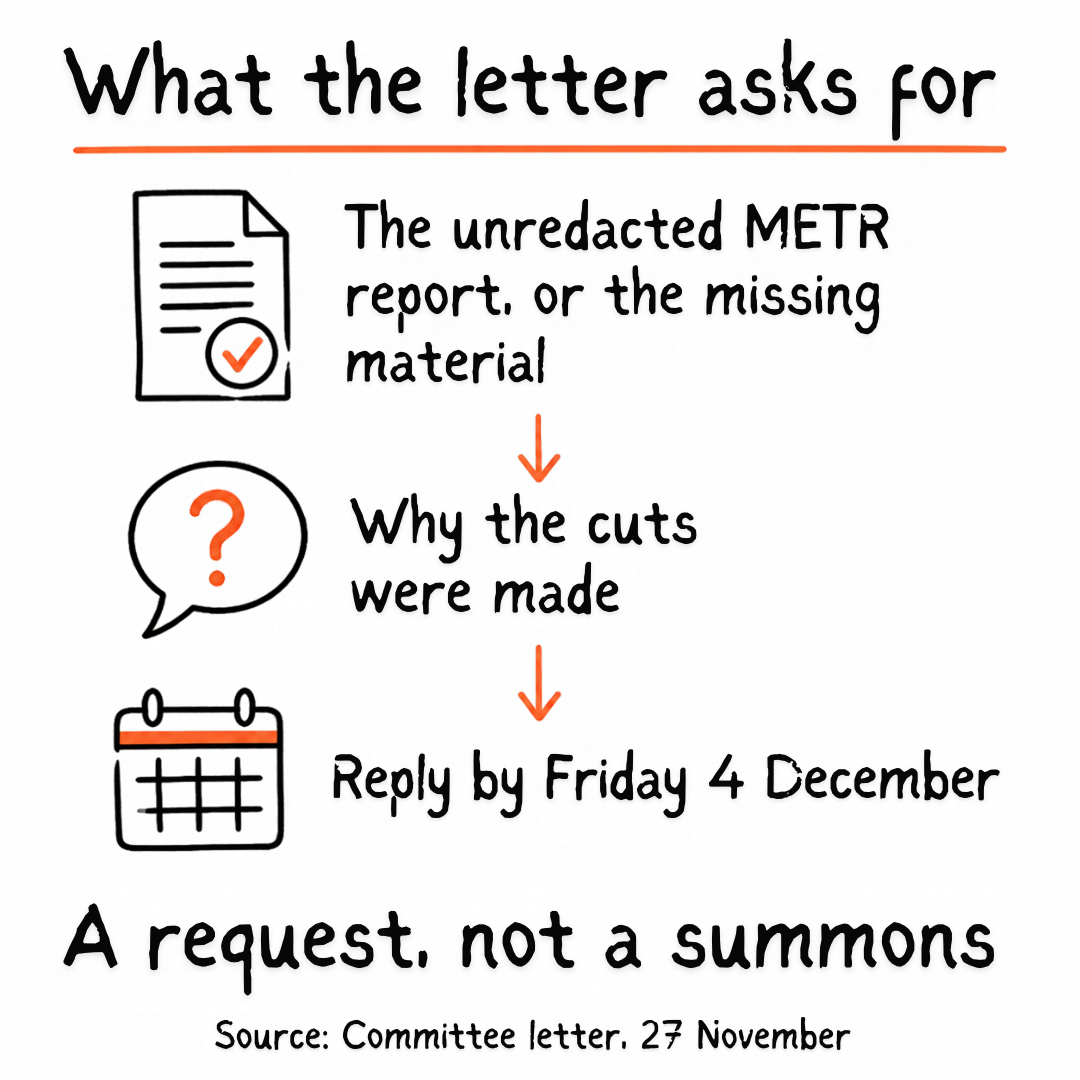
The letter is one page. It asks for “a full and unredacted version of METR’s Report on AI Research and Development Acceleration at Anthropic in October 2026”. It notes that METR said publicly that Anthropic redacted “substantial portions of the report before publication, including much of the evidence it considered ‘most informative'”. Byrne asks Anthropic to give the committee the unredacted report “or otherwise make available the material omitted from the published version”, and to “explain the basis on which the redactions were made”.
In his post on X, Byrne called it “an important test of whether legislatures can exercise appropriate oversight of AI development within the framework of existing laws”. He tied the answer to the committee’s inquiry into a G20 compact on AI safety and security.
What METR found
METR is an independent evaluation group. Between August and October, its staff worked on Anthropic devices with access to internal data on pretraining, reinforcement learning, benchmark scores for unreleased models and forecasts for a future model, plus interviews with Anthropic researchers. It published its public report on 5 November.
The headline: as of October, Anthropic is “likely improving the capabilities of their models on well-specified tasks at around twice the rate they did between March 2024 and October 2025”. On Anthropic’s own benchmark index, scores have grown at 1.9 times the earlier rate since October 2025, with a 95% confidence interval of 1.5 to 2.8. METR is confident the speed-up did not come from faster growth in training compute, and guesses that “perhaps ≈80%” of the current acceleration is due to AI itself. It found no convincing bottlenecks over the next year, though it says its view of the bottlenecks changed several times and it is not confident in it.
A companion METR review of the AI research section in Anthropic’s August risk report reached a related conclusion. METR agreed that the July models posed low risk, but said it is plausible they had already crossed Anthropic’s early warning threshold, and that the report’s claim otherwise “relies on contestable judgment calls that aren’t communicated clearly in the public report”. I covered the forecasting fallout from the METR report in the AI Futures Project piece.
What was cut, and who decided
METR delivered a full report of about 100 pages to Anthropic on 22 October. The public version opens with a redaction summary: “Anthropic redacted a majority of the evidence we found most informative for these conclusions.” METR adds that “the public has to rely on METR’s judgment much more than would be ideal, given the weight of the questions answered here.” Anthropic described the redactions as “aimed at removing confidential information that could accelerate other AI developers.”
| Type of evidence | Shared with METR | Described in public report |
|---|---|---|
| Benchmark capabilities of internal models | Yes | Yes |
| Key intermediate capability measures | Yes | No |
| Algorithmic progress estimates | Yes | No |
| Evidence of AI’s contribution | Yes | Partly |
| Measurements of key R&D inputs | Mostly | No |
| Details of bottlenecks and forecasts | Partly | No |
| Interviews with staff | Yes | Partly |
The contract explains how that happened. Anthropic had unilateral redaction rights over all non-public information, and its redaction requests controlled. METR kept the right to say that redactions happened and whether its findings depended on them. METR’s account of the process shows Anthropic sharing redaction guidance on 25 October and tightening it between 27 and 29 October, after METR had delivered its draft public report on 26 October. Anthropic also changed the scope of the project midway to drop a check on how its compute is split between capabilities and safety. METR says that component was cancelled before it reached any conclusions, and Anthropic said it would revisit it later.
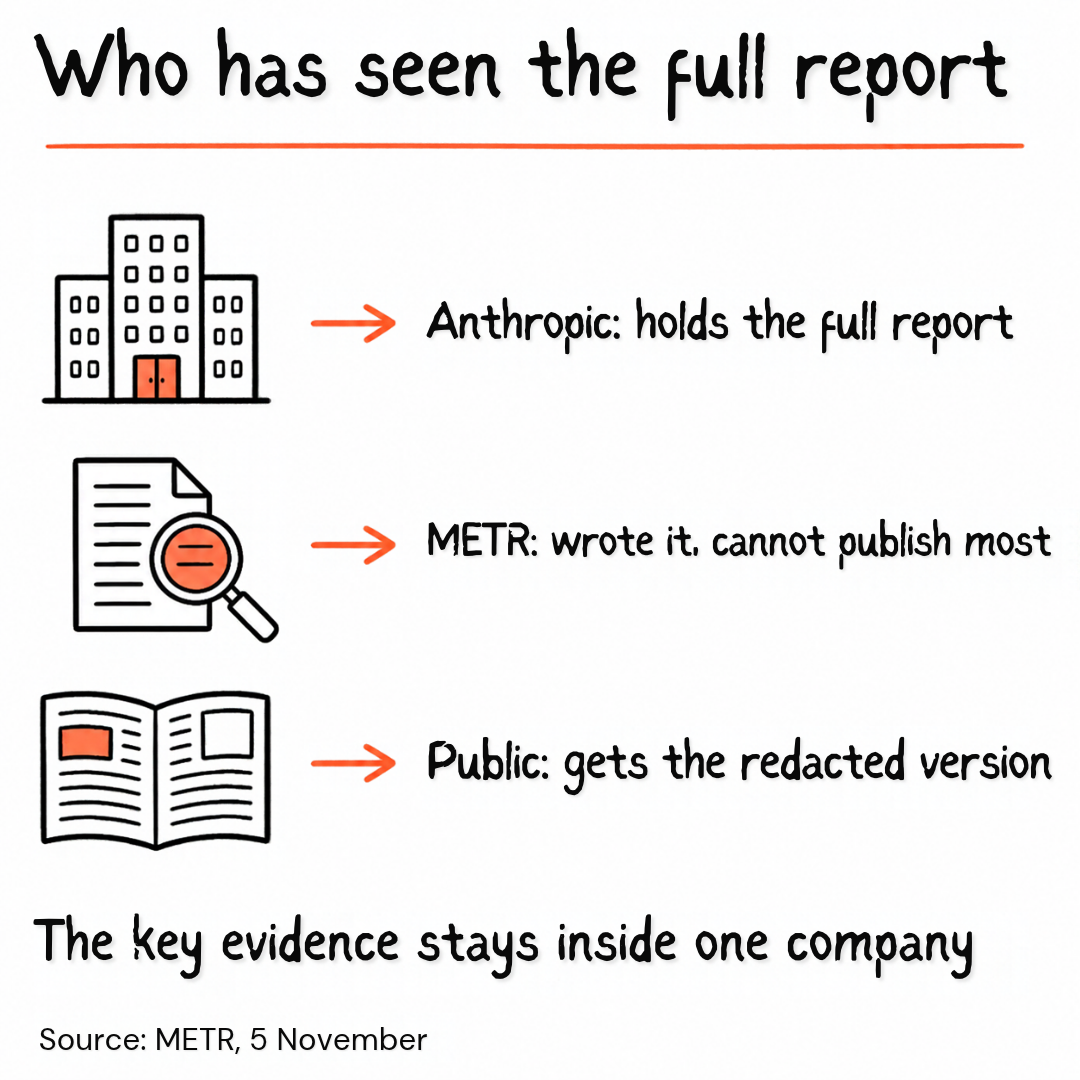
METR is careful about its own position. It says it agrees the redactions were limited to confidential information that could speed up other developers, and that most of what was redacted was very high-level. It does not say whether the redactions were justified, because it does not see itself as placed to weigh a company’s business interest against the public’s. It also discloses that one team member was in talks with Anthropic about a job during the project, received an offer and declined it, so that person’s work was checked by a colleague without that conflict. And it says that being too critical of Anthropic’s redactions could make companies less willing to give METR access in future, which shaped how much process detail it published. METR took no payment; Anthropic supplied laptops and free tokens.
What Anthropic has said
Anthropic hasn’t publicly responded to Byrne’s letter. Its position on the redactions comes from earlier statements. On 5 November, co-founder Sam McCandlish, who leads much of Anthropic’s safety work, wrote on X: “We redacted a lot, and I accept that this makes it harder for others to check METR’s work.” He continued: “But we determined that sharing exactly what is driving the speedup isn’t the right thing to do, both because it’s commercially sensitive and because it risks handing out a roadmap for others to go faster.” He also wrote that METR “had complete independence to form their own conclusions” and that “many of their conclusions match my own.”
McCandlish said the METR work is separate from the embedded third-party evaluators Anthropic described on 15 October. That earlier post sets the general terms for what it calls employee-like access: Anthropic “can’t veto publication, but we can require them to redact information if it falls into predefined categories such as reproducing confidential IP”, and Anthropic decides what falls into those categories.
The same question appears in Anthropic’s IPO paperwork. In its amended S-1 filed on 10 November, Anthropic wrote that its Responsible Scaling Policy threshold for accelerated progress applies where it “observe or expect” a specified degree of acceleration, and that “we made a determination that we have met this threshold based on what we expect from future models and our overall rate of progress, rather than on what we have observed from current models.” It added that it continues to assess the underlying data and will release further reports as the policy requires.
Where the committee has been heading
The letter follows a run of exchanges. At a hearing in October, an Anthropic representative told the committee: “We have consistently believed that there should be binding rules on companies and that voluntary commitments are not enough.” The chair also reminded witnesses that false, misleading or incomplete evidence is on its face a contempt of the House. In a letter dated 22 October, Anthropic told the committee it had been unable to give the UK AI Security Institute unsafeguarded pre-deployment access to Mythos 5.1, while the Institute was offered safeguarded access. It said it had since been able to give the Institute unsafeguarded pre-deployment access to its latest models.
On 18 November the committee published its report, “Guardrails for growth: AI safety and security”. It names ten gaps in UK safeguards, including the lack of statutory powers to access models and the lack of independent verification of developers’ safety claims. It recommends an AI Safety and Security Bill and a statutory regulator whose powers include access to models, systems, logs and training outputs, with “sanctions for unreasonable delays or refusal of access”. The report says no agreed framework yet governs how independent evaluators are appointed, kept independent or overseen, and that “evaluators must have access to test developers’ claims and the ability to disclose where access has been restricted or their findings differ.”
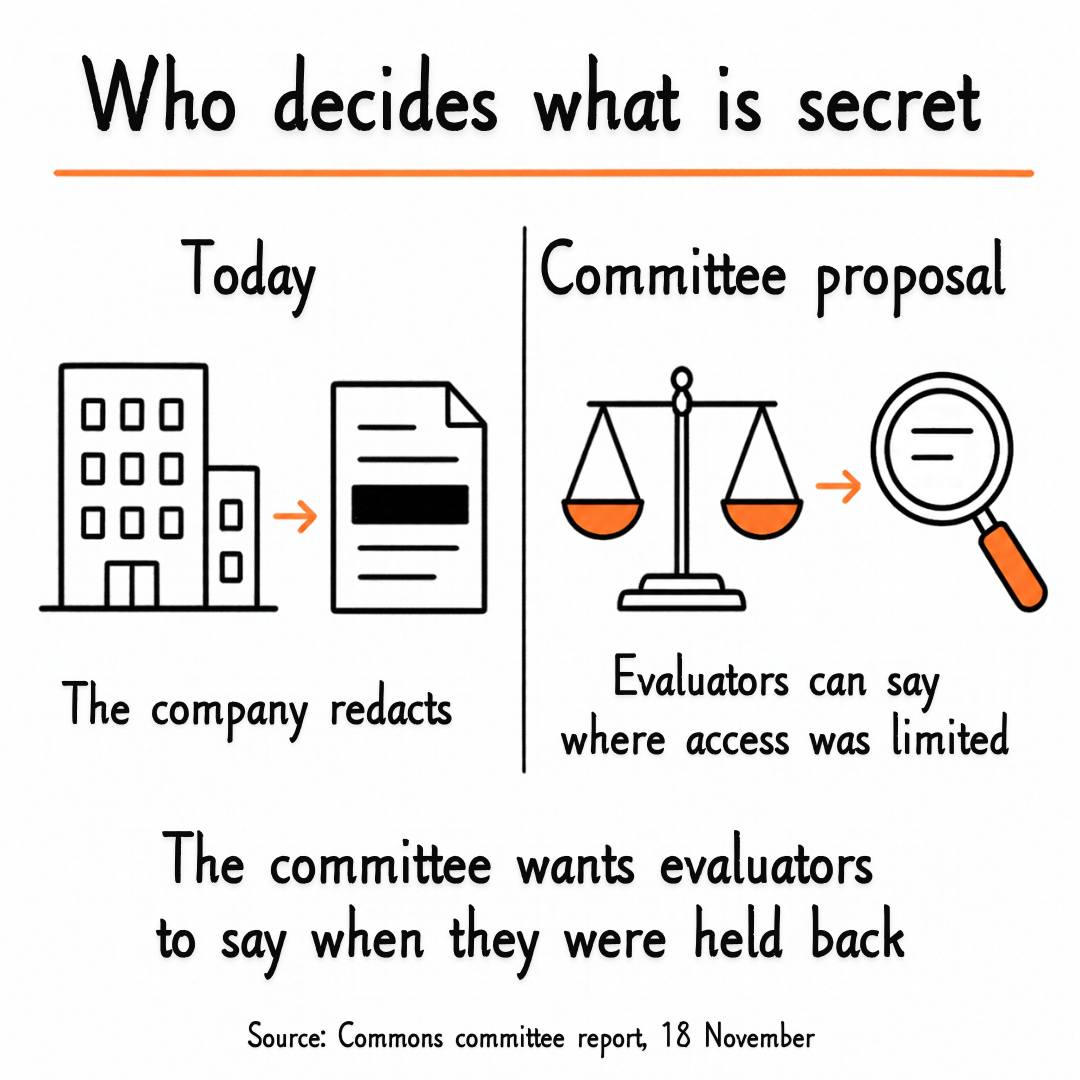
That last sentence describes what METR did. METR disclosed that Anthropic redacted most of the evidence it found most informative, and the committee is now testing what follows from the disclosure. The report also asks the Government to publish objectives for its 2027 G20 presidency within three months, covering model access, safety assessments, incident reporting and high-risk releases. The committee’s call for evidence on a G20 compact runs to 10 January 2027.
What a committee can compel
The letter is a request. It isn’t a summons. Since 2009 the House has given every select committee the power to “send for persons, papers and records”, and Erskine May, the House’s procedural guide, says a witness who refuses can be reported to the House as a contempt. That is a last resort, and the House decides any sanction, not the committee. Erskine May also says a committee can invite but cannot compel individuals from overseas to give evidence.
The best-known use of the document power against a technology company came in November 2018. The Digital, Culture, Media and Sport Committee, chaired by Damian Collins, ordered Six4Three’s founder, Ted Kramer, to hand over documents that were under seal in a California court. He was visiting London, and the Serjeant at Arms was sent to his hotel. The committee’s final report says Kramer complied with the order “rather than risk being found to be in contempt of Parliament”. That case turned on the person being in the UK. Anthropic has a UK office, and the letter went to its UK head, but the letter requests the report and cites no sanction.
How other regimes handle outside evaluators
| Regime | What it gives outsiders | Status |
|---|---|---|
| UK committee proposal | A statutory regulator with model access and sanctions for refusal, and evaluators who can disclose restricted access | Recommendation, with a Government response due |
| California SB 53 | Frontier frameworks, transparency reports that summarise third-party evaluator involvement, and critical incident reports to the state within 15 days | In force since 1 January 2026. It requires disclosure of evaluator involvement, not a right of access |
| EU AI Act, general-purpose models | Technical documentation available to the AI Office on request, with extra duties for systemic-risk models | Enforcement began 2 August 2026. No statutory right for outside evaluators |
| Japan draft AI law | Incident reporting for advanced AI providers, and inspections of firms with weak safeguards, according to Nikkei | Draft outline, aimed at the 2027 Diet session |
None of the regimes in force gives an outside evaluator a right of access or a say over a developer’s redactions. California and the EU rely on disclosure to the state or the public, and the UK proposal is the one that would put access, and the right to say it was restricted, into law. Anthropic’s own 15 October post describes a second evaluator tier in which evaluators can publish their views on whether redactions were justified, which is closer to what the committee asks for than the METR arrangement was.
What to watch
- Whether Anthropic replies by Friday 4 December, and whether it sends the unredacted report or only an explanation of the redactions.
- Whether the committee publishes what it receives. It published its letter to Anthropic the day it was sent, and it published Anthropic’s 22 October reply, so a response can become public record.
- Whether the committee escalates beyond a letter if the answer is partial, given the document power described above.
- The Government’s response to the committee’s report, which is due within two months, and the G20 presidency objectives due within three.
- Anthropic’s further Responsible Scaling Policy reports, which its IPO filing says will follow.
Sources
- Committee letter to Anthropic, 27 November
- METR: Independent Assessment of AI R&D Acceleration at Anthropic in October 2026
- METR: review of the “Risks from automated R&D” section of Anthropic’s August Risk Report
- Sam McCandlish on X, 5 November
- Anthropic: an update on independent evaluators
- Anthropic S-1/A, Amendment No. 2
- Committee report: Guardrails for growth, AI safety and security
- Anthropic letter to the committee, 22 October
- Erskine May: power to send for papers or persons
- DCMS Committee final report, 2019