
Jamieson O’Reilly, a Sydney offensive-security specialist and the founder of Dvuln, released openxor on 28 November. It’s an open-source toolkit for one-time pad encryption and secret sharing, built for the day the maths behind today’s encryption stops holding. He posted it in a long thread that cites the AI-lab cryptography rumours, with the line “Read it, break it, tell me.”
I built openxor from source and ran it. A message went from one vault to another, a changed copy was refused, a replay was refused, and any two of three shards rebuilt a file. This piece covers what the tool does, what the thread claims and what holds up, the rumours behind the timing, and the advice other security people are giving this weekend. It follows my earlier pieces on the factoring rumour and Coinbase’s response.
- What O’Reilly posted
- Why the timing
- ELI12: how a one-time pad works
- How openxor works
- What I ran
- The thread’s claims, checked
- CIRG and the RSA checklist going round
- What it costs
- What to watch
What O’Reilly posted
The thread opens with a framing: “I’m not a doomer, but If P = NP, you should probably download this before the whole internet loses its integrity.” The argument runs in five steps.
- Why now. Since October, AI models at OpenAI and Anthropic have posted machine-checked proofs on questions open for decades, he writes, including a claimed refutation of the Exponential Time Hypothesis and VP ≠ VNP. “Neither has finished human review yet.”
- The rumour. He quotes Scott Aaronson’s 25 November line that the labs are “now sitting on one or more bombshells” in cryptography.
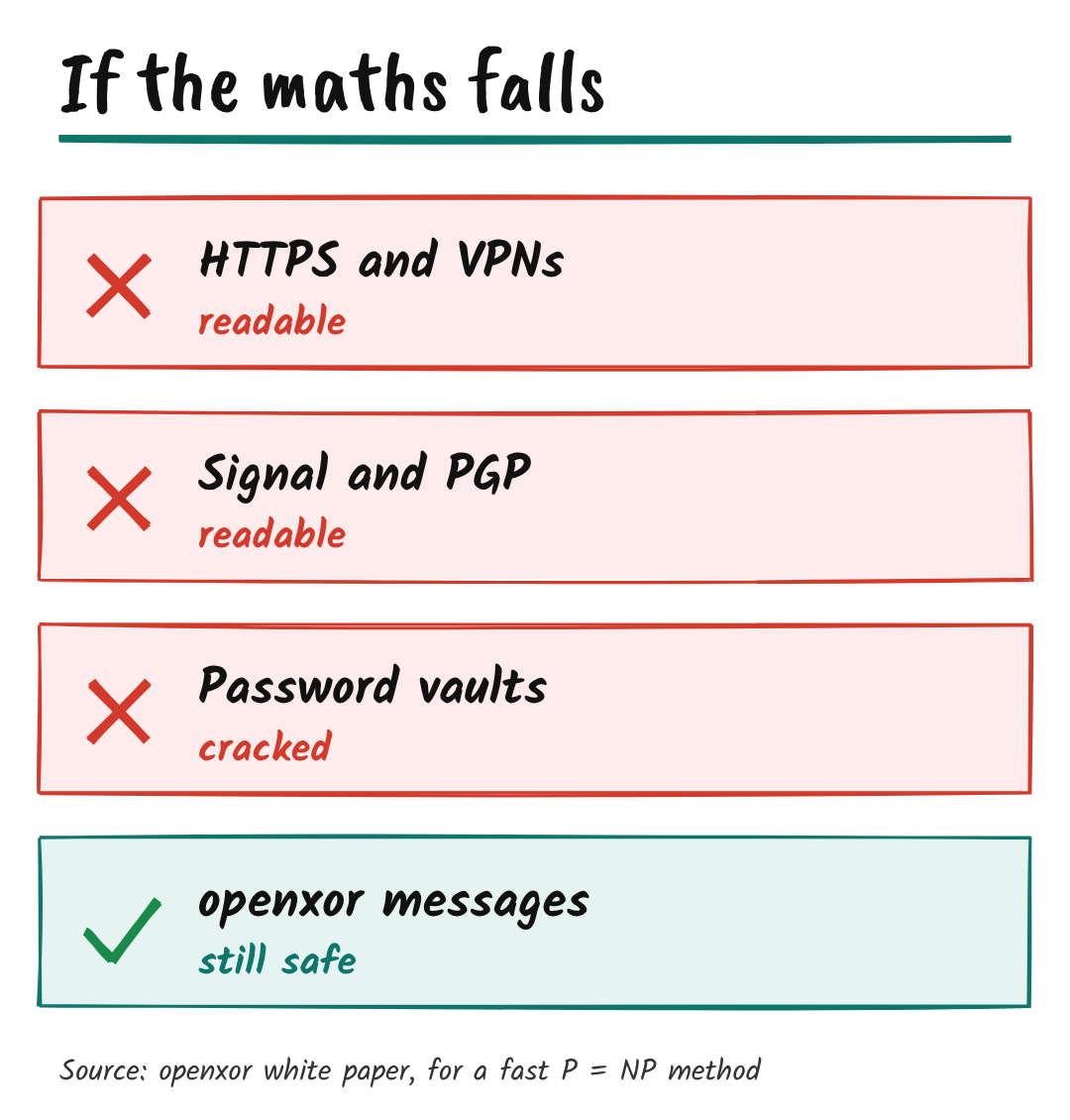
- The point. “Nobody has claimed P = NP. It doesn’t take P = NP: a fast method for the maths under RSA or elliptic curves alone would forge most of today’s certificates and signatures.”
- The fix. “A one-time pad doesn’t care what anyone discovers.” Shannon proved in 1949 that a truly random key as long as the message, never reused, reveals nothing.
- The catch. The pad can’t travel over the internet, so openxor puts it on drives: generate a pair of vaults, hand one over once, then message over anything.
He’s upfront about the limits: openxor isn’t a Signal replacement for everyday chat or a way to hide who you’re talking to, malware on your laptop beats any cipher, and “It’s experimental and not audited yet. The maths is from 1949. The code is new.” His closing philosophy is “don’t wait for the announcement”: if someone is sitting on a break, the first you hear of it may be the break itself, and “If nothing ever comes, it cost a drive and an afternoon.”
O’Reilly’s site describes him as a hacker, advisor and entrepreneur who has run red-team operations against banks, casinos and government agencies. His X bio lists Dvuln, an offence-and-defence venture and a privacy-technology project.
Why the timing
Three threads of news landed in the same fortnight.
The AI-lab proofs. OpenAI wrote that its system “has recently proved that the ETH is false, a result that was subsequently verified in Lean.” Anthropic published a refutation of its own. Science reported that Russell Impagliazzo, one of the hypothesis’s authors, said of both: “As far as I’m concerned, this is not 100% certain.” On 23 November the two labs posted claimed proofs of VP ≠ VNP, the algebraic cousin of P versus NP, hours apart. Heise reports that Anthropic’s paper and its Lean formalisation were written by AI models, and that both papers await independent expert confirmation. Neither result claims P = NP.
The cryptography rumour. On 25 November Aaronson wrote that he was “virtually certain, from multiple reliable sources, that the AI labs are now sitting on one or more bombshells” in cryptography, while feeling “much, much less confident about the specific nature of those bombshells.” Two days later he wrote that he had specific information the labs would soon release a major theoretical cryptanalysis result that “will not lead to imminent danger for any currently deployed cryptosystems.” Coinbase’s head of cryptography, Yehuda Lindell, said on 28 November that rumours need to be separated from research. The labs’ published cryptography results so far concern candidate schemes, reduced-round ciphers and legacy keys, which my earlier pieces cover.
The planners. Matthew Green of Johns Hopkins wrote in October that he sees “a 15% chance we functionally lose confidence in our existing public-key encryption algorithms,” according to CSO Online, and urged more cryptographic agility. Markku-Juhani Saarinen of Tampere University told CSO there’s no need to rip and replace established standards, because following the post-quantum transition is the sensible path. O’Reilly’s thread sits at the far end of that spectrum: don’t wait.
ELI12: how a one-time pad works
This section is for anyone who wants the idea from scratch. The whole trick fits in four lines of bits.
message   0 1 1 0
pad       1 0 1 0
          -------
sent      1 1 0 0     (flip a message bit wherever the pad has a 1)
pad again 1 0 1 0
          -------
read      0 1 1 0     (flipping again gives the message back)
That flip is XOR, which is where openxor gets its name. The sent line, 1100, could be any four-bit message, because some pad would turn it into that. Without the pad, every message of that length is equally likely. That’s Shannon’s “perfect secrecy”: his 1949 paper defines it as an intercepted message telling the enemy nothing they didn’t already know, and shows it needs as many possible keys as there are messages.
The security doesn’t rest on any problem being hard, so no discovery in maths can touch it. It rests on three rules: the pad is truly random, it’s as long as everything you send, and no part of it is ever used twice. The third rule has been broken before, with consequences. The NSA’s account of Venona says the Soviet company that produced KGB pads made about 35,000 pages of duplicate key under wartime pressure, and that was the opening American cryptanalysts used to read part of the traffic.
The method has also run real links. Crypto Museum records that the Washington to Moscow hotline from 1963 used one-time tape machines, with each side making its own key tapes and couriers delivering them to the other side’s embassy. Hand-delivering the key is the cost of the whole approach, and openxor is built around it.
How openxor works
openxor is a command-line tool and Go library under the Apache 2.0 licence, with a draft white paper and a website at openxor.com. The README calls it experimental and unaudited and says there’s no release yet. Prebuilt binaries, signed build records and reproducible builds are listed as planned.
| Part | What it does |
|---|---|
| Vault pair | openxor generate makes two password-locked vaults with identical pads, one pad per direction. You hand one vault to your contact, with a separate pickup code. |
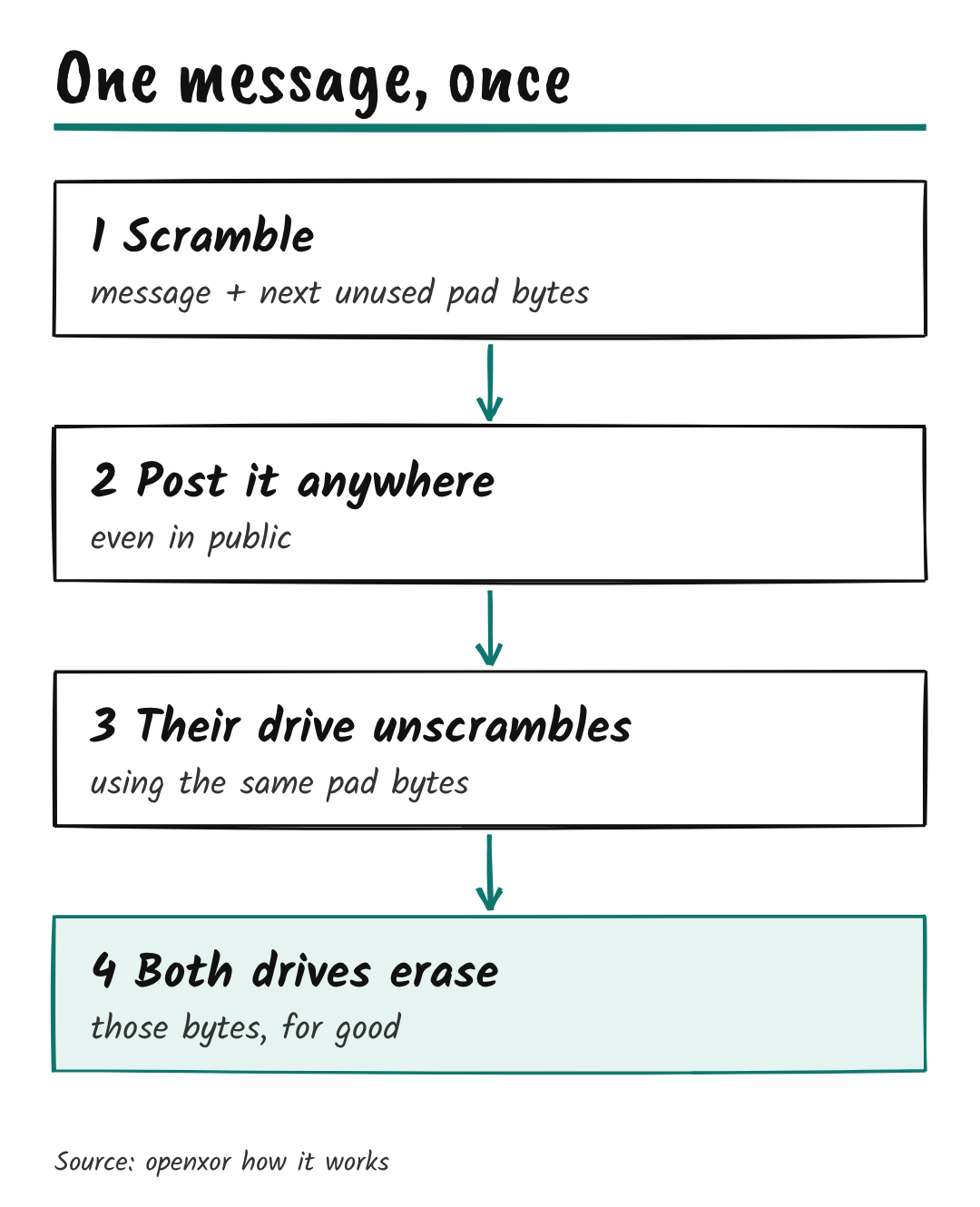
| Send and read | send combines the message with the next unused pad bytes and erases them; receive does the same on the other side. The output is one line of text you can post anywhere. |
| One-time MAC | Every message carries a Wegman–Carter tag, mod 2127 − 1, keyed from further pad bytes. The white paper bounds a forgery at about 2−104 per attempt for a 100 MB file, whatever the attacker’s computing power. |
| Scramble | openxor scramble splits a file, folder or typed secret into shards, two by default. Any K of N rebuild it, and fewer reveal nothing. There’s no password and no way back if too few shards survive. |
| Randomness | Pads and shards come from hardware noise: timing jitter on every computer, the processor’s RDSEED or RNDRRS circuit where it has one, and a USB generator if you add one. Each source passes NIST SP 800-90B health tests and a Toeplitz extractor, then gets mixed with the operating system’s generator. |
The randomness design is what sets this apart from a textbook demo. The white paper says a pad stretched from a short seed isn’t a one-time pad: a fast P = NP method could solve for the seed, and every operating system’s standard generator works that way. So openxor counts only hardware noise, and counts it conservatively: half a bit per timing sample, four bits per processor-circuit byte and two per USB-generator byte. If it finds no hardware source, it refuses unless you pass --standard-randomness, and then it labels the pads “not P = NP-proof.”
The repository also carries test vectors checked by second implementations written in Python from the white paper alone, and it builds and tests on macOS, Windows and Linux. The vault’s password lock is ordinary encryption (Argon2id and AES-256-GCM), and the white paper says plainly that it doesn’t hold against a fast P = NP method.
What I ran
I cloned the repository, built it with Go and ran the commands below. Nothing here used an AI model; it’s a command-line tool, so I drove it directly.
- Build and tests. The build made a 5.3 MB binary in about ten seconds. The binary reports version 0.0.0-dev, since there’s no release.
go test ./...passed in every package that has tests, in about 25 seconds. - Self-test.
openxor selftestpassed all six checks in two seconds: published test vectors, message and vault round trips, health tests, hardware randomness and unlock time. It found two hardware sources. The processor circuit measured 7.3 bits of randomness per byte against the 4 openxor credits, and timing jitter measured 6.9 against 0.5. Unlocking a vault took 0.7 seconds. - Vault pair. Generating a pair with 1 MB of pad each way took 37 seconds, at about 55 KB a second. Each vault file came to 2.2 MB. The pickup code is shown once. Opening the second vault with it, then choosing a new password, made the pickup code stop working.
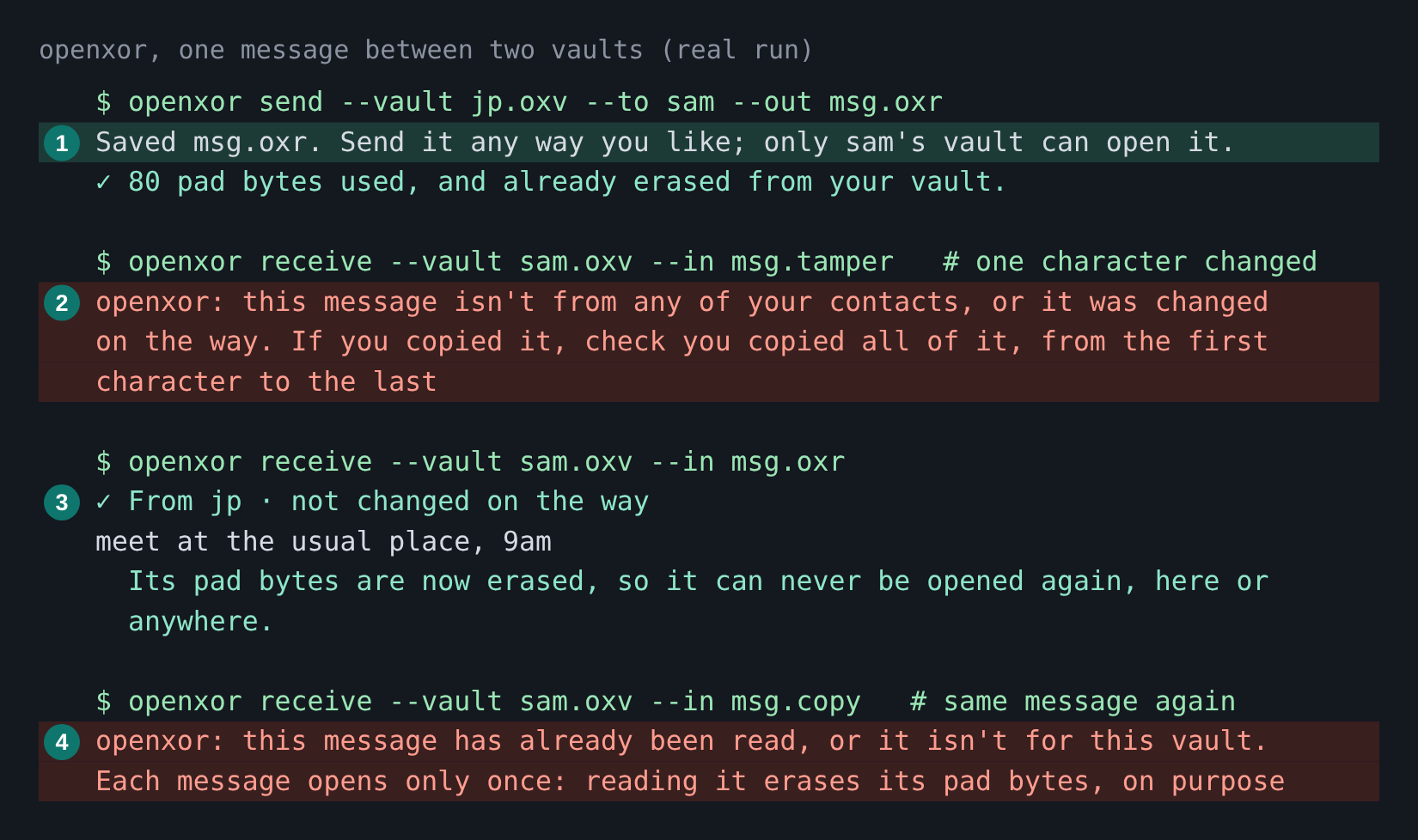
- Messages. A 28-byte message used 80 pad bytes, which openxor erased from the sender’s vault. At that rate a 1 MB pad covers roughly 12,000 messages like it. I changed one character of a copy and the receiver refused it. The refusal didn’t burn pad: the genuine message still opened afterwards, once. A replay of that message was refused.
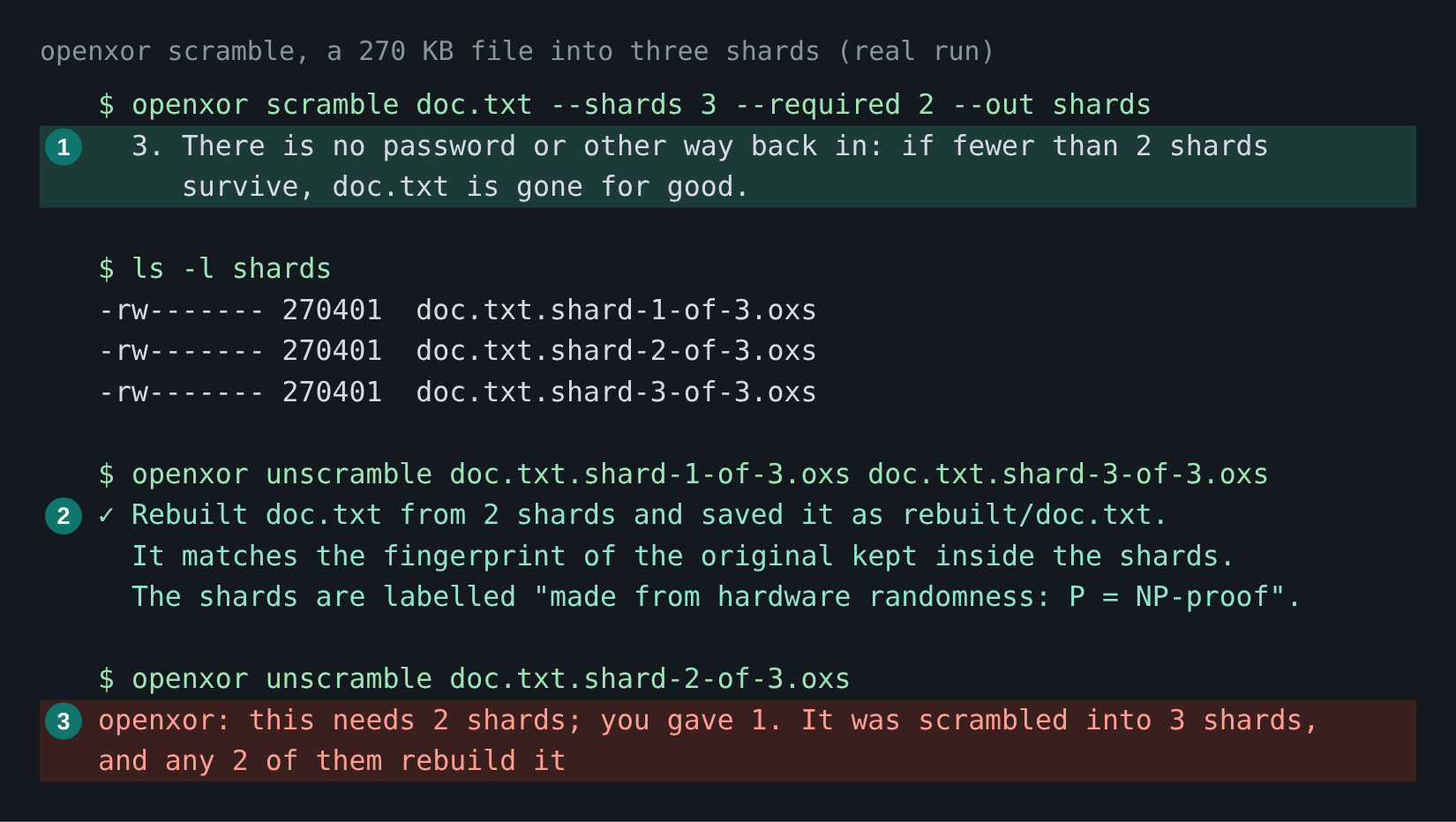
- Shards. I scrambled a 270 KB text file into three shards with two required. Each shard was 270,401 bytes. Any two rebuilt the file with a matching SHA-256, and a single shard was refused with a message saying how many were needed. A shard wouldn’t compress with
xz -9, which fits random bytes but proves nothing about their quality.
What my run doesn’t cover. It ran on a cloud virtual machine, so the “hardware” sources are whatever that machine’s processor exposes, not a laptop with an Apple or Intel chip. I didn’t test a USB random generator, physical drives or the vault’s behaviour if stolen, and I ran it on Linux only. I ran the project’s tests and exercised the commands; I didn’t audit the cryptographic code, and the project says it hasn’t been independently audited.
The thread’s claims, checked
| Claim | What I found |
|---|---|
| “Nobody has claimed P = NP.” | Correct. The labs’ October claims concern the Exponential Time Hypothesis and the November claims concern VP ≠ VNP. Heise notes that proving Valiant’s conjecture wouldn’t solve P versus NP. |
| A break of RSA or elliptic curves alone would forge most certificates and signatures | Consistent with the factoring coverage: RSA signatures are still common in certificates and software signing, and elliptic-curve signatures rest on a separate problem. |
| Signal’s post-quantum encryption still relies on a hard maths problem | Correct. Signal’s PQXDH spec says it “still relies on the hardness of the discrete log problem for mutual authentication,” and its post-quantum layer, ML-KEM, rests on lattice problems. Signal mixes the two so an attacker must break both. |
| Even AES-256 falls to a fast P = NP method | That’s the textbook consequence of a fast method for all of NP: finding a key that fits known plaintext becomes a search problem that method solves. Aaronson, answering a reader in his comments, says P = NP would leave only the “practical” questions of the constants and exponent. |
| A one-time pad is immune | Correct under Shannon’s conditions: random, as long as the message, never reused. |
| The one-time MAC is secure without a hardness assumption | The white paper’s bound is a probability over the key, independent of attacker compute, about 2−104 for a 100 MB file. |
| “Read it once and it’s gone” | Matched my run. The README’s own limit applies: flash drives can keep stray copies of erased bytes, so old drives should be destroyed. |
CIRG and the RSA checklist going round
CIRG. Steve Weis, a software engineer at Anthropic, shared a link to cirg.org, the Cryptography Incident Review Group. The site describes a group of cryptographers “aiming to review and help navigate cryptanalytic advances,” advising on how to disclose a break, communicate with those affected and plan for cryptographic resilience. It lists 21 members, among them Dan Boneh, Matthew Green, Nadia Heninger, Yael Tauman Kalai, Chris Peikert and Ryan Williams, who serve in a personal capacity. Weis isn’t on the list. The site names no incident, and its one “forthcoming statement” page says it hasn’t been published yet.
The checklist. The same weekend Akul Gupta, co-founder and CTO of the AI-security startup MindFort, posted advice that opens “There are rumors that one of the frontier AI labs has cracked 2048-bit RSA.” No lab has said that. Aaronson, who started the public trail, says he doesn’t know what the bombshells are, and the factoring papers Google published break nothing. Gupta’s advice is a sensible hedge against an RSA-only break, and most of it holds up against the sources:
| Gupta’s advice | What it does |
|---|---|
| Replace RSA SSH keys with Ed25519, and disable RSA host keys | Moves to elliptic-curve signatures, which an RSA-only break doesn’t touch. An elliptic-curve break would reach them, and Ledger’s Charles Guillemet says he’s heard that rumour too and doubts it. |
| Prefer TLS 1.3 with ECDSA certificates and scan chains for RSA | Same trade: safe from an RSA-only break, exposed to an elliptic-curve one. |
| Don’t send anything sensitive over RSA-encrypted email | RSA encryption would fall to a factoring break, retroactively for recorded traffic. |
| Treat RSA-signed updates and JWTs as untrusted | A factoring break would let an attacker forge RSA signatures. |
| Use hybrid post-quantum encryption such as X25519 plus ML-KEM | Signal deploys this today: PQXDH pairs X25519 with Kyber-1024, and its Triple Ratchet mixes ML-KEM-768 with its elliptic-curve ratchet. |
Gupta’s “what’s not affected” list, Bitcoin and AES-encrypted data, is right for an RSA-only break, and Coinbase made the Bitcoin point too. It’s a different scenario from O’Reilly’s: if a fast P = NP method existed, AES and elliptic curves would fall with RSA. The two posts answer different failures. Gupta’s is about migrating off one broken problem. O’Reilly’s is about not depending on any.
What it costs
The README lists the limits itself, and they’re big.
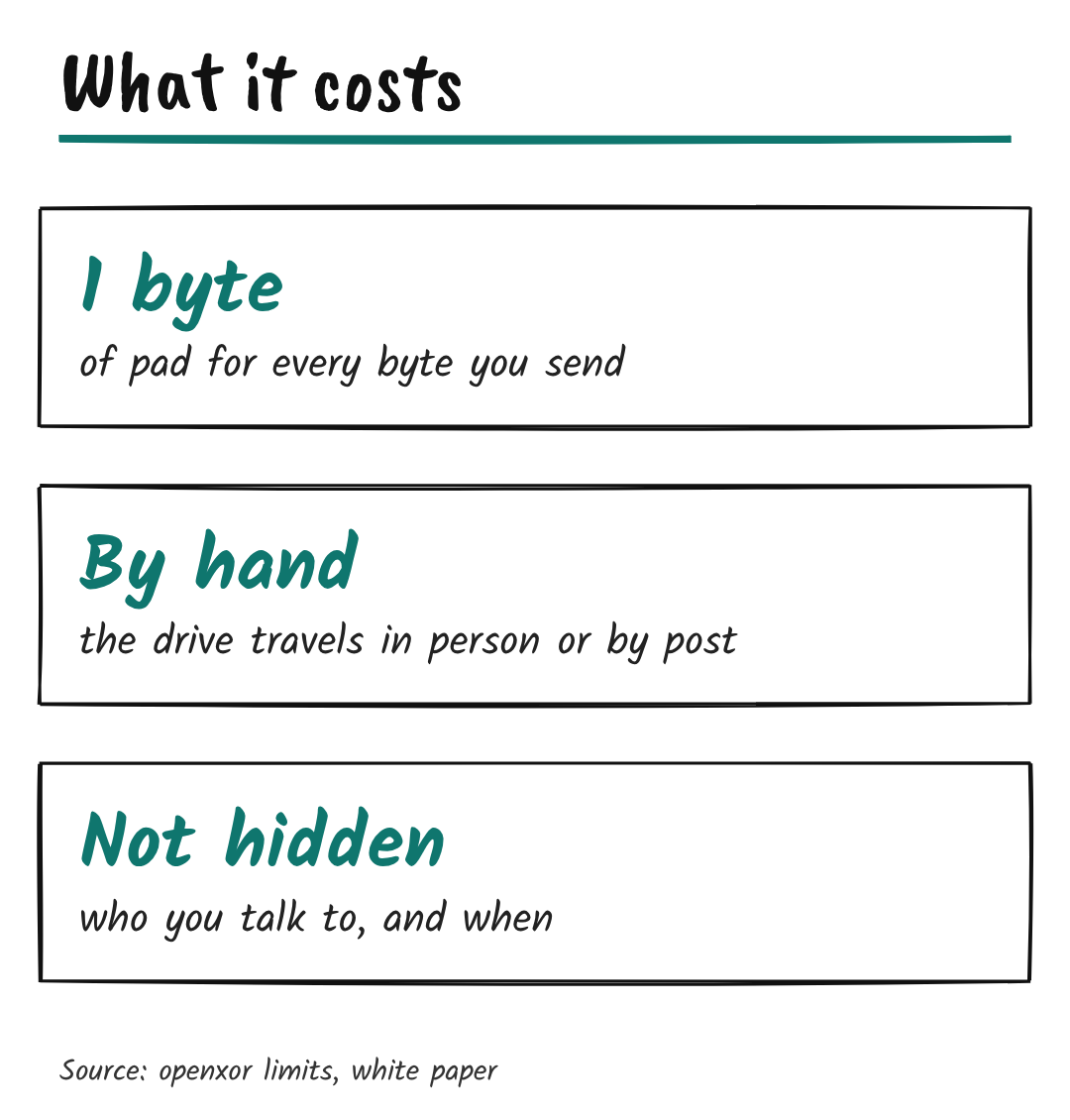
- The pad has to travel physically. In person, or by post in a tamper-evident bag, with the pickup code sent separately. “That is the whole point, and the whole cost.”
- One pad byte per byte sent. A gigabyte covers years of text or one gigabyte-sized file. When it runs out, a new drive has to be handed over.
- It hides what you say, not that you’re talking or when.
- A stolen drive is exposed. A thief with your password can read unread and future messages, and against a fast P = NP method the password doesn’t matter. Messages already read stay safe because their bytes are erased.
- Flash memory keeps strays. Destroy old drives physically.
- Malware beats any cipher. Use a machine you trust.
That puts openxor where O’Reilly says it belongs: for people who meet now and then, such as lawyers and clients, colleagues and family, and for files that must stay private for decades. The scramble command suits a different job, keeping a recovery phrase, signing key or password-manager export safe by splitting it across places. For everyday messaging, the README sends you back to TLS, Signal and PGP.
What to watch
- openxor’s first signed release and any independent audit. The project lists both as still to come.
- CIRG’s first statement, and whether it says anything about a specific result.
- The theoretical cryptanalysis result Aaronson says the labs will release soon.
- Human review of the VP ≠ VNP and Exponential Time Hypothesis proofs.
Sources: Jamieson O’Reilly on X; openxor repository; openxor how it works; openxor white paper; Aaronson, 25 November 2026; heise; OpenAI; Science; CSO Online; CIRG; Steve Weis on X; Akul Gupta on X; Signal PQXDH; Signal SPQR; Shannon, 1949; NSA, VENONA overview; Crypto Museum, hotline; O’Reilly’s site.
Disclosure: I’m an OpenAI, Firecrawl and Devin ambassador.