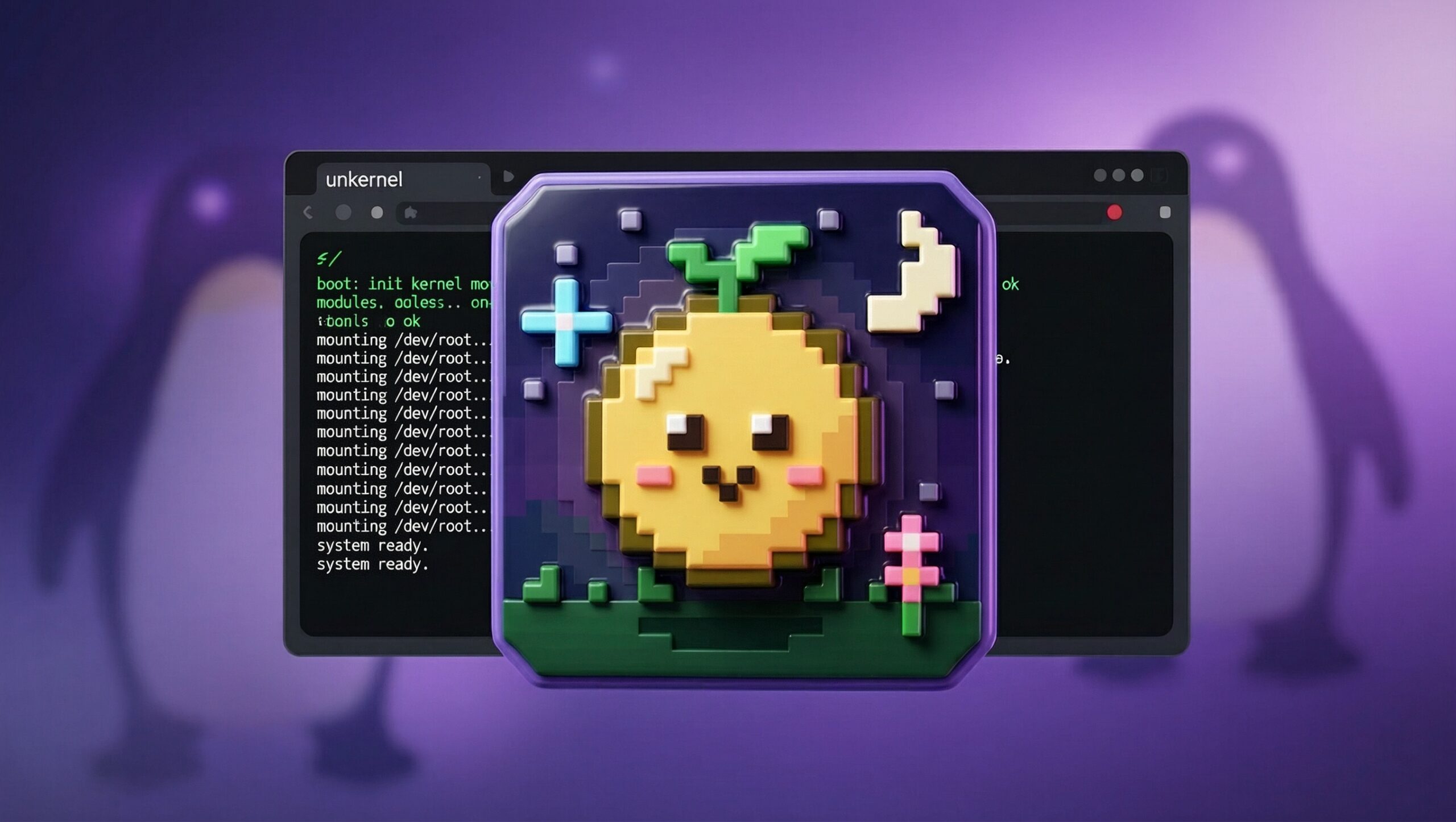
Guillermo Rauch, Vercel’s chief executive, posted a video on 28 November of Debian Linux booting inside a browser tab at unkernel.dev, with fx, a Vercel Labs coding agent, running in the terminal. The system is unkernel: a real Linux kernel, version 7.3.4 with patches, compiled to a single WebAssembly module. His post calls it “absolutely unreal” and says it runs “a full Linux [kernel] and distro in a browser tab”. The boot banner in the video reads 1.30 seconds on 4 CPUs.
What the video shows
The clip opens on a console window at unkernel.dev. A boot log ticks off its steps: browser features checked in 6 ms, the 3.6 MiB unkernel-smp.wasm downloaded in 23 ms, the kernel compiled in 4 ms, 2048 MiB of memory allocated, and a 74.2 MiB Debian image streamed in. The banner then reads “Booted in 1.30 s on 4 CPUs” and the prompt welcomes you to Debian GNU/Linux 13 (trixie) on unkernel, aarch64. Later frames show uname -a reporting Linux 7.3.4 with SMP, and a settings panel for CPUs, memory and distro, with Debian, Alpine or a bare shell on offer.

Then Rauch runs fx. It’s version 0.0.18, on the model deepseek-v4.1-flash-1017-ultrafast. He types “hi there” and “who are you”, and fx replies that it’s a local coding CLI assistant working in /home/user, able to read and edit files, run commands and check git state. That’s the demo: an agent that expects a shell, files and git, running on a Linux machine that exists only inside the tab. fx is the agent Rauch showed building lsx earlier this week, which we covered when it happened.
The README’s own Node figures are smaller than the banner. It says the kernel reaches /init about 70 ms after it starts, and an Alpine prompt appears 0.3 seconds after node launches. The browser run also downloads and attaches a 74.2 MiB Debian image, so the two numbers measure different things.
How it works
unkernel isn’t an emulator of a whole PC. The kernel is the program the browser runs: Linux, compiled to WebAssembly, with a real memory management unit built on arch/wasm page tables, so each process gets its own address space. User programs are ordinary aarch64 binaries. They run on kwemu, a CPU emulator written in Zig and linked into the kernel, which walks the kernel’s own page tables, and a JIT compiles hot code to WebAssembly. Task switches use JSPI, the JavaScript Promise Integration API, which gives the kernel real stacks it can suspend and resume. Devices are small paravirtual drivers that talk to the JavaScript host: block, network, display, input, sound, vsock and shared memory.
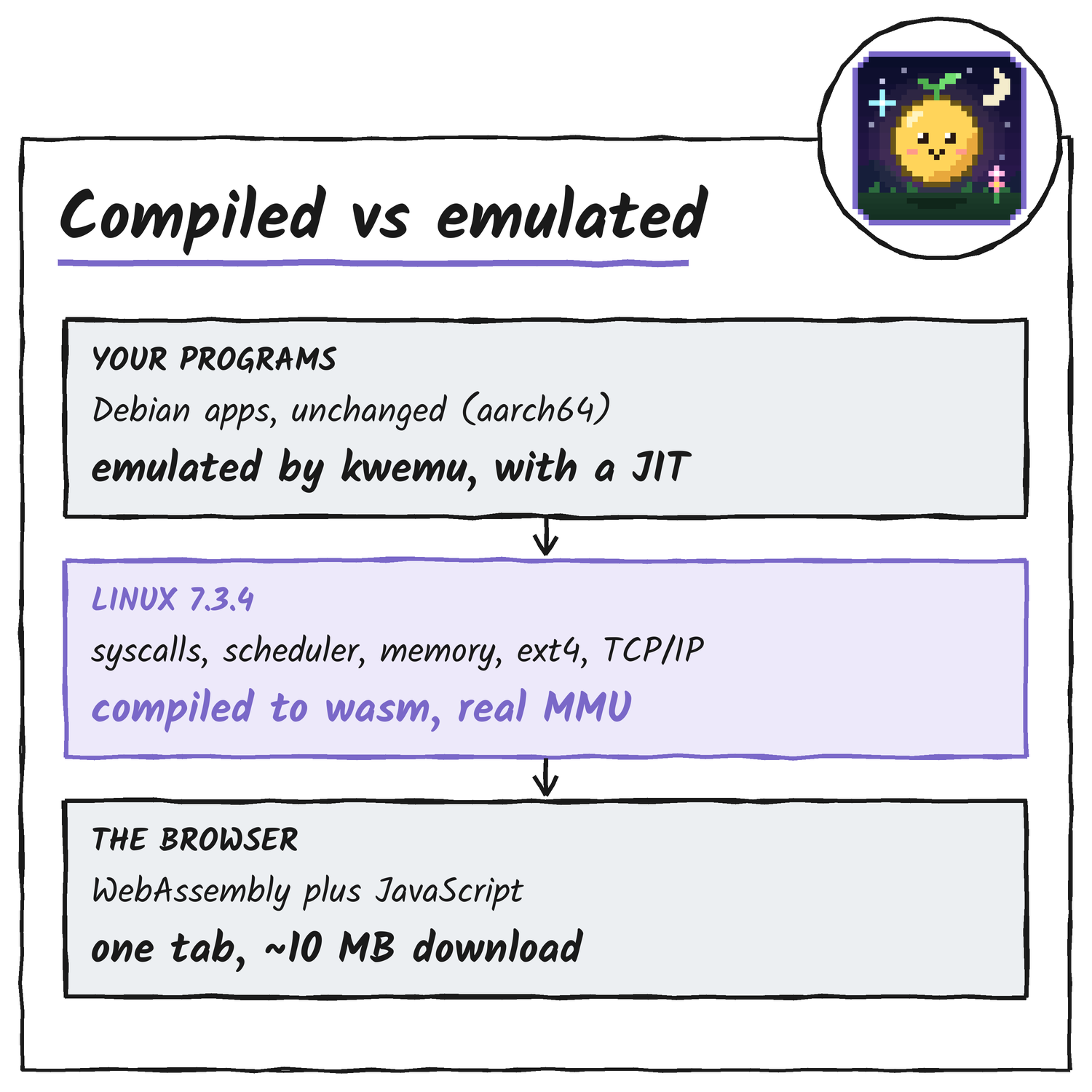
That split explains the speed profile. Starting processes, syscalls, page faults and file and network I/O all run as WebAssembly, so only the instructions of the programs themselves are emulated.
The numbers
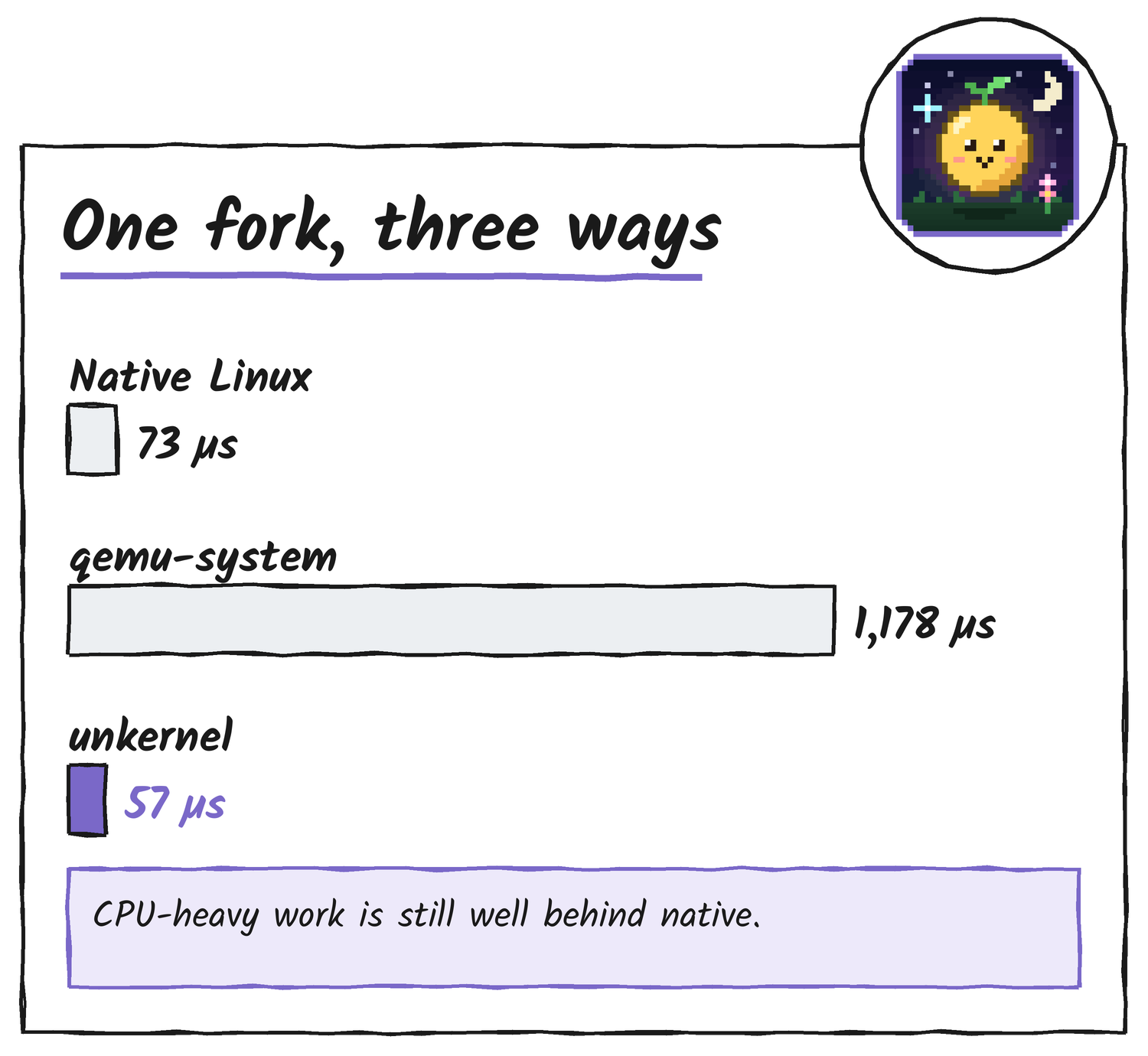
The README publishes Node benchmarks from 14 November. They’re the author’s own figures, not an independent test. In that run fork, exit and wait takes 57 µs in unkernel against 73 µs natively and 1,178 µs under qemu-system, so it beats native and is about 20 times faster than qemu-system. A bare getppid syscall takes 172 ns against 110 ns native and 1,662 ns under qemu-system.
| Operation | Native | qemu-user | qemu-system | unkernel |
|---|---|---|---|---|
| getppid | 110 ns | 320 ns | 1,662 ns | 172 ns |
| read 64 B from /dev/zero | 161 ns | 481 ns | 2,247 ns | 172 ns |
| pipe write + read | 417 ns | 1,032 ns | 7,256 ns | 482 ns |
| fork + exit + wait | 73 µs | 537 µs | 1,178 µs | 57 µs |
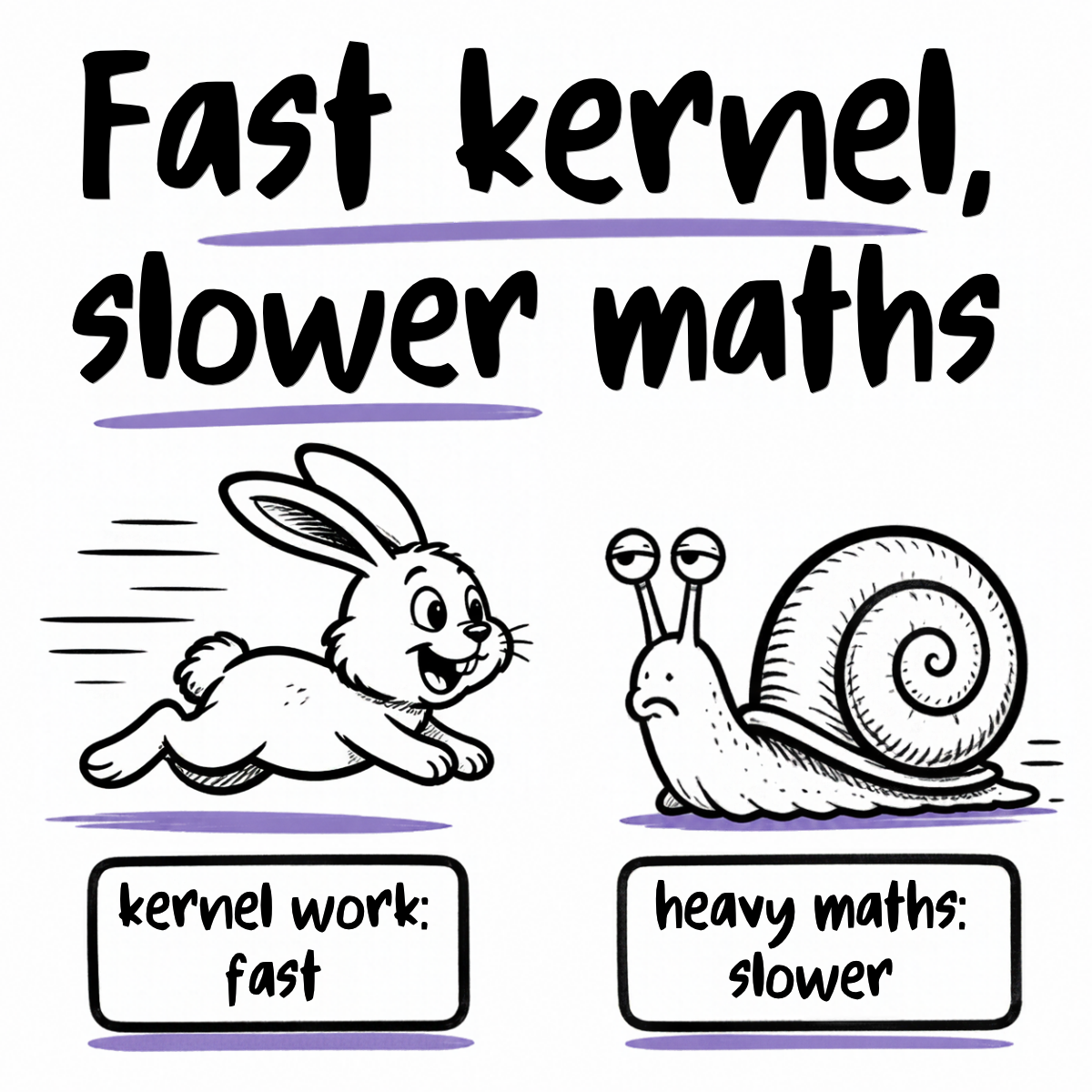
Computation is the other side. The README says kwemu’s interpreter runs integer code at about 250 to 300 million guest instructions a second under Node, and the JIT makes real Alpine work 1.6 to 2.3 times as fast as that, which is still well behind native. In the README’s test, apk add python3 takes about 3.4 seconds.
Outside numbers are thin and come with a caveat. Farid Zakaria moved trynix.dev from qemu-wasm to unkernel and claims it’s 2x to 32x faster in his 23 November post. The two engines ran different builds, x86_64 on one side and aarch64 on the other, so that range isn’t a like-for-like test.
Two weeks of releases
- 12 November: the repository is created.
- 19 November: the aarch64 release. Its notes say claude, opencode, node, bun and fx just work, installed on first use.
- 22 November: a GPU and a Wayland desktop, where Firefox, Chromium and SuperTuxKart run as windows through virglrenderer on WebGL2.
- 24 November: Vulkan on WebGPU. The release notes cite llama.cpp and Ollama.
Rauch’s post says unkernel “can even run Chrome inside Chrome”, but the video doesn’t show a browser inside the browser. The release notes list Chromium and Firefox running as windows inside the guest, and the nested demo Zakaria documents is Firefox inside Firefox.
Who built it
The author is Pooya Parsa, known as pi0, who said in an 8 July 2025 post that he’d joined Vercel. The README credits Vercel as a sponsor. The kernel is GPL-2.0-or-later, and the JavaScript SDK and the page are MIT.
How it sits beside the alternatives
The README sorts the alternatives by how they handle the kernel, user space and the MMU. Running agent code in WebAssembly has come up here before, when Cloudflare showed OpenAI’s Codex running as Wasm.
| Approach | Kernel | User space | MMU |
|---|---|---|---|
| Whole-machine emulators (v86, JSLinux, container2wasm, QEMU’s wasm build) | Linux, emulated | Unmodified, emulated | Emulated |
| Syscall emulators | None: a runtime reimplements the syscalls | Unmodified, emulated | The runtime’s own |
| POSIX runtimes for wasm (Wasmer WASIX, WebContainers, BrowserPod) | None: a runtime provides the syscalls | Rebuilt for wasm, or JavaScript | None |
| Linux without an MMU (linux-wasm, tombl/linux, WasmLinux) | Linux, native wasm | Rebuilt for wasm | None |
| unkernel | Linux, native wasm | Unmodified aarch64, emulated | Real page tables |
The README says that without an MMU, fork and anything else that needs one breaks or is approximated. unkernel is the one entry that pairs the real kernel at WebAssembly speed with unmodified binaries and real page tables.
The limits
- No IPv6, no UDP beyond DHCP and DNS, and no inbound connections.
- No ptrace, so strace and gdb don’t work.
- A WebAssembly trap ends the session.
- Scaling stops near 4 CPUs, and Safari slows down with more.
- The page needs JSPI: Chrome or Edge 137 or later, Firefox 153 or later, or Safari 27.
- Browser networking goes through a Wisp relay over WebSocket with an allow-list.
Until someone measures real workloads, the README’s numbers and the 1.30-second banner are what exists. The part to watch is the agent angle: a coding agent now has a disposable Linux machine that runs in the page and can be suspended and resumed. The unkernel repository, Rauch’s post and Zakaria’s 23 November post hold the details used here.
Disclosure: I’m a Vercel customer.