
Mercor plans to open an office in Asia next year to widen its client base in the region, including Chinese AI model developers, The Information reports, citing two people with knowledge of the plan. The San Francisco company supplies AI training data and services to labs including OpenAI and Anthropic, and was recently valued at US$20 billion.
The Information’s article is paywalled. A summary of it on Dealroom adds that Mercor has been talking to several Chinese AI firms to gauge demand for its products and services ahead of the move, and it doesn’t name a city. I found no announcement from Mercor. I’ve reported the plan as The Information’s and built the rest from Mercor’s own posts, an ASX filing, a court docket and other outlets’ reporting.
How Mercor got here
Mercor started in 2023 as a recruiting platform and became a supplier of expert human work to AI labs: doctors, lawyers, bankers and engineers who write answers, grade model output and build tests. In November it raised a US$750 million Series D at a US$20 billion valuation, double the US$10 billion it was worth a year earlier. Nvidia, Salesforce and Zoom were among the investors. Mercor says its network has more than five million experts, and that it opened New York and London offices this year. We covered the round when it landed.
On the day, co-CEO Brendan Foody said Mercor’s gross annualised revenue had reached US$3 billion, with more than 100 customers, Forbes reported. Gross means before Mercor pays its experts. The Information reported in July that Mercor passes 60 to 70% of gross revenue to contractors.
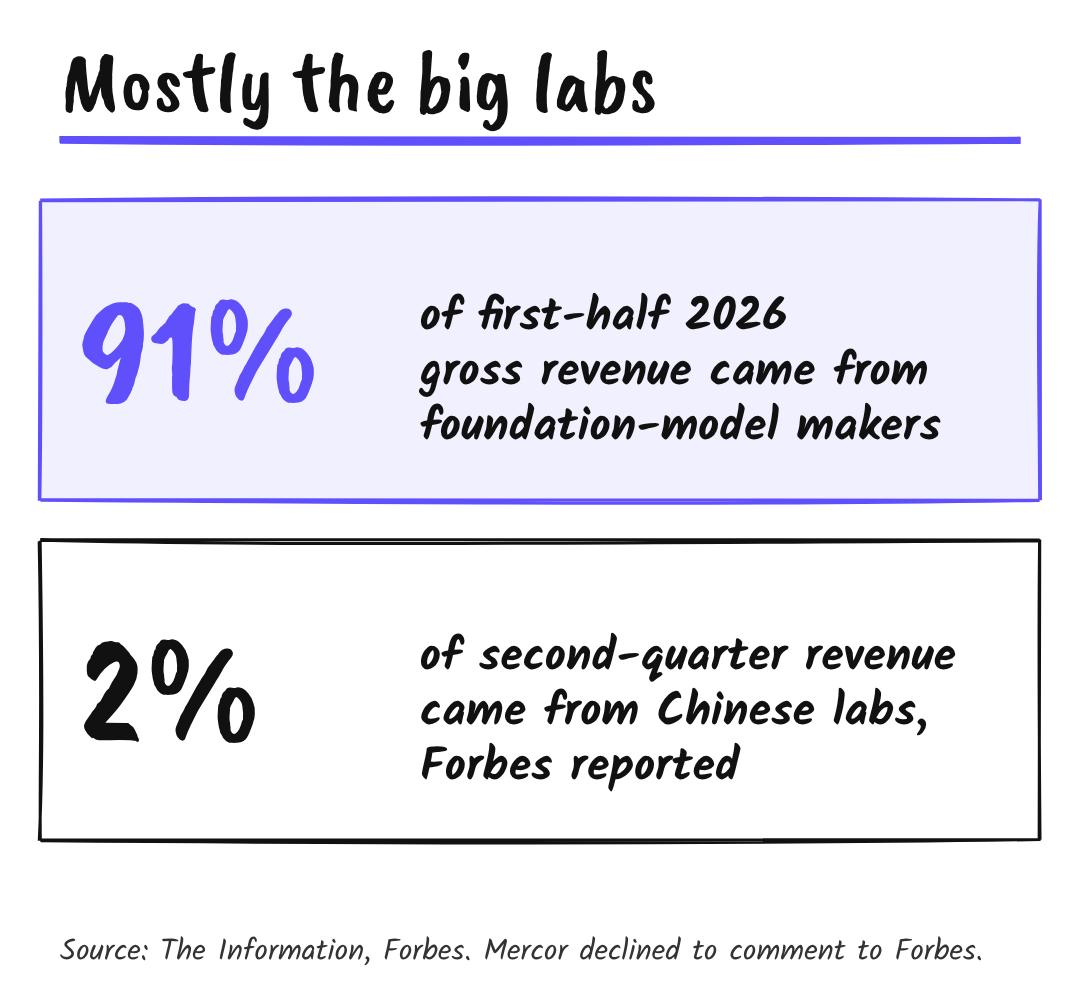
The same July reporting, drawn from internal documents, put Mercor’s first-half 2026 gross revenue at about US$614 million, with about 91% of it from foundation-model developers. Nearly all of it rides on a few buyers.
The year hasn’t been smooth. Scale AI sued Mercor and a former Scale employee over trade secrets in September 2025, then dismissed the case with prejudice in January. In March, Mercor was caught up in the LiteLLM supply-chain attack. Its own update says the investigation is complete, that a very limited subset of its experts had sensitive information affected, and that all frontier labs have increased their work with it since. WIRED reported that Meta paused its work with Mercor after the breach. Contractors have filed proposed class actions over the exposed data, which Mercor disputes.
The China business it already has
Chinese labs already buy from Mercor, on the reporting so far. Forbes reported in August, citing a source, that Chinese AI labs made up 2% of Mercor’s second-quarter revenue and that Mercor had hired an engagement manager for China. Mercor declined to comment to Forbes.
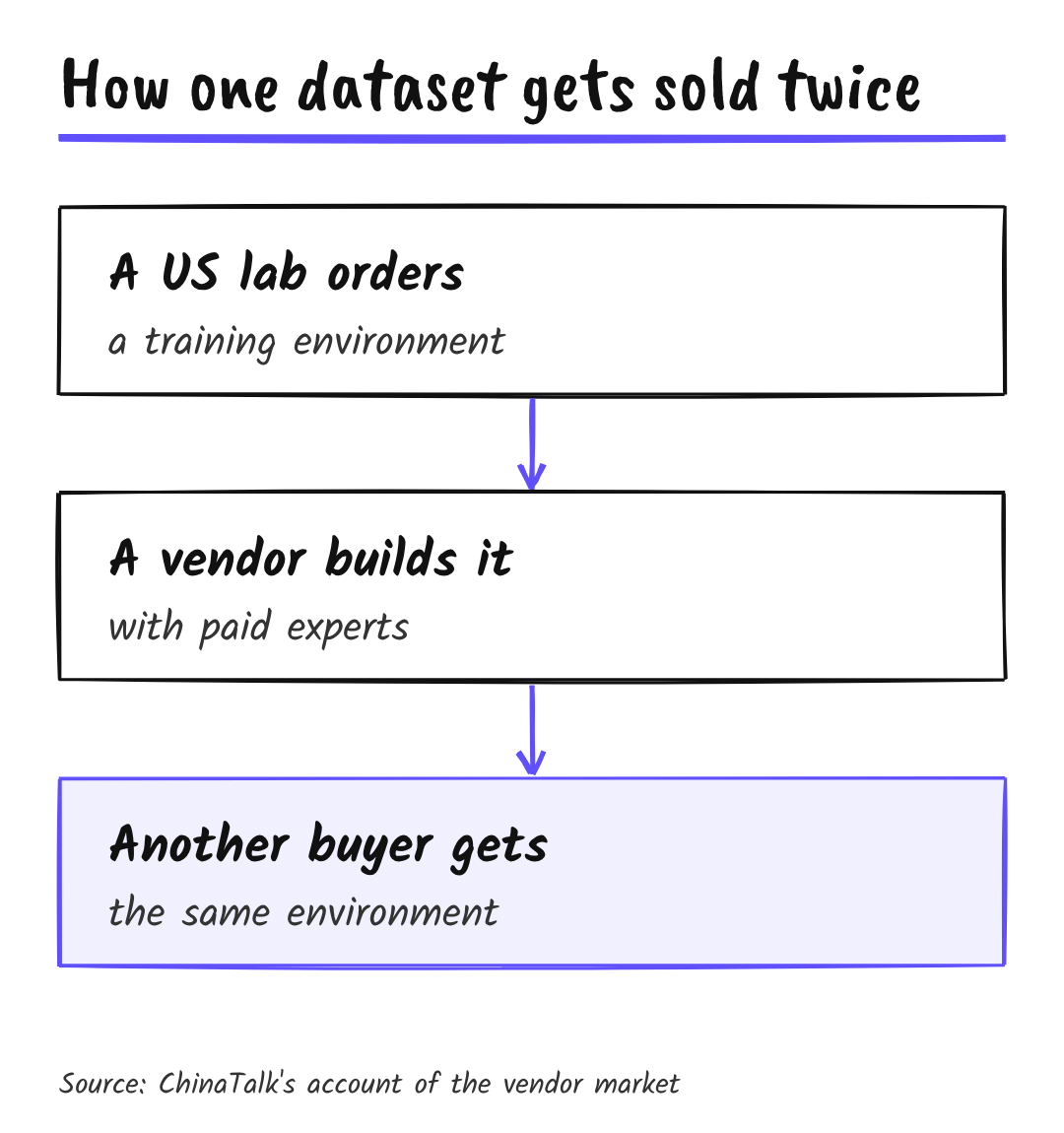
ChinaTalk’s November report named a buyer. It said data it accessed shows Mercor sold software-engineering reinforcement learning environments to Alibaba, and that a source at a Chinese lab said they buy from Mercor. These are practice worlds where a model learns to do a task by trial and error. ChinaTalk’s report carries no response from Mercor.
What Mercor’s own rules say
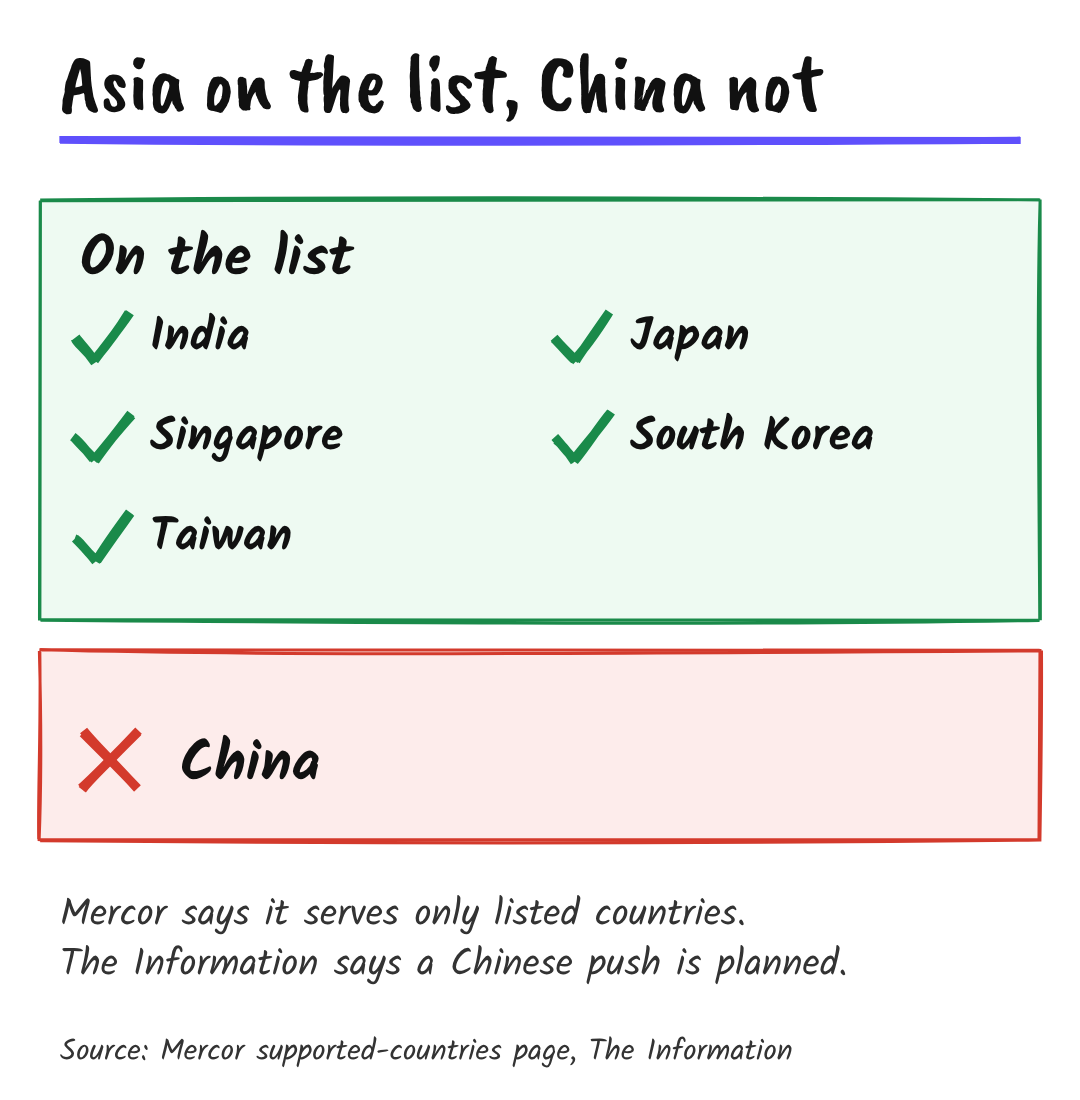
Mercor publishes a supported-regions list, and the wording is plain.
Mercor does not provide its products or services to, and does not engage contractors located in, countries outside of those listed in our Supported Regions Policy.
Mercor, Supported Countries & Regions
The list names India, Japan, Singapore, South Korea and Taiwan. China isn’t on it. ChinaTalk says Mercor changed the policy in May from a test of who owns the customer to a test of where it’s located. How a sales push to Chinese developers fits that page is a question the plan raises, and I found no statement from Mercor on it.
What the US rules cover
Chips are the controlled export. Expert-made training data mostly isn’t, and Forbes put it this way.
While the U.S. has long prohibited China from buying the chips that power America’s top-tier AI models, it hasn’t taken the same precautions with the data required to train them.
Forbes
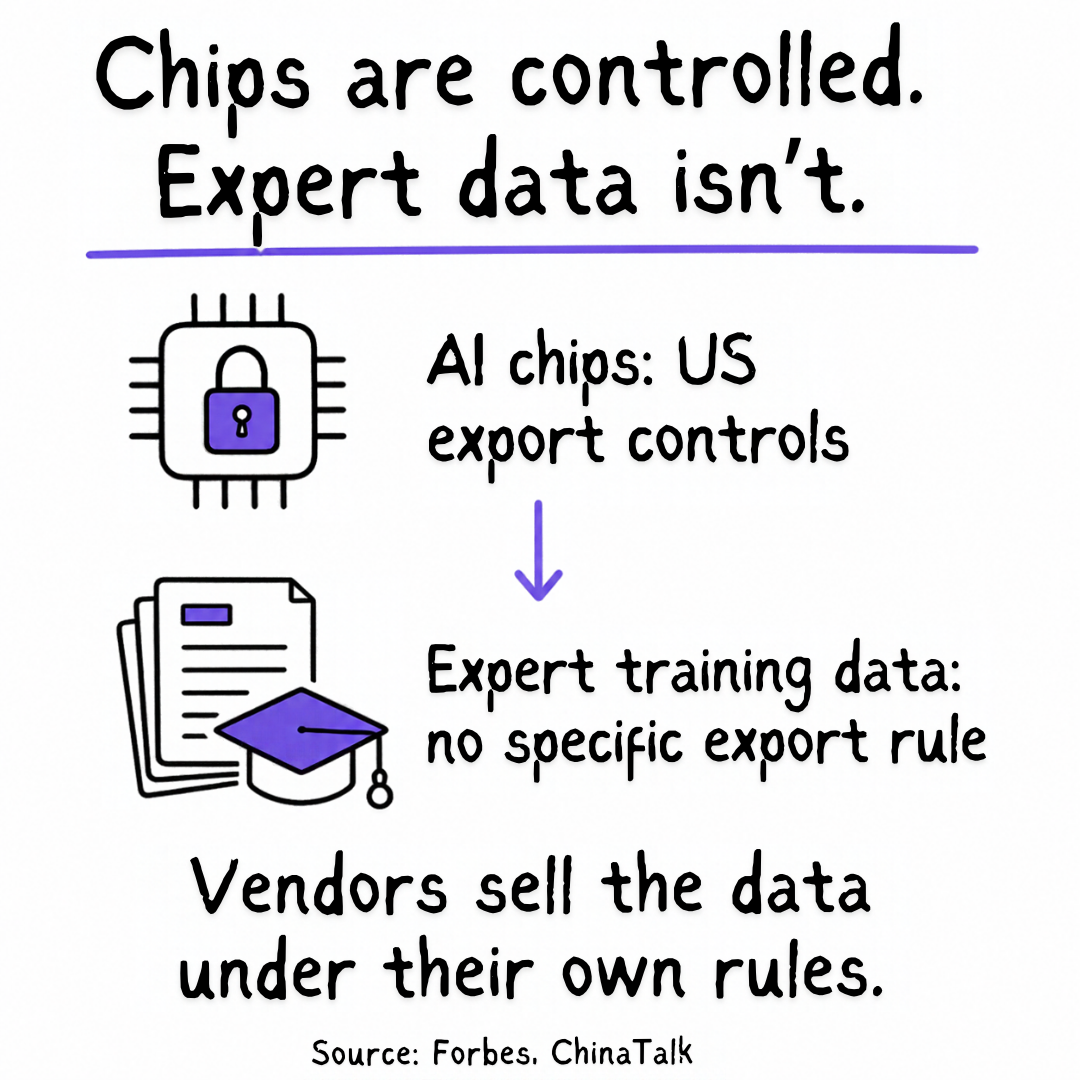
ChinaTalk’s reading is that reinforcement learning environments are largely free of export controls except for buyers on the Entity List, such as Zhipu, which was added in January 2025. It says the Justice Department’s Data Security Program and the Protecting Americans’ Data from Foreign Adversaries Act cover identifiable American data, medical data and large volumes of unidentified data, not purchased expertise. It also says deals can run through offshore desks, naming ByteDance’s teams in Singapore and San Jose.
Its authors argue Chinese labs deliberately buy the same environments that US labs commissioned, so they know the data works and skip failed training runs. They also note a limit: Chinese buyers have to wait for a US lab to commission an environment first, which keeps them months behind. Their proposals are for the Commerce Department’s Bureau of Industry and Security to treat dual-use environments under existing rules and send warning letters to vendors, and for defence procurement rules to bar contractors from selling to Chinese labs of concern.
Why Chinese labs buy
Chinese labs have their own reasons to buy. The Jamestown Foundation’s China Brief says China’s data-labelling sector lags the US despite central calls to expand it, with most local work still labour-intensive rather than expert-driven. It reports Hunan Daily’s account that DeepSeek founder Liang Wenfeng regards data annotation as the most important work at this stage, with half of the company’s core researchers on it. Its conclusion is that Chinese labs are buying from foreign vendors what domestic supply is missing.
Appen, the ASX-listed data company, has a China arm that points the same way. In its half-year results, Appen said Appen China’s revenue rose 80% on a year earlier, driven by generative AI projects, including supporting the international expansion of Chinese technology companies.
How the rivals compare
Scale AI is the one Mercor is measured against. Meta paid about US$14.3 billion for 49% of it in 2025, which implies a valuation near US$29 billion, and ChinaTalk says Scale, micro1 and Fleet are the only vendors it knows of that publicly say they forgo China business. Surge AI is the other heavyweight. It says it has run profitably without venture funding, and it was reported to have made about US$1.2 billion in revenue in 2024. ChinaTalk and Forbes, citing SemiAnalysis and sources, say it sells to Tencent, Z.ai and Moonshot, and Surge told Forbes it doesn’t disclose customer information.
Turing and Invisible are also named by ChinaTalk as sellers to Chinese buyers, and Forbes reported that AfterQuery draws at least US$50 million of recurring revenue from Chinese labs. AfterQuery told Forbes it doesn’t disclose customer information. None of the vendors has confirmed the sales. The revenue figures here aren’t like for like: Mercor’s US$3 billion is a gross run rate, while Surge’s US$1.2 billion is full-year 2024 revenue.
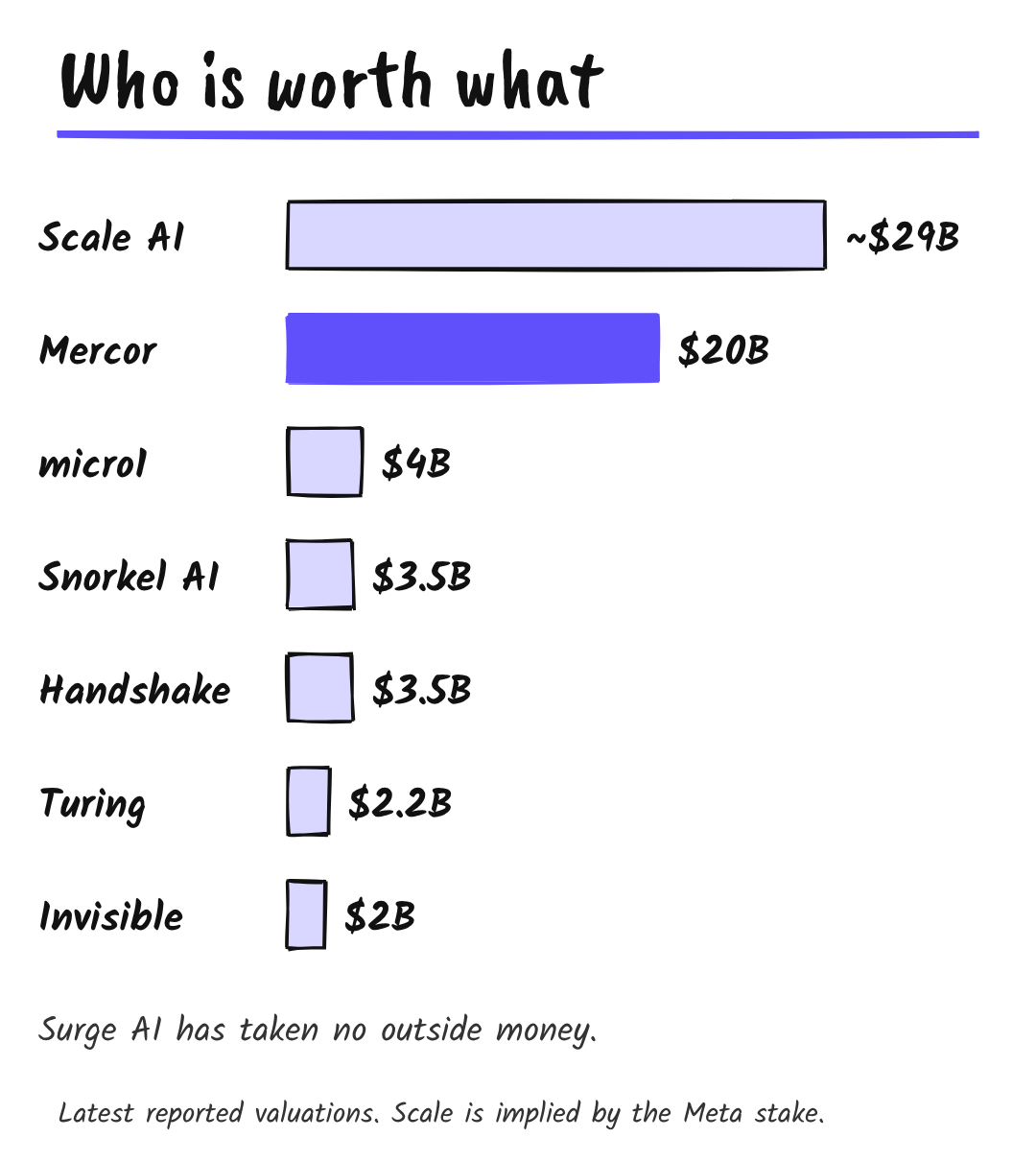
Below them sit micro1 at about US$4 billion, Snorkel AI at US$3.5 billion, Turing at US$2.2 billion and Invisible at about US$2 billion, all on their latest reported rounds. Handshake’s US$3.5 billion dates from 2022, before it moved into AI training data.
What an Asia office changes
Mercor’s revenue sits with a handful of US labs, and China is about 2% of one quarter. An office in the region puts sales staff near Asian buyers and near the experts Mercor already pays across Asia, including India. It also makes the China business visible in a way a single engagement manager for China wasn’t.
That visibility lands in a market where the rules are unsettled and ChinaTalk’s proposals are aimed at vendors like Mercor. It also lands after a breach and a customer pause, in a business where, as TechCrunch noted when the breach broke, vendors hold model makers’ custom datasets and processes.
What to watch
- Where the office goes and when Mercor confirms it.
- Whether Mercor updates its supported-regions page, which today leaves China off the list.
- Whether the Commerce Department or Congress acts on training data and environments sold to Chinese labs, as ChinaTalk urges.
- Whether the 2% China share moves once Mercor has local staff.
Disclosure: I’m an OpenAI, Firecrawl and Devin ambassador.
Sources: The Information; Mercor Series D post; Mercor security update; Mercor supported countries; Forbes on Chinese labs; Forbes on Mercor’s revenue; ChinaTalk; Jamestown China Brief; Appen ASX release; Scale AI v Mercor docket; WIRED.