
Okazaki Kota, co-founder of the consulting firm FAKE, Inc., posted in Japanese that OpenAI is hiring someone to run strategy and operations for its forward deployed engineering (FDE) business. His view is that OpenAI is starting to build the operating capability of a consulting firm in-house. I checked his five points against the listing, and all five match its wording. The listing also shows how big the business behind it has become.
Disclosure: I’m an OpenAI, Firecrawl and Devin ambassador.
What the post says
Okazaki writes that OpenAI is recruiting for “Forward Deployment Strategy & Operations”, a role that handles strategy and management of the FDE business. He finds the job content interesting because it shows OpenAI starting to hold, inside the company, the business-operations skills of a consulting firm. He lists five duties:
- Designs the go-to-market approach and revenue model for the FDE business.
- Manages revenue, gross margin and utilisation.
- Optimises project demand against staffing.
- Decides between one-off deployments and standardised ones.
- Sets partner strategy.
What the listing says
The Forward Deployment Strategy and Operations listing is a Strategy & Operations role in San Francisco. OpenAI says it wants “a senior operator to build and scale OpenAI’s forward deployed business”, and calls the job “a foundational, hands-on individual contributor role at the intersection of business strategy, finance, go-to-market, and technical delivery.” It pays US$293,000 to US$325,000 plus equity.
| Okazaki’s point | What the listing says |
|---|---|
| Go-to-market and revenue model | “Define and drive the business and GTM strategy for the forward deployed motion, including target customer needs, engagement portfolio, positioning, commercial models, partner motions, and where to standardize versus tailor deployments.” |
| Revenue, gross margin and utilisation | “Deep command of deployment economics and operating levers such as pipeline, bookings, backlog, revenue timing, gross margin, utilization, capacity, staffing mix, delivery quality, and customer outcomes.” |
| Demand and staffing | “Build and maintain integrated demand, capacity, staffing, and revenue models; develop scenarios and sensitivities; improve bottom-up forecast accuracy.” |
| Bespoke versus standard | “Translate recurring customer and deployment patterns into inputs for product strategy, enablement, partner strategy, and more repeatable product-plus-deployment offerings.” |
| Partner strategy | “You will own business planning, commercial strategy, forecasting and modeling, partner strategy, and cross-functional strategic initiatives.” |
His consulting-firm comparison fits the background the listing asks for. The first qualification is “8+ years of experience in management consulting, Business Operations, Strategic Finance, or a comparable role”, with direct experience in a forward-deployed engineering, enterprise implementation, systems-integration or managed-services organisation. The listing wants models that are “auditable”, fluency in spreadsheets, and SQL or BI tools. It also says the person will “replace one-off analyses with durable processes” and “establish operating cadences that help leaders act early.”
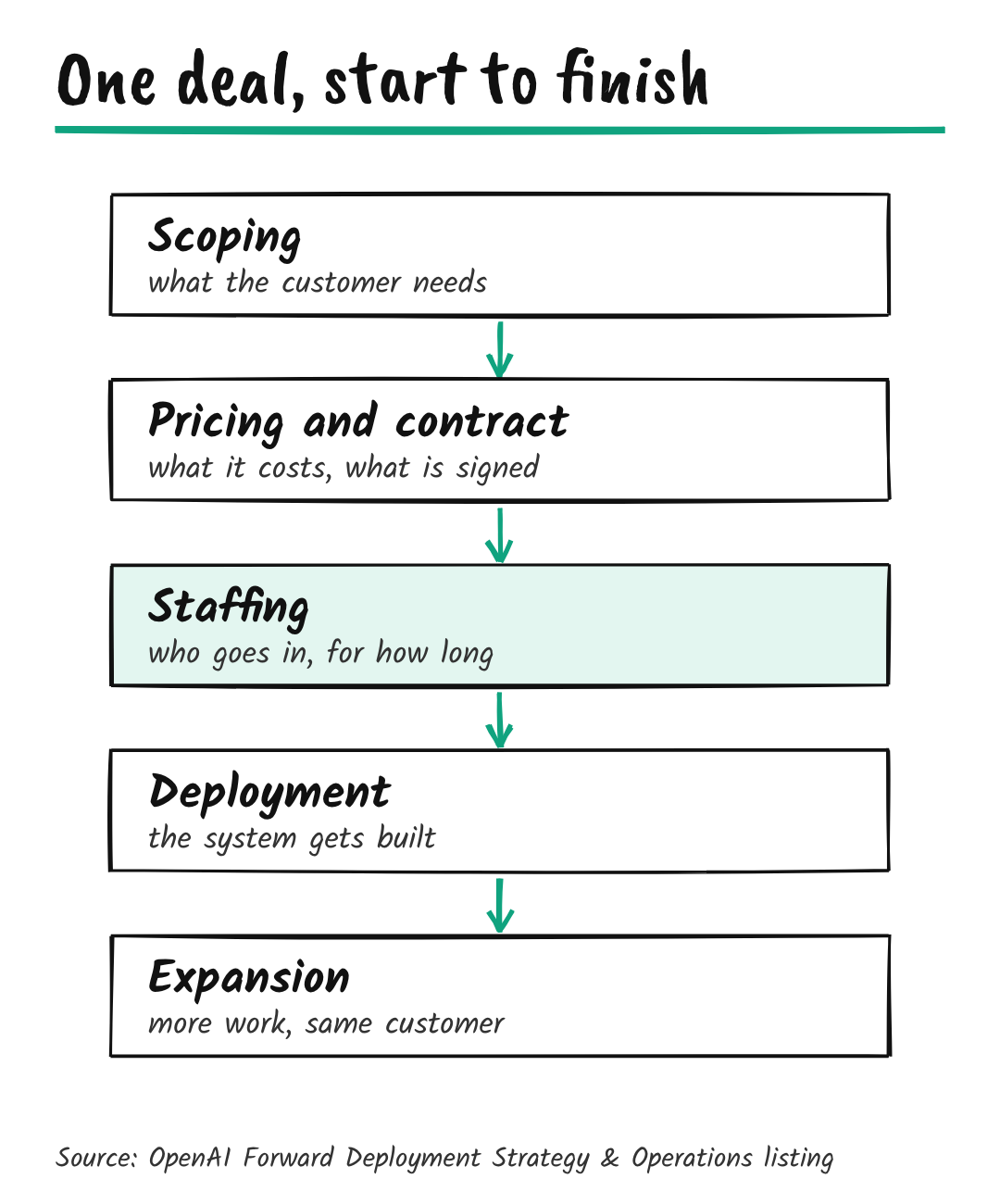
The role covers the whole life of an engagement. The listing asks for improvements “from opportunity intake and scoping through commercial design, contracting, staffing, deployment, and expansion”, in partnership with Revenue Operations and Systems. The partners it names are FDE, GTM, Technical Success, Finance, Product, Legal and Data leaders.
The business behind the job
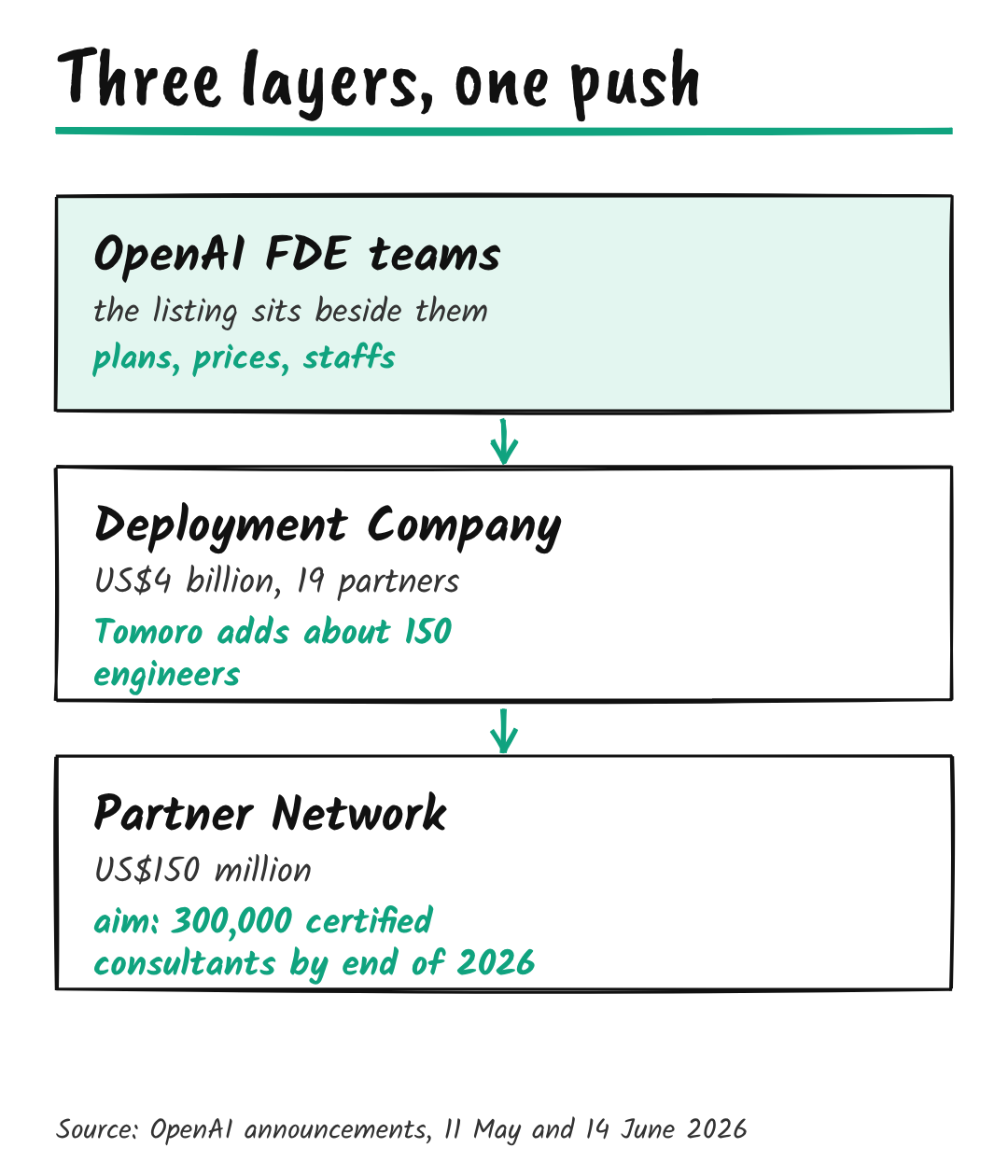
OpenAI has built a lot around FDEs this year, and the job only makes sense against that. On 11 May OpenAI launched the OpenAI Deployment Company, a standalone unit it majority-owns and controls. OpenAI says the unit extends its ability to embed Forward Deployed Engineers in organisations “working on complex problems in demanding environments”. It has 19 partners: TPG leads, with Advent, Bain Capital and Brookfield as co-leads, and Bain & Company, Capgemini and McKinsey & Company are among the investors.
OpenAI also agreed to acquire Tomoro, an applied AI consulting and engineering firm whose clients include Tesco, Virgin Atlantic and Supercell. The deal brings about 150 FDEs and Deployment Specialists to the new company. OpenAI described a typical engagement as a focused diagnostic, a small number of priority workflows picked with the customer’s leaders, and then FDEs who design, build, test and deploy production systems inside the organisation.
US$4B+
initial investment in the Deployment Company
19
investment firms, consultancies and integrators in the partnership
~150
FDEs and specialists coming from Tomoro
300,000
certified consultants the Partner Network aims for by end of 2026
On 14 June OpenAI introduced the OpenAI Partner Network with US$150 million of investment and the aim of enabling 300,000 certified consultants by the end of 2026. The network has Select, Advanced and Elite tiers. OpenAI is also piloting a Forward Deployed Experts programme with founding partners, so partner practitioners can work in step with OpenAI’s own Forward Deployed Engineering teams on deeper deployments. Accenture, Bain, BCG, Eliza, McKinsey and PwC are among the partners quoted in the announcement.
Put together, the strategy and operations hire is the person who plans how those pieces fit: where OpenAI’s own engineers go, what an engagement is priced at, how many people it needs, and which work partners take.
Where it sits on OpenAI’s job board
OpenAI’s careers page lists a spread of FDE roles besides this one: general Forward Deployed Engineer openings in San Francisco, New York and Seattle, vertical roles for healthcare, financial services and legal, Deployment Lead, Manager, Forward Deployed Engineering and a Platform Engineer role. The strategy and operations listing is the business-side counterpart: it doesn’t build the systems, it runs the model that decides which ones get built and by whom.
The wider market
Palantir is widely credited with creating the FDE model, according to Gartner analysts quoted by CIO Dive. In 2026 the job spread to the big platforms.
- AWS committed an initial US$1 billion to a unit that sends pods of five to six engineers to customers for 45-day stretches, Reuters reported.
- Microsoft launched Microsoft Frontier Company with US$2.5 billion and 6,000 staff embedded at customers, according to CNBC.
- Accenture and Google Cloud are building a 1,000-person FDE workforce inside a new Gemini Enterprise business group.
- Anthropic hires FDEs of its own and trains partner engineers through its Frontier Academy. Our piece on its Staff Forward Deployed Engineer listing covers that ladder.
Job postings show the same climb. Lenny Rachitsky’s report, which we covered, puts FDE openings at about 1,500, up 4.6 times in a year from a base of a few dozen roles. Our piece on Anthropic’s Forward Deployed Engineer learning path covers the training side.
What stands out in OpenAI’s listing is the business half. Most FDE job ads describe people who build. This one describes the person who forecasts, prices and staffs the builders, which is the work consultancies have long kept apart from the engineering.
How to read an FDE strategy listing
- Does it build or plan? This role is hands-on with models, dashboards and processes, not with customer systems.
- Which numbers does it own? Bookings, revenue, gross margin, utilisation and capacity are the named levers.
- Who does it answer to? It works with GTM leadership and FDE leaders, and sits in Strategy & Operations.
- Where does the partner work go? The listing puts partner strategy in the role’s scope, next to the Deployment Company and Partner Network.
Okazaki’s summary holds up. Behind the listing sits a company, a partner programme and a pricing and staffing job that OpenAI now treats as a senior hire.
Sources: OpenAI careers listing / OpenAI Deployment Company announcement / OpenAI Partner Network announcement