Stability AI released Stable Diffusion 2.1 on 7 December, revising the training behind its text-to-image model. The company says less aggressive filtering restores more pictures of people to the training material while continuing to filter adult content.
Stability says the update improves anatomy and hands and makes more older prompts useful again. Those are the developer’s assessments, rather than independent evidence that difficult images are solved. The change follows feedback that version 2.0’s filtering had removed too many pictures of people.
Two checkpoints, familiar architecture
The release notes list a 768×768 model and a 512×512 base model. Both are fine-tuned from version 2.0 and retain its architecture and parameter counts. The notes warn that half-precision attention can be numerically unstable with the standard attention implementation.
How latent diffusion works
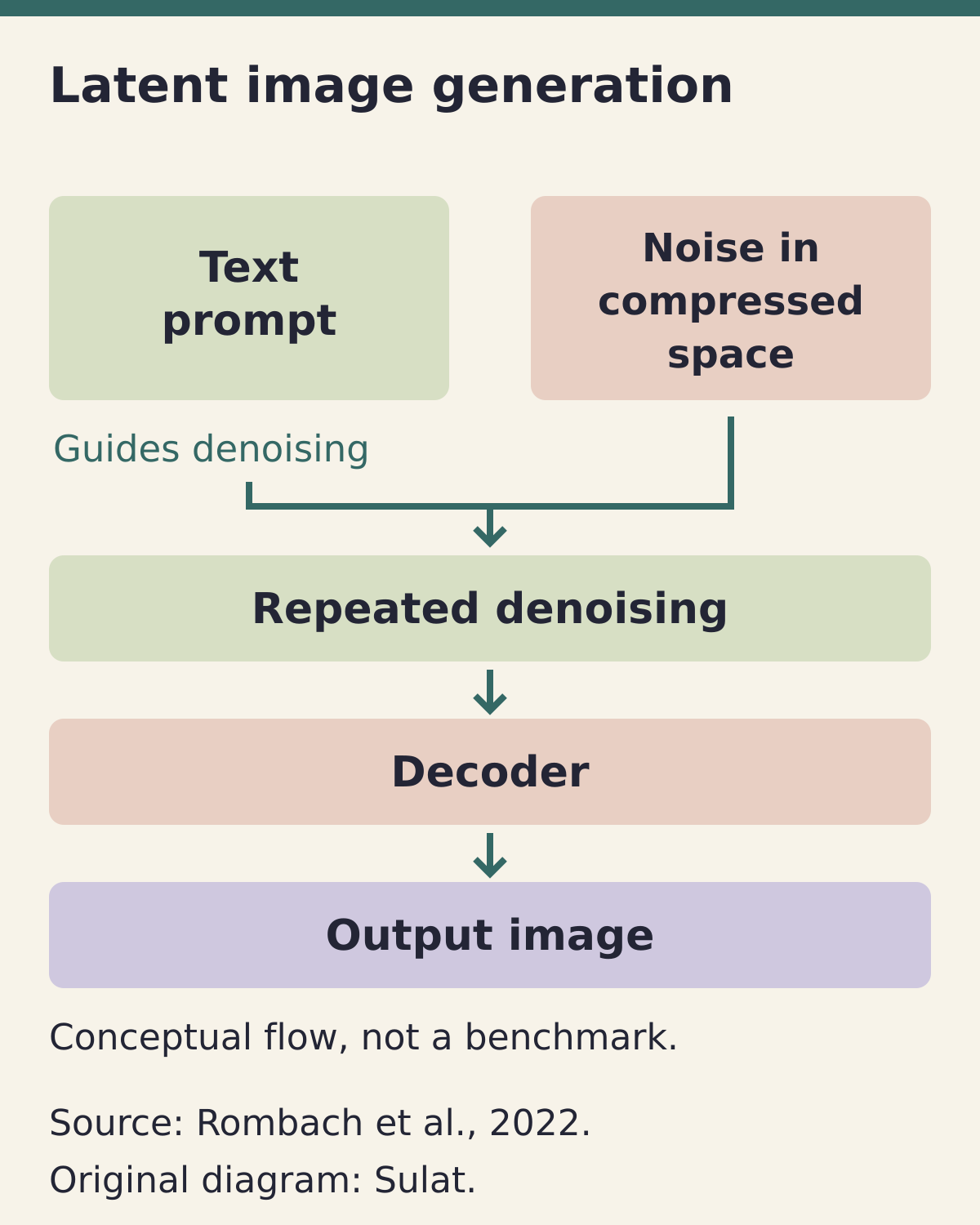
The underlying approach comes from research by Robin Rombach and colleagues. Instead of performing every generation step over full image pixels, latent diffusion works in a compressed representation. Text can guide repeated denoising, and a decoder turns the resulting representation into an image.
The researchers presented this as a way to reduce computation while retaining useful visual detail. That architectural tradeoff explains the method; it is not a fresh benchmark showing how much faster version 2.1 runs on a particular computer.
Availability still has conditions
The weights are distributed under the CreativeML Open RAIL++-M licence, which includes restrictions on use and requires those restrictions to follow redistributed models. The licence expressly excludes the training data. Releasing weights does not make every use, source image or output unrestricted.
The release documentation also warns that training-data biases can appear in outputs and recommends additional safety measures before using the weights in products or services. Creative control, dependable results and deployment safeguards remain separate questions.
Illustration: Sulat. Logo: Stability AI. Independent editorial illustration; no endorsement implied.
Discover more from Sulat AI & Tech News
Subscribe to get the latest posts sent to your email.