NVIDIA announced the release of CUDA Toolkit 12.0 on 8 December, highlighting support for its Hopper architecture. The major version updates the software tools used to build applications for NVIDIA GPUs.
Compiler gains, compatibility costs
The initial release notes list C++20 support in NVCC and NVRTC. Coverage has limits: device code does not support coroutines, and modules are unsupported in both host and device code. NVRTC also changes its default language dialect from C++14 to C++17.
Migration deserves attention. CUDA 12.0 removes Kepler architecture support and NVCC’s 32-bit compilation support. It also removes CUDA-MEMCHECK. Developers maintaining older hardware or build pipelines should check those dependencies before upgrading.
Linking GPU code at runtime
The toolkit includes nvJitLink, a library that combines GPU device code while an application is running. It accepts several input formats, including PTX, compiled device binaries and the intermediate representation used for link-time optimization. Its output is a linked binary that the CUDA driver can load.
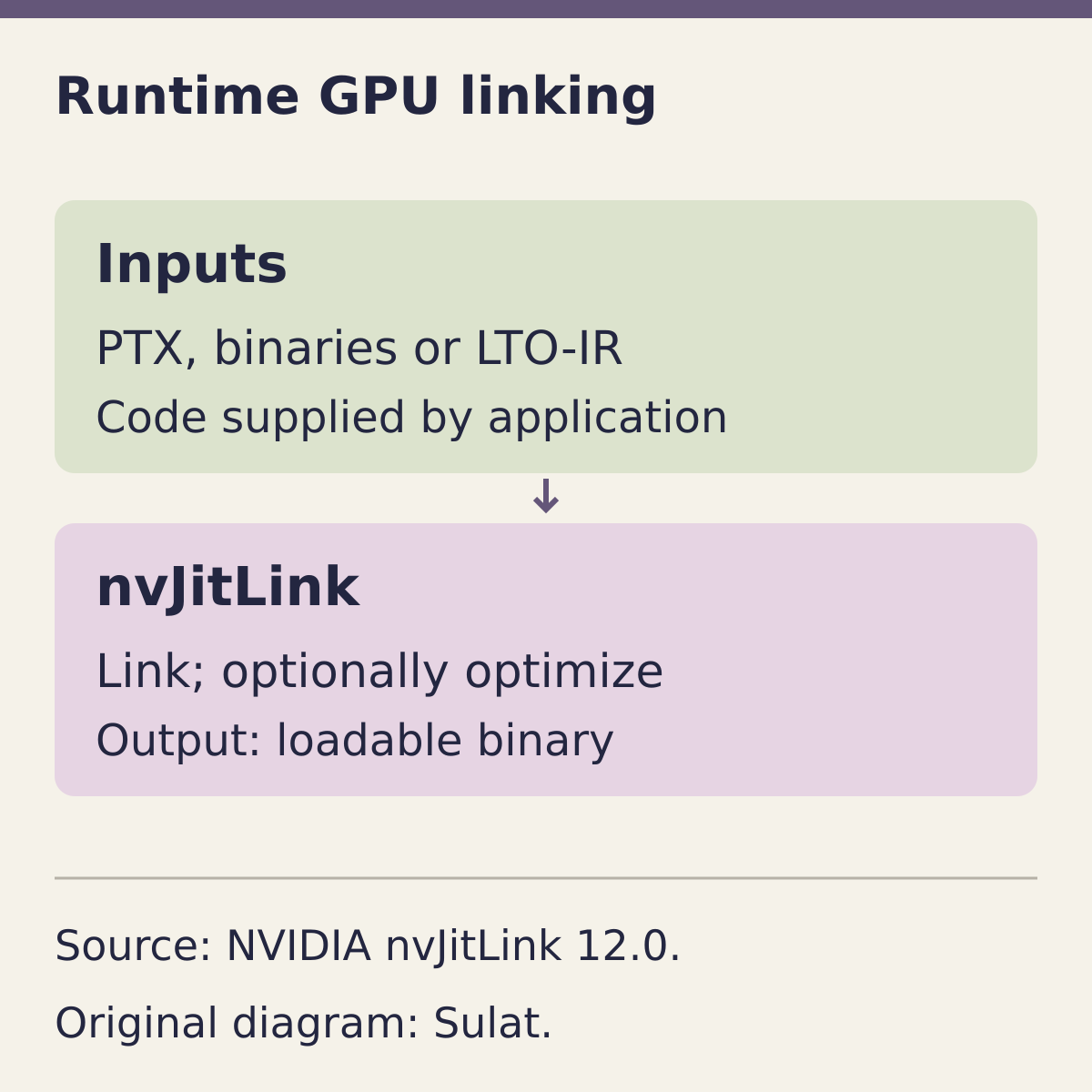
Link-time optimization is available when the inputs contain the required intermediate representation. The library also exposes low-level compiler options, giving application developers control over the link step. This is a way to assemble and optimize code at runtime; it does not establish a universal speed improvement for existing applications.
For teams adopting the release, a useful first test is whether their toolchain still builds and runs correctly, followed by measurements on the actual workload. A new toolkit version and a faster production application are separate milestones.
Illustration: Sulat. Logo: NVIDIA. Independent editorial illustration; no endorsement implied.
Discover more from Sulat AI & Tech News
Subscribe to get the latest posts sent to your email.