Kubernetes announced version 1.26 on 9 December, with 37 enhancements spanning stable, beta and alpha features. For cluster operators, the immediate upgrade work includes checking container runtimes and the path used to download release images.
Illustration: Sulat. Logo: Kubernetes.
Check the runtime before the node
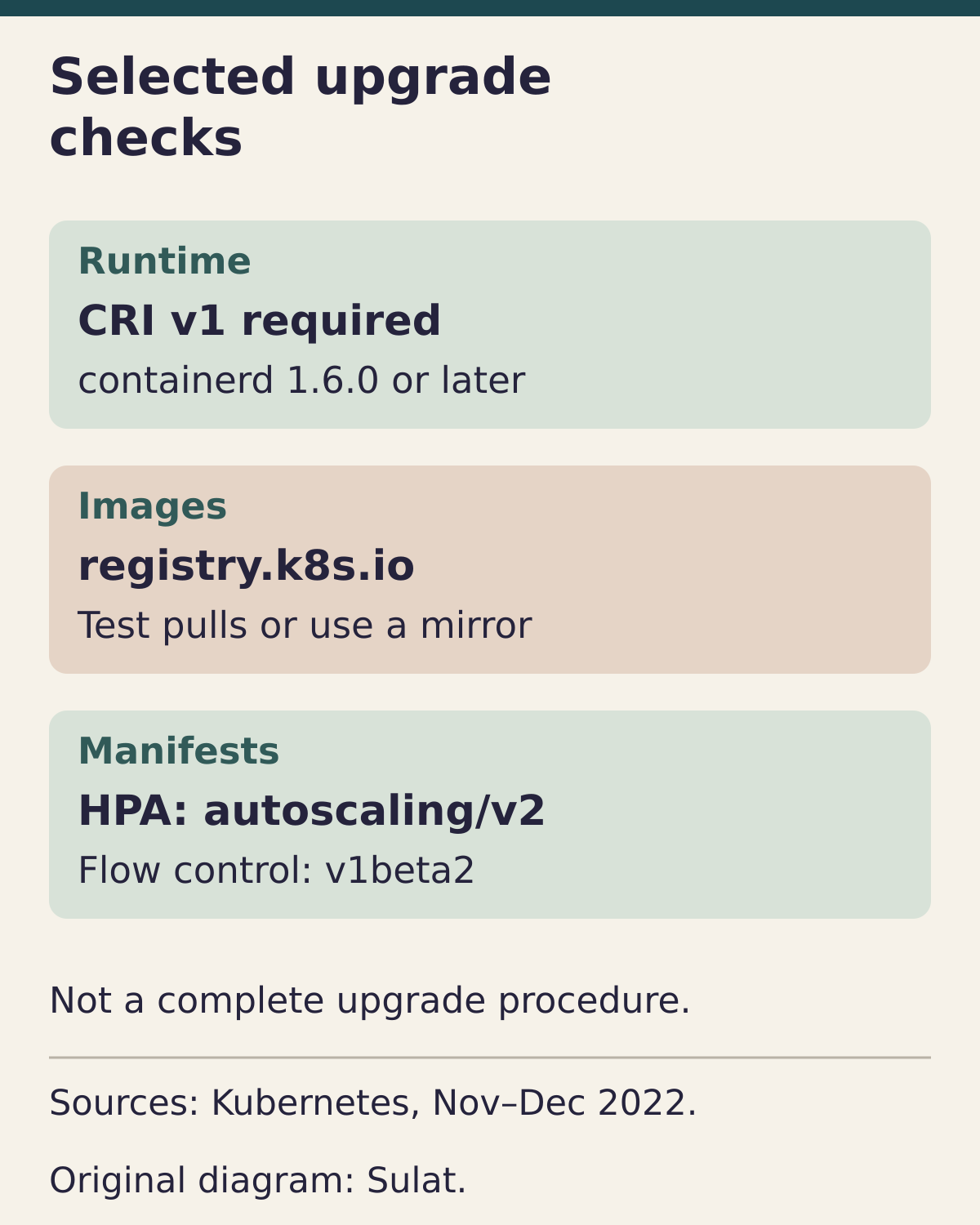
The runtime compatibility change removes CRI v1alpha2, the older interface between kubelet and a container runtime. A 1.26 kubelet cannot register its node if the runtime lacks CRI v1. Operators using containerd 1.5 or earlier need containerd 1.6.0 or later before upgrading that node.
Application manifests also need a review: HorizontalPodAutoscaler clients must move from autoscaling/v2beta2 to autoscaling/v2. FlowSchema and PriorityLevelConfiguration clients using flowcontrol.apiserver.k8s.io/v1beta1 must move to v1beta2.
A new registry changes the network path
The release team directs users to registry.k8s.io, saying 1.26 image tags will not be published to k8s.gcr.io.
The project’s registry guidance explains why changing a hostname alone may be insufficient. Downloads can redirect to different cloud backends, so a network allowlist tied to the old registry can stop image pulls. Kubernetes recommends a private mirror for tightly restricted environments. The practical check is whether nodes can retrieve the required images through their actual network controls.
Stable additions, experimental options
Windows HostProcess containers, which support privileged host-level tasks, and CSI migration for Azure File and vSphere reach stable status. Dynamic Resource Allocation, which gives third-party developers more control over specialized resource scheduling, enters alpha behind a feature gate. Its inclusion does not make it a default production capability.
Discover more from Sulat AI & Tech News
Subscribe to get the latest posts sent to your email.