OpenAI’s Point-E research, dated 16 December, explores turning text into 3D point clouds in one to two minutes on a single GPU. The authors report faster sampling than leading alternatives, with lower sample quality.
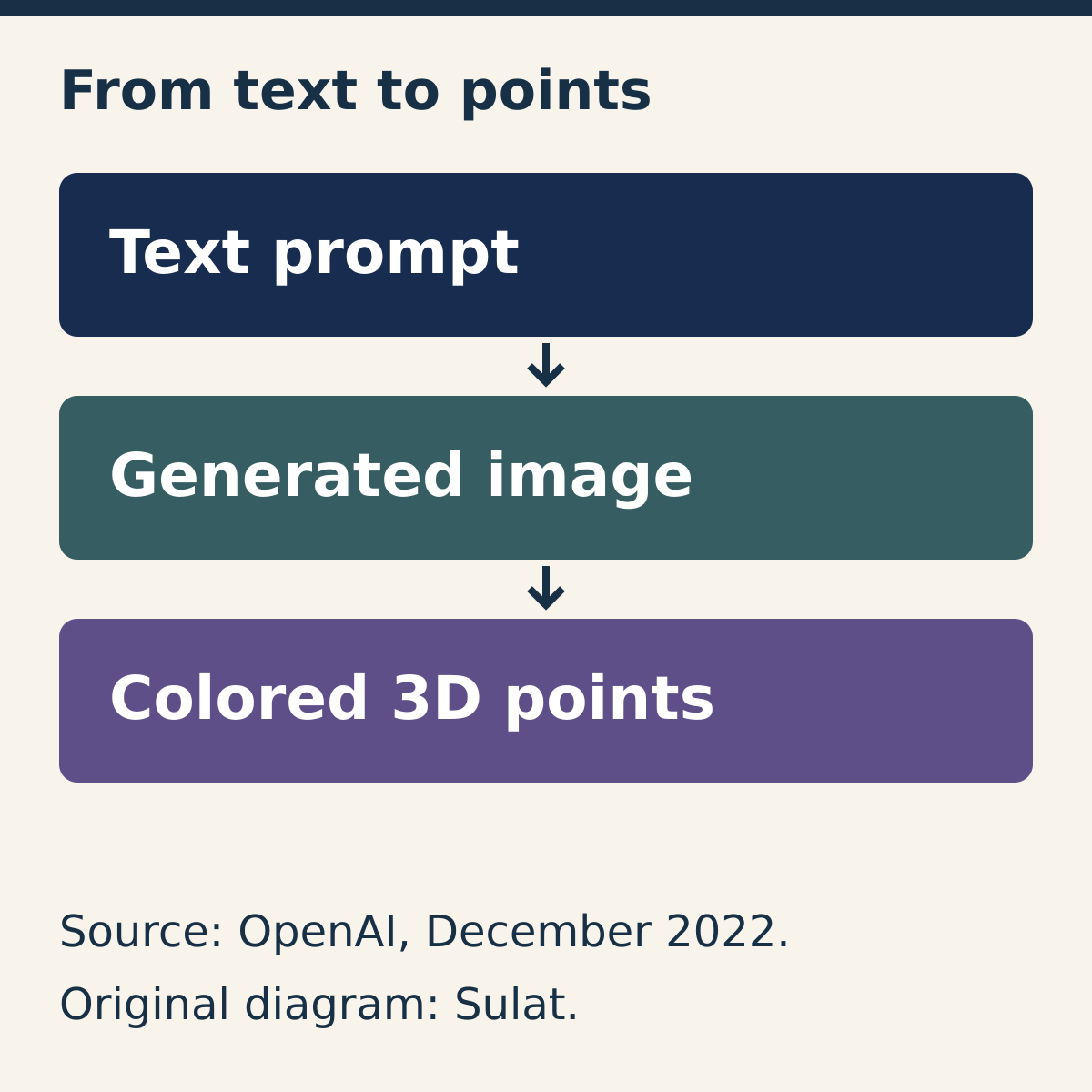
The system first generates an image, then uses it to guide a model producing colored points in three-dimensional space. Those points describe an object; they are not a finished production asset.
Another route from images to objects
September’s DreamFusion paper showed a different way to use a text-to-image model for 3D generation. Its researchers repeatedly render a developing 3D representation from different angles and use the image model to guide its improvement. That approach does not require a collection of 3D training examples.
DreamFusion describes a neural radiance field, a representation that can be rendered from new viewpoints and under different lighting. Its central idea is to use knowledge learned from two-dimensional images to guide the construction of a three-dimensional object.
These approaches make the choice of output important. A useful evaluation should consider the representation a project needs, the work required to refine it and the cost of trying alternatives, alongside generation time.
Point-E’s reported timing is a research result, not a guarantee for every prompt, computer or downstream workflow.
Illustration: Sulat. Logo: OpenAI. Independent editorial illustration; no endorsement implied.
Discover more from Sulat AI & Tech News
Subscribe to get the latest posts sent to your email.