Google announced Bard on 6 February, opening its experimental conversational service to trusted testers. Wider public access is planned for the coming weeks.
Sulat illustration; Google logo.
Bard initially uses a smaller version of LaMDA. Google says it draws on web information and needs less computing capacity, allowing more people to provide feedback.
Google plans Search features that condense complicated questions and differing perspectives into accessible summaries. It also says it will start onboarding developers, creators and enterprises to a LaMDA-based Generative Language API next month. Both initiatives remain forthcoming.
Research behind the service
Google’s January 2022 LaMDA paper describes a family of dialogue models trained on public conversations and web text. Its researchers separate conversational quality from safety and factual grounding: a plausible-sounding reply is not, by itself, evidence that its claims are supported.
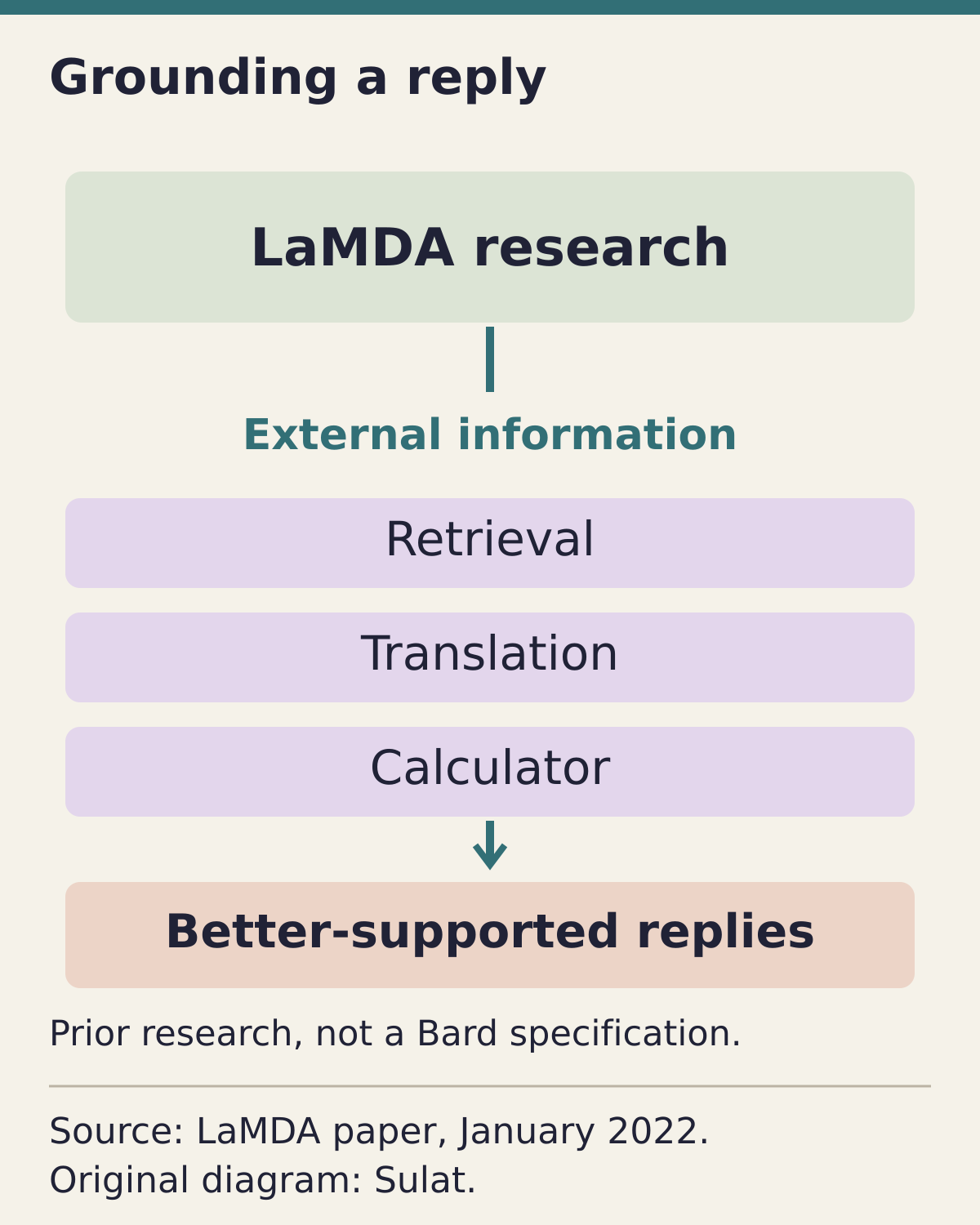
The study explores fine-tuning on annotated examples and consulting external information sources. Those sources include retrieval systems, a translator and a calculator. The researchers report improvements from these techniques, rather than relying on model scale alone.
The paper studies models as large as 137 billion parameters. That figure describes the research family, not a disclosed size for the smaller Bard service.
Discover more from Sulat AI & Tech News
Subscribe to get the latest posts sent to your email.