David Baker, Demis Hassabis and John Jumper have won the 2024 Nobel Prize in Chemistry, announced on 9 October, for protein design and structure prediction.
Baker, of the University of Washington, receives half the 11 million Swedish kronor prize for computational protein design. The other half goes jointly to Google DeepMind’s Hassabis and Jumper for protein structure prediction.
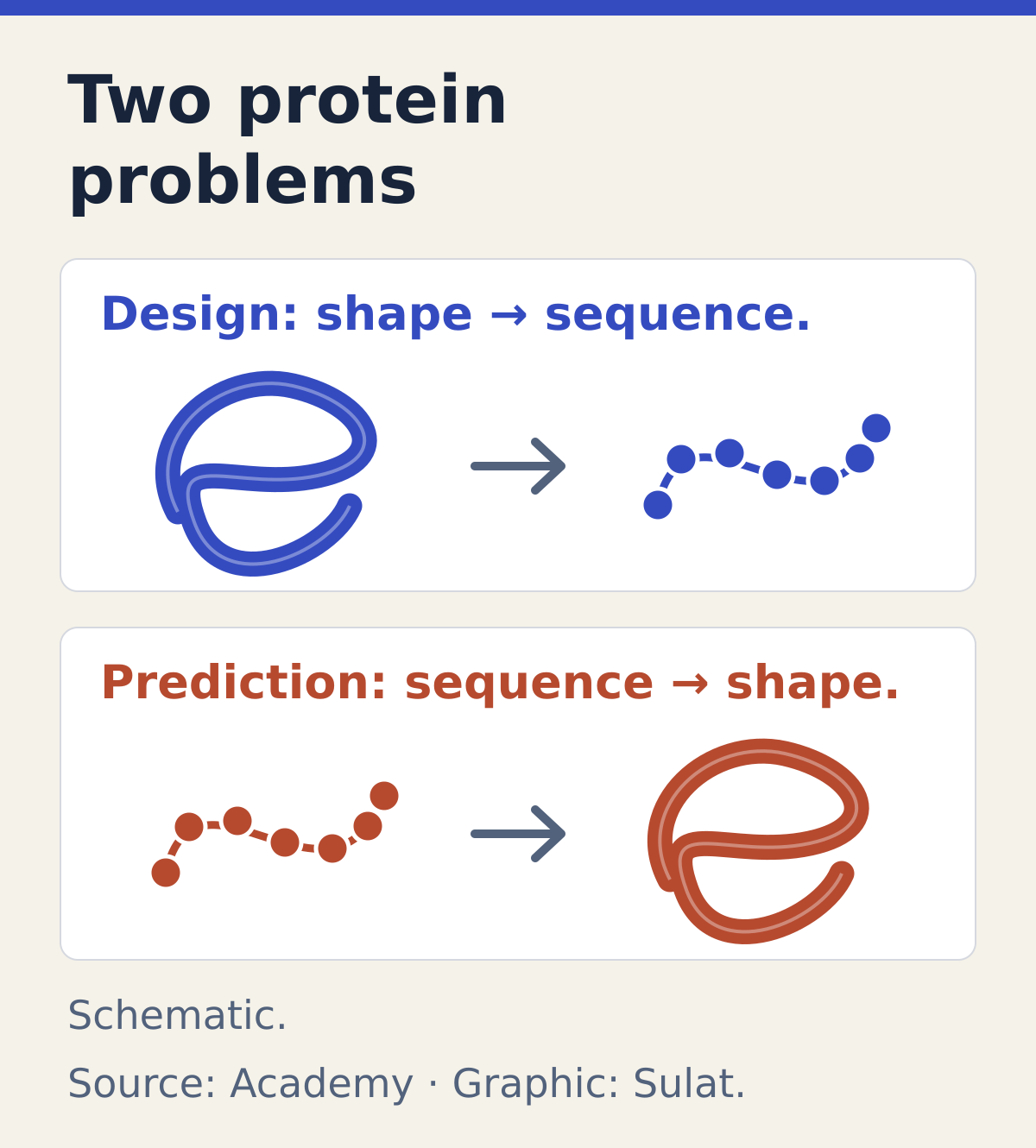
The two achievements tackle related questions. Structure prediction starts with a protein’s sequence of amino acids and seeks its three-dimensional shape. Protein design reverses the problem, choosing a target shape and finding a sequence that will produce it. Shape is central to a protein’s function.
The Nobel committee’s scientific background identifies Baker’s 2003 work on Top7 as a design breakthrough. His team used computation to create a protein with a structure unlike known natural proteins, then verified it by X-ray crystallography. The measured structure closely matched the design.
Hassabis and Jumper’s AlphaFold2 made its breakthrough in the 2020 CASP14 assessment, where predictions were tested against experimental structures withheld from participants. Its accuracy was competitive with experimental results for a majority of targets. That advance concerns predicting a protein’s final structure, a different task from explaining the physical process by which it folds.
The Academy says AlphaFold2 has been used by more than two million people in 190 countries. It cites research on antibiotic resistance and plastic-degrading enzymes.
Illustration: Sulat. Logos: University of Washington and Google. Decorative ribbons, not protein structures.
Discover more from Sulat AI & Tech News
Subscribe to get the latest posts sent to your email.