A lower Ahrefs score is not a Google penalty. More ChatGPT searches do not necessarily mean more visits to your website. And an AI agent reaching your checkout is not the same as a completed order.
Ahrefs previewed a replacement for Domain Rating, Google added direct home-service booking links to AI Mode in the US, and Microsoft and Cloudflare expanded ways to see what agents do on websites. Meanwhile, unexplained Search Console click spikes made some apparently good news harder to trust.
This review covers Monday 2 November to Sunday morning, 8 November 2026, in New Zealand daylight time. Older features and studies are identified as context rather than fresh launches.
The two Ahrefs posts tell different stories
Ahrefs’ Saturday post says API unit allowances have doubled: Lite to 200,000, Standard to 800,000, Advanced to two million and Enterprise to four million. That gives people building reports and agents more headroom. It is not, however, evidence of a second increase this week. Ahrefs’ own September feature roundup already lists exactly those changes, and its API help page dated 23 September shows the higher allowances.
The help page says direct API access, its MCP connection and Ahrefs Connect draw from the same allowance. MCP is a standard way for an AI assistant to call another service. Units are not requests: usage depends on returned rows and requested fields, with a minimum charge for non-free requests. The help table also describes Enterprise allowances as custom, so enterprise customers should check their contract rather than assume the social post changes it.
Charles Floate’s Friday post concerns something else: DR4, a preview of a new Domain Rating model. He points to score changes, including Google’s, and the reaction among link builders. The relevant change is to Ahrefs’ measuring system, not Google’s ranking algorithm.
Domain Rating estimates the relative strength of a backlink profile. DR4 scores many subdomains separately instead of allowing them to inherit their parent domain’s score. It also gives more weight to links from sites and subdomains Ahrefs estimates receive organic search traffic. The main Ahrefs interface is scheduled to switch on 1 December; the preview can already be checked through a demo or its free Domain Rating API.
That matters if you buy a placement because the host advertises a high DR. A page on a large hosting platform may no longer borrow the parent’s score. Check the actual host, its audience and whether the placement brings useful visitors. Changing a spreadsheet number does not demonstrate that any backlink disappeared.
Ahrefs tested ranking correlations across 10 million hosts. DR4’s correlation with top-ten Google ranking positions was 0.359, compared with 0.140 for DR3. But the root-domain subset went the other way: 0.304 for DR4 against 0.407 for DR3. The claim of a stronger overall relationship therefore needs its population attached. It is not evidence that every site gets a better prediction, or that increasing DR causes rankings to rise.
| Population | Hosts | DR3 | DR4 |
|---|---|---|---|
| All hosts | 10,000,000 | 0.140 | 0.359 |
| Root domains | 5,231,436 | 0.407 | 0.304 |
| Subdomains | 4,768,564 | 0.172 | 0.259 |
Google’s confirmed changes were narrower than the noise
The Search Status Dashboard showed no incidents in the reviewed period. That is not a promise of stable rankings: it means the dashboard did not confirm a named ranking rollout or service incident for this week. A tracker’s volatility reading cannot establish which algorithm changed.
Google did clarify its help text for Crawled – currently not indexed. Search Engine Roundtable reported the wording change on 3 November, and the current help page confirms it: Google does not index every page, the message is common, and it does not necessarily require action. For important pages, Google points owners to URL Inspection and diagnosis before reporting a suspected site-wide indexing bug.
Treat that as documentation guidance, not a new route to guaranteed indexing. Start with the pages that sell your service, explain your product or contain reporting people need, rather than trying to turn every excluded URL green.
Search Console also produced unusual click spikes for some sites. Barry Schwartz reported seeing discrepancies between its API and web interface and asked Google whether a reporting bug was involved. The report reviewed here does not contain a Google confirmation. Before celebrating a surge, compare landing-page sessions, server logs and completed actions, and check whether the API and interface agree.
There was no verified new AI-click reporting launch to announce. Search Engine Journal reported Gary Illyes saying Google had nothing to announce about additional data. Google’s current AI-features guide still places AI-feature traffic within the Web Performance totals. Do not create a clean AI-versus-classic-search click split from a report that does not provide one.
Search results are becoming places to act, not just lists to leave
Google Search product vice-president Robby Stein announced direct home-service links in AI Mode through Angi, Thumbtack, Housecall Pro and Jobber, with ServiceTitan coming later. His post says the feature is available in the US. For New Zealand readers, this is a development to watch, not a claim that local booking eligibility has expanded here.
A button beside a Bing result opened an infographic-style summary in a recording reported by Search Engine Roundtable this week. The report credits Khushal Bherwani. We found observed interface evidence, not a Microsoft announcement establishing a universal rollout. It illustrates another way a person can consume a page’s information without immediately visiting it.
Microsoft’s bigger confirmed announcement was Clarity’s expansion on 4 November. Its agent dashboard and simulations are intended to show which supported agents visit, whether tasks complete and where they get stuck. Simulations start with commerce and travel. Brand Agents can also extend eligible Shopify and WooCommerce products into Copilot, Bing and MSN, with purchases completed on the merchant’s site. Local-service integrations connect to booking systems such as Square and Jobber.
Not everything in that announcement is available to everyone. Despite its broad introductory wording, the detailed Ask Clarity section says the experience is in closed beta for retailers. Its 88% positive early-access finding means 14 of 16 respondents, not a representative survey of all businesses.
Microsoft’s nearly two million weekly agent sessions are also not a count of customers acquired this week. Its underlying analysis covers 5.23 million agent sessions across 230,511 projects from 13 August to 9 September. That is useful evidence of activity in its observed estate, but not a market-wide adoption rate.
Cloudflare announced a Personal Assistants category in Security Analytics and per-agent access choices on 4 November. Owners can inspect requests and error responses, then allow or block supported agents, including blocking them on pages with ads. Existing Search and Training policies remain separate. Account-level agent identity features depend on Account Abuse Protection, which is in early access.
For a publisher, allowing a search crawler and allowing a personal assistant to fetch articles are different decisions. For a shop, blocking an agent at the firewall may stop a customer’s attempted purchase. Review actual paths and errors before changing access rules wholesale.
ChatGPT’s search-volume claim needs a different denominator
In an interview published by Big Technology on 3 November, OpenAI consumer product lead Adam Fry put ChatGPT’s search-like query volume at roughly one-fifth of Google’s. Search Engine Journal’s follow-up explains that OpenAI counts questions that send ChatGPT to the web. The Google comparison figure, geography and measurement window were not supplied.
That is a company estimate of search activity, not a claim that ChatGPT sends publishers one-fifth as much traffic. Ahrefs’ current traffic tracker, updated this week, analyses a fixed set of 118,671 sites using its Web Analytics service. For October, it reports Google at 24.74% of tracked traffic and ChatGPT at 0.36%.
These can both describe different things. A person can ask several web-backed questions, see citations and never click. The Ahrefs sample is also a selected population of sites using its analytics, not the whole internet. Its page explicitly warns that some channel categories overlap; they should not be stacked into a pie chart.
OpenAI’s current merchant documentation describes US shopping discovery, integrated Shopify and Etsy catalogues and checkout on merchants’ sites or apps. We did not establish those existing arrangements as a new launch this week. A retailer should keep product price and availability accurate, but should not read a fresh social discussion as proof of a new integration deadline.
Sulat has separately covered an observer’s report of a ChatGPT dashboard that would count brand mentions and clicks. That remains a reported product under development, not a confirmed public analytics launch. The distinction matters if you are being sold access to a measurement capability today.
An older study returned to the conversation too. Search Engine Land’s 6 November analysis revisits Ahrefs’ 75,000-brand research from 2025, in which web mentions had a stronger association with AI Overview brand mentions than raw backlink counts. That is context, not a new study this week. The original sample required DR above 40 and a high-volume keyword; it says about 26% of brands had no AI Overview mentions and that it studied the remaining group. Those filters matter before extending the findings to a small local business.
What should change on Monday?
Keep four measures separate: whether a page is eligible to appear, whether people see it or its brand mentioned, whether they visit, and whether they complete something useful. Use them together to investigate a change, not as interchangeable scores.
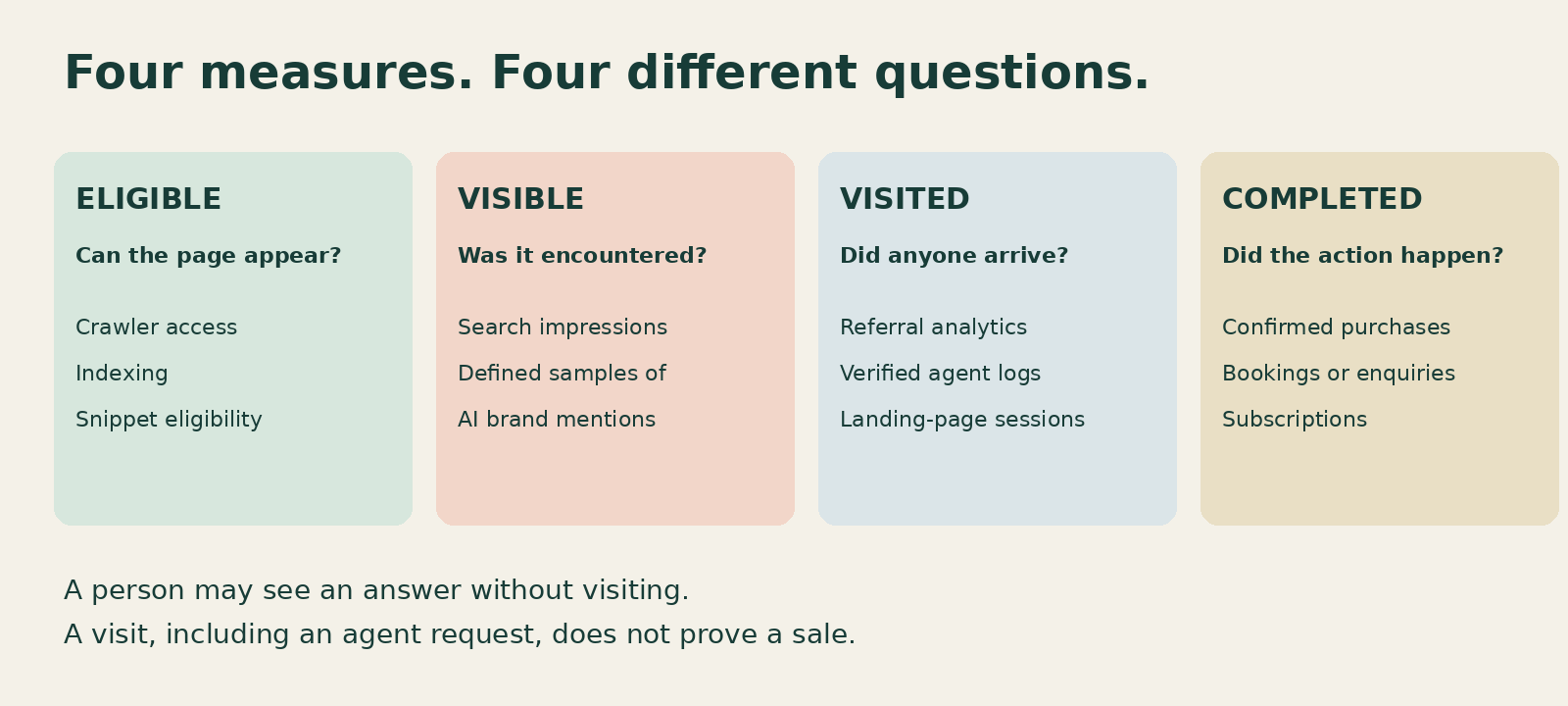
- Eligible
- Can the page appear? Check crawler access, indexing and snippet eligibility.
- Visible
- Was the page or brand encountered? Use impressions and clearly defined AI mention samples.
- Visited
- Did someone arrive? Check referrals, landing-page sessions and verified agent logs.
- Completed
- Did the intended action happen? Check confirmed purchases, bookings, enquiries or subscriptions.
The map separates measures rather than predicting a guaranteed funnel. See Google’s eligibility and measurement guidance and Clarity’s task-completion announcement.
Record DR3 and DR4 side by side before December’s switch, including competitors and the exact linking host. Verify important pages can be crawled and indexed. Keep Business Profile details and product feeds current. Check booking and checkout journeys against the agents you actually see in logs, while preserving appropriate privacy and security controls.
For content, prioritise information that answers a real buying or research question and adds evidence another summary cannot supply: original tests, clear product constraints, local details and identifiable sources. Google’s standing guidance requires no special AI markup or new AI text file for AI Overviews or AI Mode; supporting pages must be indexed and eligible for snippets.
A publisher may gain mentions without gaining subscribers. A business may gain fewer visits but more qualified enquiries. Neither result can be diagnosed from Domain Rating alone. This week’s useful shift is towards measuring those journeys separately, then checking which ones pay for the work.
Another way to follow the week
Barry Schwartz’s published Search Engine Roundtable rundown includes indexing guidance at 5:03, Search Console click spikes at 7:42, home-service booking at 10:20 and Clarity at 16:07. These are the publisher’s chapter markers; our reporting above was checked against the linked written and primary sources.
Discover more from Sulat AI & Tech News
Subscribe to get the latest posts sent to your email.