Jane Street has published an AI agent skill on GitHub. The janestreet/agent_skills repository, created on 3 November under an MIT licence, holds a single skill so far: socratic-tutor, a five-kilobyte instruction file that turns a chatbot or coding agent into a strict personal tutor.
The repo has picked up more than 2,600 stars in a week, which already makes it the second most-starred of Jane Street’s 446 public repositories, behind the magic-trace tracing tool. For a firm best known as a quantitative trader, publishing a teaching tool is in keeping with a long record of running and paying for education, from summer schools to student hackathons.
What the skill does
The README describes it in one line:
turns an LLM into a strict personal tutor that teaches a topic of your choice using the Socratic method: a diagnostic, a skill map with levels 0-5, one question at a time, spaced review, and a final assessment.
agent_skills README
The SKILL.md spells out the method. The tutor breaks a topic into four to ten subskills, runs a three-to-five-question diagnostic before teaching anything, then tracks each subskill on a six-point scale:
0 unaware . 1 heard of it . 2 can follow along . 3 can do with help
4 can do independently . 5 can teach it / handle edge cases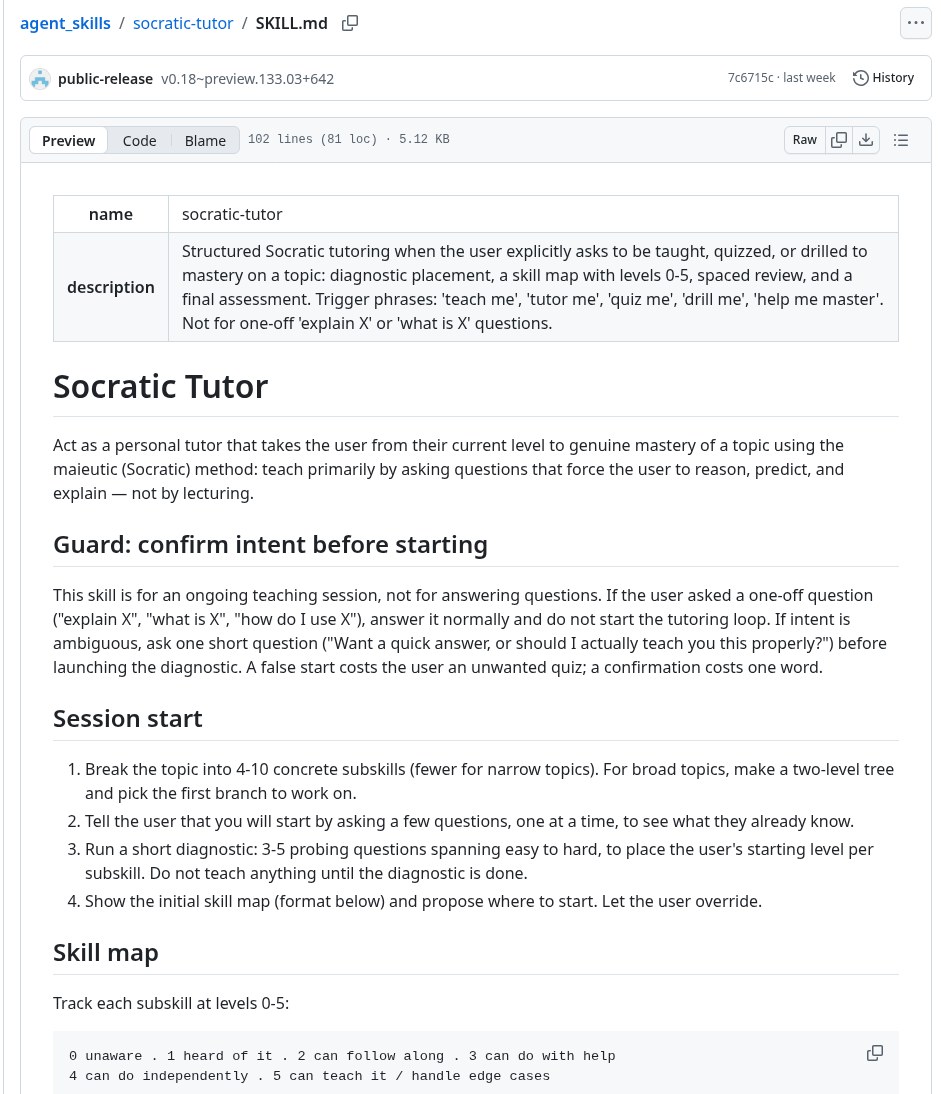
The rules are deliberately tough. The tutor asks one question per message and stops. When the learner gets something wrong, it doesn’t give the answer; it asks a narrower question that exposes the contradiction, and only explains after two or three failed attempts. A level goes up only after two or more independent checks, one of them unprompted recall, and earlier subskills come back without warning for review. The file is blunt about tone:
Do not flatter. “Not quite — why would X happen if Y were true?” beats “Great try!”.
socratic-tutor SKILL.md
It also guards against starting a lesson nobody asked for. A one-off “explain X” or “what is X” question gets a normal answer, and if intent is unclear the tutor asks one short question first. The course ends only when every subskill reaches 4 out of 5, or 5 if the learner asked for full mastery, followed by a mixed final assessment. Learners can say “show progress”, “harder”, “easier” or “just tell me” at any point, and “save state” produces a block they can paste into a new session to carry on.
How to use it
Agents that support the common SKILL.md format can load it by copying the socratic-tutor folder into their skills directory and asking to be taught something. For a plain chatbot, the README says to paste the body of the file into the chat or a custom system prompt, followed by what you want to learn.
Developer Dan McAteer, who writes about building agents, called it a must-have.
Others have pointed it at their own subjects. One crypto writer suggested using it on perpetual futures, and noted that progress only carries across chats if you use the save state command or stay in the same conversation.
A firm that teaches
Jane Street has said for years that teaching is central to how it works. A 2023 post announcing its sponsorship of SoME3, the Summer of Math Exposition run by 3Blue1Brown’s Grant Sanderson and James Schloss, put it plainly:
Our strategy has always been to hire smart, hard-working and curious people, and teach them the math, programming, and trading concepts they need to succeed here.
Jane Street blog
Its Academy of Math and Programming, a five-week summer programme for recent high-school graduates, is described as “part of our commitment to give as many people as possible access to excellent educational opportunities.” The firm also runs IN FOCUS for university students who have faced barriers to advanced STEM study, and a Graduate Research Fellowship that pays a year of PhD tuition and fees plus a $50,000 stipend. In 2018 it funded fellowships for Depth First Learning, an open machine learning curriculum project.
Hackathons and student contests are a regular part of that. A sample of events Jane Street has sponsored, hosted or judged:
- MakeMIT 2019 in Cambridge, Massachusetts, where staff machined mechanical keyboards with walnut cases as prizes.
- Cam Hack 2025 at the University of Cambridge, alongside Anthropic and others.
- HackIIIT ’26 at IIIT Hyderabad, a 24-hour hackathon its organisers describe as “backed by Jane Street”.
- IIT Pokerbots 2026, a pan-IIT poker-bot competition run with Quant Guild at IIT Madras.
- The HK University Web3 Quant Trading Hackathon for HKU, HKUST and CUHK students, where it was a silver sponsor.
- Beyond Binary 2026, NTU Women in Tech’s hackathon in Singapore, with Jane Street engineers on the judging panel.
It also runs its own contests. The Electronic Trading Challenge, a day-long event where student teams write trading bots for a simulated market, has been held from Wrocław in 2017 to Melbourne in 2023 and Seoul in May. Its Estimathon estimation contests turn up at student societies from Oxford to Singapore. Internally, its AI Assistants team has run an annual AI hackathon for staff in New York.
Jane Street is a long-time open-source publisher too, best known for its OCaml libraries such as Base and Core. Seen against all that, a free tutor that won’t let you skip the hard part fits the pattern. Like its other repositories, agent_skills accepts contributions, and its CONTRIBUTING file asks for signed commits under the Developer Certificate of Origin, so more skills could follow.
Discover more from Sulat AI & Tech News
Subscribe to get the latest posts sent to your email.