Reverse Engineer Anything, or REA, has become one of the biggest repositories on GitHub in about a month. Shubham Saboo, a senior AI product manager at Google, flagged that it had passed 440,000 stars. The morluto/rea repo has since crept closer to 450,000, with more than 110,000 forks.
The star count isn’t the interesting part. What matters is what people are doing with it: pulling jump physics out of an old platformer, rebuilding a Samsung TV’s home screen, bringing a dead game back in the browser. Here’s what REA does, why it caught on, and what the community has built with it.
REA in action
Most of what people share is video. Here’s a sample of what they’ve taken apart and rebuilt.
Stefan Vaskevich, who posts about 3D and AI tools, used REA to pull the run and jump numbers out of a classic 3D platformer, then had Claude Code build a new game that matched how the original moved.
Max took apart VLC’s 200% volume boost and turned it into a menu bar toggle that works for every app on a Mac.
Smart TVs are a popular target. Hunter ran REA on his Samsung TV’s Tizen software and built a cleaner launcher and home screen, without the autoplaying free channels.
Aswin DG used it to work out his Samsung TV’s control protocol, then built a web remote for volume, channels and apps.
Eason Zhang shared how another developer used Codex and REA to work out an air conditioner app’s protocol, then switched the unit on and off with a hand gesture through Snap’s Specs AR glasses.
Old software is fair game too. Defileo highlighted a Reddit user who rebuilt stress.exe, a piece of freeware from 2000, with REA and Opus 5.5, then shipped it as a macOS app.
A demo shared by Chrome shows REA rebuilding a Mac clipboard app and modding a game, with Claude Code reasoning over what Ghidra returns.
Games get the most attention. Samakcha Mishra studied how the racer Redline ’80 plays, then built a new top-down racer with fresh code and art.
Lucas brought back Hawken, a PC mech game that’s long gone, as a browser game for PC and mobile.
Others are modding. One user is building a custom radio station for Watch Dogs.
What REA is
REA is an open-source, MIT-licensed Model Context Protocol (MCP) server and command-line tool, published on npm as rea-agents. It gives a coding agent the tools to inspect software it doesn’t have the source code for. The README puts it in one line:
One MCP for reverse engineering across binaries, applications, and runtime behavior.
REA README
It doesn’t replace decompilers. For native binaries it drives an existing Hopper, Ghidra, IDA or Kuna installation, and setup can install Hopper after you approve it. Static analysis of JavaScript, Electron apps and .NET assemblies needs no native engine at all. The README’s target table also covers Android APKs, websites, recorded browser traffic, firmware and several game formats.
The analysis runs on your own machine. As the README’s FAQ puts it, “Your agent receives the tool results, and its model provider has its own data policy.”
How it works
Setup is one command. It registers REA with your agent and installs matching workflow instructions. The README lists support for Claude Code, Codex, Cursor, Gemini CLI, Grok Build and other agents.
npx rea-agents@latest setupAfter that, you ask a plain-language question about one feature. REA hands the agent the evidence: pseudocode, assembly, strings, symbols, calls and references for native code, plus what the program does while it runs. The agent reads those findings, explains the feature and, if you ask, builds its own version. The README’s example prompt:
Understand how search works in the Notes app, show me the evidence, and build a similar feature for my project.The project site walks through two worked examples. In one, the agent reads the running code of Chrome’s dinosaur game to find its speed rule and rebuilds it with a slider. In the other, it reads the installed Windows Calculator DLL to work out why 200 + 10% gives 220.
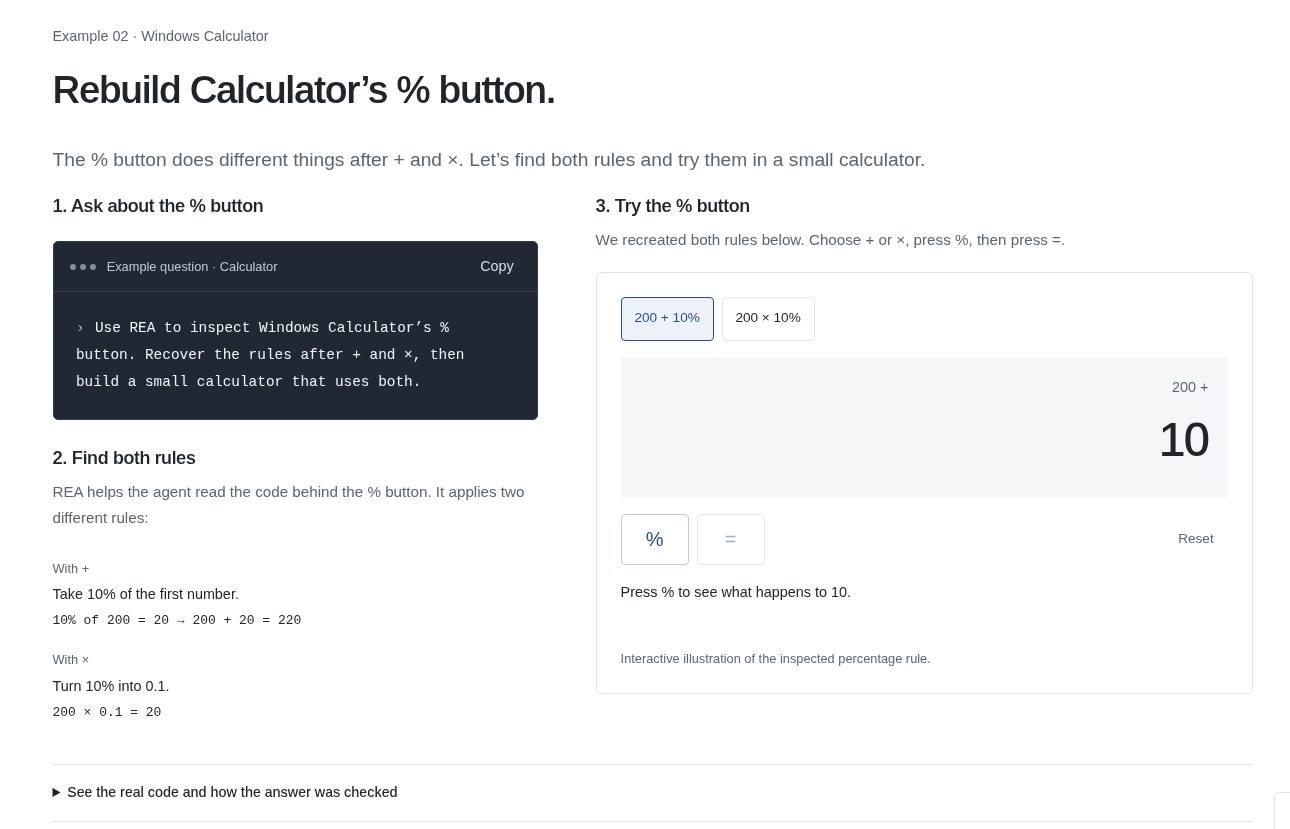
The answer is that after +, the % button takes a percentage of the first number, and after × it turns 10% into 0.1. REA supplies the handler’s instructions, decompiled code and calls; the agent explains which branch applies and how to rebuild it.
Why it took off
Reverse engineering used to mean learning Ghidra or IDA, reading assembly and keeping careful notes. Coding agents can now do much of that legwork if someone wires them up to the right tools, and REA is that wiring. Its pitch is aimed at product builders rather than security specialists:
See a feature you like. Understand how it works, down to the binary level.
REA README
Three things helped it spread. It works with almost every popular coding agent rather than locking you to one. Installing it is one copy-paste. And every demo ends with something you can run, which makes for very shareable posts.
The repo was created in April, but it took off in October. Daily GitHub Trending trackers logged it at under 10,000 stars on 7 October and above 80,000 by 11 October, when it held the top spot. By the end of the month it had passed 400,000. Downloads tell the same story: npm counted 491 downloads of rea-agents in September and more than 1.5 million in October, with about two million in the past 30 days.
| Measure | Figure | Source |
|---|---|---|
| GitHub stars | 447,896 | GitHub |
| GitHub forks | 110,432 | GitHub |
| npm downloads, September | 491 | npm |
| npm downloads, October | 1,522,851 | npm |
| npm downloads, past 30 days | 1,992,243 | npm |
| Latest release | rea-agents 6.8.0 (25 October) | GitHub releases |
One of the most widely shared explainers came from Vlad in mid-October, at the height of the run:
That kind of fame brings copycats. The README now tells people to get REA only from the morluto/rea repo, rea.tools or the rea-agents npm package. In October, users on X flagged a lookalike GitHub repo that copied the official description and pushed people to download an executable.
What people have built with it
Some builders have gone further and written up the whole process.
Mehal Kumar, who runs a gaming YouTube channel, pointed REA at CapCut, had Claude Code explain how its editing features worked, then rebuilt them in his own video editor.
Former Amazon engineer Samin Yasar replaced a YouTube research tool he’d been paying for with HookLab, an open-source version that runs on his own machine. He’s careful to say it’s a rebuild, not a copy.
Others have gone after hardware. One user had REA trace how their drone’s companion app handled camera feeds, telemetry and flight commands. Claude Code then built person tracking and a follow controller on top, with speed limits and pilot takeover.
Smaller projects show the same pattern. Anuhas D. took apart the Windows-only Yeelight Station installer and rebuilt it as a native Mac app in Swift.
The project’s own case studies are more rigorous, with each result checked against the original program:
- DX-Ball: REA recovers a sound-pan calculation from the 1996 Windows game as a small C function. The reconstruction “passes 3,205 original-x86 cases and reproduces all 63 compiled function bytes.”
- Notion: it traces how the Electron app copies text and HTML, following IPC wrappers through to the system clipboard.
- TH04: it matches a 16-bit PC-98 angle helper to readable C++ to show how the game aims a ring of bullets at the player.
- Aegis: it finds the six-digit code calculation in the authenticator’s released APK.
- A CTF challenge: it turns a DownUnderCTF flag checker’s masks and sums into equations, then checks the solved flag against the original program.
REA has also branched out from inspection. It can record a web app session, turn the app’s API into tools and export a reinforcement-learning environment that an agent can train or be tested in.
The fine print
Pointing an agent at someone else’s software raises obvious legal questions, and the README addresses them directly:
REA is for lawful research, education, interoperability, software preservation, and analysis of software you own or are authorized to examine.
REA README
It also says you must legally obtain commercial tools such as IDA Pro and Hopper, and that “Cracked copies, stolen keys, unauthorized key sharing, and bypassing license restrictions are not authorized.” Learning how a feature works and writing your own version is a long way from copying someone’s code or assets, which is why builders like Samin Yasar spell out that their rebuilds contain nothing from the original.
Model providers are drawing their own lines too. Anthropic has moved to restrict Claude from reverse engineering video games, and reports say the limits have also caught legitimate game developers. So whether a given REA job runs smoothly can depend on which agent you plug it into.
The next version is close. Creator morluto said on 7 November that “rea v6.9 took a bit of time but will be ready soon!” We covered REA briefly when it first started trending; a month on, the projects people are building with it make a better case for it than the star count does.
Discover more from Sulat AI & Tech News
Subscribe to get the latest posts sent to your email.