A post on X by Slumdog8 says Capy’s cloud machines cost more than Amp’s, and that Amp’s US$20 plan is far better value. The value claim holds on both companies’ own pricing pages: Amp’s Megawatt plan includes 45,000 minutes (750 hours) of cloud machine time, while Capy’s Lite plan includes US$20 of credits. The Capy machine sizes in the post are wrong, though. It lists them with half the RAM Capy documents.
The biggest problem with @capydotai is the pricing.
— Slumdog8 (@slumdog_8) November 14, 2026
Capy subscription tiers ($20/$100) convert to usage credits:
• 2 CPU, 4GB: $0.20/hr
• 4 CPU, 8GB: $0.40/hr
• 1 CPU, 2GB: $0.10/hr
Compare this to @AmpCode pay-as-you-go:
• 2 CPU, 4GB: $0.17/hr (15% cheaper)
Value breakdown (subscription):
• Capy $20: 100 hours
• AmpCode $20: 750 hours
With an AmpCode subscription, you get 750 hours on a 2 CPU, 4GB machine for $20. That’s ~$0.027/hr—an absolute steal.
I really like Capy, but I hope they adjust their pricing to make cloud usage more cost-effective.
The post sets Capy’s US$0.20 an hour machine against Amp’s pay-as-you-go 2 CPU, 4 GB machine at US$0.17, which it calls 15% cheaper. It then counts hours: US$20 buys 100 on Capy and 750 on Amp, about US$0.027 an hour.
What Capy’s machines are
Capy’s machines page lists Small as 1 CPU and 4 GB at US$0.10 an hour, Medium as 2 CPU and 8 GB at US$0.20, and Large as 4 CPU and 16 GB at US$0.40. The prices in the post are right. At each price, the RAM is half of what Capy lists.
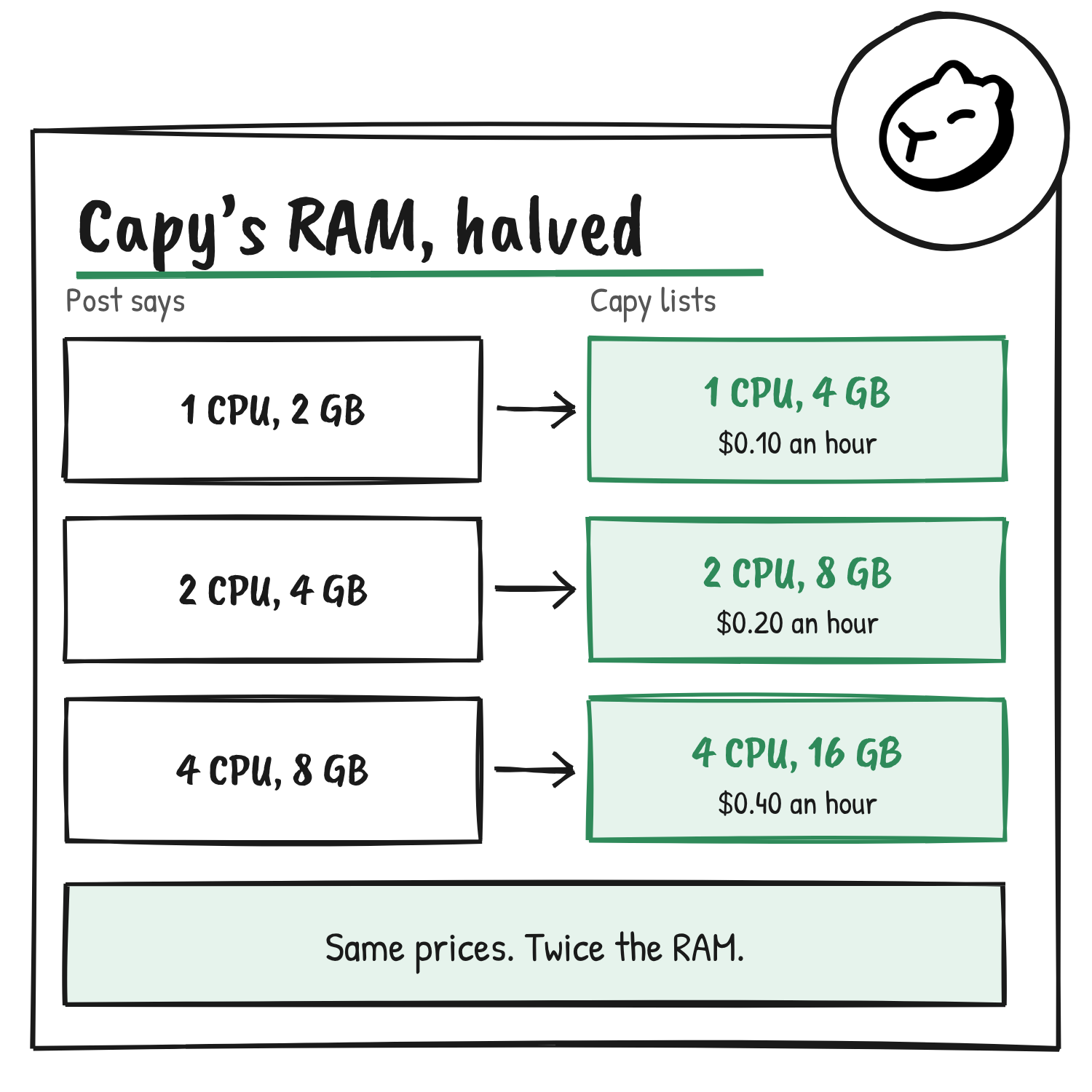
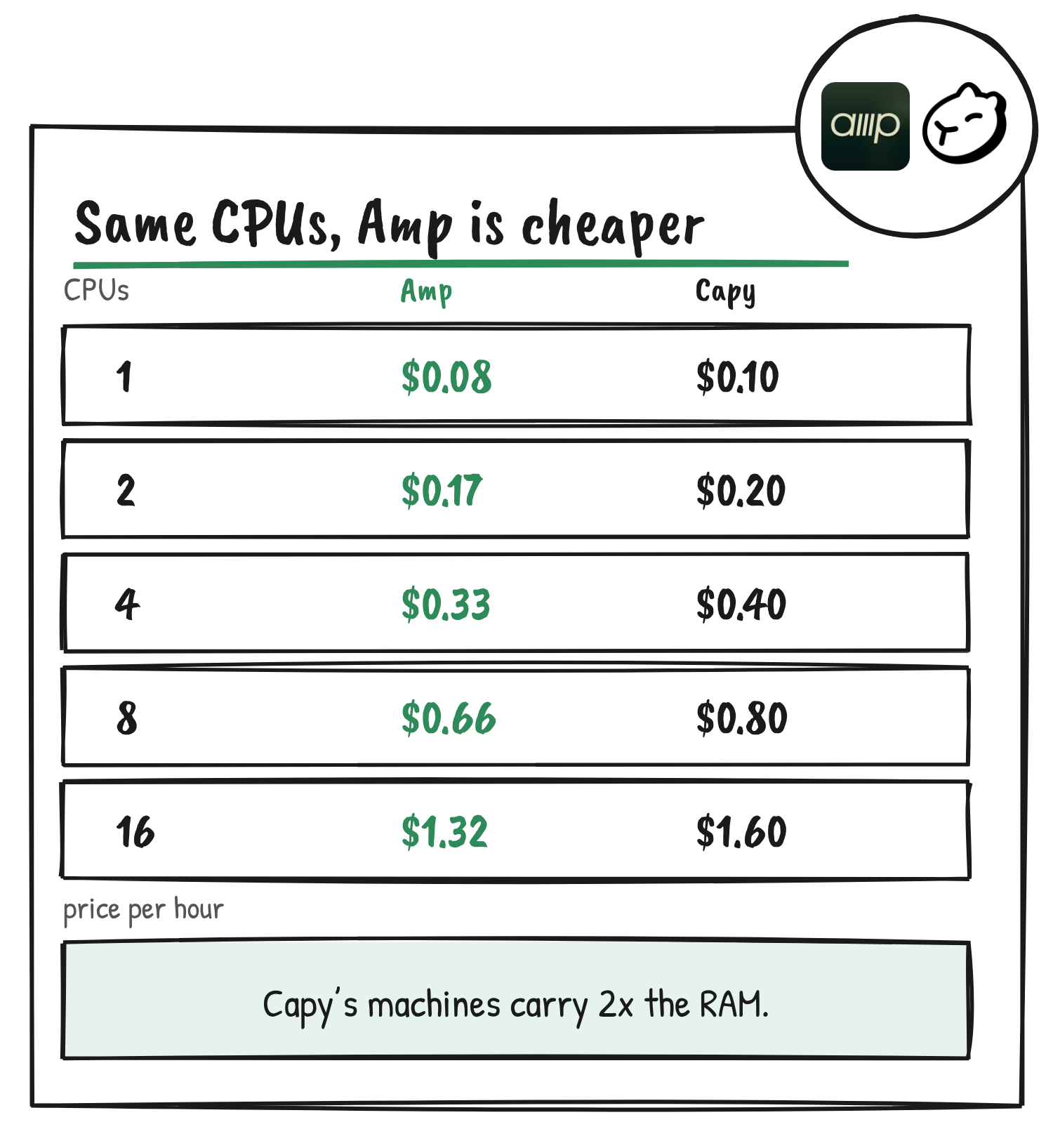
That changes the 15% figure. Amp’s sizes and costs page lists a1.small as 2 CPU and 4 GB at US$0.17 an hour, and Capy’s US$0.20 machine has 2 CPU and 8 GB. Matched on CPUs, Amp’s hourly price is 15 to 20% lower at every size, and Capy’s machine has twice the RAM.
| CPUs | Amp size, RAM, price an hour | Capy size, RAM, price an hour | Amp lower by |
|---|---|---|---|
| 1 | a1.tiny, 2 GB, US$0.08 | Small, 4 GB, US$0.10 | 20% |
| 2 | a1.small, 4 GB, US$0.17 | Medium, 8 GB, US$0.20 | 15% |
| 4 | a1.medium, 8 GB, US$0.33 | Large, 16 GB, US$0.40 | 17.5% |
| 8 | a1.large, 16 GB, US$0.66 | Ultra, 32 GB, US$0.80 | 17.5% |
| 16 | a1.xxlarge, 32 GB, US$1.32 | Hyper, 64 GB, US$1.60 | 17.5% |
Capy’s pricing page caps the largest machine by plan: 4 CPU and 16 GB on Lite, 8 CPU and 32 GB on Pro, and 16 CPU and 64 GB on Max.
Where Amp’s 750 hours comes from
Amp’s pricing docs list Megawatt at US$20 a month with 45,000 minutes of Amp-hosted orbs, the cloud machines Amp runs its agents in. The docs say orbs use a separate allowance from agent usage, and that larger orbs use it faster. The 750 hours is of a1.small, the 2 CPU, 4 GB size, which is worth US$127.50 at its US$0.17 standard price.
Amp bills orbs by the minute. It pauses one 5 minutes after the agent stops working, or 20 minutes after you last interacted with it, whichever comes later, and a paused orb costs nothing.
Capy’s Lite plan is one pool instead. Its US$20 of credits pays for model tokens at each provider’s list price, machine time while a machine is awake, generated images and code reviews. A machine bills only while awake, plus a two-minute wind-down each time it sleeps. On Medium at US$0.20 an hour, US$20 buys 100 hours if nothing else comes out of the balance, and on Small at US$0.10 it buys 200.
Tokens served through a connected ChatGPT, GitHub Copilot or SuperGrok subscription, or through your own API keys, don’t use Capy credits. A thread that runs on your own computer through the desktop app uses no machine time.
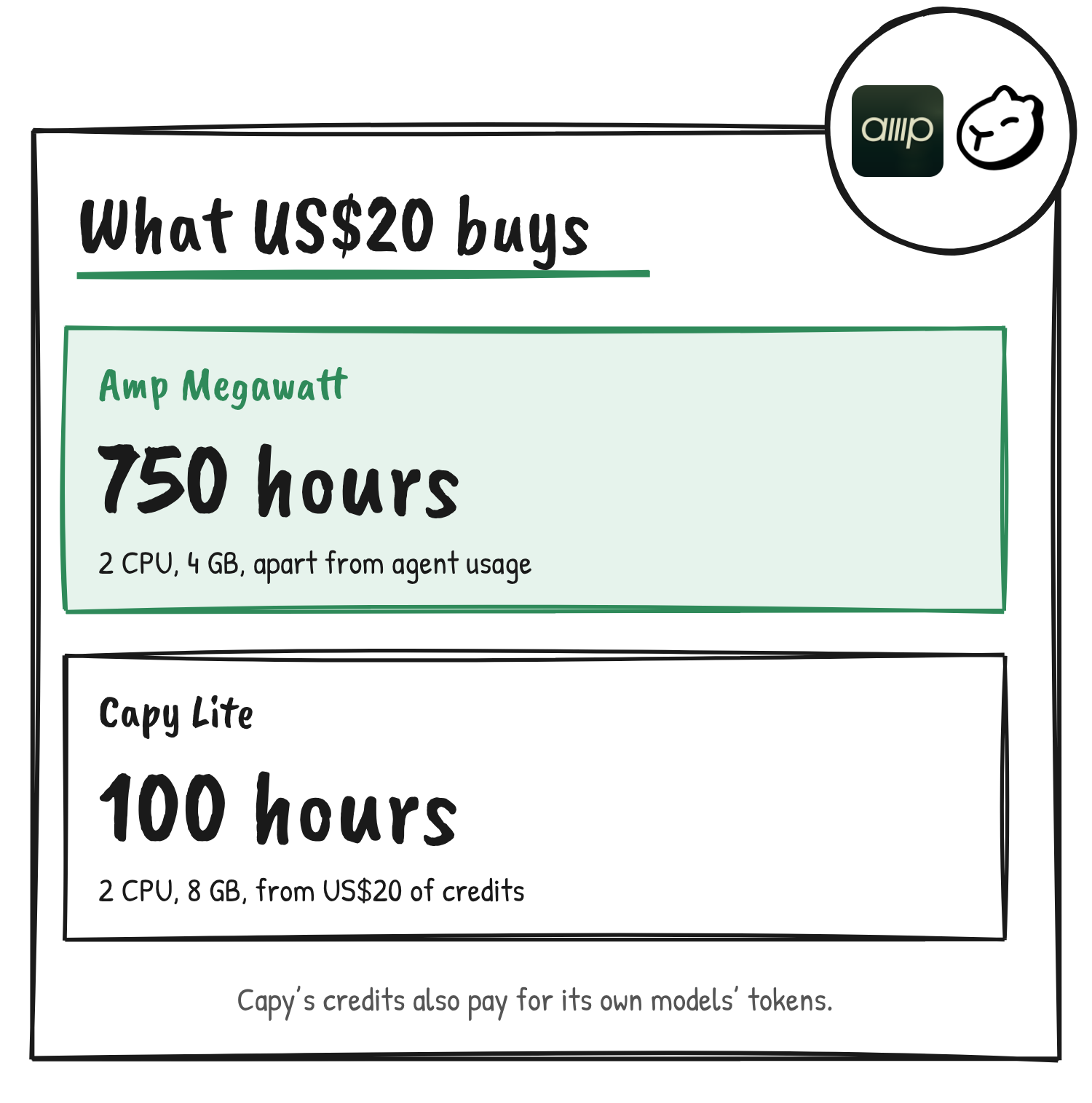
Counted in CPU-hours, US$20 buys 1,500 on Amp’s a1.small (750 hours of 2 CPUs) and 200 on Capy at either Small or Medium. That’s 7.5 times as many on Amp.
Ways to skip the machine bill
Amp’s Hobby tier is free, with Amp-hosted orbs at the standard prices above. Amp’s sizes and costs page says self-hosted orbs stay free on the Hobby, Individual and Teams plans, and Amp’s pricing page says you can use your own ChatGPT, Claude and other subscriptions or API keys with no Amp token fees. Capy’s Lite plan opens with a US$1 first week, then US$20 a month, and credits can also be bought without a plan from US$5.
One thing to check when you compare the two: Capy’s docs page at docs.capy.ai/pricing still lists a US$20 “Capy Pro” tier. Capy’s pricing page and models page call the US$20 plan Lite and sell Pro at US$100, with US$105 of credits.
Discover more from Sulat AI & Tech News
Subscribe to get the latest posts sent to your email.