TeamGroup CEO Chen Ching-wen told investors on 2 November that memory prices won’t fall in 2027 and that supply and demand won’t balance before the second half of 2028. A post on X by the gaming news account Pirat_Nation repeats that outlook on 14 November, and adds figures the earnings call didn’t contain.
The call covered TeamGroup’s third quarter. The Taiwanese memory module maker reported revenue of NT$10.14 billion, quarterly earnings per share of NT$37.19 and a gross margin of 49.27%. Business customers made up 64.6% of revenue in the first nine months of 2026, up from 24.6% a year earlier, according to its investor presentation.
What Chen said on the call
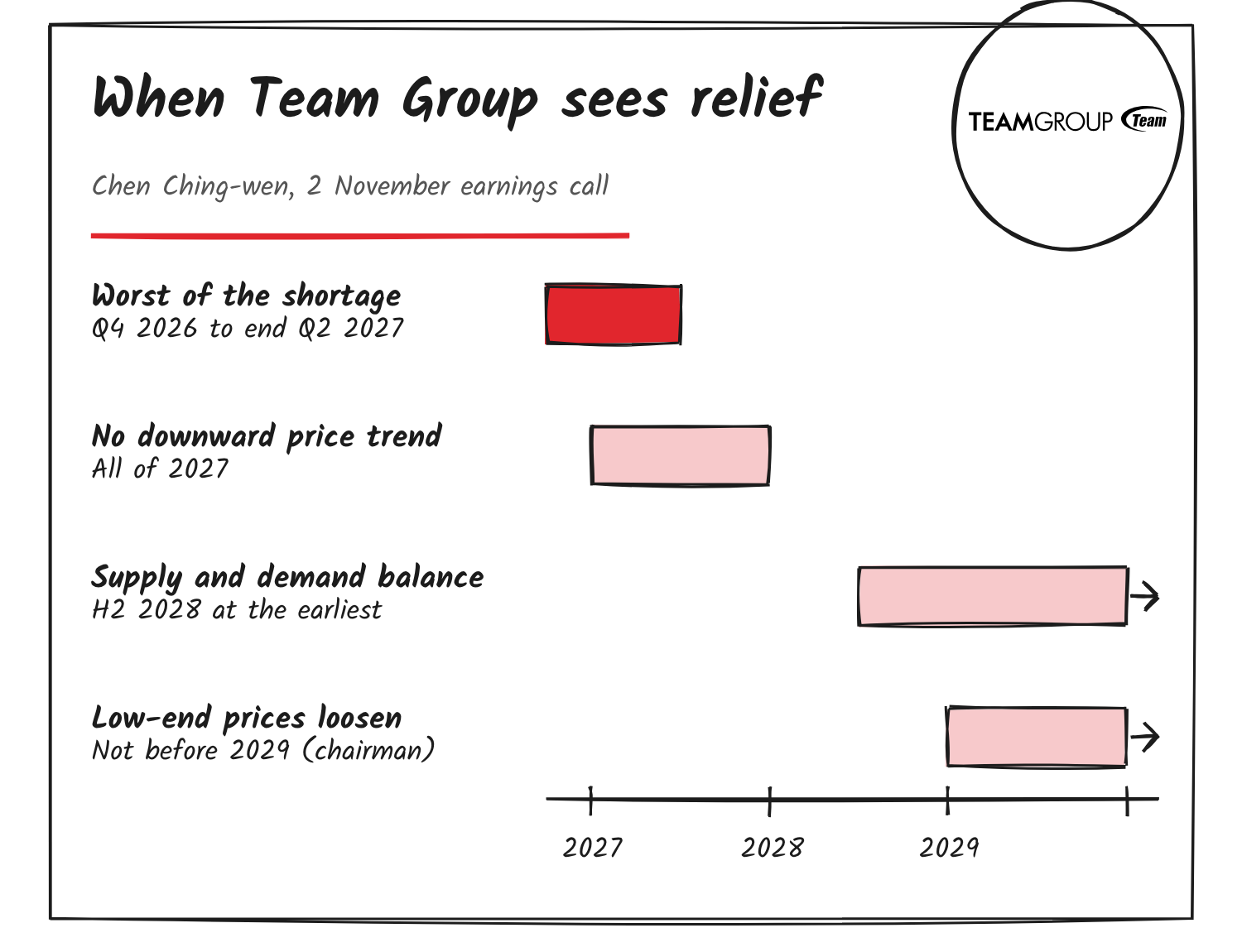
Chen said the worst of the shortage runs from the fourth quarter of 2026 to the end of the second quarter of 2027, and that 2027 will see “no downward price trend whatsoever”, according to BigGo Finance’s report of the call. Taiwan’s Economic Daily News carried the same timeline. Chen told analysts, “Right now you can still buy goods, they’re just expensive. In a little while, you may not be able to buy goods at all.” Some buyers will reach a point where “even money can’t buy goods”.
Chen puts the earliest balance between supply and demand in the second half of 2028, or later. Chairman Hsia Tan-ning said CXMT and YMTC, the Chinese memory makers, together hold close to 10% of the market, and that Samsung, Micron, SK hynix and Kioxia still supply the high-end DRAM and flash. He put the earliest loosening of prices for regional low-end products at 2029.
Where the post’s numbers come from
The post’s outlook matches the call. Two of its figures need their sources.
| The post says | The sources show |
|---|---|
| The shortage may not improve until late 2028 | Chen puts the earliest balance in the second half of 2028, or later. |
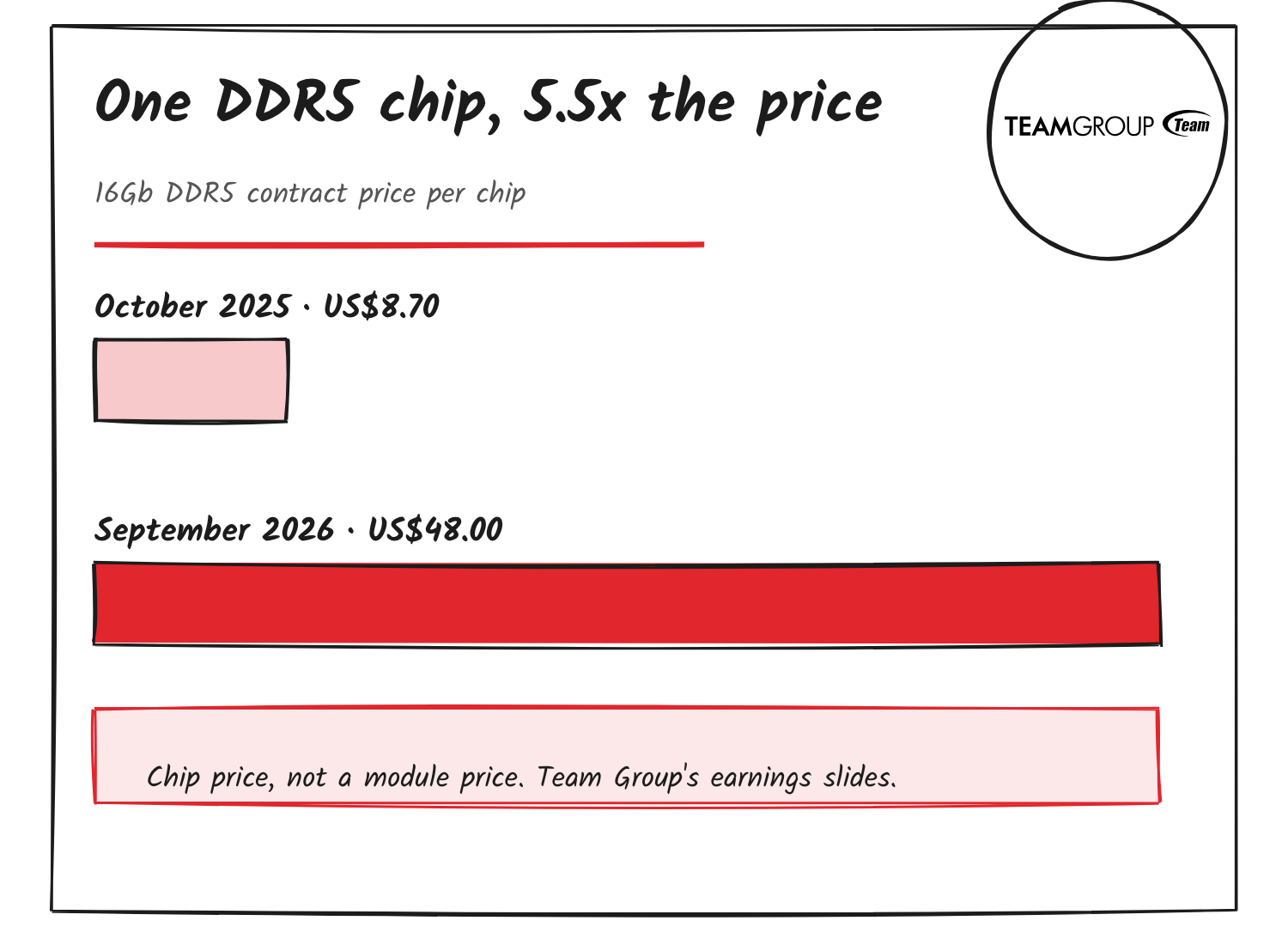
| RAM prices are up 334 to 600% year over year | The post gives no source. TeamGroup’s slides show a 16Gb DDR5 chip’s contract price going from US$8.70 in October 2025 to US$48 in September 2026, up 452%. |
| TeamGroup is paying 30 to 50% more through spot markets | Chen says spot prices run 30% to 50% above contract, and TeamGroup buys on the spot market because its contracts don’t cover its volume. |
| SK Hynix expects the worst shortage in history in 2027 | SK hynix CEO Kwak Noh-jung told Reuters on 10 July that 2027 will be the industry’s worst supply year. |
The 452% is the price of a chip, not a memory module. Some coverage puts it above 550%; the two prices give a rise of 452%, or 5.5 times.
Counterpoint Research’s 369% is a different measure. Its third-quarter tracker puts global DRAM revenue at nearly US$200 billion, up 369% on a year earlier. Bit shipments rose about 4% in the quarter, and the average selling price reached US$1.90 per gigabit. Revenue blends price, volume and product mix, so it isn’t a price rise. Counterpoint reports DDR revenue up 500% and LPDDR revenue up nearly 400%.
Why TeamGroup buys on the spot market
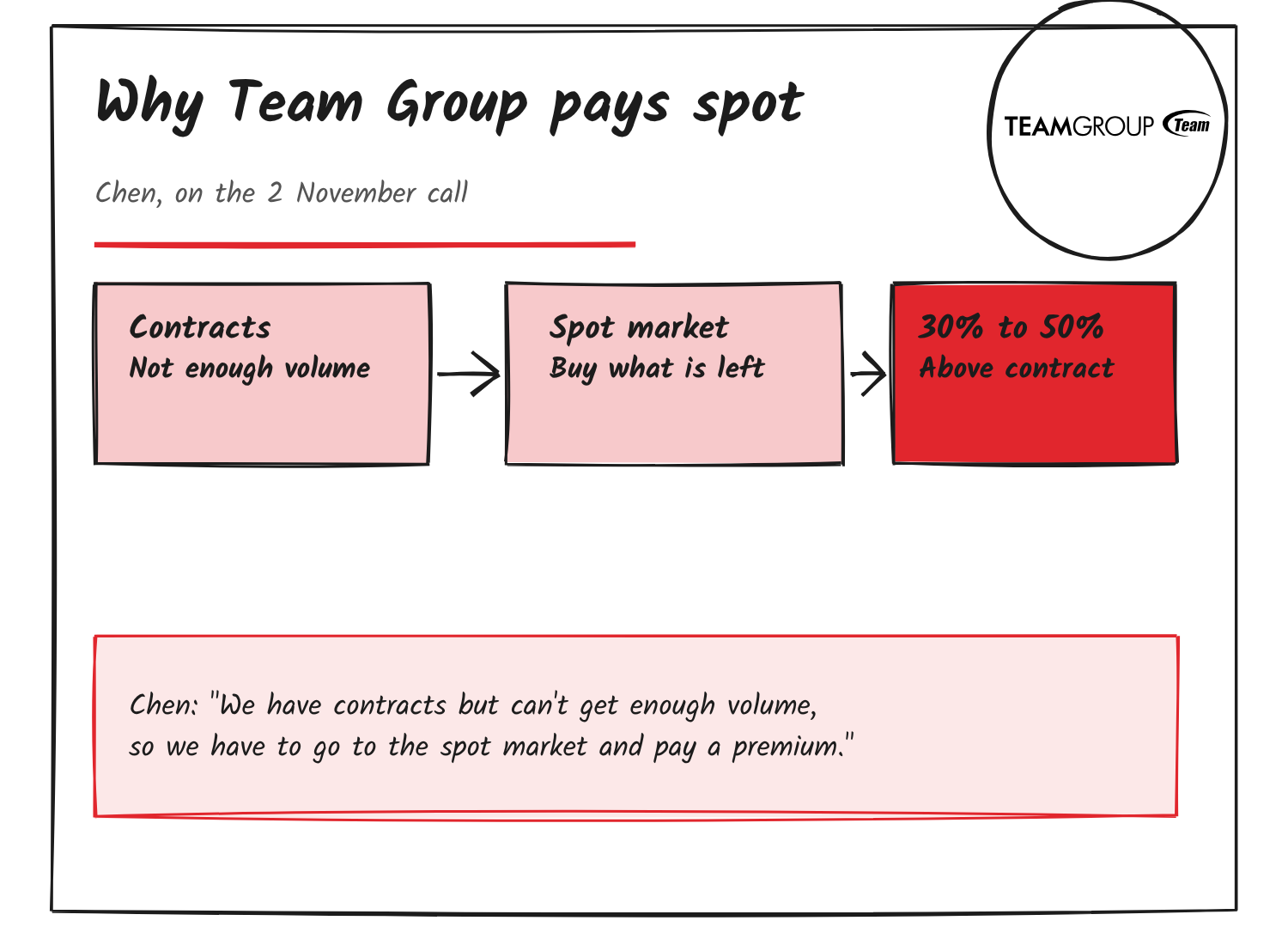
Chen said TeamGroup has supply contracts but “can’t get enough volume, so we have to go to the spot market and pay a premium to grab supply”. The spot market is where buyers purchase chips for immediate delivery at the going price, instead of at a price fixed in a contract. Chen put the gap between spot and contract prices at 30% to 50%, and the Economic Daily News reports the gap for some server memory at 30% to 50% or more.
Why supply is short
Chen said the three big memory makers are giving capacity to HBM, the stacked memory sold alongside AI chips, and to high-end DDR5. That squeezes DDR4 and older products, and one maker will stop DDR4 production next year. SK hynix said on 27 October that demand will exceed its supply through 2030, and that long-term agreements already cover more than half of its capacity for 2027 and 2028, Fortune reports.
TeamGroup didn’t give fourth-quarter guidance on the call. It’s building a new plant in New Taipei City, with equipment going in during the first quarter of 2027 and production starting in the second, which Chen said adds about 50% to its capacity. That’s the same quarter Chen expects the worst of the shortage to end.
Discover more from Sulat AI & Tech News
Subscribe to get the latest posts sent to your email.