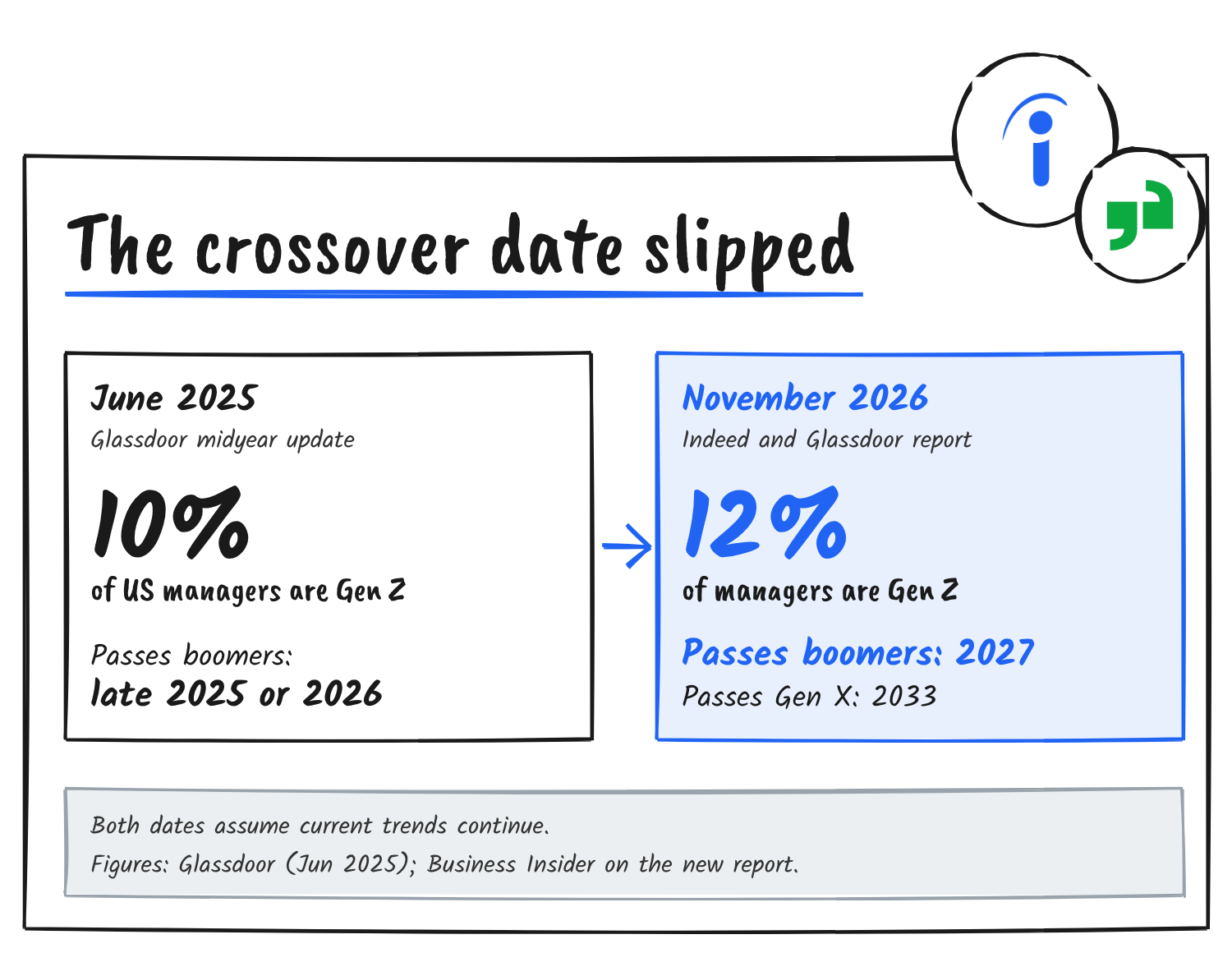
Gen Z could pass baby boomers as a share of US managers in 2027 and Gen X in 2033, according to Indeed and Glassdoor’s 2027 US Hiring and Worklife Trends Report. The report puts Gen Z at 24% of the US labour force and 12% of managers in 2026. Both crossover dates are projections, not certainties: they assume historical trends continue. The comparisons below draw on Glassdoor’s earlier published analysis of the same question.
The date has moved back
Glassdoor’s June 2025 midyear update said Gen Z had reached 10% of managers in April and would likely pass baby boomers in late 2025 or 2026. The new report has Gen Z at 12% and passing boomers as soon as 2027. The same 2025 update said millennials had overtaken Gen X as the largest share of managers.
Gen Z is on the same track as earlier generations
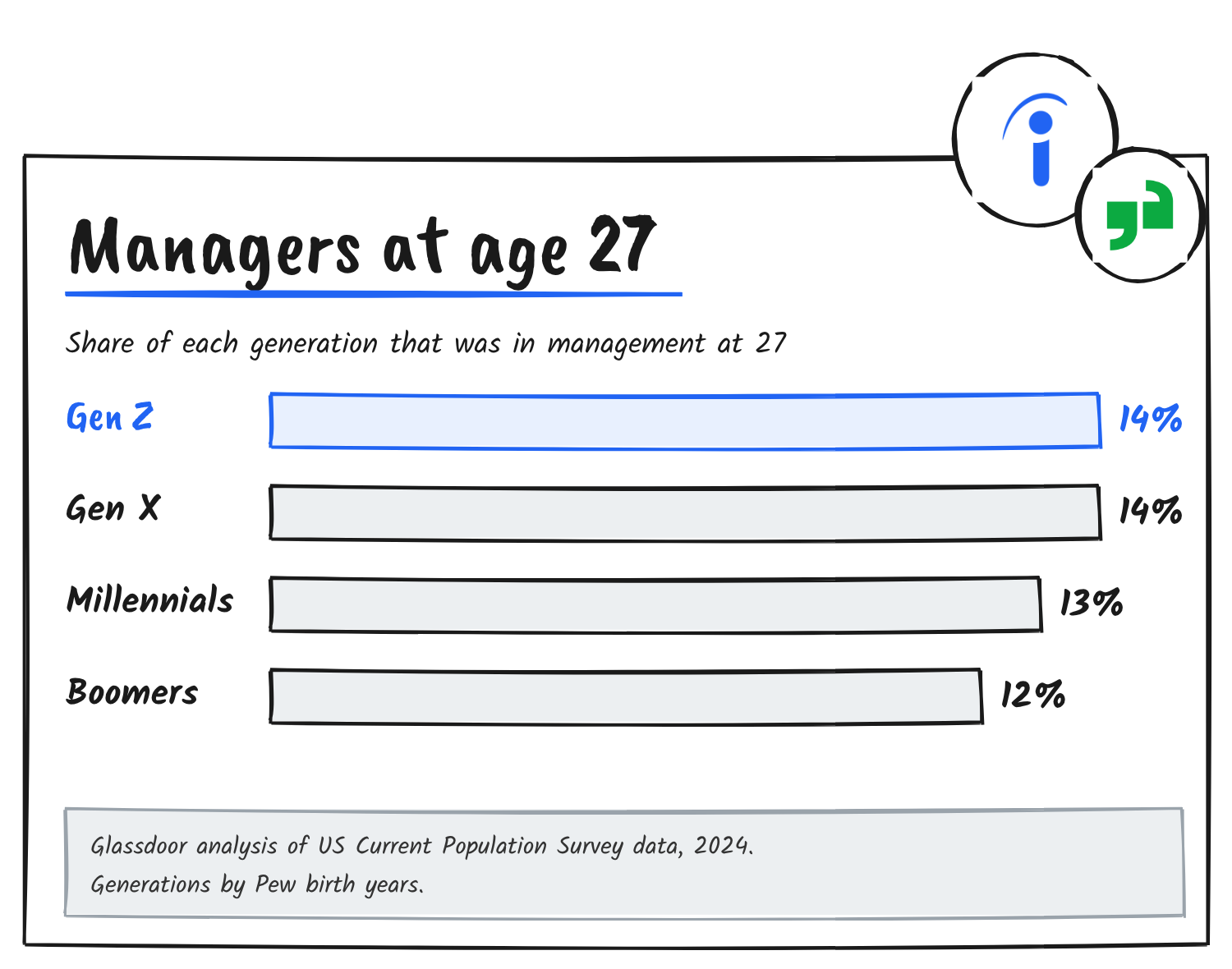
Glassdoor’s November 2024 analysis found 14% of Gen Z workers aged 27 were managers, against 14% of Gen X, 13% of millennials and 12% of baby boomers at the same age. Glassdoor chief economist Daniel Zhao told Fortune in January 2025 that he was surprised to see Gen Z’s path into management match earlier generations. The June 2025 update called the rise in Gen Z’s share a demographic inevitability as the generation ages into the workforce.
Glassdoor’s earlier analyses used Current Population Survey data. They count managers using the US Census management occupation codes plus first-line supervisors, and they define generations by Pew Research Center birth years: 1997 to 2012 for Gen Z and 1946 to 1964 for baby boomers.
The new report’s methodology projects each birth-year cohort’s size, labour-force participation and share in management, then combines those estimates by generation. It assumes historical patterns in cohort size and recent patterns in participation and progression into management continue. Changes in those patterns could change the crossover dates.
Many Gen Z workers say they don’t want the job
People Management reported on 13 November that a Robert Walters survey found 87% of Gen Z workers have no desire to supervise colleagues, and that half would avoid a management role to progress their careers. Zhao told Fortune in July 2025 that Glassdoor’s reports show no evidence of that trend, which has been called conscious unbossing. Glassdoor’s June 2025 update said workers who moved from individual contributor to manager got an 11% pay rise that year, against 7% for those who stayed individual contributors.
New Zealand and Australia
I couldn’t find an equivalent breakdown of managers by generation for New Zealand or Australia. Student Job Search says in a December 2025 press release that Gen Z makes up almost a third of the New Zealand workforce. The same release cites a Robert Walters survey finding that about 70% of Gen Z see middle management as a stressful job with little reward, and that over half don’t want those roles.
Update: This article now links directly to Indeed and Glassdoor’s published report and methodology. An earlier version relied on Business Insider’s account because I hadn’t located the report. The primary source confirms the 12% figure and the conditional 2027 and 2033 projections.
Discover more from Sulat AI & Tech News
Subscribe to get the latest posts sent to your email.