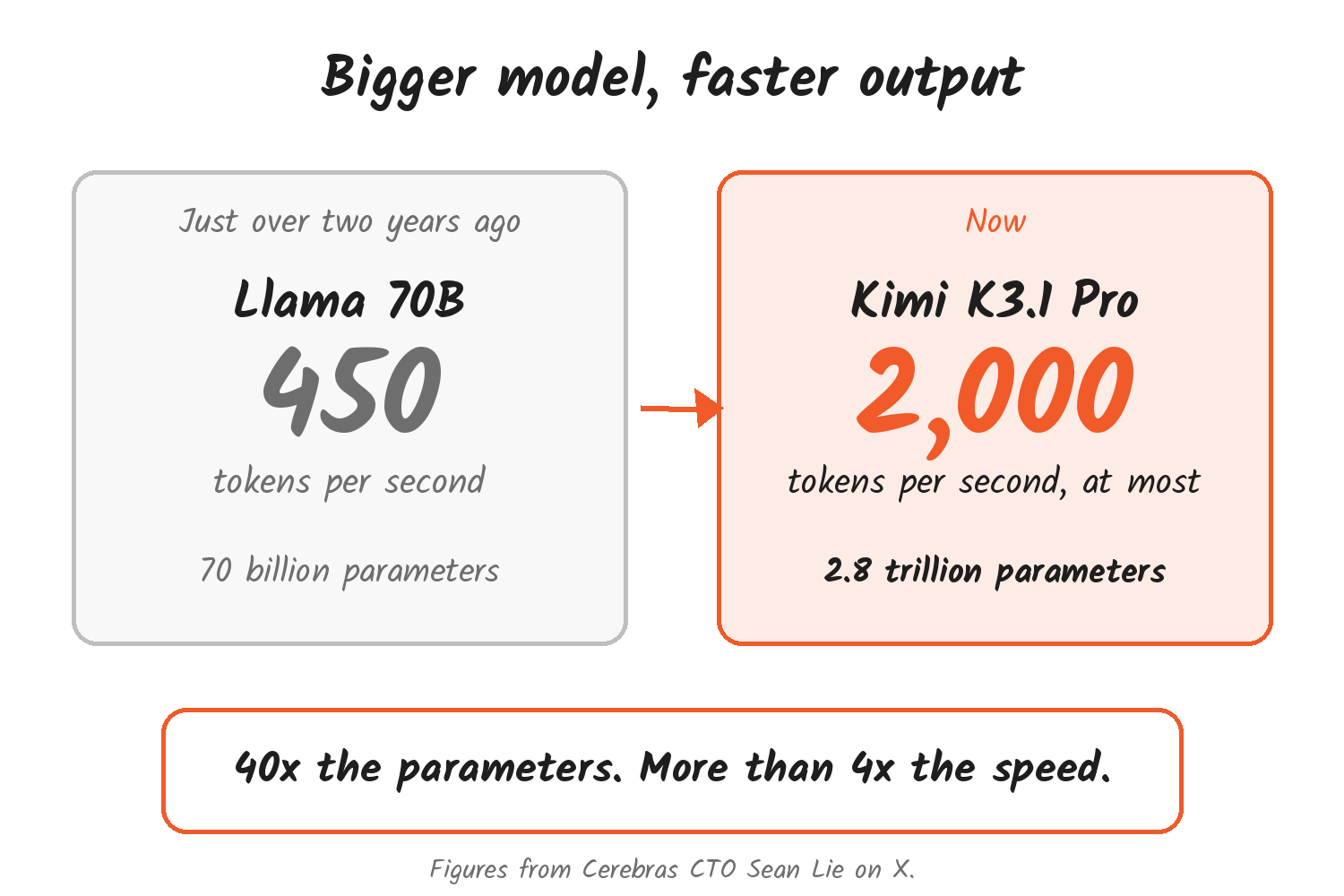
Cerebras says it now serves Moonshot AI’s Kimi K3.1 Pro, a 2.8-trillion-parameter model, at up to 2,000 tokens per second. Cerebras chief technology officer Sean Lie posted the figure on X. A token is the small chunk of text a model reads or writes, and a parameter is one of the learned numbers that make up the model.
Lie set the number against where Cerebras started. “The first model we ever served at @cerebras was Llama 70B at 450 tokens/sec,” he wrote, and that was just over two years ago. He says Kimi K3.1 Pro has 40x the parameters and that “our inference speeds are only going up”.
The first model we ever served at @cerebras was Llama 70B at 450 tokens/sec. That was just over two years ago.
— Sean Lie (@seanlie) November 18, 2026
Now we’re serving Kimi K3.1 Pro, a 2.8 trillion parameter model, at up to 2,000 tokens/sec. It has 40x the parameters, and our inference speeds are only going up.
I’m extremely proud of how far we’ve come, but also that we’ve stayed committed to the open model community along the way.
We want developers to have more models to choose from and the speed to actually build with them.
What Cerebras has said about it
Cerebras made the same claim in its third-quarter results on 12 November. The release calls Cerebras a “day-zero launch partner” for Kimi K3.1 and says Kimi K3.1 on Cerebras “is the fastest in the industry, running up to 2,000 tokens per second”. Both figures are Cerebras’s own. For the earlier Kimi K2.6, Cerebras’s May blog post cites a measurement from Artificial Analysis, an independent benchmarking firm, of 981 output tokens per second.
Moonshot put Kimi K3.1 Pro on its own API on 23 October and said the weights would follow by 4 November. It’s post-trained from Kimi K3. Featherless’s write-up describes a mixture-of-experts model, which sends each token through only a few of its parts: 104 billion of the 2.8 trillion parameters are active per token, and the context window is 1,048,576 tokens. Moonshot lists it at US$2 per million input tokens and US$10 per million output tokens, and a Highspeed version at twice that price.
On speed, DeepInfra’s summary of Artificial Analysis data has Moonshot’s own API at 31 tokens per second and Highspeed at 69.4. DigitalOcean leads at list price with 200.8, ahead of Baseten at 183.0.
How a model this size fits
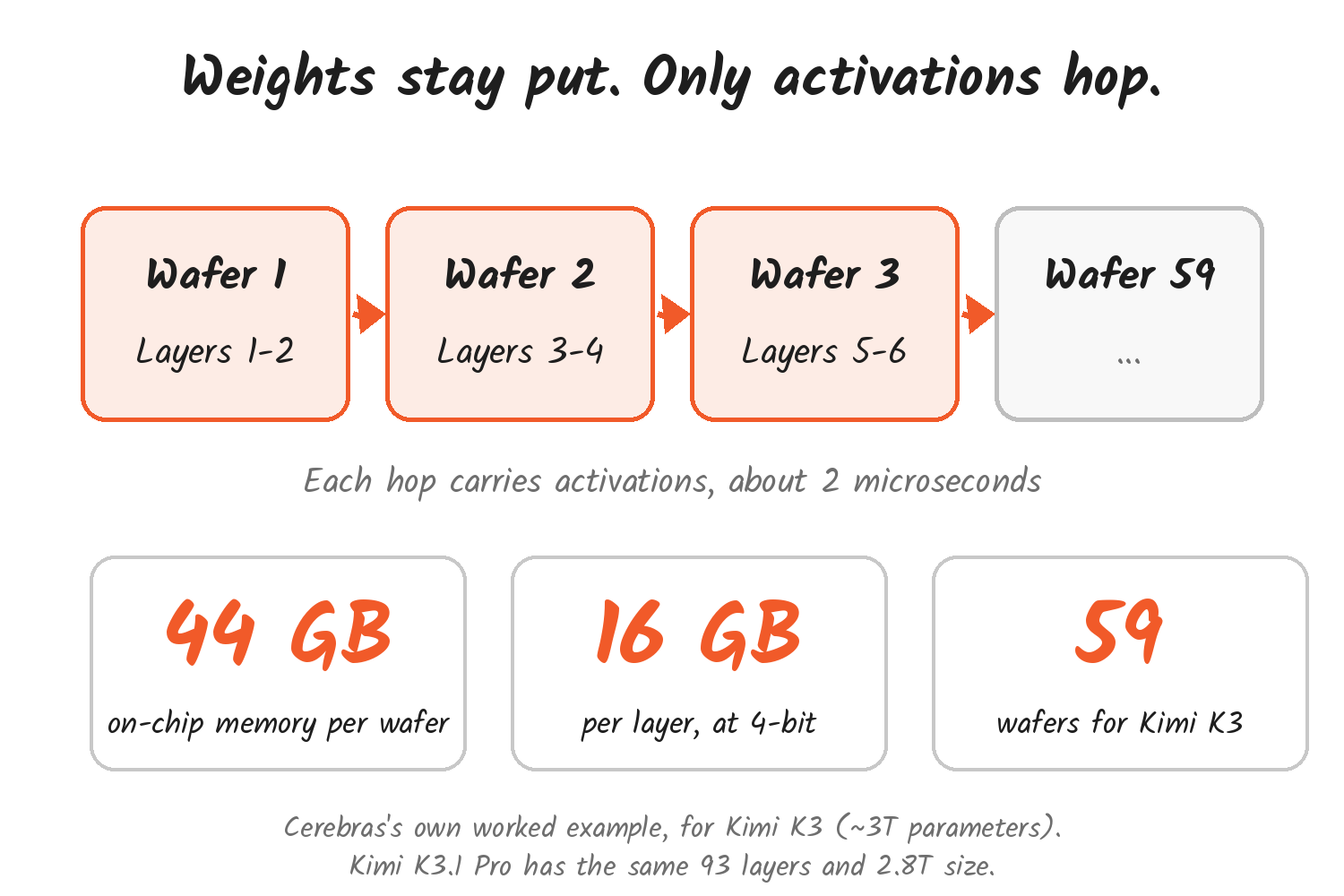
A Cerebras chip is a whole silicon wafer with 44 GB of on-chip memory, so a trillion-parameter model has to be spread across many of them. Cerebras’s 22 October post works through the earlier Kimi K3, about 3 trillion parameters stored at 4-bit precision. Cerebras puts that at roughly 16 GB for each of 93 layers. A wafer holds two of the 69 linear-attention layers or one of the 24 dense layers, for 59 wafers in total. Featherless’s summary of K3.1 Pro says the size and layer count carry over from K3.
The weights stay on the wafers. Only the activations, the intermediate results of each layer, pass from one wafer to the next, at roughly 2 microseconds a hop, the post says. Cerebras says that layout runs multi-trillion-parameter models at “1000-2000+ tokens per second”.
Who can use it
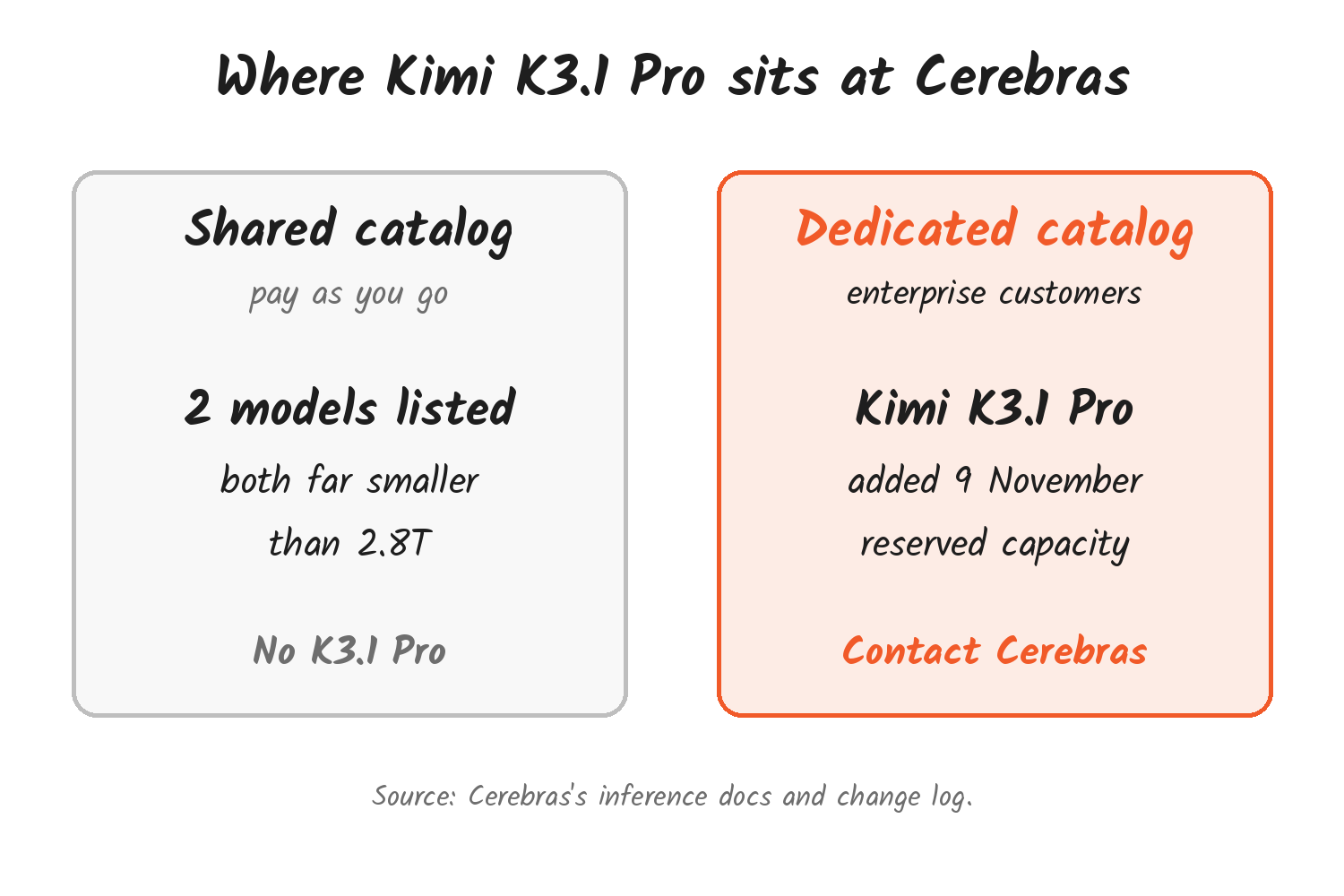
Cerebras’s change log shows Kimi K3.1 Pro joined its Dedicated model catalog on 9 November, with reasoning levels of low, medium, high and max, and max the default, plus image input. Dedicated Inference reserves capacity for one organisation and, per Cerebras’s docs, is available to enterprise customers, who contact Cerebras to set it up.
The shared catalog, where developers pay per token, lists two models, a 120-billion-parameter model and Qwen 3.8 27B. Both are a small fraction of K3.1 Pro’s size.
Cerebras says its CS-4 system will soon be in full production and that its next system, the CS-5, is targeted for early summer 2027 in the northern hemisphere, designed for up to 10,000 tokens per second per user. Both claims are in the same 12 November release.
Discover more from Sulat AI & Tech News
Subscribe to get the latest posts sent to your email.