Cloudflare says it has rebuilt Clairic, its extraction model, and released it and a new 9-billion-parameter sibling, Clairic-flash, as open weights under the Apache-2.0 licence on Hugging Face. Both are also hosted on Workers AI, Cloudflare’s service for running models on its network. The announcement is a blog post by Alex Reneau and Michelle Chen, published at 22:00 UTC on 18 November, which is 11am on 19 November in New Zealand. An extraction model reads text, images or PDF pages and returns typed values, such as a supplier name, a total or a due date.
Two models, two endpoints
Clairic is now the 27-billion-parameter model and Clairic-flash is the 9-billion-parameter one. The preview, announced on 19 October, ran the 9B model at US$0.10 per million input tokens. That model has moved to the flash endpoint, and Cloudflare says anything wired to the old endpoint gets the new Clairic rolled out in place.
| Model | Size | Workers AI ID | Input price per million tokens | Base model on the Hugging Face card |
|---|---|---|---|---|
| Clairic | 27B | @cf/cloudflare/clairic | US$0.24 (US$0.10 until 1 December) | Qwen3.8-27B |
| Clairic-flash | 9B | @cf/cloudflare/clairic-flash | US$0.10 | Qwen3.5-9B |
The team behind both is what Cloudflare now calls the Workers AI superintelligence team, which also made Clef, its decision model released on 1 October. The post opens with the line “Cloudflare has become a neolab.” Clairic and Clef belong to what Cloudflare and TypeSafe call System One models: small models that return typed answers in a single request instead of free text. TypeSafe launched the category with its Jev model on 15 September.
The rebuild: each field writes its own answer
The preview’s pitch was speed through a single forward pass. Cloudflare’s October post said Clairic and Clef “answer in a single pass, without reasoning or generating tokens”, and that because Clairic generates no tokens it can’t produce a mistyped answer or “hallucinate” in the same way as an LLM.
The new post changes that for most fields. For ordinary text and number fields, Cloudflare now uses what it calls parallel slot autoregressive generation. Each field uses the tokens it has already written to choose its next token, then stops at its own end marker, and all the fields advance together in the serving batch. Cloudflare says this raised accuracy for text and images and that the gain offsets “the small latency cost”. For computation, estimation and forecasting, it trained separate heads that handle estimates, forecasts, durations, calculated dates and explicit arithmetic.
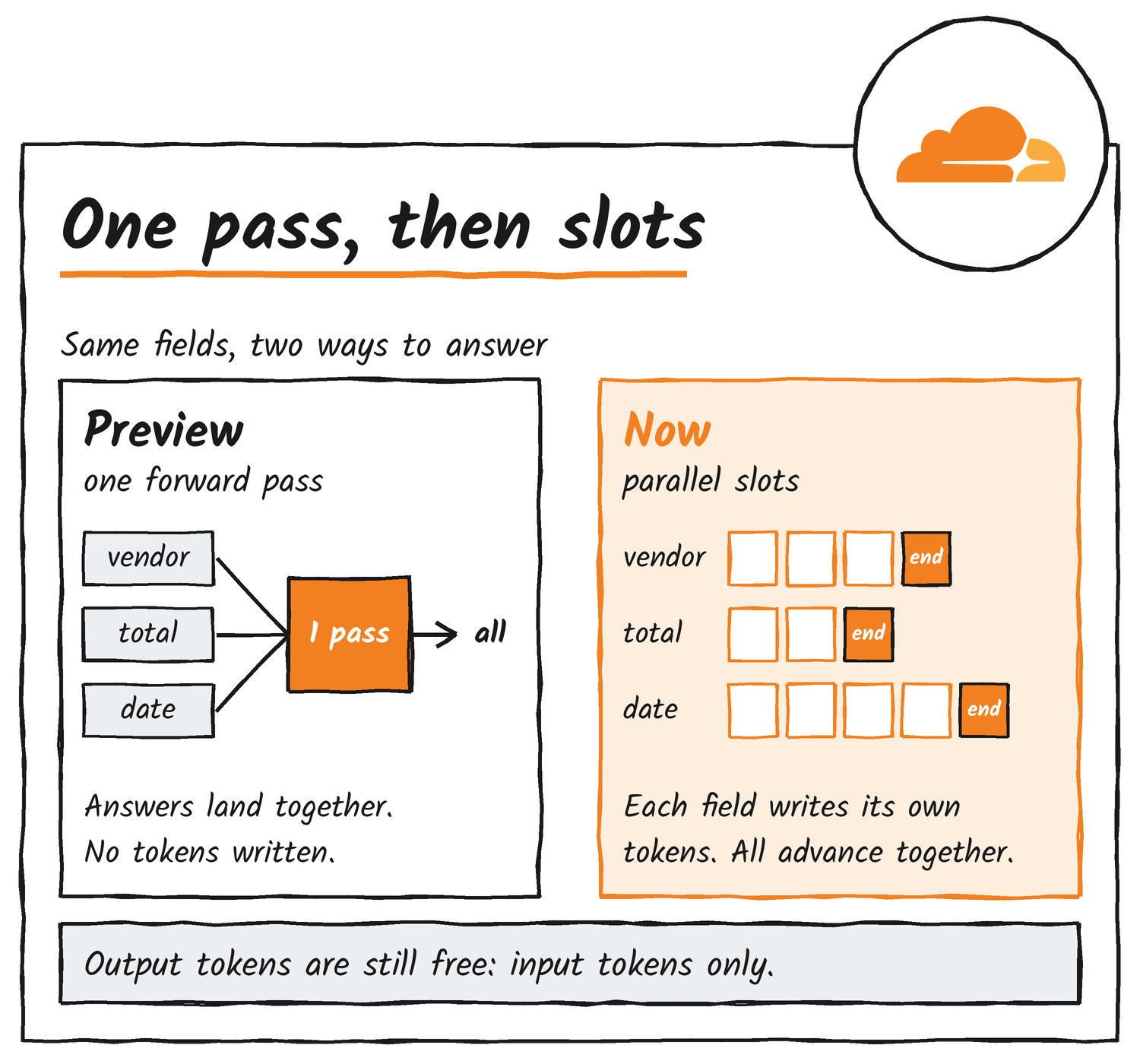
The post says the model “does technically generate output tokens” but keeps the System One pricing rule of charging for input only. The Hugging Face cards add that schema constraints come from xgrammar, a Python library, applied through a Transformers logits processor. The new post doesn’t repeat the preview’s claim that Clairic can’t hallucinate the way an LLM does.
The typed API is unchanged. Every answer still comes back with a confidence score, character spans and probabilities, and Cloudflare says the API schemas are unchanged from the preview endpoint.
Billing counts the input once per pass
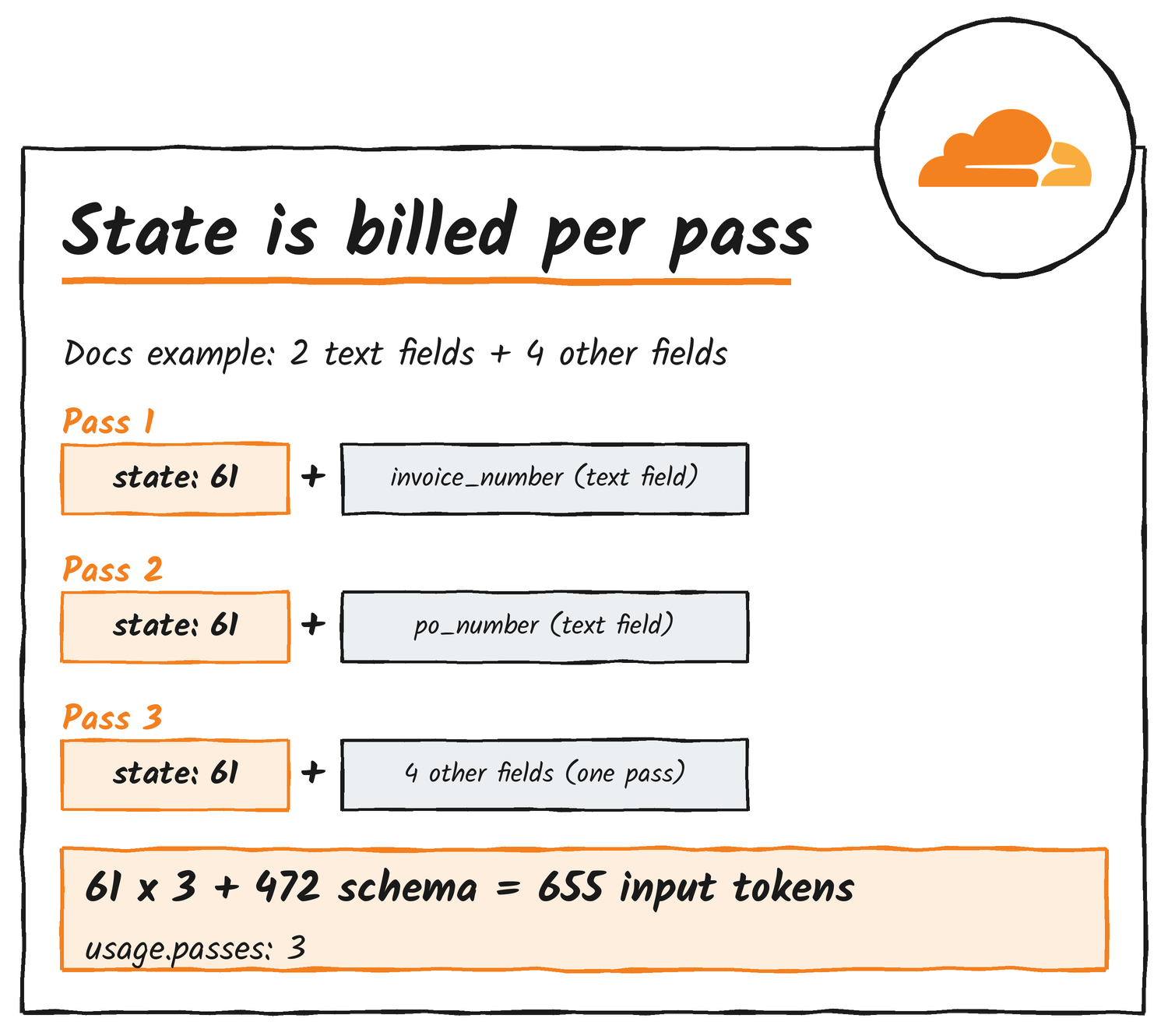
Clairic’s docs page explains a cost detail the blog post doesn’t. Clairic answers each text field in its own pass, and the other fields share a pass. Fields that don’t fit beside the input are split across more passes. Every pass includes the full input and all images, so those tokens are billed once per pass, and usage.passes reports the count.
Here’s the docs example. An invoice of 61 tokens, six fields (two of them text) and 472 schema tokens came to 655 input tokens over three passes, which is 61 × 3 + 472.
At scale that adds up. A 20,000-token document with four text fields and a number field would run five passes and bill about 100,000 input tokens before the schema, which is US$0.01 at US$0.10 per million and US$0.024 at US$0.24. That’s my arithmetic from the docs’ rules, not a figure Cloudflare published. Images cost one token per 32×32-pixel block plus two marker tokens, so a 1,024×768 receipt photo is 770 tokens on every pass. Each request takes up to four images, and a prompt has to fit in 65,273 input tokens.
The benchmarks are Cloudflare’s own
Cloudflare says there are no public extraction benchmarks yet, so it ran internal evals and asks readers to take them as “directional guidance since they are self-reported”. The two rivals are Liquid AI’s D1.2, which Cloudflare paired with Apple Vision for text recognition, and Scaledown’s Extract. The table shows Cloudflare’s counts with the percentages worked out.
| Eval | Clairic-preview | Clairic | Clairic-flash | D1.2 + OCR | ScaleDown |
|---|---|---|---|---|---|
| Fresh text fields (96 requests) | 295/336 (87.8%) | 335/336 (99.7%) | 328/336 (97.6%) | 304/336 (90.5%) | 259/336 (77.1%) |
| Mixed-input fields (36 requests) | 207/226 (91.6%) | 221/226 (97.8%) | 213/226 (94.2%) | 116/226 (51.3%) | 156/226 (69.0%) |
| Tracked customer assertions (139 request shapes) | 1,033/1,263 (81.8%) | 1,263/1,263 | 1,263/1,263 | 973/1,263 (77.0%) | 653/1,263 (51.7%) |
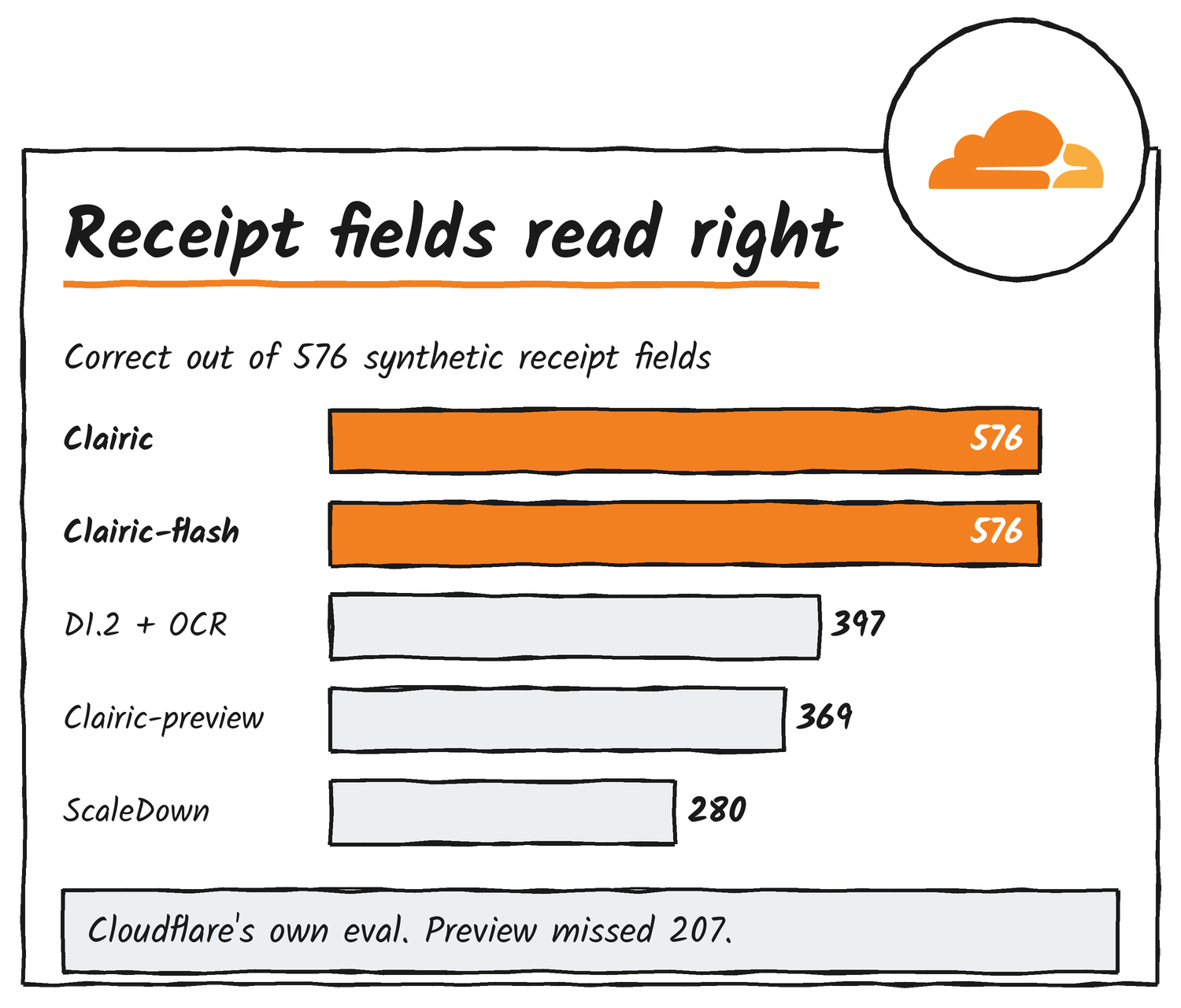
| Synthetic receipt fields, text and images | 369/576 (64.1%) | 576/576 | 576/576 | 397/576 (68.9%) | 280/576 (48.6%) |
The post says image reading accuracy improved “from 207 errors to 0”. That 207 matches the preview’s misses on the receipt row, 576 minus 369. The post’s example is a synthetic coffee shop receipt where the preview returned null for the merchant name and Clairic returned “Coffee House”, with all five fields right. The post doesn’t publish the test sets or the prompts.
PDF reading is new. Clairic could read a photo of a receipt in the preview. Cloudflare says the family now reads PDFs too, so one request can ask for the supplier, line items and total even when they sit on different pages, with line items returned as rows that keep description, quantity and price together. The limit is four images or PDF pages per request.
Latency: under a second, measured off-platform
Cloudflare measured the full HTTP response, including every field in the request, from a self-hosted server. It wasn’t measuring Workers AI. Its slowest result is a 976 ms p95 for Clairic on image fields. Clairic-flash’s median is between 1.5 and 2.3 times faster than Clairic’s across the six sets, by my arithmetic.
| Eval set | Requests per model | Clairic p50 / p95 | Clairic-flash p50 / p95 |
|---|---|---|---|
| Fresh text fields | 96 | 358 / 736 ms | 155 / 328 ms |
| Fresh image fields | 48 | 453 / 976 ms | 305 / 605 ms |
| Commercial leases | 180 | 691 / 803 ms | 379 / 519 ms |
| Loan pricing | 600 | 395 / 407 ms | 188 / 192 ms |
| Traffic forecasting | 114 | 532 / 585 ms | 243 / 261 ms |
| Expense audit, development | 60 | 632 / 742 ms | 393 / 512 ms |
Pricing: a promotion until 1 December
Until 1 December 2026, Clairic and Clairic-flash both cost US$0.10 per million input tokens. On 1 December Clairic goes to US$0.24 and Clairic-flash stays at US$0.10. The docs page calls the promotion 58% off. Output tokens are free on both, which Cloudflare says follows System One pricing principles.
For comparison, Liquid AI lists D1.2 at US$0.02 and D1.2-ultra at US$0.042 per million input tokens in its 16 November announcement, and TypeSafe lists Jev at US$0.042. OpenRouter’s catalogue, dated 6 November, lists Scaledown Extract at US$0.04 and Clairic at US$0.10. Those are list prices for models with different jobs, and Clairic’s per-pass billing means the price per request depends on how many text fields you ask for.
Running the weights yourself
Both repositories carry the Apache-2.0 licence and ship as BF16 safetensors. Hugging Face lists Clairic at 28B parameters and Clairic-flash at 10B, which comes to about 56 GB and 20 GB for the weights alone at two bytes per parameter. That’s my arithmetic, and it leaves out the memory the model needs while running.
The cards say to use Python 3.11 or later with PyTorch, Transformers and xgrammar. Each repository includes a clairic_model.py helper with a systemone function and a clair_head.safetensors file for the typed outputs. The local helper takes embedded inputs of up to 4 MiB each and 8 MiB combined, within the four-image limit, and it doesn’t accept remote media URLs.
On Workers AI, a request looks like this, trimmed from the docs example:
const response = await env.AI.run("@cf/cloudflare/clairic", {
  model: "clairic",
  state: "Invoice INV-2291 from Northwind Supply, issued 2026-09-02, net 30. 4 pallets at $250.00 each, shipping $80.00.",
  fields: {
    invoice_number: { type: "text" },
    due_date: { type: "date", instructions: "Issue date plus the net payment days" },
    total: { type: "number", decimals: 2, unit: "USD", instructions: "Amount due including shipping" },
    po_number: { type: "text", instructions: "Purchase order number" }
  }
});
In the docs example the invoice has no purchase order number, so po_number comes back null with a p_null of 1. Null is how the model says the input doesn’t contain the value.
What the docs still say
Clairic’s docs page still calls the model “in preview”, and the Clairic-flash page calls it an “early research preview”, although the blog post says Clairic graduates from preview. The flash page lists US$0.10 and doesn’t carry the promotion banner. The post doesn’t describe how the 27B model was trained or on what data.
Discover more from Sulat AI & Tech News
Subscribe to get the latest posts sent to your email.