Pierre has released Words, a streaming Markdown renderer for chat output. Its own tests show it producing HTML about twice as fast as md4x and doing about 6x less streaming work than Streamdown. The company announced it on X on 18 November and put the documentation and benchmarks on its Diffs site.
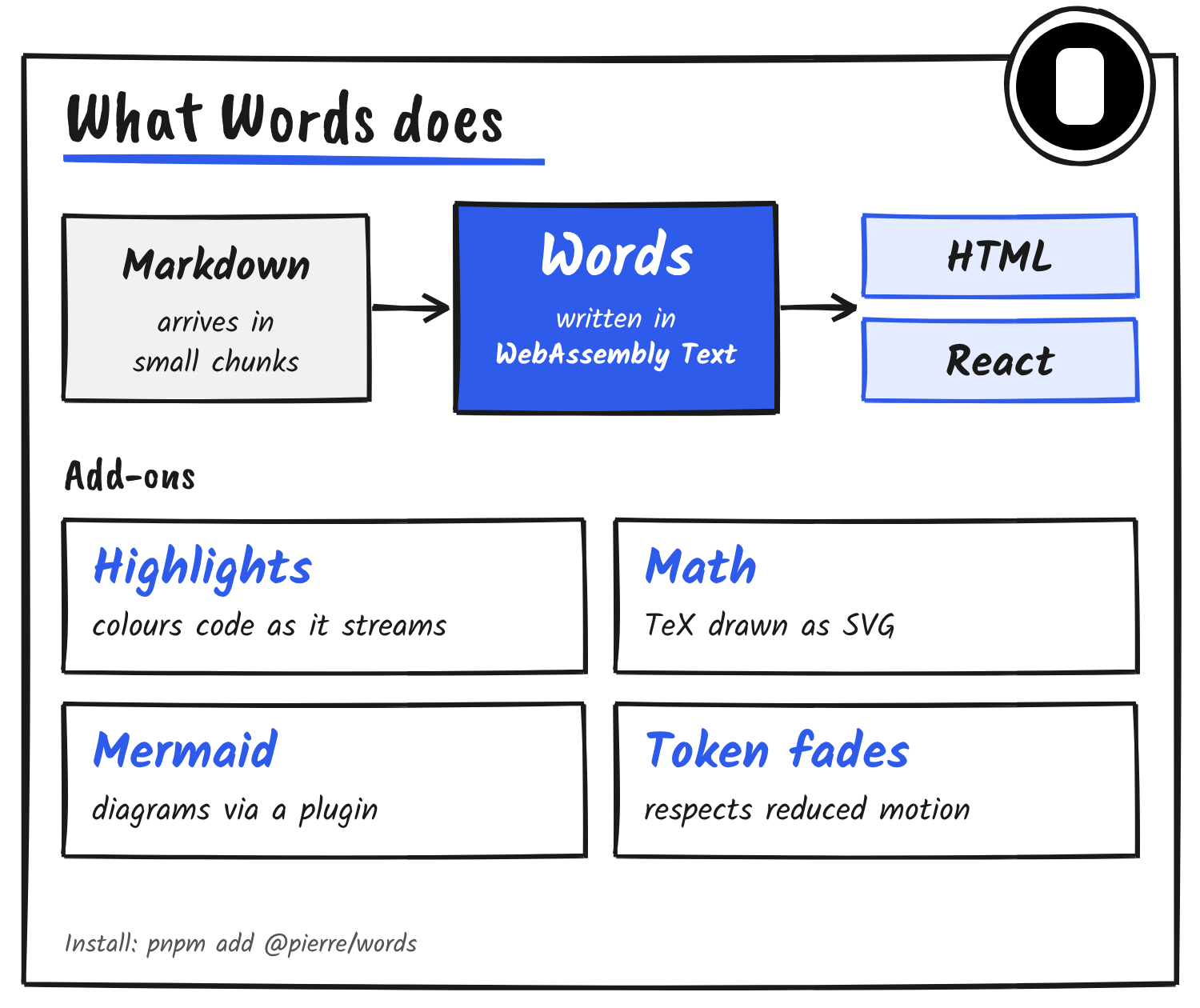
Words ships as the @pierre/words package and is written in WebAssembly Text, the human-readable form of WebAssembly. Streaming matters here because a model’s reply arrives in pieces, and the renderer has to format each piece as it lands instead of waiting for the final token. Pierre’s page says emphasis, links, lists and late references settle into place as the text comes in.
What it renders
Words renders straight to HTML and supports GitHub Flavored Markdown, the dialect that adds tables and task lists. It also has a React renderer. Pierre’s example passes the streaming state to the component through an isAnimating prop.
import { Markdown } from '@pierre/words/react';

export function Message({ text, streaming }) {
  return (
    <Markdown isAnimating={streaming}>
      {text}
    </Markdown>
  );
}
Code blocks get colour from Highlights, Pierre’s syntax highlighter, as they stream. The page lists four other options: token fades that respect reduced-motion settings, HTML render hooks for headings, links and inline code, TeX maths drawn as SVG without an extra dependency, and Mermaid diagrams through a plugin. The install command is pnpm add @pierre/words.
The benchmark numbers
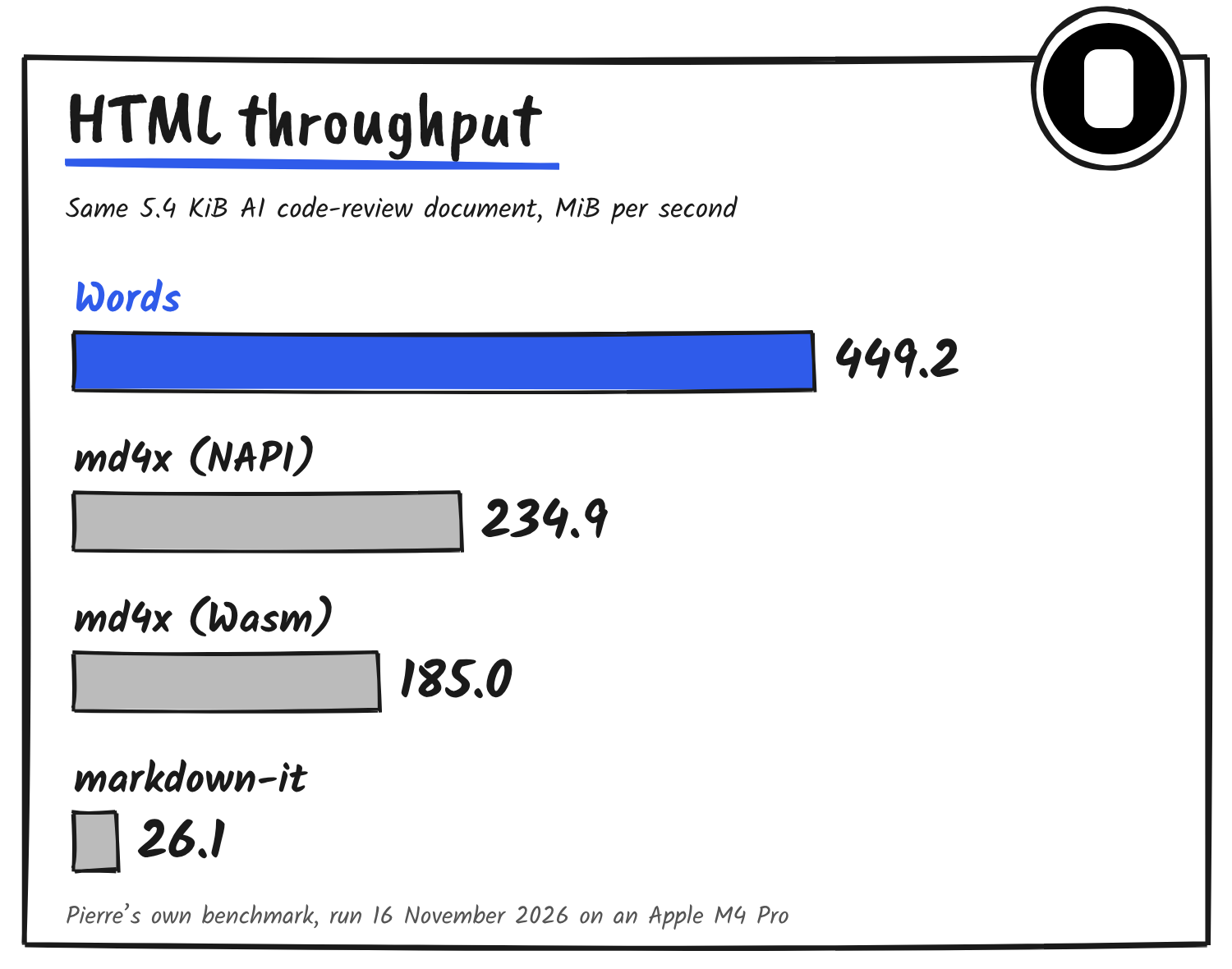
Pierre tested five documents, from short Markdown to technical specifications. On a 5.4 KiB AI code-review document, Words produced HTML at 449.2 MiB per second. That compares with 234.9 for md4x’s native build, 185.0 for its WebAssembly build and 26.1 for markdown-it, which puts Words at roughly 1.9x and 2.4x md4x.
The Streamdown comparison runs in a browser with highlighting on. Streamdown 2.7.1 spent 70.2 milliseconds on streaming work against 11.6 for Words, about 6x as much. It kept 11 MB of JavaScript memory against 0.5 MB, about 22x as much, and downloaded 1,057.8 KB gzipped against 253.6 KB. The Words figure includes all 152 built-in languages, while Streamdown loads languages on demand. Pierre says the base React renderer alone is 65% smaller than Streamdown.
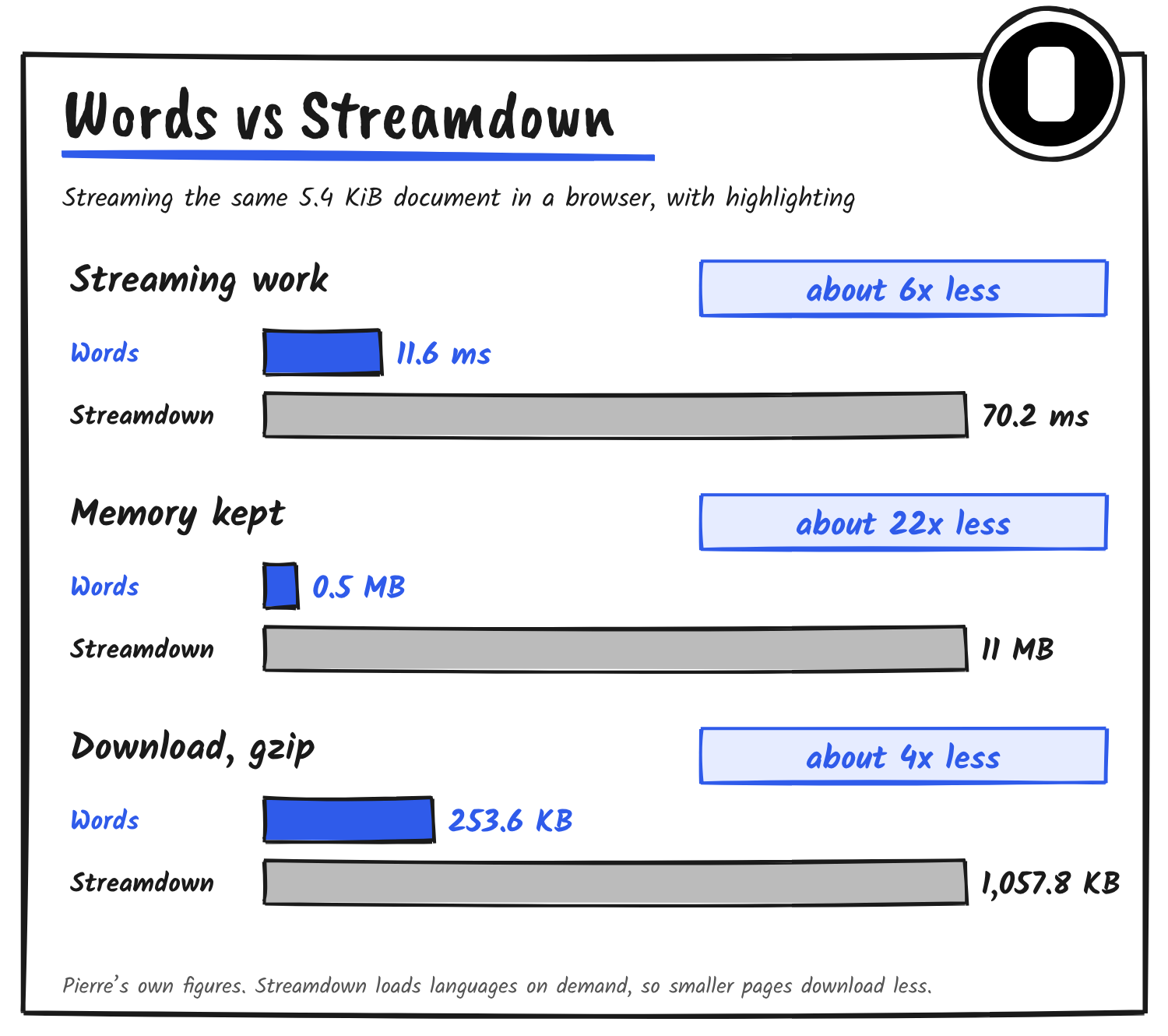
Pierre ran the benchmarks itself on 16 November, on an Apple M4 Pro with 48 GiB of memory. The browser results are the median of three fresh runs, with text delivered in chunks of 256 UTF-16 code units and the next chunk sent 40 milliseconds after each commit.
OpenAI said on 4 November it would acquire Pierre, subject to closing conditions including regulatory approvals, and that Pierre’s open-source projects would stay open source. The deal is covered in an earlier piece.
Hero illustration uses the official Pierre mark, which remains the trademark of its owner.
Disclosure: I’m an OpenAI, Firecrawl and Devin ambassador.
Discover more from Sulat AI & Tech News
Subscribe to get the latest posts sent to your email.