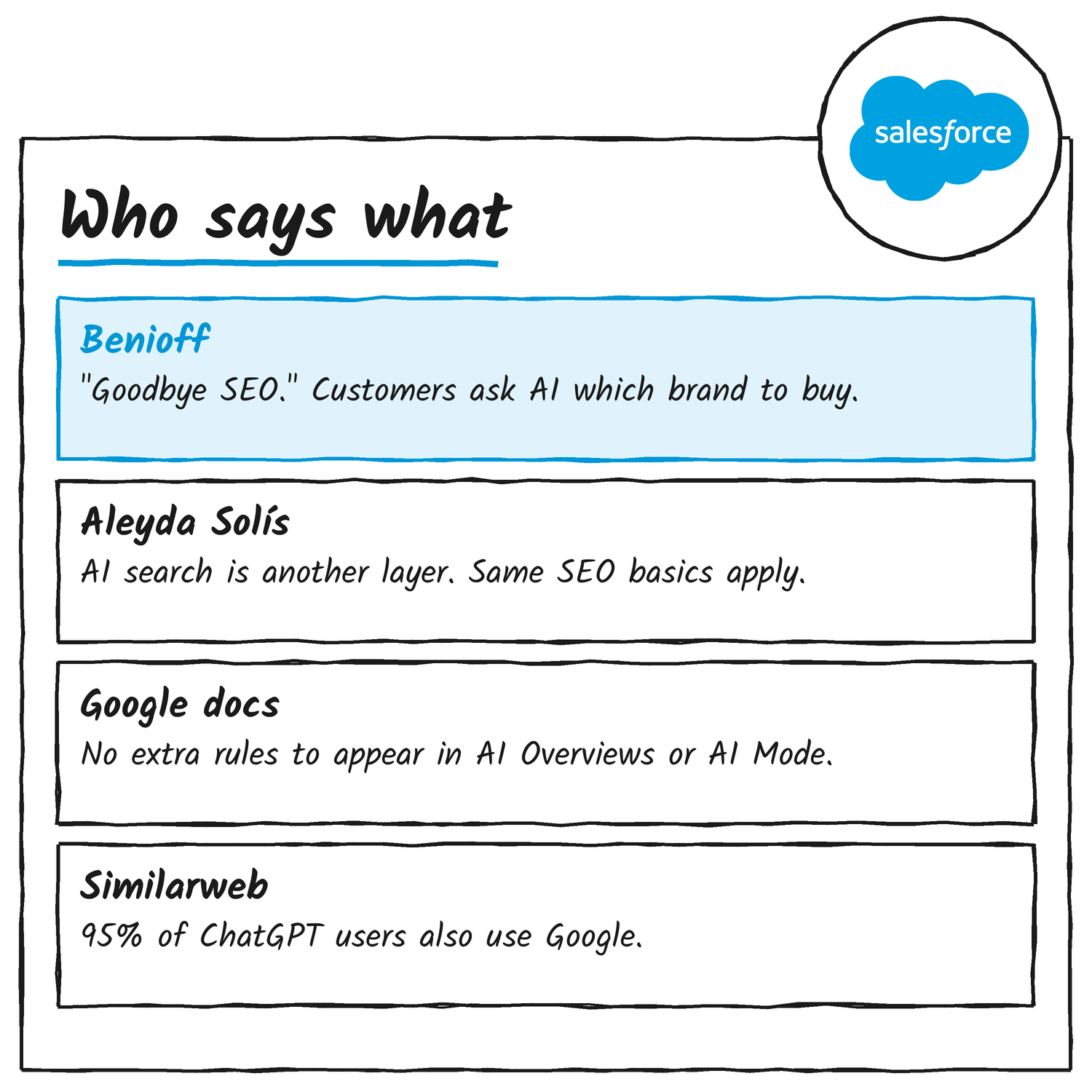
Salesforce CEO Marc Benioff posted on X on 19 November that brands should say “Goodbye SEO. Hello Palmata!”, promoting Palmata, the AI visibility product Salesforce now sells. SEO and AI search consultant Aleyda Solís answered with a post of her own the same day, saying AI search relies on the same fundamentals as SEO and hasn’t replaced Google.
Benioff’s post says customers “aren’t searching anymore” and are asking Claude, ChatGPT, Gemini and other AIs which brand to buy, with “No click. No referral. Nothing in your analytics.” He says Palmata shows what those AIs say about a company and the sources behind each answer, then simulates the impact of a change before anything is published. The post tagged @Palmata, an unrelated account; the product’s own account is @palmata_ai.
Welcome @Palmata! 🚀 Google SEO no longer performing for you? Yeah… your customers aren’t searching anymore. They’re asking Claude, ChatGPT, Gemini, and other AIs which brand to buy. No click. No referral. Nothing in your analytics.
Marc Benioff (@Benioff) November 19, 2026
What Palmata is
Contentful launched Palmata on 23 June and called it generally available. Salesforce signed a deal to buy Contentful on 1 June and completed it on 1 September. Palmata now sits on Salesforce’s marketing site as its platform for answer engine optimisation, or AEO, which means work to change how a brand shows up in AI-generated answers. Salesforce says you don’t need a Salesforce or Contentful subscription to use it.
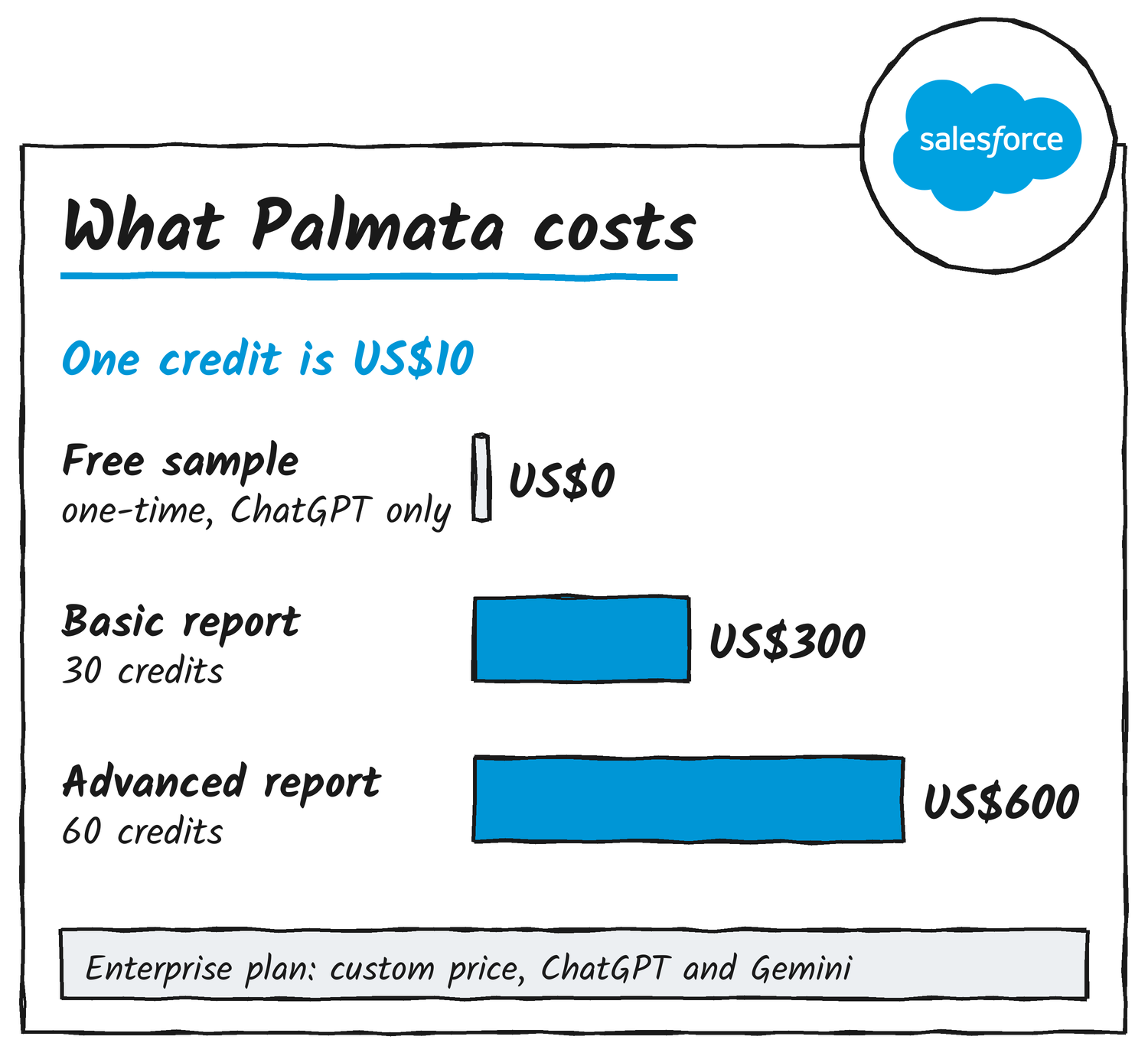
Palmata researches a brand and its market, builds buyer-style questions, then reports how AI engines describe the brand, which sources they draw on and what to change. The pricing page lists a free sample report, a one-time run of 450 prompts on ChatGPT. The Enterprise plan has custom pricing and covers ChatGPT and Gemini. Extra reports are bought in credits at US$10 each: 30 credits for a basic report, 60 for an advanced one, and one credit for five simulations. Benioff’s post names Claude, and the pricing page doesn’t list it.
Solís’s three corrections
Solís quoted Benioff’s post and made three points.
I didn’t have Marc Benioff saying “Goodbye SEO” to promote a new AI search tool on my 2026 bingo card, but I guess the AI search gold rush is too tempting for the big companies!
Aleyda Solís 🕊️ (@aleyda) November 19, 2026
First, AI search shares its fundamentals with SEO. Making content discoverable, crawlable, accessible and understandable helps search engines and AI search platforms retrieve it, she says, and AI search optimisation goes beyond SEO without replacing it. Second, she calls SEO an execution problem more than a knowledge problem. Knowing what to change is the base; getting the changes implemented, securing resources and aligning stakeholders is the rest, and a tool that promises automated workflows still needs its site integrations approved and its output checked by experts.
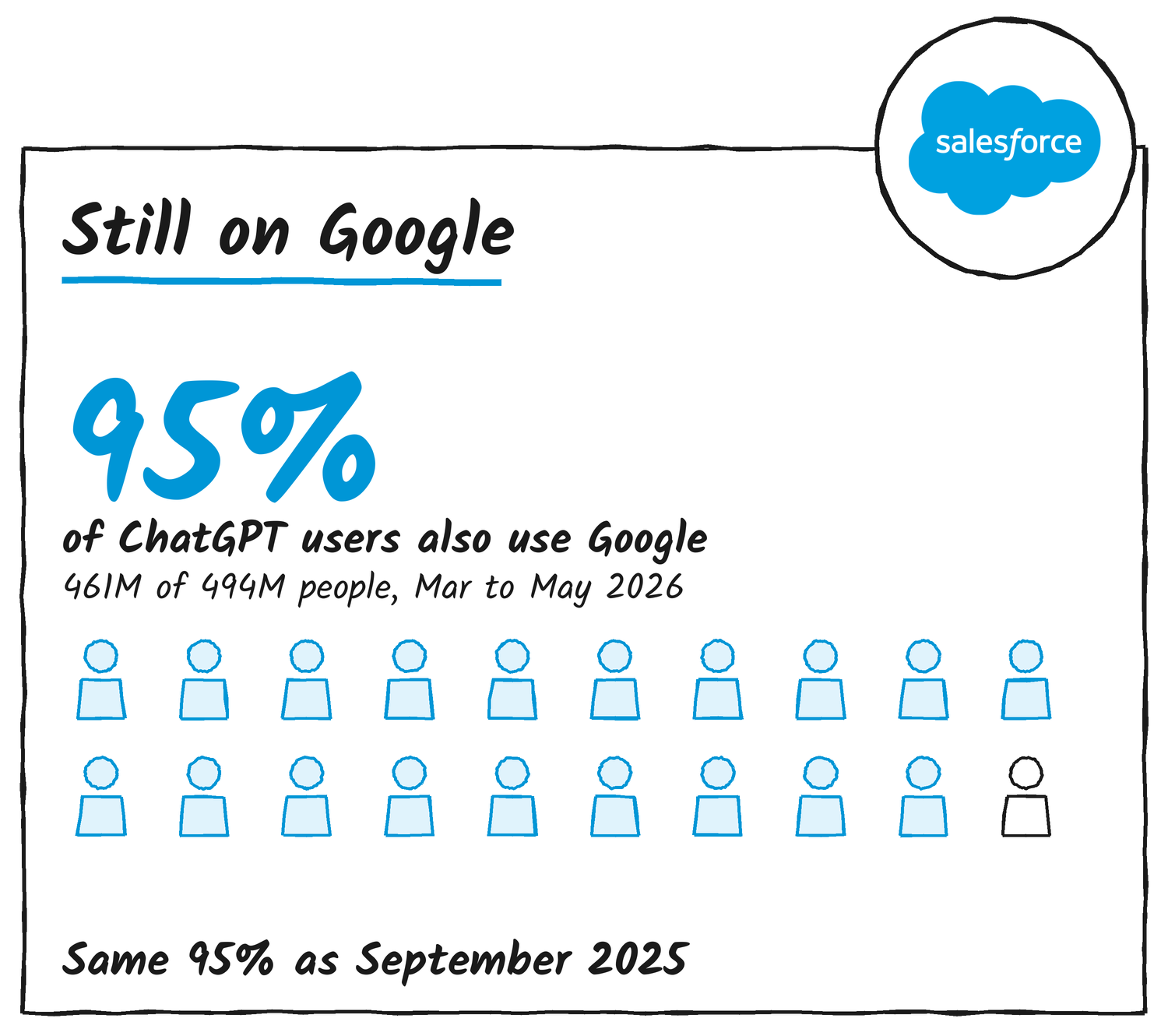
Third, she says AI search hasn’t replaced Google. She cites Similarweb data showing 95% of ChatGPT users also use Google, and points out that Google runs its own AI search through AI Overviews and AI Mode. She adds that measuring AI visibility matters, but monitoring what AI platforms say about a brand and improving its visibility and business results are different jobs.
What Similarweb and Google say
The 95% figure comes from Similarweb’s 2026 Generative AI Landscape report. It counts 461 million of 494 million ChatGPT users as Google users too between March and May 2026, and the share was also 95% in September 2025. Search Engine Journal notes the overlap counts people who used both, not how many queries each one gets. It doesn’t measure the clicks and referrals that Benioff’s post is about.
Google’s documentation lines up with her first point for Google’s own features. Its guide to generative AI features says SEO best practices still apply because those features are rooted in Google’s core ranking and quality systems, and its AI features page says AI Overviews and AI Mode have no additional requirements beyond Search’s own. Those pages cover Google’s features only. They don’t cover ChatGPT, Gemini or Claude.
Palmata’s product pages describe a simulated-impact feature that previews the effect of a change on AI answers. They don’t publish a figure for how often a simulation matched what AI engines said after the change was made. The free sample report is on Palmata’s site.
Hero illustration features the Salesforce logo, which remains the trademark of its owner.
Discover more from Sulat AI & Tech News
Subscribe to get the latest posts sent to your email.