
Hookdeck has released an open-source bridge that turns ordinary webhooks into MCP events, so an agent can subscribe to an email, a GitHub issue or a Stripe payment without waiting for the service to support the protocol. Hookdeck announced the MCP Events bridge on 29 October. It’s an MIT-licensed MCP server built on Hookdeck Event Gateway, and it’s the bridge that came up in my piece on the MCP Events extension reaching beta.
Hookdeck’s announcement still describes SEP-3415, the proposal behind MCP Events, as a draft. The official Events page now lists the SEP as Final and the extension as Beta. The bridge was written against the draft, so check its conformance table before you build on it.
Why Hookdeck built it
Few MCP servers offer events yet, but most services already send webhooks. Hookdeck says the idea started with a reply to a post about MCP Events, where someone wished Resend supported the extension so their agent could have its own inbox and wake up when they emailed it. Resend already sends a webhook when a message reaches an inbound address, and GitHub and Stripe send webhooks too. The bridge sits between those senders and the agent.
In Hookdeck’s demo video, an email reaches ChatGPT, a new GitHub issue reaches an agent built with the Vercel AI SDK, and a comment wakes Claude Code.
How a webhook becomes an event
The bridge is an MCP server that sits beside Event Gateway and configures it. A webhook takes four steps:
- The service sends its usual webhook to an Event Gateway source URL that the bridge’s
setupcommand created. - Event Gateway checks the service’s signature and keeps the request. A request that fails verification goes no further.
- A transformation turns the webhook into an event named
{source}.{event}, such asresend.email.receivedorgithub.workflow_run, with an ID, a timestamp and the webhook’s data. - Event Gateway delivers the event to each subscriber whose filters match, signs every attempt with the subscriber’s secret, drops repeats and retries failures.
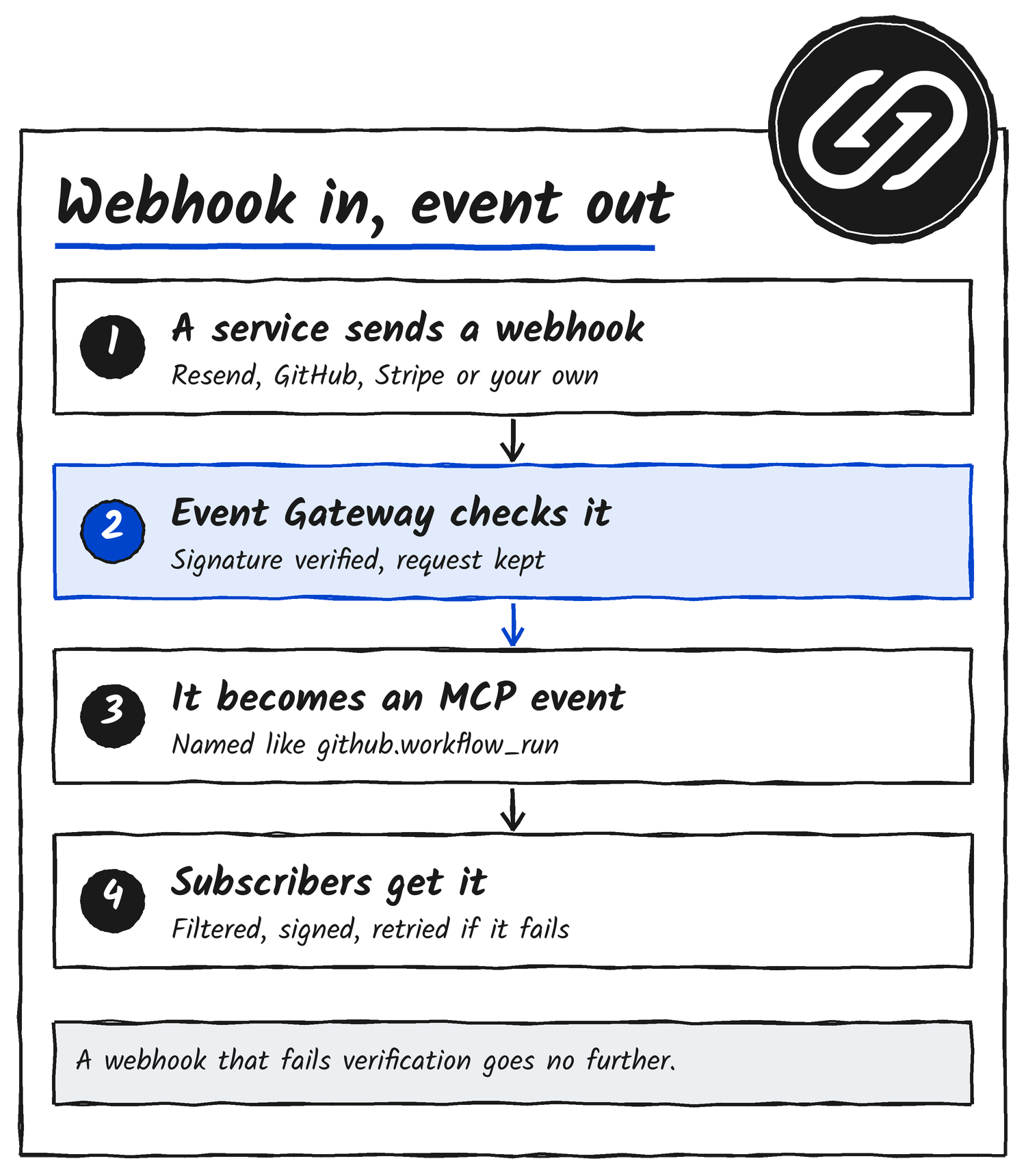
The design choice that matters is what the bridge doesn’t do. It keeps no database, and each subscription is an Event Gateway connection with its own filter, dedupe and retry rules. Event Gateway doesn’t relay events through the bridge, so deliveries carry on while the bridge restarts or redeploys. Hookdeck’s reasoning is that a bridge which stored subscriptions and delivered events itself would need a database, a queue and a retry scheduler next to every deployment, and Event Gateway already runs those.
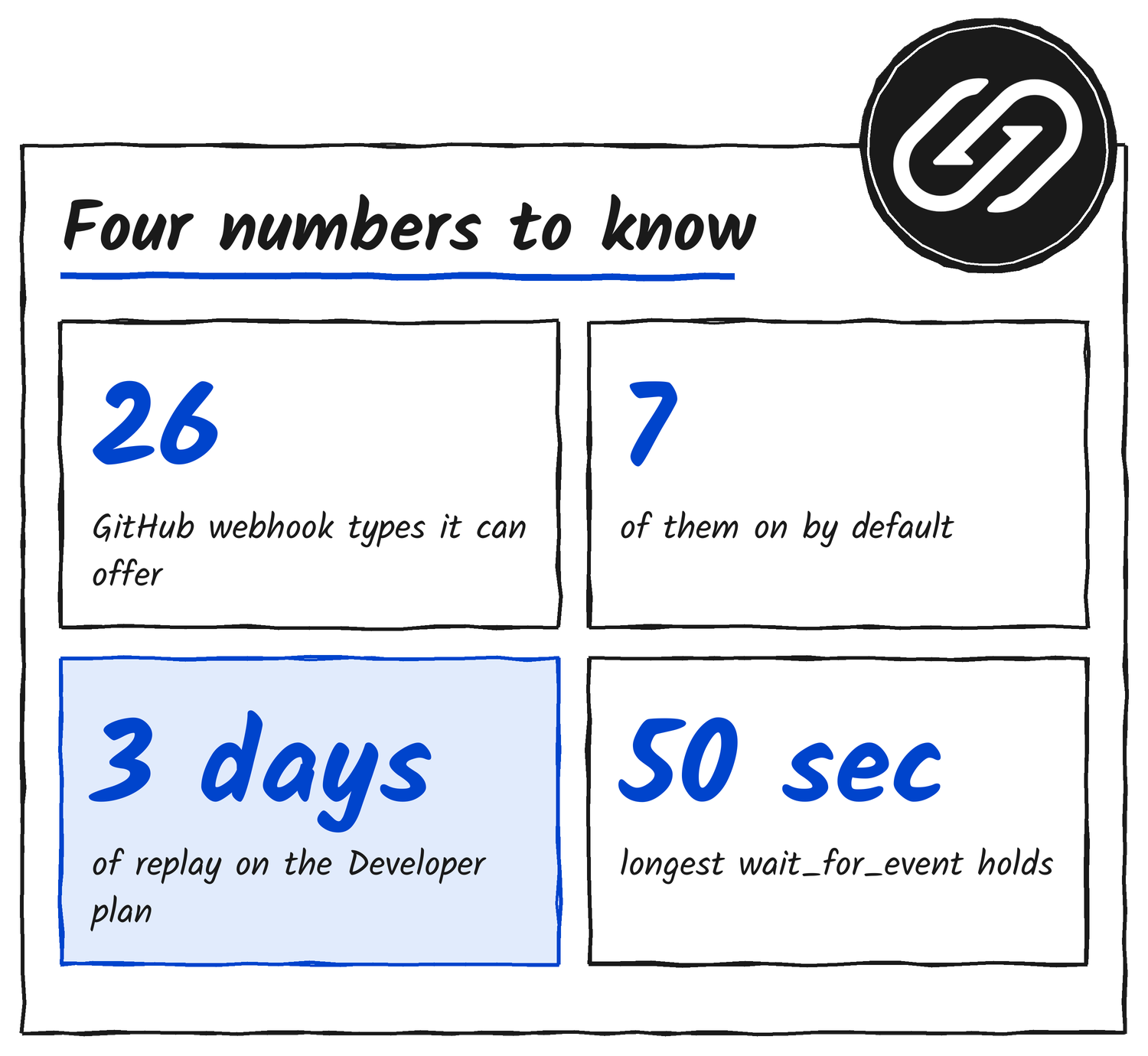
Event Gateway’s record of each request also powers poll mode, replay and the bridge’s get_event and list_events tools. Every delivery carries a cursor. A client that resubscribes with its latest cursor gets what it missed, as far back as Event Gateway keeps requests, which is three days on the Developer plan.
What it can listen to
- Resend: inbound email, offered as
resend.email.receivedwith the sender, recipients and subject. The body stays in Resend, and the agent reads it with Resend’s own tools. Subscribers filter byfromandto. - GitHub: 26 webhook types. Seven are on by default: issues, issue comments, pull requests, reviews, pushes, releases and workflow runs. Subscribers filter by repository, action or sender.
- Stripe, Slack, Shopify, Linear and others: a source entry uses Event Gateway’s own source type for the service, so signature checks need no code. Hookdeck says it has tested Stripe and Slack with requests signed the way those services sign them, but not yet from accounts at those services.
- Your own services: any sender that signs the body with HMAC or Standard Webhooks, or sends Basic auth or an API key. There’s no unverified option, because anyone with the URL could otherwise wake your agent with whatever they sent.
Hookdeck’s example is a trading server that sends a webhook when an order fills. One command turns it into a fills.order.filled event, and an agent subscribes to fills for the symbols it trades:
npx mcp-events-bridge sources add fills --type webhook \
  --event order.filled --event-id-header x-delivery-id \
  --filter symbol --filter side
Which agents get the events
ChatGPT, Hermes Agent, the Vercel AI SDK, Mastra and TanStack AI take events by webhook, and Mastra can poll instead. Hookdeck tested the bridge with all five. Support in Hermes Agent and the three libraries is experimental, and none of the official MCP SDKs has it yet.
Claude doesn’t support MCP Events yet, and Hookdeck links an open feature request for Claude Code. So the bridge ships a Claude Code plugin that polls. It runs the bridge’s watch command as a Claude Code monitor, which wakes Claude on each event, including while it’s idle between prompts. A new session catches up on up to 24 hours of missed events.
Codex and Cursor’s CLI use the wait_for_event and poll_events tools, and Hookdeck tested both non-interactively. A wait_for_event call returns as soon as events arrive, or after up to 50 seconds without any.
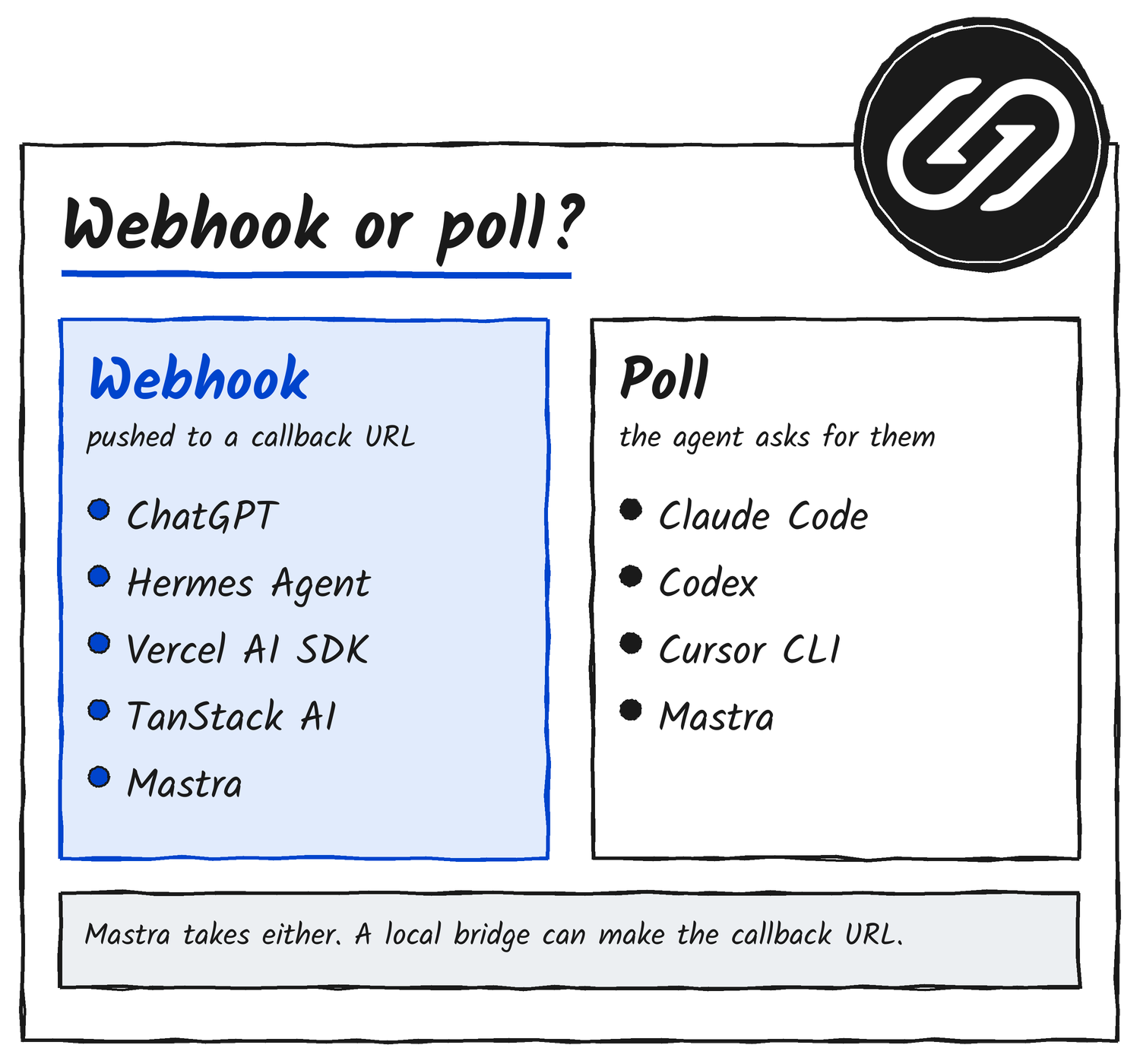
An agent on a laptop with no public address can still use webhook delivery. A local bridge creates a callback URL through Event Gateway and the Hookdeck CLI with its create_callback_url tool. Hermes Agent v0.22.5 or later works this way, and because that URL is pass-through, the agent has to check each delivery’s signature itself.
Setting it up
You need Node 22.12 or later and a free Hookdeck account with a project for the bridge. To run it locally, you also install the Hookdeck CLI.
- Install
@hookdeck/mcp-events-bridgein a new project and list your sources inbridge.config.ts. - Put
HOOKDECK_API_KEY,HOOKDECK_SIGNING_SECRETand each source’s credentials in.env. - Run
npx mcp-events-bridge setup. It creates the Event Gateway sources and transformations and registers the Resend and GitHub webhooks. The first run generates an MCP secret forBRIDGE_MCP_SECRET. - Run
npx mcp-events-bridge serve.
A coding agent can do the setup for you through the bridge’s Agent Skill, which installs with npx skills add hookdeck/mcp-events-bridge.
For ChatGPT, the bridge has to be reachable from the internet, either deployed to Fly.io, the documented host, or behind a tunnel, and you add it under Plugins as an MCP app with Developer mode on. The bridge’s secret goes in the URL for ChatGPT, so Hookdeck says to treat that URL as a credential.
Treat the events as untrusted
An email’s subject can say anything, and the agent reads it. Hookdeck says to treat event content as untrusted input, a prompt-injection risk, and to filter by sender where you can, though an email’s from address can be forged. For Resend and GitHub the bridge sends only a summary, and the agent fetches the rest with the service’s own tools. That matches the guidance in the MCP Events docs.
What it doesn’t do yet
- It delivers by webhook and poll only. There’s no push mode (
events/stream). - It doesn’t support OAuth yet. Hookdeck says that’s planned.
- Each bridge has one owner. Anyone with the secret has full access, and there are no per-user accounts.
- Each bridge needs its own Hookdeck project, because bridges in the same project share sources, subscriptions and callback URLs.
Hookdeck’s post says SEP-3415’s 23 October revision gives each delivered message its own webhook-id, separate from the event’s ID, while OpenAI’s guide for ChatGPT, the Vercel AI SDK and TanStack AI expect the two to match. The bridge has a BRIDGE_WEBHOOK_ID_FORMAT setting for that, because those clients reject deliveries where they differ.
Where Event Gateway is heading
Hookdeck says it’s building the same capability into Event Gateway itself, so an agent’s MCP client can subscribe to Event Gateway directly with no bridge to run. That hasn’t shipped.
Separately, the same 29 October changelog introduced an MCP_EVENTS source type that puts Event Gateway in front of your own agent as a forward proxy. It answers each subscription’s verification challenge at the edge, verifies the Standard Webhooks signature on every delivery and answers 401 to a bad one. That source holds one whsec_ secret with no rotation yet, and payloads over 2.5 MiB skip edge verification.
Hookdeck asks for feedback in issues on the bridge’s repository, and its latest release is v0.8.1.
Sources
- Hookdeck: Turn any webhook into an MCP event with the MCP Events bridge
- Hookdeck changelog: MCP Events
- GitHub: hookdeck/mcp-events-bridge
- Hookdeck: MCP Events guides
Disclosure: I’m an OpenAI, Firecrawl and Devin ambassador.
Discover more from Sulat AI & Tech News
Subscribe to get the latest posts sent to your email.