
Goodfire, the interpretability lab, has published its first findings on Thinking Machines’ Inkling 2 Mini. Thinking Machines gave Goodfire early access to the model’s weights, and the post, dated 20 November, is by Andrew Lee, Kamesh Krishnamurthy, Jack Merullo, Dan Balsam and Ekdeep Singh Lubana. It maps how the model’s layers hand information to one another, and it reports that a single coordinate in the model’s activations carries 46% of an activation’s squared norm.
Inkling 2 Mini is a 26.4 billion parameter open-weights model that Thinking Machines released the same day. It runs its middle layers three times for every token, a design called looping. Goodfire’s post isn’t about the benchmarks. It asks what happens inside the loop, and Goodfire calls its answers preliminary.

This article covers:
- How the model is wired
- Where each layer’s input comes from
- Who writes to the readers
- A coordinate that stands out
- Which lenses read the loops
- What the post doesn’t show
- Trying it yourself
How the model is wired
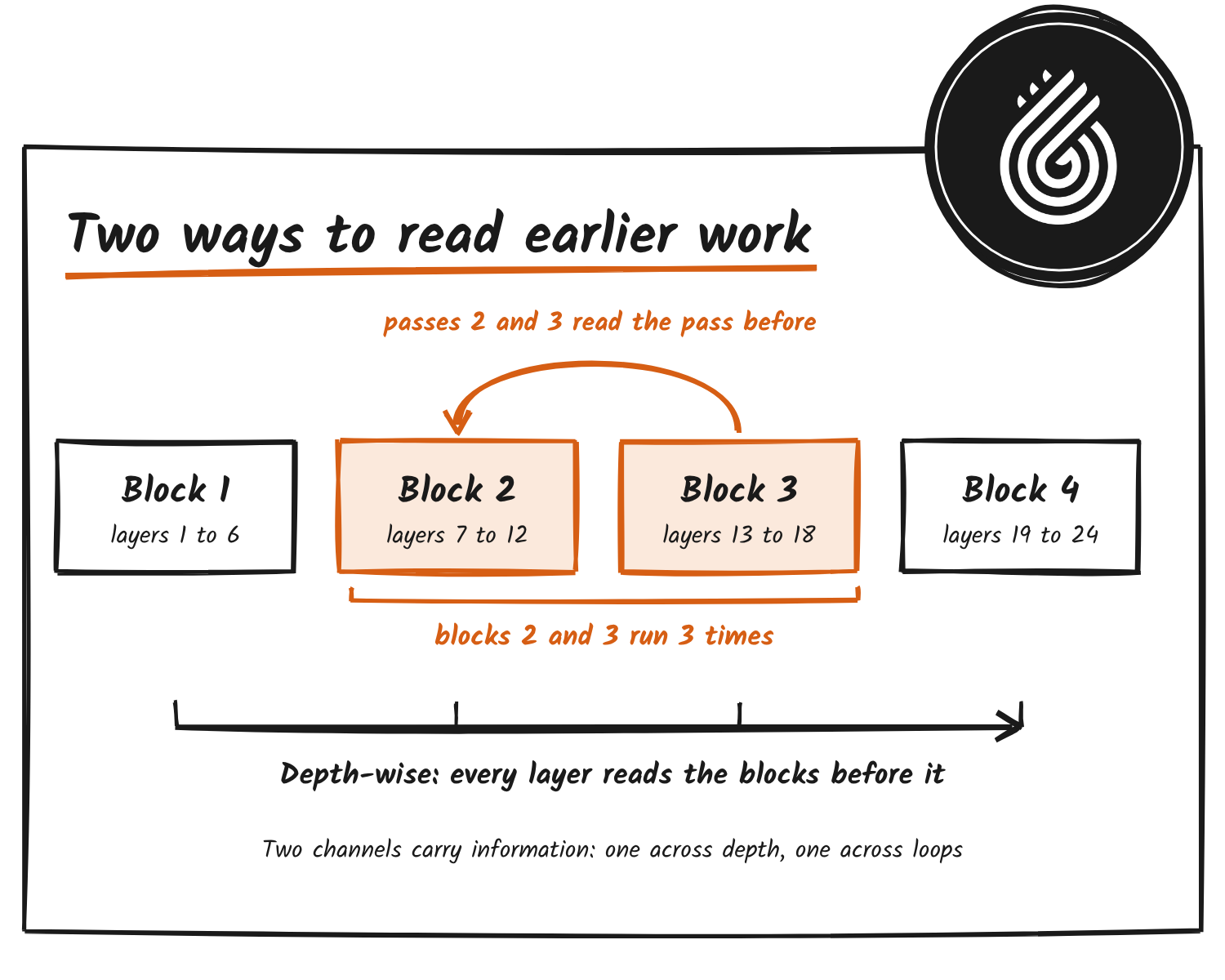
Inkling 2 Mini has 24 layers. Each is an attention sublayer followed by a mixture-of-experts sublayer, a set of specialist sub-networks of which only a few run for each token. A standard transformer adds every layer’s output into one running total, the residual stream. Inkling 2 Mini has no such stream. It uses attention residuals, a design from the Kimi team1, where each layer reads earlier outputs through attention and picks its own mix of them.
24
layers, each an attention sublayer plus a mixture-of-experts sublayer
4
blocks of six layers each
3
passes through blocks 2 and 3
48
layer applications per token, from 24 stored layers
Goodfire’s post says the 24 layers split into four blocks of six, and each block keeps a running sum of its own layers’ outputs, starting from zero. Blocks 2 and 3 are the looped ones. On the second and third pass, each sublayer also reads the outputs of blocks 2 and 3 from the pass before, which Goodfire calls cross-loop attention. That gives information two channels between blocks: depth-wise attention within a pass, and cross-loop attention from one pass to the next.
Where each layer’s input comes from
Every layer’s input is a weighted mix of earlier outputs, so Goodfire can split it back into contributions from individual earlier layers and work out how much each one supplies. The shares add up to exactly one. The post’s flow map averages them over 13,233 tokens from 400 FineWeb documents, FineWeb being a public web-text dataset.
Two patterns show up. Within a pass, the model leans on recent layers, which Goodfire compares to a sliding window. Across passes, later loops favour block 3 over block 2, and block 3 almost always reads its own output from the previous pass. Goodfire suggests that’s because block 3 already gets block 2’s information through depth-wise attention.
counterintuitively, looped model layers can write to themselves, or read from “future” layers!
Goodfire, Interpreting Inkling 2 Mini, 20 November
Who writes to the readers
Both kinds of attention choose which block to read using small sets of learned weights, which Goodfire calls readers. There are 56 for depth-wise attention: 31 for attention sublayers, 24 for mixture-of-experts sublayers and one before the final output. There are 48 for cross-loop attention, because each of the 12 looped layers has four. That’s 104 readers.
On the other side are the writers. Each layer’s mixture-of-experts sublayers hold 147,456 neurons, and each neuron has a weight vector that’s added to the model’s activations when the neuron fires. Across 24 layers that’s 3,538,944 writers. Goodfire compared every writer with every reader, 368 million pairs, using absolute cosine similarity, a measure of how closely two vectors point the same way. Keeping the top 0.001% set the cut-off at 0.30 and left 3,490 pairs.
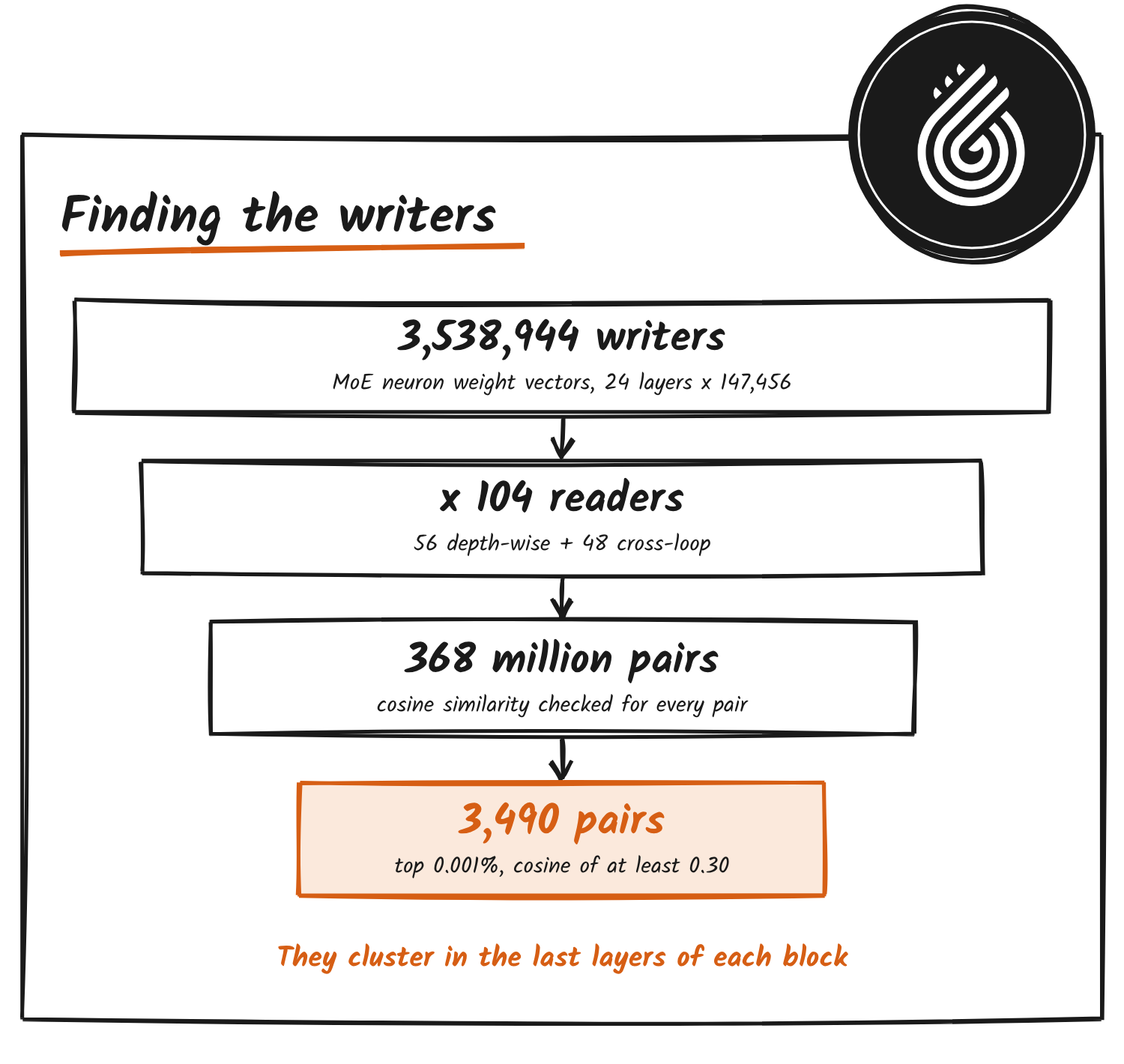
| Item | Count | How Goodfire gets it |
|---|---|---|
| Depth-wise readers | 56 | 31 attention sublayers, 24 mixture-of-experts sublayers, 1 before the final output |
| Cross-loop readers | 48 | 12 looped layers, four readers each |
| Writers | 3,538,944 | 24 layers × 147,456 neurons |
| Pairs checked | 368 million | every writer against every reader |
| Pairs kept | 3,490 | absolute cosine similarity above 0.30, the top 0.001% |
Those pairs aren’t spread evenly. For depth-wise attention they sit mostly in the last layer of each block, layers 6, 12 and 18. Goodfire reports that layer 6 writes mostly to block 4, layer 12 mostly to blocks 3 and 4, and layer 18 to block 4. It reads this as the last layers of a block tagging their output so that later layers know which block to read.
The cross-loop pairs tell the same story. Block 3’s layers do most of the writing, the last one especially, and mostly to layer 13, the first layer of block 3. That lets layer 13 in a later loop read block 3, which matches the attention pattern in the flow map.
A coordinate that stands out
Goodfire normalised each activation by its root mean square2. That makes each vector’s squared norm 2,304, the model’s hidden width, so an even spread would give every one of the 2,304 coordinates a magnitude of 1, or about 0.043% of the total. In the looped layers one coordinate doesn’t follow that. Coordinate 2027, which Goodfire calls d2027, averages a normalised value of +32.4, about 46% of the squared norm.
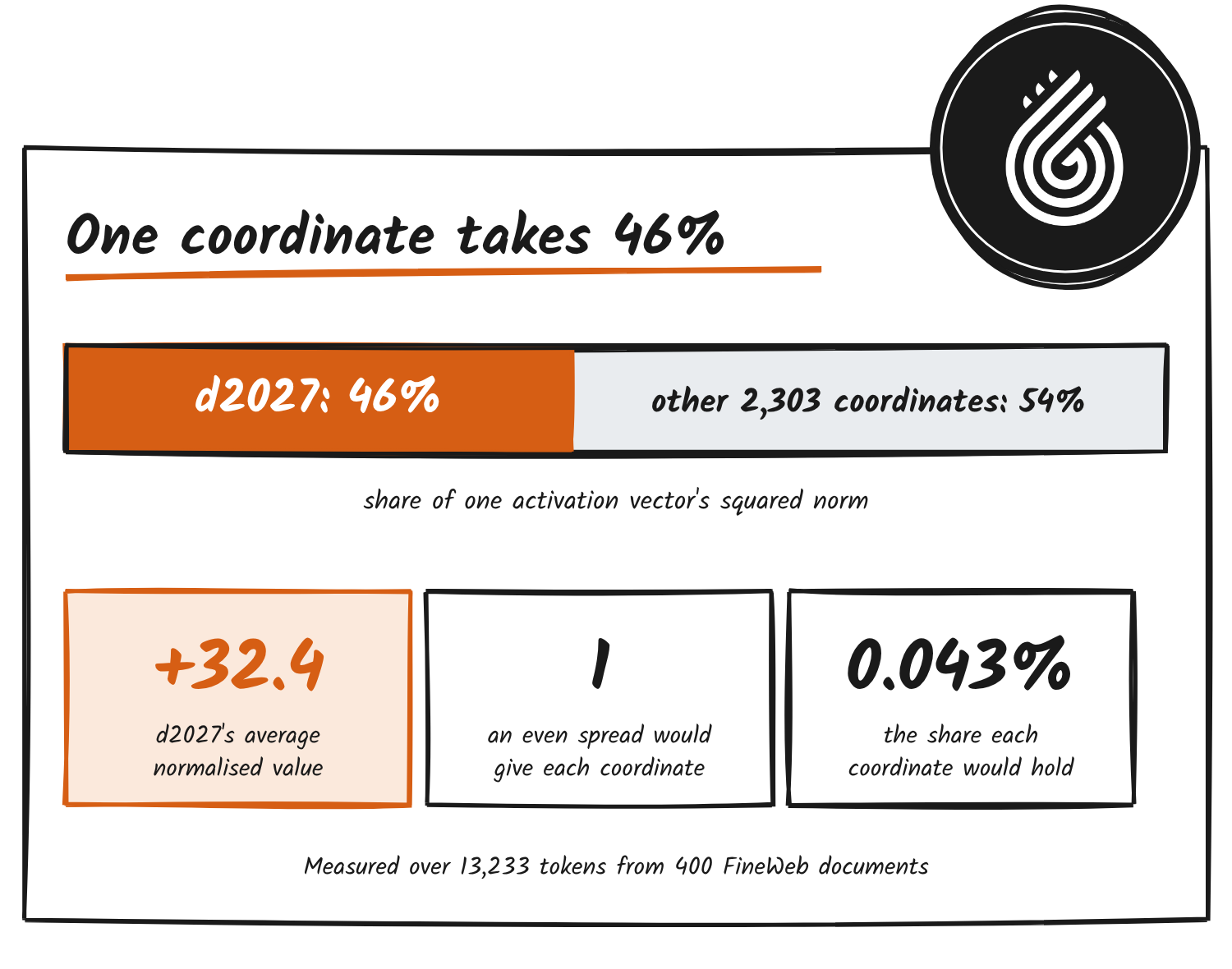
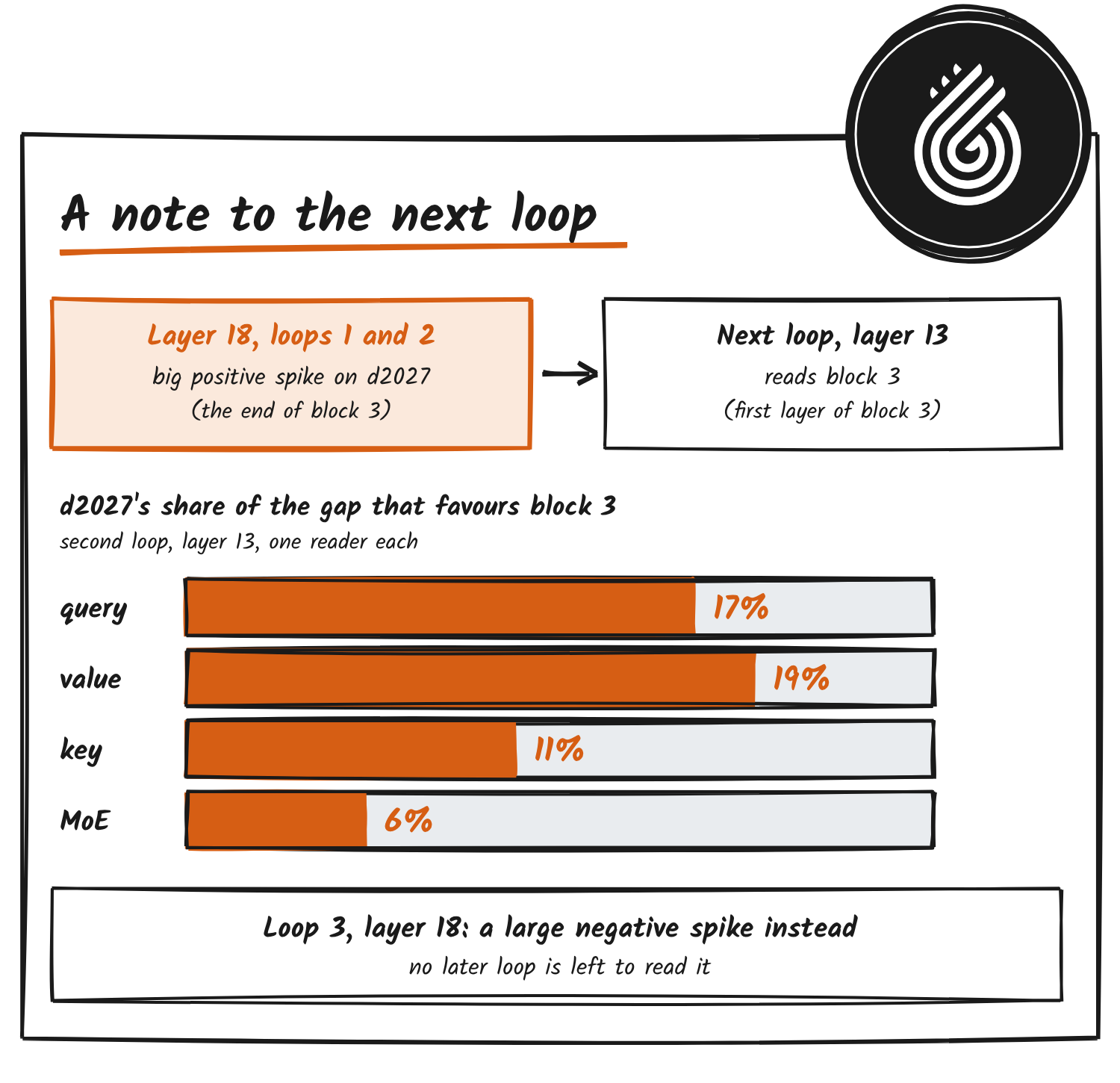
On the same 13,233 tokens, d2027 surges at layer 18, the end of block 3, in the first two loops. In the third loop the same layer writes a large negative value. Goodfire believes d2027 coordinates which blocks later loops read. Its speculation about the negative spike is that the model clears d2027 because no loop follows.
The read side fits. At layer 13 in the second loop, d2027 is the largest or second-largest contributor to the score gap that decides whether each of the four cross-loop readers attends to block 3 or block 2. It supplies 17%, 19%, 11% and 6% of that gap for the query, value, key and mixture-of-experts readers. It isn’t the only outlier. The top five coordinates account for 60%, 62%, 32% and 30% of the same gaps, and all five rank in the top 15 coordinates by normalised size.
What the “gap” is
Each cross-loop reader scores block 2 and block 3 against a learned vector, then turns the scores into attention weights with a softmax. With only two blocks, the weight on block 3 is a sigmoid of the difference between the two scores. That difference is the gap. A large positive gap sends nearly all the attention to block 3, and Goodfire measures how much of the gap each coordinate of the activation supplies.
Which lenses read the loops
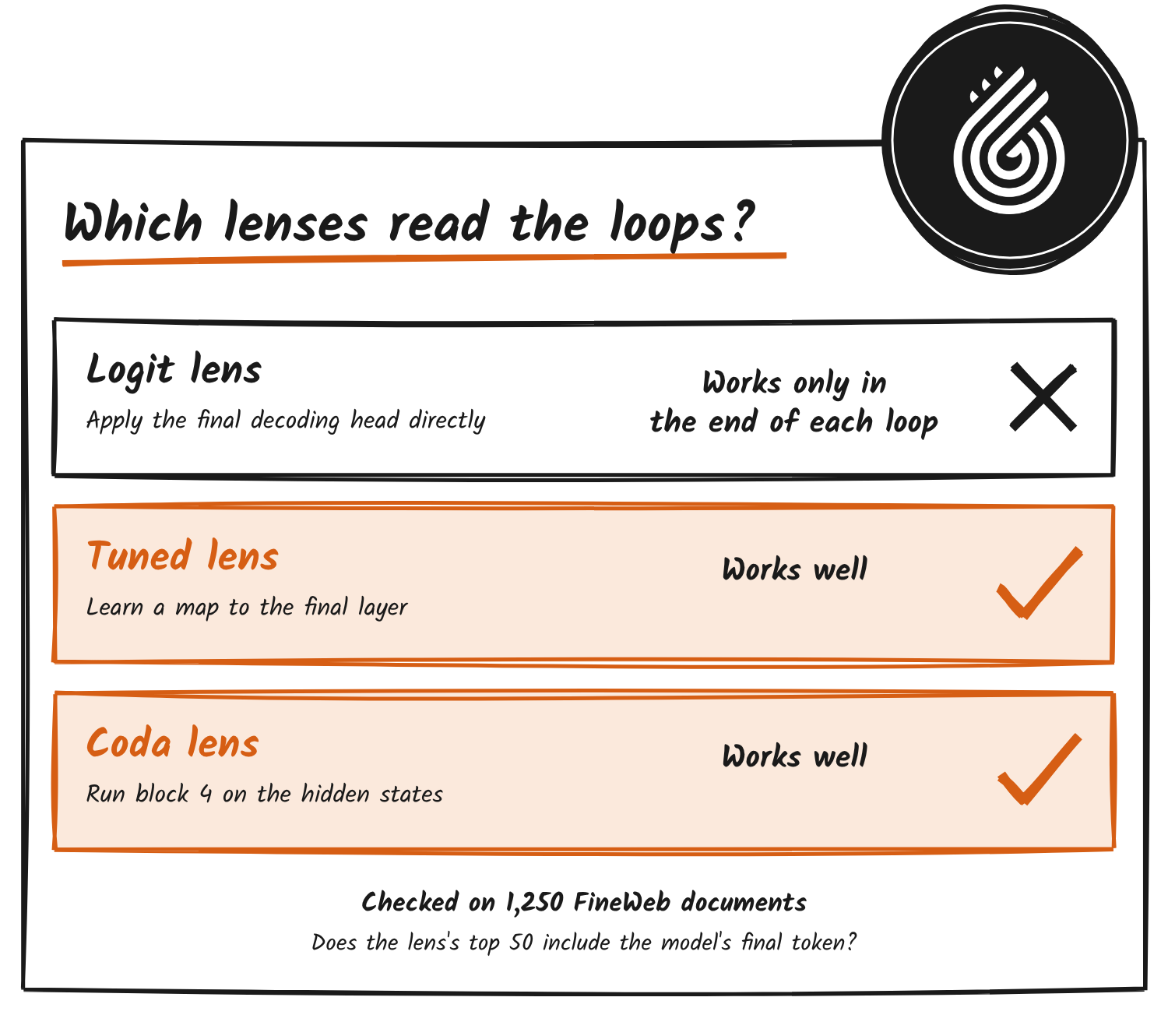
Goodfire also tested ways of reading what the model is computing partway through. The logit lens applies the model’s final decoding head to a hidden state from the middle of the network. Goodfire compared that with a tuned lens, which learns a transformation from a hidden state to the final layer, a J-lens, which uses an averaged Jacobian matrix, and a coda lens, which runs the final block, block 4, on the hidden states.
Two measures score each lens: how often its top 50 tokens include the model’s final output token, and how much probability it puts on the model’s top 50 tokens. The tests used 1,250 FineWeb documents, and the tuned lens was trained on another 23,750. The summary is that the logit lens fails except in the last few layers of each loop, where the coda would run, while the tuned lens and the coda lens work very well. Goodfire adds that layers in the early loops are easier to read than the mid-layers of each block, whereas in a standard transformer the logit lens typically works only in the mid to late layers.
What the post doesn’t show
Goodfire calls its findings preliminary, and its conclusion calls them early results. The post measures weights and average activations over FineWeb text. It doesn’t include a test that edits d2027 or the writer neurons and watches how later loops change. Goodfire says the outlier activations could serve several functions, and ties d2027 to loop coordination from where it spikes and which readers pick it up.
Thinking Machines’ own work on looping and monitorability, including a variable-loop research model, is separate and sits in its release post.
Trying it yourself
NDIF, the National Deep Inference Fabric, hosts Inkling 2 Mini and the variable-loop research model for remote access, so researchers can read, patch and steer activations across every loop through the nnsight library without downloading the weights. NDIF’s post on nnsight says a plain hook on a layer’s output captures only the six-layer block in progress, so reading the full state means working across the active block, the completed blocks and the cross-loop messages.
The Looped Lens Challenge asks entrants to build the lens that best reads Inkling 2 Mini. NDIF, Thinking Machines, Goodfire and Northeastern University are listed as its organisers and partners. Entrants need an NDIF key and a registration, and a judge scores the tokens each lens reads out. Phase one opens on 23 November, and the closing date hasn’t been announced.
The model-loading lines from NDIF’s example
NDIF’s example needs nnsight 0.8.3 and a transformers build from the add-inkling2-mini branch. It loads the model’s structure locally and runs the trace on NDIF’s servers:
CONFIG.set_default_api_key("YOUR_NDIF_API_KEY")
MODEL_ID = "thinkingmachines/inkling-2-mini"
model = TransformersModel(MODEL_ID, task="text-generation")

with model.trace(prompt, remote=True) as tracer:
    for _ in tracer.iter[:3]:  # three passes over the middle blocks
...- Block
- A group of six consecutive layers whose outputs are summed together. Inkling 2 Mini has four.
- Pass or loop
- One trip through the middle two blocks. Each token makes three.
- Reader
- A learned weight vector that scores earlier blocks to decide which one a layer reads.
- Writer
- A mixture-of-experts neuron whose weight vector is added to the model’s activations when it fires.
- Residual stream
- The running total a standard transformer’s layers all add into. Inkling 2 Mini doesn’t have one.
- Lens
- A method that reads a hidden state partway through a model and says, in tokens, what the model is computing there.
as neural network architectures continue to evolve, we believe our intuitions and understanding of their internal mechanisms will be able to evolve with them.
Goodfire, closing its Inkling 2 Mini post, 20 November
Sources
- Interpreting Inkling 2 Mini, Goodfire, 20 November
- Introducing Inkling 2 Mini, Thinking Machines, 20 November
- Opening the box of Inkling 2 Mini using NNsight and NDIF, nnsight, 20 November
- The Looped Lens Challenge, NDIF
- Goodfire’s post on X, 20 November
- Attention Residuals, Kimi Team (Guangyu Chen et al.), 2026, arXiv 2603.15031, as cited in Thinking Machines’ Inkling 2 Mini post. ↩︎
- Dividing a vector by its root mean square rescales it so its squared norm equals its number of coordinates, here 2,304. ↩︎
Discover more from Sulat AI & Tech News
Subscribe to get the latest posts sent to your email.