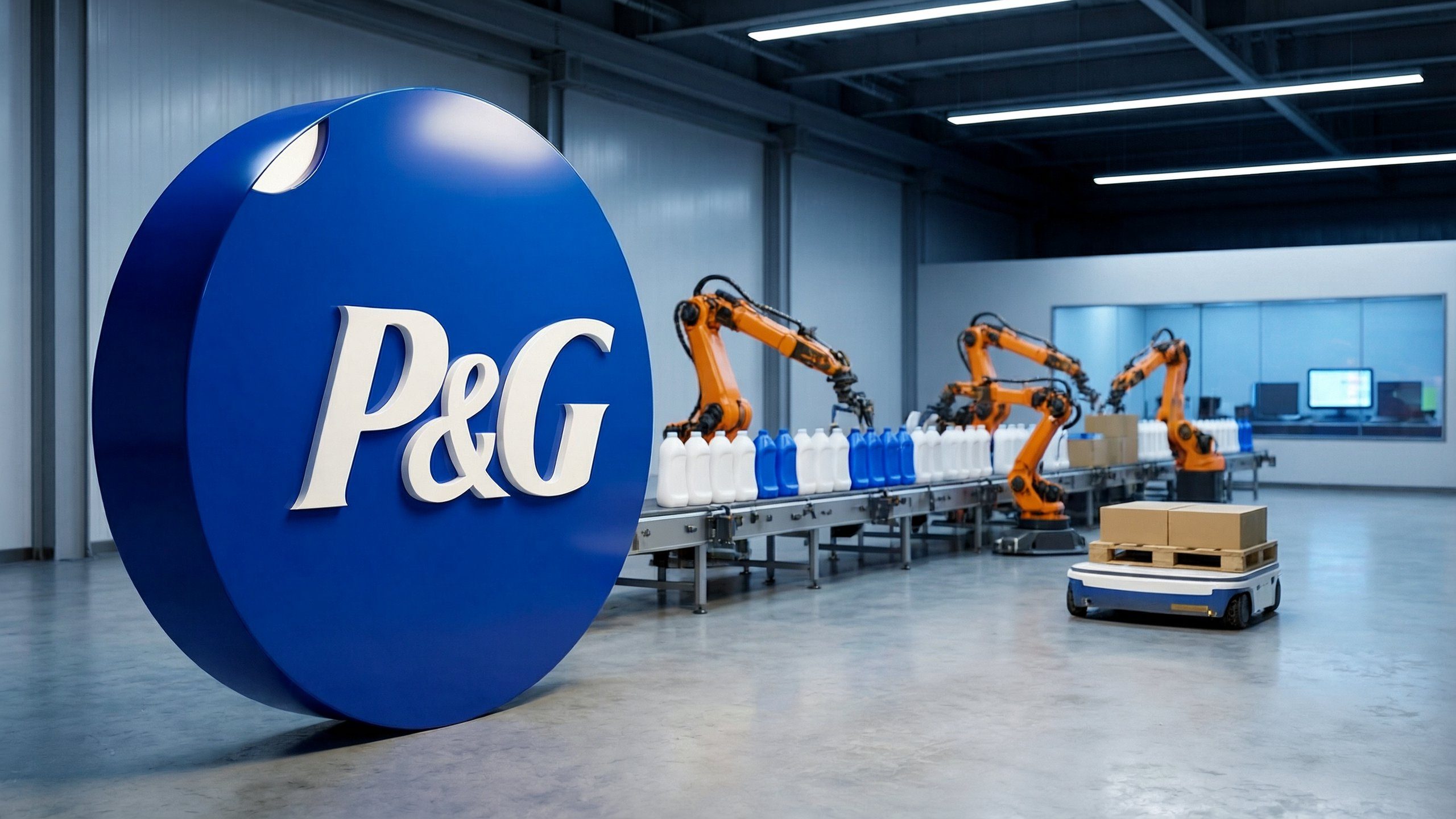
Procter & Gamble plans to run more factory shifts with nobody on the floor, and to cut its product supply workforce by 20% to 30% by 2030, contractors included. Luc Reynaert, P&G’s chief product supply officer, laid out both at the company’s investor day in Cincinnati on 19 November. The New York Times reported the plan on 22 November under the headline “Procter & Gamble to Increase Factory Shifts Without Humans to Cut Costs”.
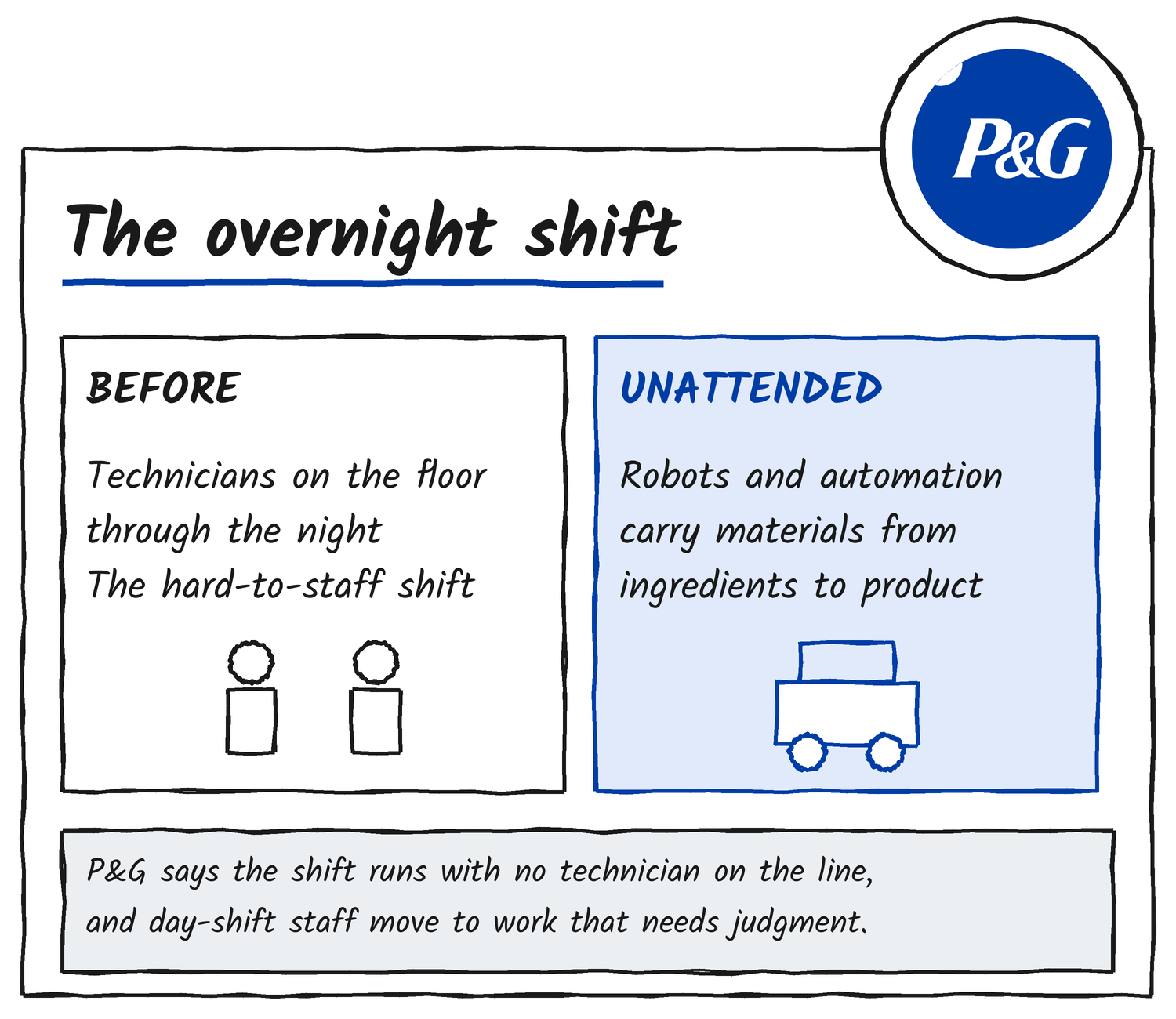
P&G calls the practice unattended operations. It started with one night shift at a Gillette plant in Berlin and now runs at more than 15 sites. This piece goes through what P&G said on the day, what the figures cover and what the company hasn’t given.
- What Reynaert told investors
- From one Berlin night shift to 15 sites
- What changes for the night shift
- The jobs target
- The money
- Beyond the factory floor
- What P&G hasn’t said
What Reynaert told investors
Reynaert presented under the banner of Supply 3.0, P&G’s name for its programme to automate and connect manufacturing, warehousing and transport. He said unattended operations use robotics, automation and digitisation to improve safety, quality and reliability, with the potential to deliver up to 20% productivity improvement by 2030. P&G’s fiscal year starts on 1 July, so fiscal 2027 is the year that began in July 2026.
We are taking unattended operations to a whole new level.
Luc Reynaert, chief product supply officer, P&G Investor Day, 19 November 2026
We showed a video of the Berlin pilot at this meeting two years ago. We’re now running at more than 15 sites with plans to further scale in FY 2027.
Luc Reynaert, P&G Investor Day transcript, 19 November 2026
15+
sites running unattended operations
Up to 20%
productivity improvement by 2030, P&G’s potential
20-30%
smaller product supply workforce by 2030, contractors included
US$1.8bn
a year in productivity savings, up to1
From one Berlin night shift to 15 sites
The first unattended shift ran at the Berlin plant on 1 July 2024.2 Since then the approach has moved from a single line to a programme with a company-wide target.
| Date | What happened | Source |
|---|---|---|
| 1 Jul 2024 | First unattended shift at the Berlin plant | Manufacturing Dive |
| 3 Dec 2024 | P&G describes a night shift at a Gillette factory that ran without a technician on the floor | Consumer Goods Technology |
| Sep 2025 | Schulten puts the gain from an unattended shift at 15% to 60%; the approach has spread to nine other pilots | Consumer Goods Technology |
| 5 Oct 2026 | P&G’s blog reports a four-hour unattended night shift at the Berlin grooming plant and says pilots are expanding | P&G |
| 19 Nov 2026 | Reynaert: more than 15 sites, with further scaling in fiscal 2027 | P&G Investor Day transcript |
| 22 Nov 2026 | The New York Times reports the plan; its photo caption says the Berlin plant runs without technicians during the overnight shift | The New York Times |
P&G’s own account of the Berlin result, in an October blog post, is a four-hour unattended night shift at its grooming plant. The Times’s photo caption describes the plant’s overnight shift as run without technicians.
What changes for the night shift
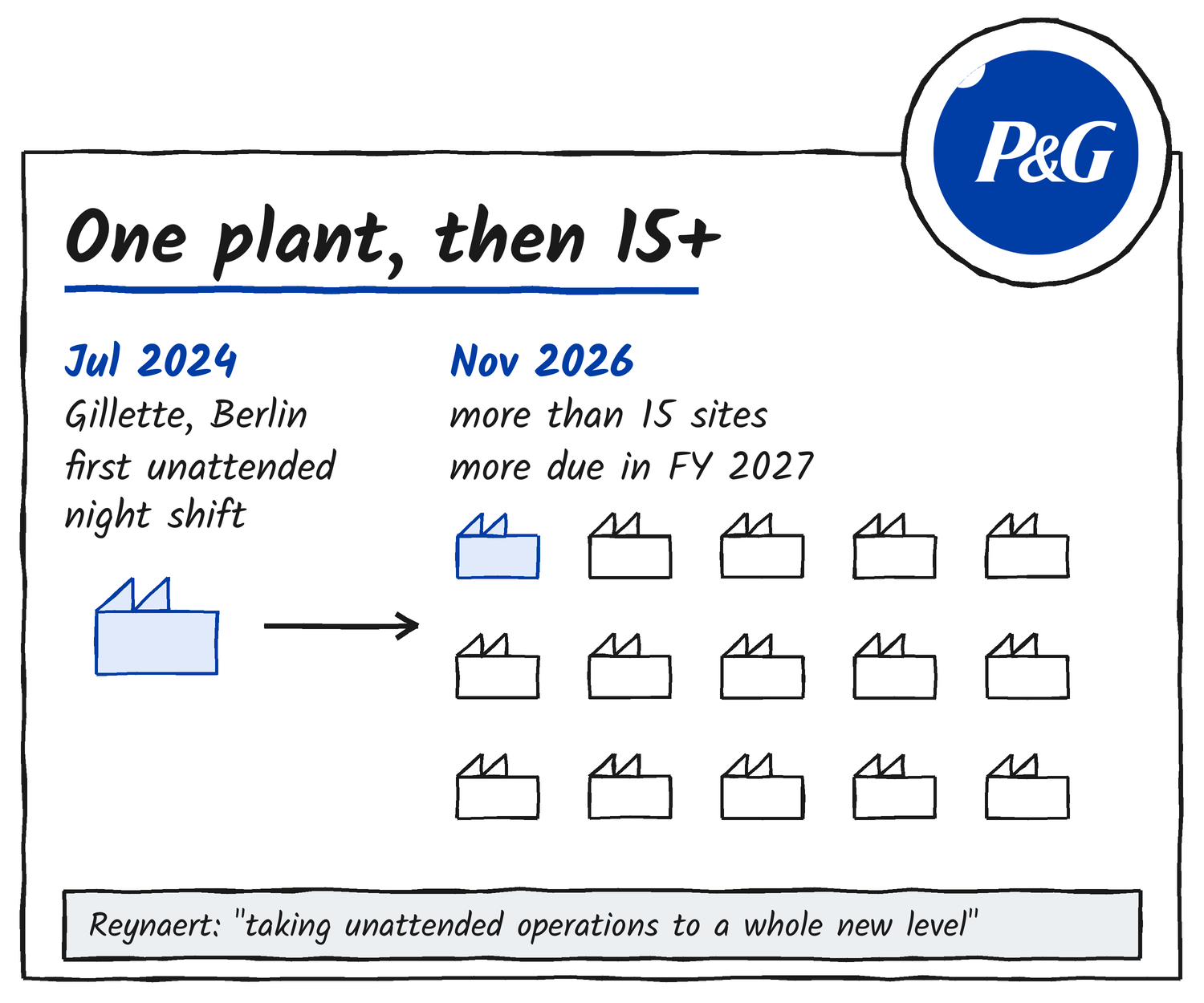
P&G’s pitch to staff is about hours. Its blog post says unattended operations can reduce the need for employees to work “less desirable night shifts”, and that day-shift employees can “focus less on repetitive tasks and more on work that benefits from their judgment and expertise”.
We have 88% favorable ratings in our employee surveys from that [Berlin] facility, which are among the highest in the company. People are thrilled that they get to spend the evenings with their family instead of working that third shift.
Jon Moeller, then P&G’s chief executive, at an investor conference in September 2025, as quoted by Consumer Goods Technology
Moeller also said the automation covers the movement of materials across the floor, from ingredients to finished product, according to the same Consumer Goods Technology report.3
- Unattended operations
- P&G’s term for manufacturing and warehousing lines that run for stretches, often overnight, with no technician present.
- Product supply
- The part of P&G that sources, makes, packs and delivers its products. P&G abbreviates it to PS.
- Supply 3.0
- The name of P&G’s current programme for its supply chain, with priorities including touchless flow and seamless data.
- Cost of goods sold
- The money spent making the products P&G sells.
The jobs target
The workforce line sits on slide 63 of the investor day deck, under the heading Commitments by 2030. It reads 20-30% product supply workforce reductions, including contractors, next to US$1.8 billion in productivity savings and free cash flow productivity of 90% or more.
We remain committed to delivering up to $1.8 billion in annual productivity savings, 90% or greater free cash flow productivity, and a 20%-30% reduction in our product supply workforce, including contractors, by 2030.
Luc Reynaert, P&G Investor Day transcript, 19 November 2026
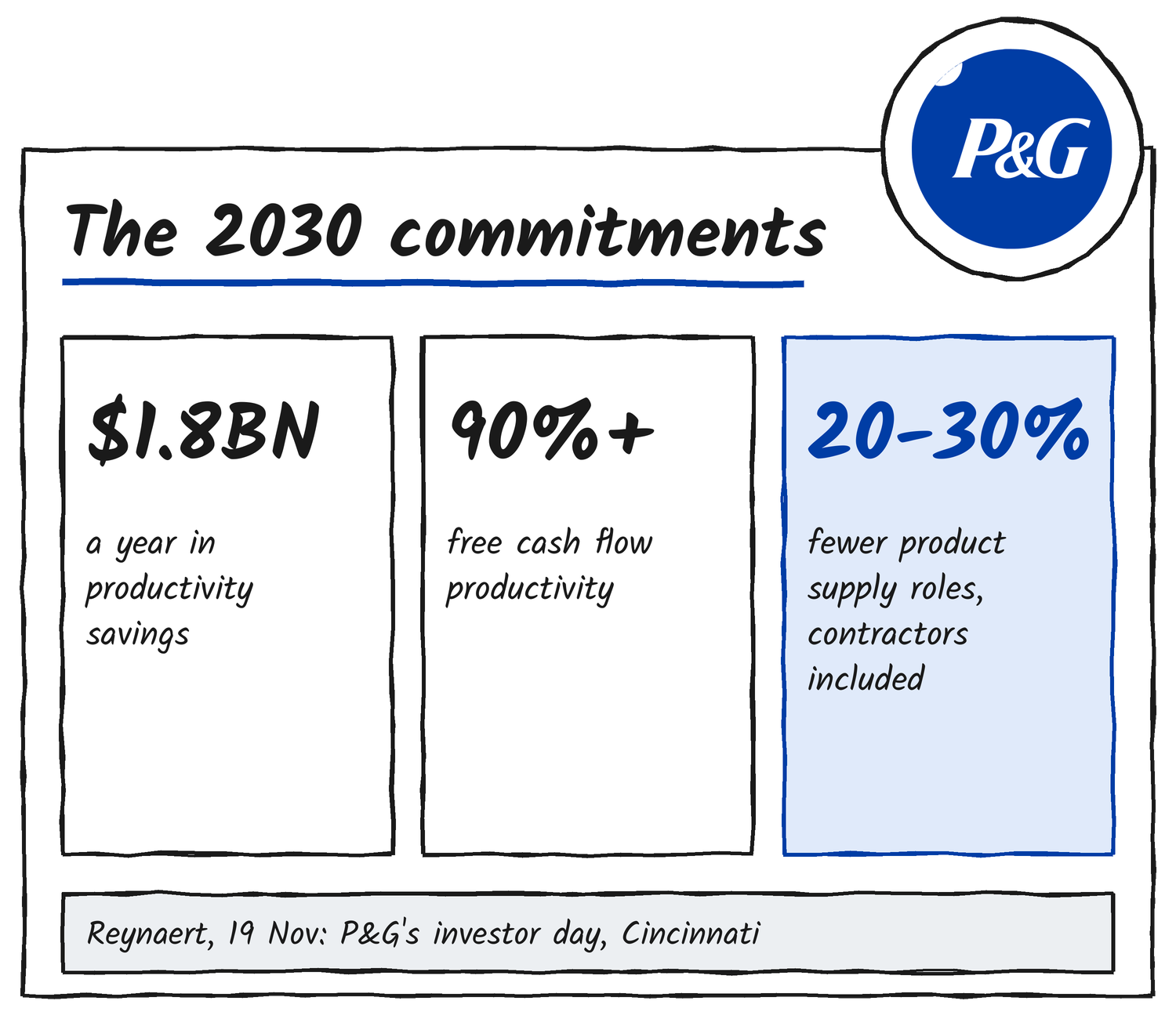
Reynaert gave a percentage. P&G didn’t give a headcount for the target, HR Director reports, and it didn’t say which countries or job types are in scope. Dow Jones reported that Reynaert said the US$1.8 billion in annual savings comes in part from the workforce reduction, and that P&G didn’t immediately respond to a request for comment on the job cuts.
How HR Director estimated the number of roles
HR Director took P&G’s fiscal 2026 annual report, which puts total employment at about 104,000 people on 30 June 2026 with 49% in manufacturing roles. Applying 20% to 30% to that manufacturing base gives roughly 10,000 to 15,000 positions. That is the outlet’s own arithmetic, not a P&G figure, and the target also covers contractors, who aren’t in the employee count.
On skills, Reynaert said a global capability programme has produced significant gains in digital skills, with 95% confidence among participants that they can apply them. His framing of the stakes:
As product supply becomes more automated, success heavily depends on a workforce with the skills to scale and optimize these technologies.
Luc Reynaert, P&G Investor Day transcript, 19 November 2026
Schulten said P&G remains on track with the reduction of up to 7,000 non-manufacturing roles announced in June 2025. His US$10 billion plan, in his words, “assume[s] roughly flat headcount and media spending”. Reynaert’s cut applies to product supply alone.
The money
Schulten announced a productivity target of up to US$10 billion from fiscal 2027 to fiscal 2030, which he said delivers in four years the savings P&G previously targeted over five. The target includes up to US$1.8 billion a year in cost of goods sold and fiscal 2027 restructuring savings.
Product supply delivered US$1.5 billion in savings last fiscal year, P&G’s blog says, and US$300 million of that went back into product and packaging. Across cost of goods sold and selling, general and administrative costs, Schulten said P&G recorded a record US$2.8 billion in productivity in fiscal 2026.
Asked by a JPMorgan analyst how P&G gets five years of savings in four, an executive answered that the pace of the past 12 months, carried forward, works out to US$10 billion over four years:
If we did what we have done in the last 12 months, moving forward, it works out to $10 billion in four years.
P&G executive, answering a JPMorgan analyst, P&G Investor Day transcript, 19 November 2026
Costs are rising. HR Director, citing Reuters and RTTNews, reports that P&G warned in October of higher raw material, energy and freight costs, and puts the commodity headwind at about US$1.4 billion after tax in fiscal 2027. Brian Jacobsen of Annex Wealth Management questioned how much of the US$10 billion is new efficiency rather than an offset to those costs, Reuters reported. P&G shares closed 1.4% lower on 19 November, at US$167.85, according to Stock Analysis.
Beyond the factory floor
Unattended operations is one of several automation projects Reynaert presented. In Europe, P&G’s Intelligent Distribution Center programme is expected to deliver a 35% productivity increase and US$100 million in savings over the next four to five years, he said. A planning and orchestration centre links transport and warehouse operations in real time. By synchronising truck arrivals, automated gate entry, case picking and pallet staging, P&G expects to bring driver waiting times under 45 minutes.
An AI-enabled platform built at the Mechelen site in Europe and now used across plants turns hours of data gathering into five minutes, Reynaert said. Autonomous mobile robots at one of P&G’s mixing centres load or unload a truck in 30 minutes on average, against the 45 to 60 minutes it typically takes, Consumer Goods Technology reported in October.
What P&G hasn’t said
P&G hasn’t named the sites beyond Berlin, HR Director reports. The deck carries the workforce target as a percentage only. P&G says the further scaling starts in fiscal 2027, the year that began on 1 July 2026.
Sources
- P&G Investor Relations: Investor Day 2026, 19 November 2026
- P&G: The Four Priorities Powering P&G Product Supply, 5 October 2026
- The New York Times: Procter & Gamble to Increase Factory Shifts Without Humans to Cut Costs, 22 November 2026
- Dow Jones via Morningstar: P&G to Cut Up to 30% of Product-Supply Workers Amid Automation Push, 19 November 2026
- Reuters: Procter & Gamble targets up to $10 billion in productivity savings, CFO says, 19 November 2026
- HR Director: P&G’s automation push puts up to 30% of supply jobs at risk, 20 November 2026
- Consumer Goods Technology: P&G’s Dark Shift Factories Gaining Traction, 8 September 2025
- Consumer Goods Technology: P&G Taps into AI and Automation for Faster, Smarter Operations, 3 December 2024
- Consumer Goods Technology: P&G to Scale Smart, Touchless Supply Chain Optimizations, 13 October 2026
- Manufacturing Dive: What manufacturers see as the value of AI, 22 April 2025
- Reynaert described the US$1.8 billion as gross productivity savings before tax, per year. ↩︎
- Amy Rardin, P&G’s global senior director of supply chain digitization and external strategic partnerships, gave the date at a manufacturing conference in Fort Worth in April 2025, according to Manufacturing Dive. ↩︎
- Jon Moeller was P&G’s chief executive at the time. Shailesh Jejurikar is chairman, president and chief executive in the 2026 investor day transcript. ↩︎
Discover more from Sulat AI & Tech News
Subscribe to get the latest posts sent to your email.