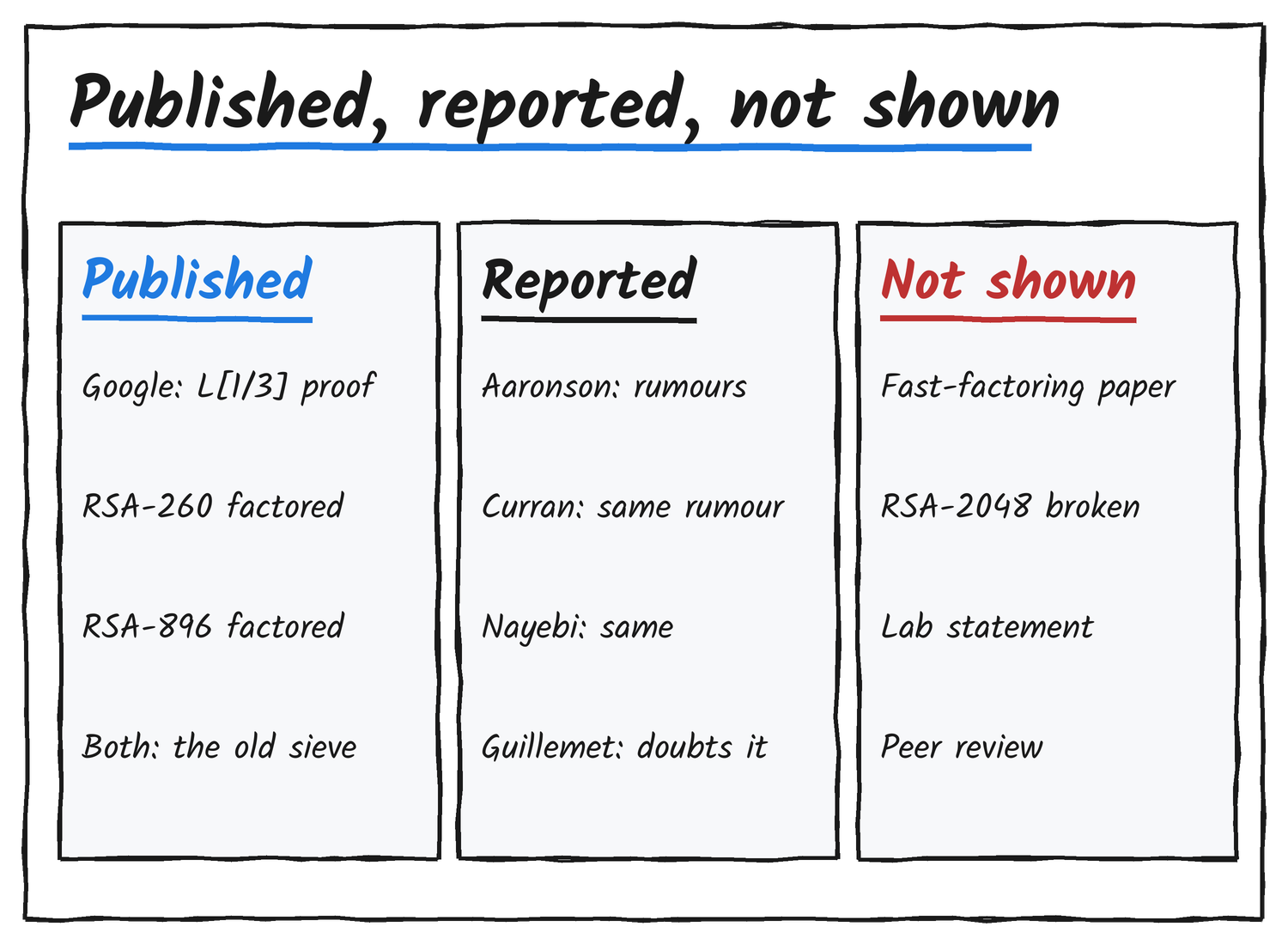
Scott Aaronson, the University of Texas at Austin computer scientist, wrote on 24 November that he had heard “many, many rumors that one or both labs are sitting on Factoring in P.” The labs he means are OpenAI and Anthropic. “Factoring in P” would be a method that splits huge numbers into primes in polynomial time, and that would break RSA encryption. No such method has been published, and Aaronson says he doesn’t know how much to credit the rumour.
What does exist is smaller. On 25 November Google Research posted AI-written papers that include a proof that factoring runs in subexponential time with no unproven assumptions. That is a milestone for theorists and no threat to RSA keys. In September, AI-built GPU code helped set two factoring records using a method from the 1990s. This piece keeps the rumour apart from those results, explains factoring from scratch in a section marked ELI12, and sets out what a real break would and wouldn’t change. The rumour rests on unnamed sources; the results rest on papers and posts I could read.
- The rumour and who has repeated it
- ELI12: what factoring is
- Polynomial, subexponential, exponential
- What Google published on 25 November
- What AI has done to factoring so far
- What a real break would and wouldn’t change
- The other rumours
- What to watch
The rumour and who has repeated it
The trail starts on Aaronson’s blog, Shtetl-Optimized. Under his 24 November post, a reader asked for the odds that factoring is in P. In comment #23 he answered:
“I’ve now heard many, many rumors that one or both labs are sitting on Factoring in P. I don’t know how much to credit this.”
Scott Aaronson, blog comment, 24 November 2026
The next day, in a longer post, he went further on cryptography. He wrote that “some of those algorithms will break currently deployed cryptosystems” and that he was “virtually certain, from multiple reliable sources, that the AI labs are now sitting on one or more bombshells in that area.” In the same passage he said he felt “much, much less confident about the specific nature” of those results, didn’t want to be “responsible for spreading unverified rumors,” and worried that exact statements “may have been mangled in a game of Telephone.” He declined to say whether ECDSA, the signature scheme Bitcoin uses, is broken.
Others said they had heard it too. AI commentator Andrew Curran wrote that the rumour had persisted for about ten days, about both Anthropic and OpenAI, and that it “would crack RSA.” Carnegie Mellon researcher Aran Nayebi said he had heard the same for about a week.
Charles Guillemet of Ledger listed the rumours he was hearing: factoring in P, a break of elliptic-curve cryptography, and ring-LWE not being quantum-resistant. He doubted all three: “Personally, I don’t think findings like these are coming.” Later he added that Google’s new batch of papers touched “exactly the topics behind the rumors,” and wrote “None of them breaks anything.”
Igor Babuschkin, an xAI co-founder who now runs River AI, argued the immediate risk to RSA isn’t a quantum computer running Shor’s algorithm. In his view it is “a math discovery through LLMs that allows factoring in polynomial time on a classical computer.” He added that factoring sits in a special place where a polynomial algorithm “would not imply P=NP.”
I looked for the thing itself. The public math repositories at OpenAI and Anthropic list no factoring paper, and I found no statement from either lab on the rumour. Those quoted above say they have heard it. None says they have seen it.
ELI12: what factoring is
This section is for anyone who wants the idea from scratch. If you know the maths, skip to the next one. The rest of the story hangs on a single trick, and it’s a simple one.
Multiplying is quick
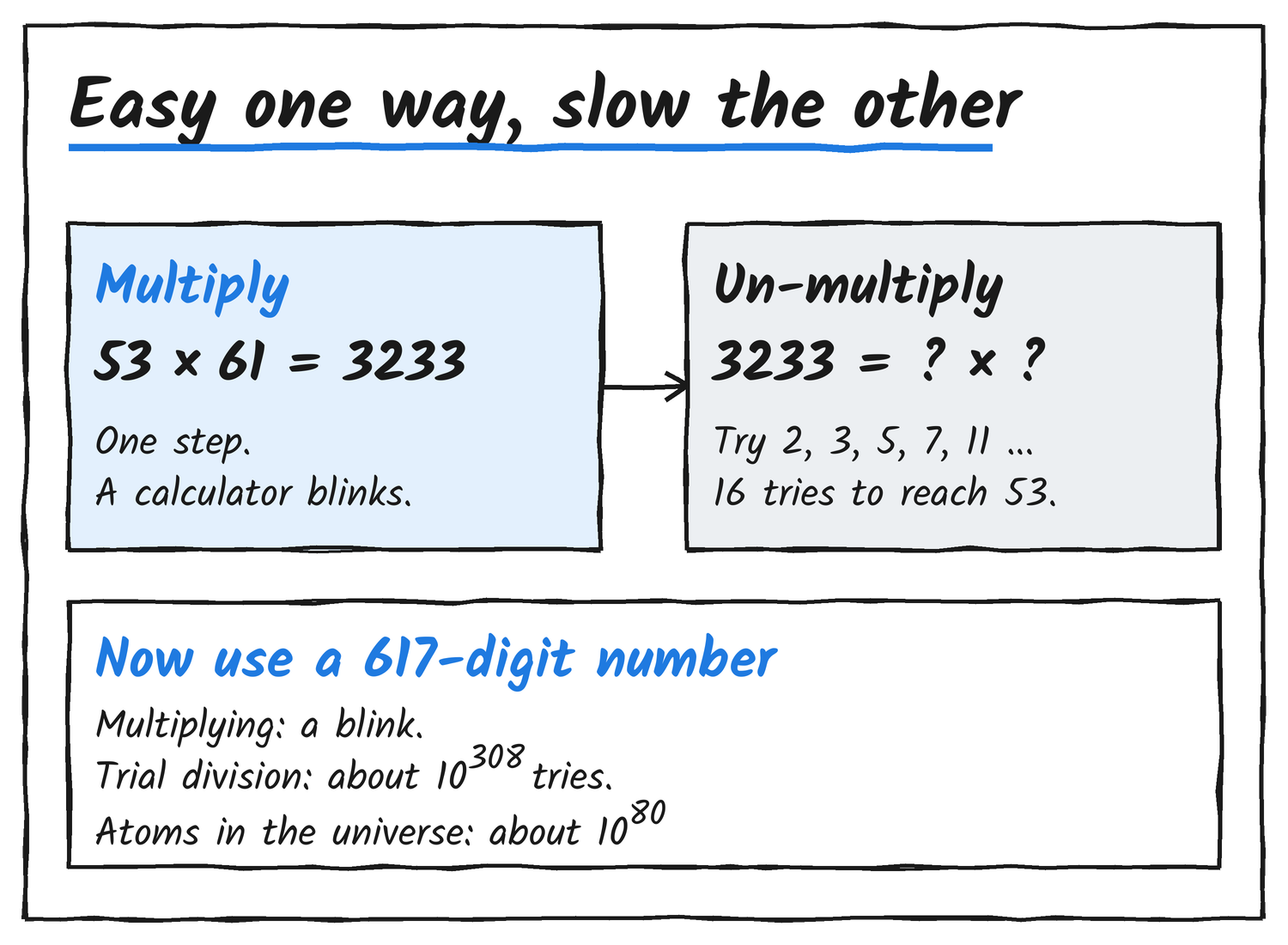
Factoring means taking a number apart into smaller numbers that multiply to make it. Primes are the numbers that can’t be split any further: 2, 3, 5, 7, 11 and so on, including 53 and 61. Every whole number above 1 is a product of primes, and only one set of primes works for each. Multiply two small primes and you get a bigger number: 7 × 13 = 91, and 53 × 61 = 3,233. Multiplying takes a handful of steps, even when the numbers have hundreds of digits.
Undoing it is slow
Now go backwards. Someone hands you 3,233 and asks which two primes made it. Nothing tells you. The plain method is trial division: try dividing by 2, then 3, then 5, and keep going until one fits evenly. You never need to go past the square root of the number, which for 3,233 is about 57. The first prime that fits is 53, the 16th prime you try, and 3,233 ÷ 53 = 61. Take 8,633: its factor 89 is the 24th prime you try, and 8,633 ÷ 89 = 97.
Check the 3,233 example yourself
Divide 3,233 by 2, 3, 5, 7, 11, 13, 17, 19, 23, 29, 31, 37, 41, 43 and 47. None goes in evenly. The 16th prime, 53, does: 53 × 61 = 3,233. Since 61 is also prime, you’re done.
Small numbers are no trouble. Real RSA keys use numbers of 617 digits. Trial division on one of those would need up to about 10308 tries, and the observable universe holds roughly 1080 atoms by the usual estimate. Cleverer methods exist and are vastly faster than trial division. They’re still too slow to matter against a 617-digit number.
Why that protects your data
RSA, named for Rivest, Shamir and Adleman, builds a lock out of that lopsidedness. A public key contains the product of two secret primes of about 309 digits each, which gives the 617-digit, 2,048-bit number. Anyone can use the public key to lock a message or check a signature. Unlocking or forging needs the primes. Split the public number and you can rebuild the private key. My own picture: the product is a padlock anyone can snap shut, and the two primes are the only key.
Why a shortcut would matter
Nobody has proved that factoring has to be slow. We just haven’t found a fast way. Checking whether a number is prime is already fast: the AKS test showed in 2002 that primality testing is in P, as Guillemet pointed out. Finding the factors is the hard part. “Factoring in P” would mean a method whose work grows only as a modest power of the number of digits. If that worked at real sizes, the padlock would stop being a padlock.
Polynomial, subexponential, exponential
One word carries the whole rumour: polynomial. The three speeds differ like this.
- Polynomial. Double the digits and the work grows by a fixed factor, such as 8 for a cube. This is what “fast” means to a theorist.
- Subexponential. The work grows faster than any polynomial but much slower than brute force. The general number field sieve (GNFS), the method behind every factoring record, sits here. Its running time is a heuristic, not a proof.
- Exponential. Every extra digit multiplies the work, as with trial division.
Theorists write the middle speed as LN[α, c], meaning roughly exp(c × (ln N)α × (ln ln N)1−α). A smaller α is faster, and for a fixed α a smaller c is faster. The table lines the known bounds up against a 2,048-bit key.
| Method | Status | Time bound | Rough steps at 2,048 bits |
|---|---|---|---|
| Trial division | Proven | √N | about 10308 |
| Harvey, deterministic (2020) | Proven | N1/5+o(1) | about 10123 |
| Lenstra and Pomerance, randomised (1992) | Proven | LN[1/2, 1] | about 1044 |
| Google Cogentic, deterministic (25 Nov) | Claimed proof | exp(3 (ln N)3/4) | about 10301 |
| Google Cogentic, randomised (25 Nov) | Claimed proof | LN[1/3, 105] | about 101,921 |
| General number field sieve | Heuristic | LN[1/3, 1.923] | about 1035, near 2117 |
| Hypothetical polynomial method | Rumour | n3 for n bits | about 1010 |
Two things stand out. The first is that the number field sieve is already far below everything proven, which is why practical factoring uses it. The second is that Google’s proven bounds are asymptotic claims. At a 2,048-bit key, by this arithmetic, its randomised bound lands above brute force and its deterministic one is no better than Harvey’s. They matter to people who study the limits of the problem, not to anyone attacking a key.
What Google published on 25 November
On 25 November Google Research added six papers to its repository under cogentic_research_papers. Cogentic is an agentic maths system built on Gemini 4, described in arXiv:2609.40324. The READMEs say each paper and its Lean 4 formalisation came from Cogentic with “no human interaction other than the initial prompt.” Seven Google Research and DeepMind researchers built the harness, and the READMEs name them. Two of the six papers are about factoring.
The first, Unconditional Integer Factorization in Time LN[1/3, O(1)], claims a zero-error randomised algorithm that factors every integer in expected time LN[1/3, 105]. Every prime it outputs is certified with the AKS test. The previous best proven bound was LN[1/2, 1], from Lenstra and Pomerance in 1992. The number field sieve already runs at exponent 1/3, but only under unproven assumptions. The paper’s claim is that the exponent can be reached with a proof.
LN[1/3, 105]
Cogentic’s claimed proven expected time
1.92
Constant for the number field sieve, heuristic
1992
Year of the previous best proven bound, LN[1/2, 1]
The second, Unconditional Deterministic Subexponential Integer Factoring, claims a deterministic algorithm that finds a factor of any composite N in about exp(3 (ln N)3/4) bit operations. That is subexponential, with no coin flips. The batch also includes a discrete-logarithm paper for finite fields of fixed characteristic, a different problem from the one behind elliptic-curve keys.
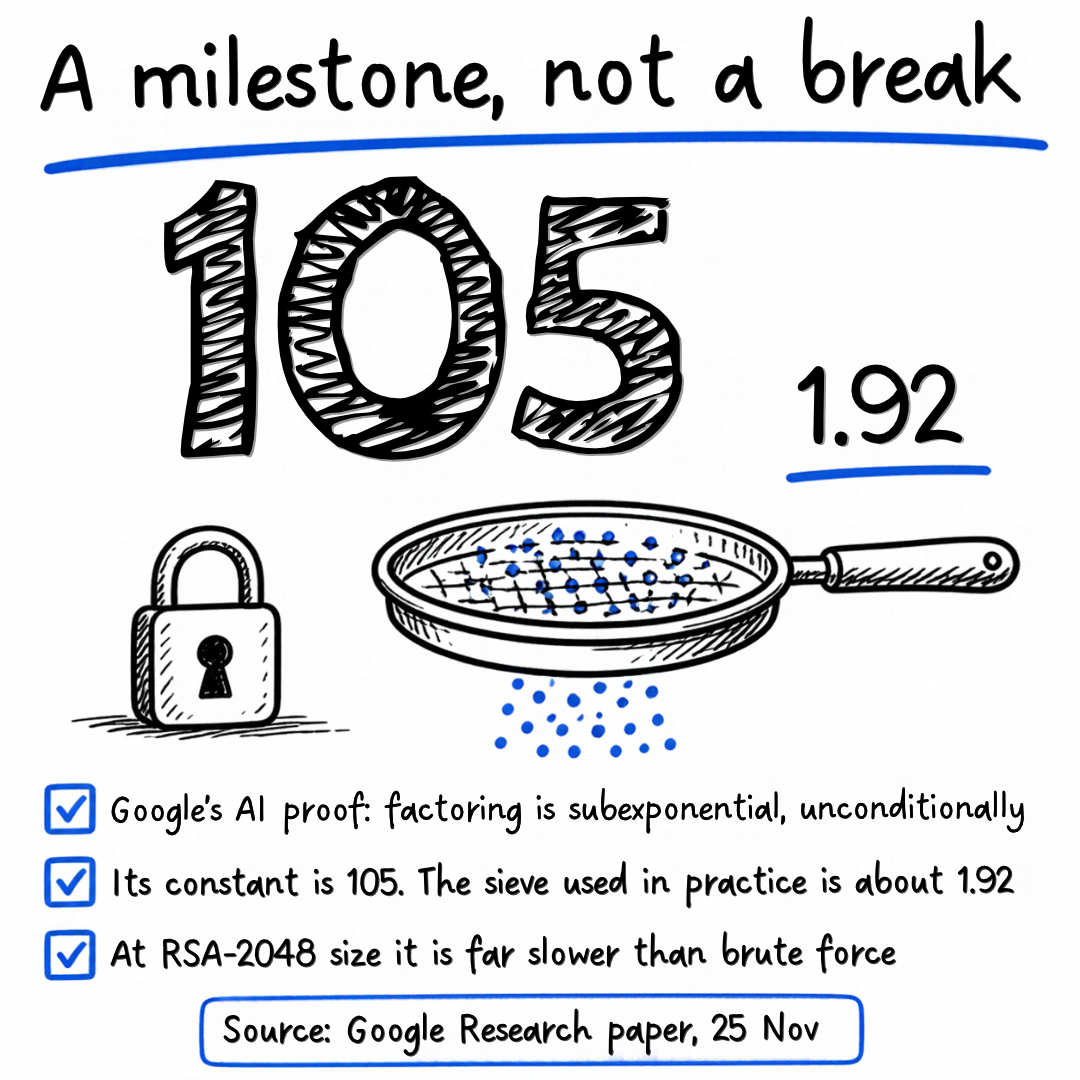
Aaronson read the batch the same day. In comment #27 he wrote that it contains “some big theoretical results on factoring algorithms like number field sieve” but “nothing of practical relevance for cryptography.” That squares with Guillemet’s reading and with the constants above.
On checking: R&D World reported that the factoring paper is 54 pages and that no outside mathematician had verified it, and that by midday on 25 November the repository held PDFs and READMEs while the Lean files were promised in a companion submission. A commenter on Aaronson’s blog said the Google papers had been reviewed by human experts. I couldn’t confirm that for the factoring pair, so I’m treating them as unreviewed claims.
What AI has done to factoring so far
The real record is more modest and better documented. On 9 September Cognition researcher Eric Lu published how he factored RSA-260, a 260-digit challenge number. He used Devin to build a GPU lattice siever for a modified CADO-NFS, the open-source number field sieve. Lu puts the run at about 4,900 GPU-days, or 13.5 GPU-years, roughly US$400,000 at market prices, and says the siever makes factoring about 10 times cheaper than the previous public state of the art. He writes that he reports “essentially no algorithmic advancements”: the gain came from performance engineering.
Ten days later, on 19 September, Anthropic’s Stephen Weis factored RSA-896 with Claude. The model ported CADO-NFS to GPUs and orchestrated a fleet of up to 2,048 of them as low-priority work, over 10 days and about 30 GPU-years. Weis says the work didn’t meaningfully improve the runtime of the algorithm and doesn’t affect deployed RSA-2048 keys, but shows that 1024-bit keys are within reach of many actors with data-centre GPU fleets.
13.5 GPU-years
Lu’s RSA-260 run, about US$400,000
US$30 million
Cognition’s estimate for RSA-1024
1.2 trillion GPU-years
Cognition’s estimate for RSA-2048
Cognition’s post is the clearest statement of the gap. It estimates RSA-1024 at about 78 times the work of RSA-260, or around US$30 million, and says RSA-2048 is “roughly a billion times harder than RSA-1024 and does not appear to be meaningfully affected by this work.” Lu also notes that RSA-1024 was deprecated in 2013 and that its insecurity isn’t news. I covered DeepMind’s 6 November legacy-RSA work too: it cut a known 1024-bit experiment from 1,380 to 391 CPU core-years.
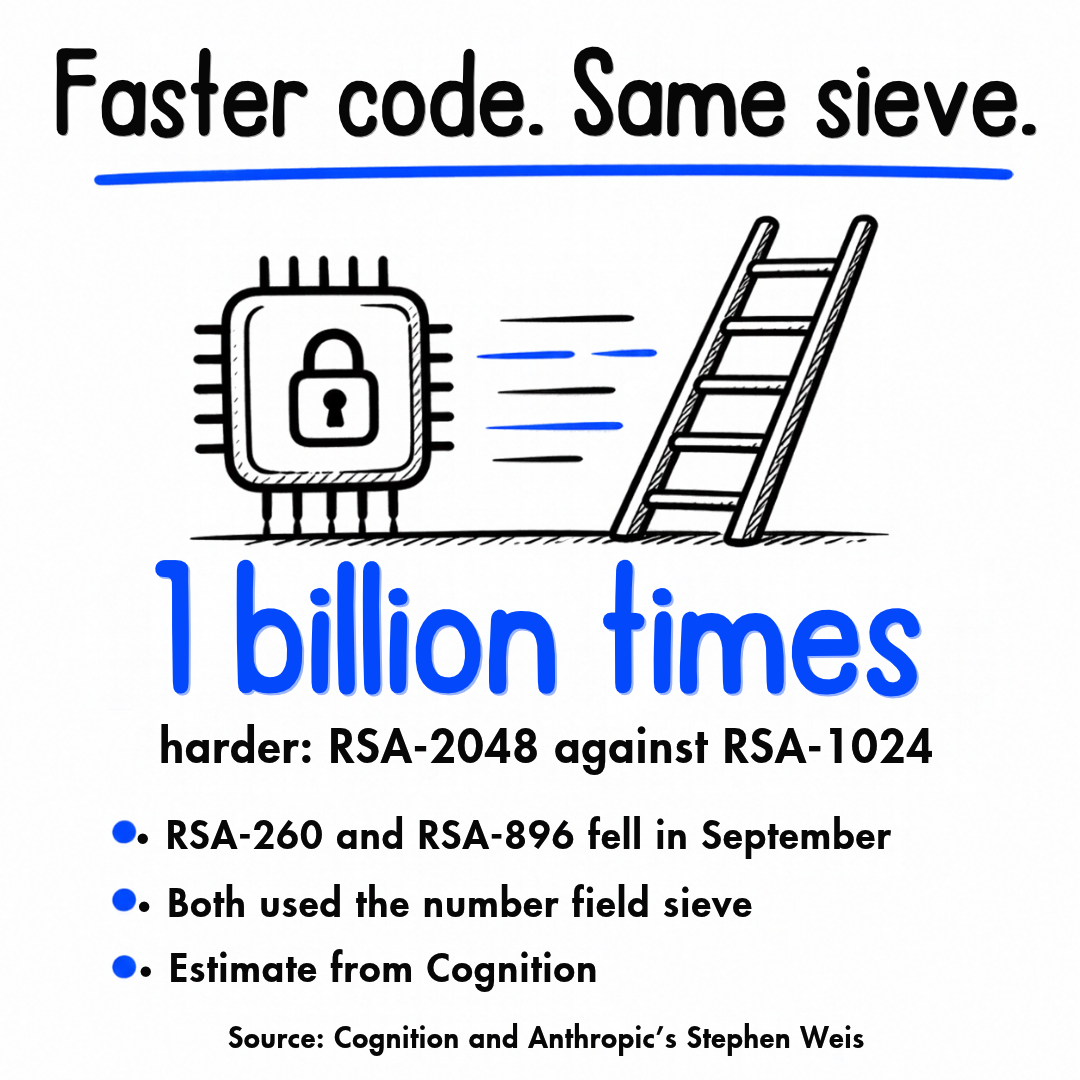
That is what AI has done to factoring in public so far: made a known method cheaper to run. It hasn’t changed how the work grows with key size, which is why the 2,048-bit keys in use today sit out of reach.
What a real break would and wouldn’t change
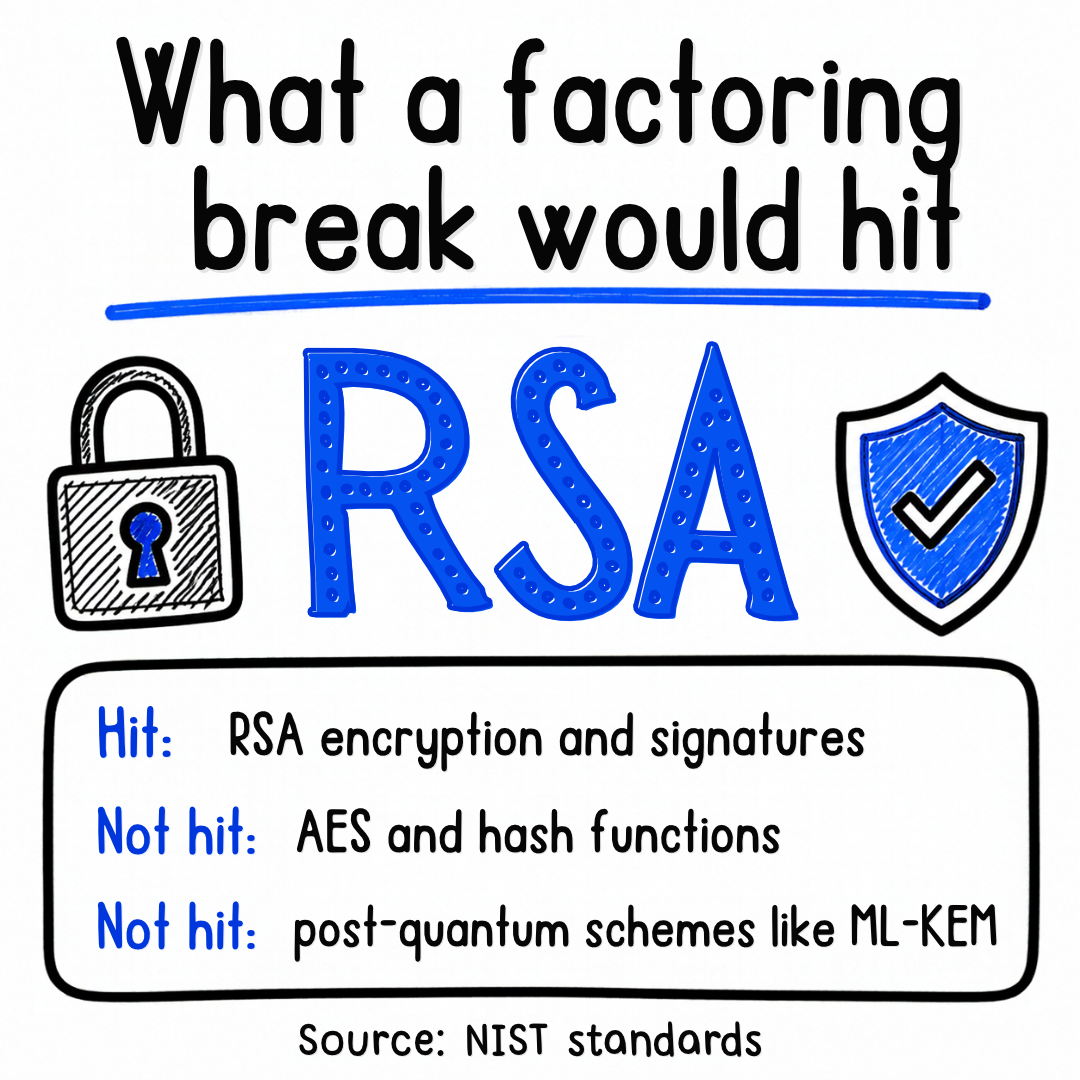
If a polynomial-time method existed and worked at real sizes, RSA would fall at any practical key length, for both encryption and signatures. TLS 1.3 dropped RSA key exchange, but RSA signatures are still common in certificates and software signing, and plenty of older systems use it throughout.
It would leave other tools alone. Symmetric ciphers such as AES and hash functions don’t rest on factoring. Elliptic-curve signatures, including Bitcoin’s ECDSA, rest on the elliptic-curve discrete logarithm problem, which is a separate problem; that is why Guillemet lists an ECC break as its own rumour. NIST’s post-quantum standards, including ML-KEM in FIPS 203, rest on lattice problems, which is why the separate ring-LWE rumour would matter to them and a factoring break wouldn’t.
Quantum computers already change the picture. Shor’s algorithm factors in polynomial time on a large enough quantum machine, which is why NIST published post-quantum standards in 2024 and why NIST IR 8547 went final on 27 October. NIST’s announcement says National Security Memorandum 10 set 2035 as the target for finishing the move, and Executive Order 14412 pulls it forward to 2030 for key establishment and 2031 for digital signatures on federal high-value and high-impact systems. NIST’s Moody said that, because of “harvest now, decrypt later” collection, organisations might move sensitive, long-lived data to the ML-KEM standard first.
A classical factoring break would change the trigger. Today the deadline is “when a large quantum computer arrives.” With a polynomial-time classical method it would be “when someone has the method,” and anyone recording encrypted traffic now would gain from it later. Nayebi’s reaction to the Google papers points the other way: he had half expected factoring and discrete logs to fall to classical methods, and said that quantum computers keeping their advantage for those problems made him “a bit less impressed.”
The other rumours
The factoring story isn’t the only whisper. On 20 November quantum-information researcher Anthony Leverrier asked on X whether anyone else had heard that Anthropic has an attack on ring-LWE, and later wrote that it was apparently a quantum attack. Guillemet reports the ECC rumour. All of it sits in a week when Aaronson lists AI-lab claims on VP ≠ VNP, the matrix multiplication exponent and the Riemann hypothesis. I haven’t checked those results; they’re his account, and each has its own papers.
| Claim | Who is saying it | Status |
|---|---|---|
| Factoring in P | Aaronson (heard it), Curran, Nayebi | Unconfirmed; no paper in the labs’ public repositories |
| Attack on ring-LWE | Leverrier asked on 20 Nov; later said it was apparently quantum | Unconfirmed |
| Elliptic-curve cryptography broken | Guillemet reports hearing it; doubts it | Unconfirmed |
| Unconditional subexponential factoring | Google Research, 25 Nov | Published as a claim; Lean files promised, outside review not yet reported |
What to watch
- A paper or statement from OpenAI or Anthropic that names factoring, or any cryptographic algorithm, with details.
- Google’s Lean files for the factoring pair, and any outside check of the LN[1/3, 105] proof.
- Whether Aaronson, who said he wanted details or a word from a lab, updates what he has heard.
- Notices from NIST and national cyber agencies, which would move first if a real break landed.
If you run RSA, nothing here changes what to do today. List where it’s used, check which systems hold data that has to stay secret for years, and plan the move to NIST’s post-quantum standards against the dates above.
Sources: Aaronson, 24 November 2026; Aaronson, 25 November 2026; Google Research, 25 November 2026; Cognition, 9 September 2026; Stephen Weis, September 2026; Harvey, 2020; NIST IR 8547, 27 October 2026; R&D World, 25 November 2026.
Disclosure: I’m an OpenAI, Firecrawl and Devin ambassador.