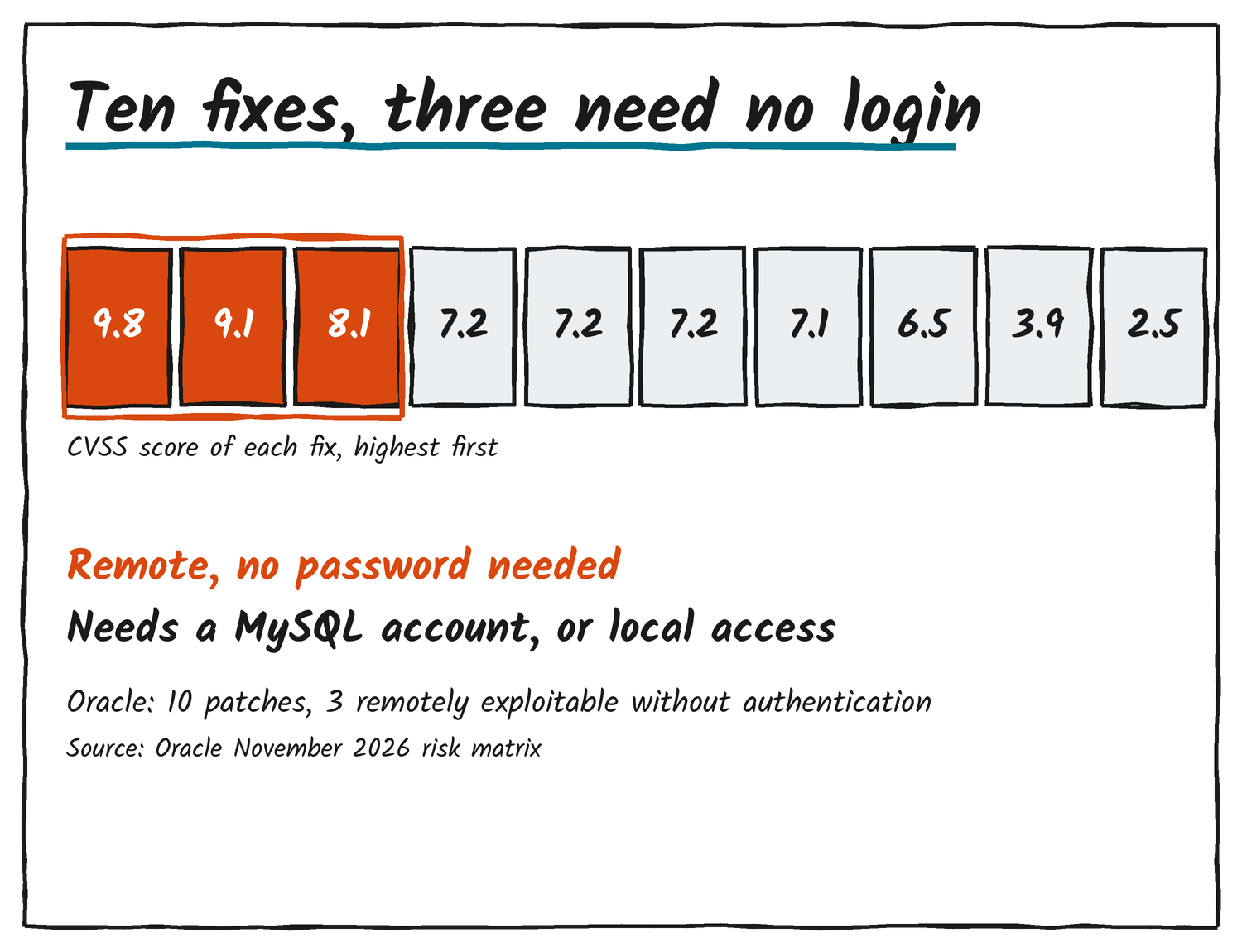
Oracle fixed 10 MySQL flaws on 17 November, and three of them can be reached over the network without a login. MySQL’s X account pointed to the community advisory on 26 November, so I went back to Oracle’s risk matrix, the release notes, the download pages and the vendors around MySQL to see what it changes if you run it.
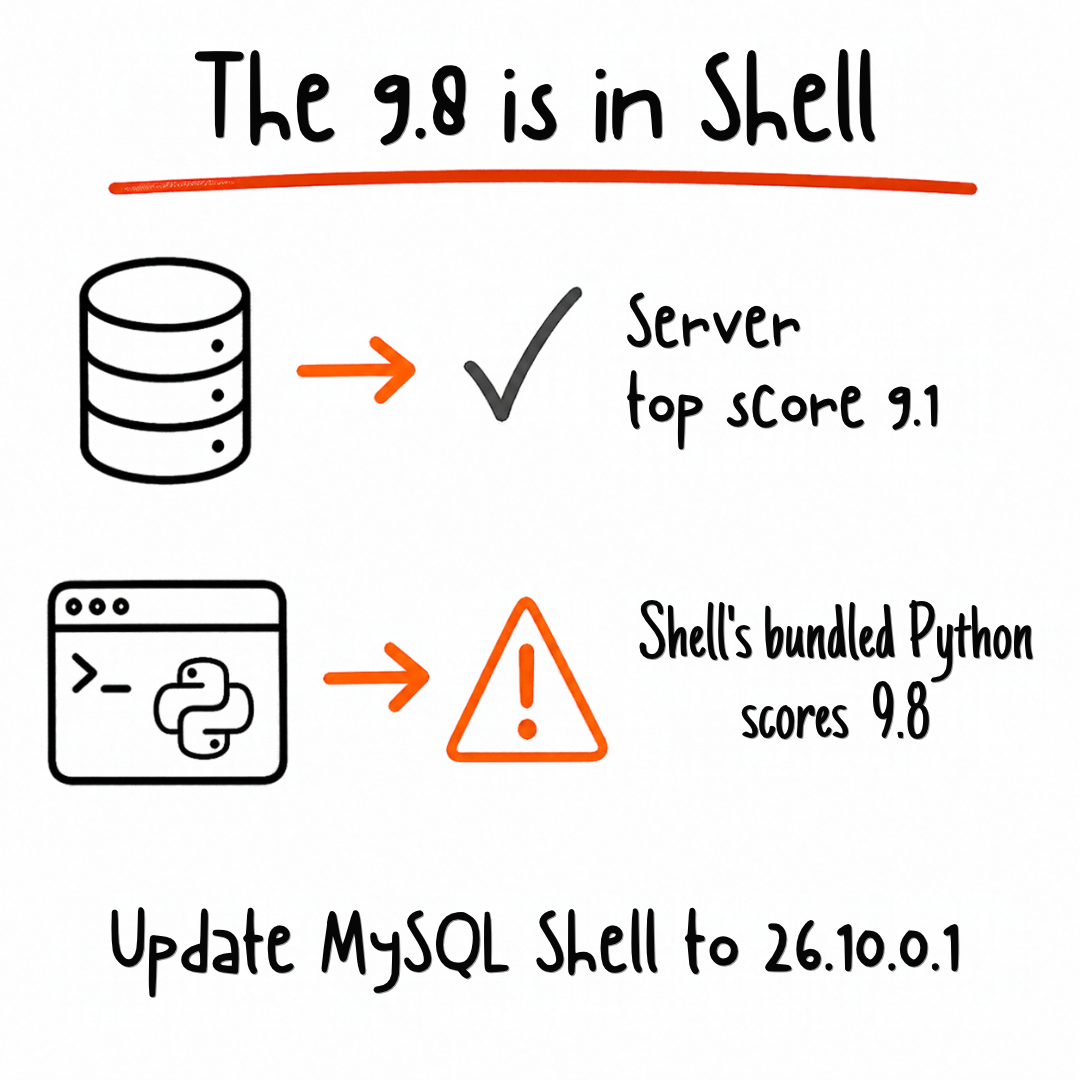
The top score, a 9.8, sits in MySQL Shell’s bundled Python, not the server. The one that matters most for servers is CVE-2026-114952, a 9.1 in the client programs, and Oracle hasn’t said which program, what the bug is or whether a workaround exists. The public fixed builds arrived on 24 November, a week after the advisory.
10 fixes
MySQL patches in Oracle’s 17 November update
3 need no login
Scored 9.8, 9.1 and 8.1, remotely exploitable without authentication
7 days
From the advisory to the public 8.4.13.1 and 9.7.4.1 releases
What the advisory lists
The MySQL Community Edition advisory, published 24 November, covers the fixes in Oracle’s November Critical Security Patch Update (CSPU). A CSPU is the interim release Oracle now runs between its quarterly Critical Patch Updates. Here is the MySQL risk matrix:
| CVE | Component | Score | Needs a login? |
|---|---|---|---|
| CVE-2026-115557 | MySQL Shell, Core Client (Python) | 9.8 | No |
| CVE-2026-114952 | Server and Cluster, client programs | 9.1 | No |
| CVE-2026-92392 | Server packaging (bundled curl), HTTP/2 | 8.1 | No |
| CVE-2026-114951 | Server: Logging | 7.2 | Yes, high privileges |
| CVE-2026-114950 | Server: Optimizer | 7.2 | Yes, high privileges |
| CVE-2026-114949 | Server: Replication | 7.2 | Yes, high privileges |
| CVE-2026-127428 | Server: GIS | 7.1 | Yes, low privileges |
| CVE-2026-114953 | Server: Replication | 6.5 | Yes, low privileges (availability only) |
| CVE-2026-114122 | Workbench (Electron) | 3.9 | Local access |
| CVE-2026-114948 | Cluster: JS module | 2.5 | Local access |
One discrepancy is worth knowing. The community advisory lists the affected range as 26.7.0 to 26.10.0, while Oracle’s own advisory lists 26.10 for the server and 26.10.0 for Shell. Both agree on 8.4.0 to 8.4.13 and 9.7.0 to 9.7.4.
The 9.8 is in Shell, not the server
CVE-2026-115557 is in the Python runtime that MySQL Shell bundles. Oracle lists the protocol as HTTP and the affected release as Shell 26.10.0. Shell moved to a single-version release model at 26.7, so the fix is 26.10.0.1. Percona, which builds its own Shell packages, says it has rebuilt its 8.4 and 9.7 Shell packages with a fixed Python and has them in testing.
The 8.1 is a similar story. It is in the curl library bundled with the server packages, over HTTP/2, with high attack complexity. Oracle fixed it by upgrading the bundled curl. Percona’s packages use the operating system’s curl instead, so for those the fix is your OS vendor’s curl update.
CVE-2026-114952: the one nobody can explain yet
This is the top-scoring server-side item: 9.1 in the “client programs” component of MySQL Server and Cluster, over the MySQL protocol, no privileges and no user interaction, high impact on confidentiality and integrity. Oracle’s matrix doesn’t name the binary or describe the bug class, and no workaround is published. Percona’s own forum answer says the same: Oracle hasn’t published the root cause, the affected binaries, the attack path or a workaround.
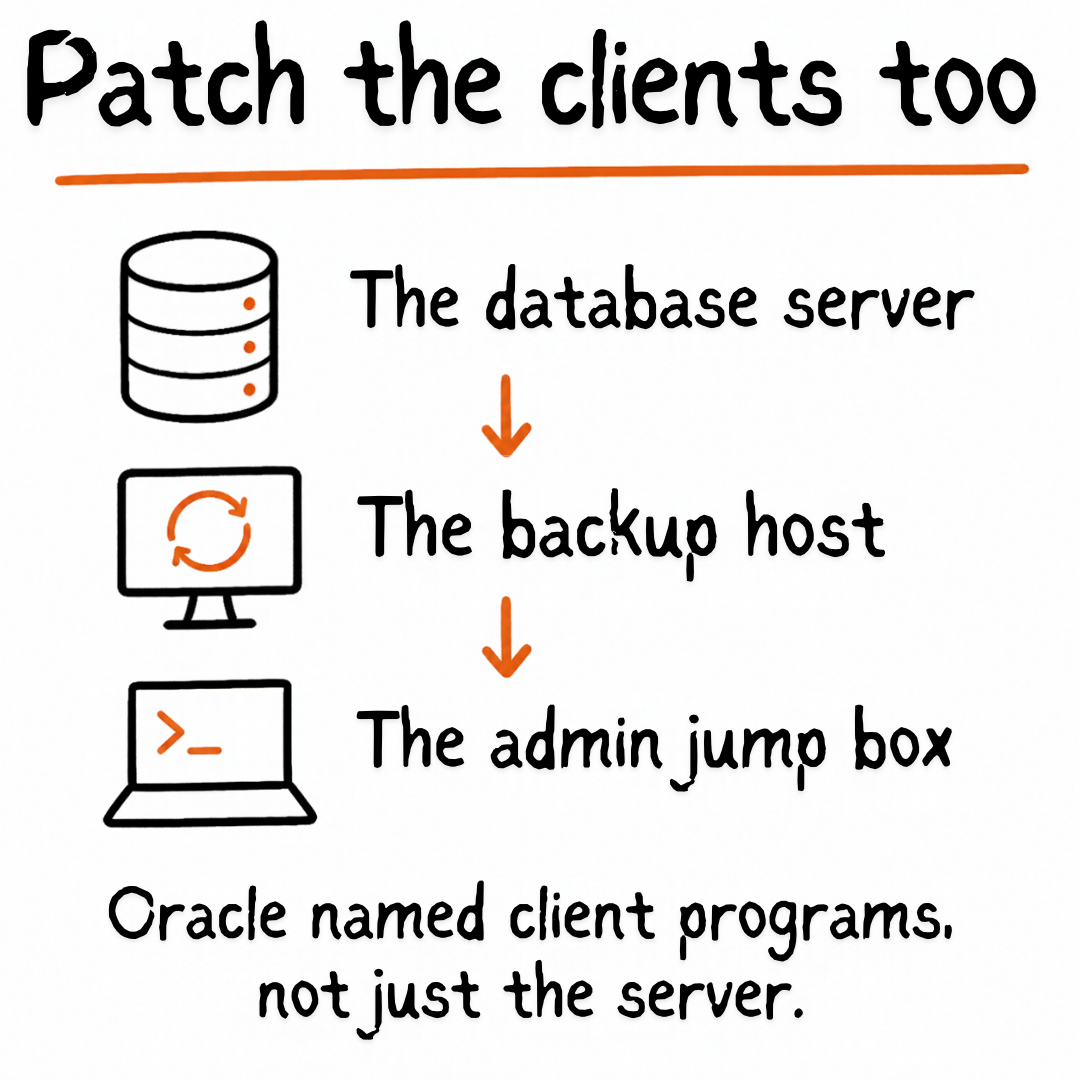
That makes the practical advice different from a normal server patch: the programs that connect to MySQL are in scope, so backup hosts, jump boxes, CI runners and application containers all need checking. The vendors don’t agree on how urgent it is:
| Who | Rating | Status when I checked |
|---|---|---|
| Oracle | 9.1, no login | Fixed in 8.4.13.1, 9.7.4.1 and 26.10.0.1 |
| Red Hat | Critical, 9.1, CWE-306 | No mitigation that meets its criteria |
| Ubuntu | Medium priority, 9.1 listed | MySQL 8.0, 8.4 and 9.7 packages marked “needs evaluation” |
| Debian | Not rated | mysql-9.7 in unstable (9.7.4-2) listed as vulnerable and unfixed |
| Percona | Treated as affected | 8.4 fixes merged; 9.7 waiting on Oracle’s source; releases due as 8.4.13-13 and 9.7.4-4 |
| CISA’s SSVC data, via TuxCare | CWE-287; exploitation “none”, automatable “yes”, technical impact “total” | Not in CISA’s known-exploited list on 18 November, per TuxCare |
The gap between Ubuntu’s “medium” and Red Hat’s “critical” on the same 9.1 is real. I haven’t re-checked CISA’s known-exploited list myself. TuxCare, a vendor that sells extended support for MySQL 8.0, also notes that the rogue-server trick abusing LOAD DATA LOCAL INFILE against connecting clients has been public for years, and says nothing ties it to this CVE. I’m repeating it as an example of the class of risk, not as an explanation.
A week between the advisory and the public fix
Oracle published the advisory on 17 November. TuxCare reported the next day that the fix was available only to Oracle support customers through My Oracle Support and wasn’t in the public source. The public release notes for 8.4.13.1 and 9.7.4.1 are dated 24 November. The 26.10.0.1 download is on Oracle’s CDN. Percona said on 24 November that Oracle had published the 8.4 source for the fixes but not the 9.7 source.
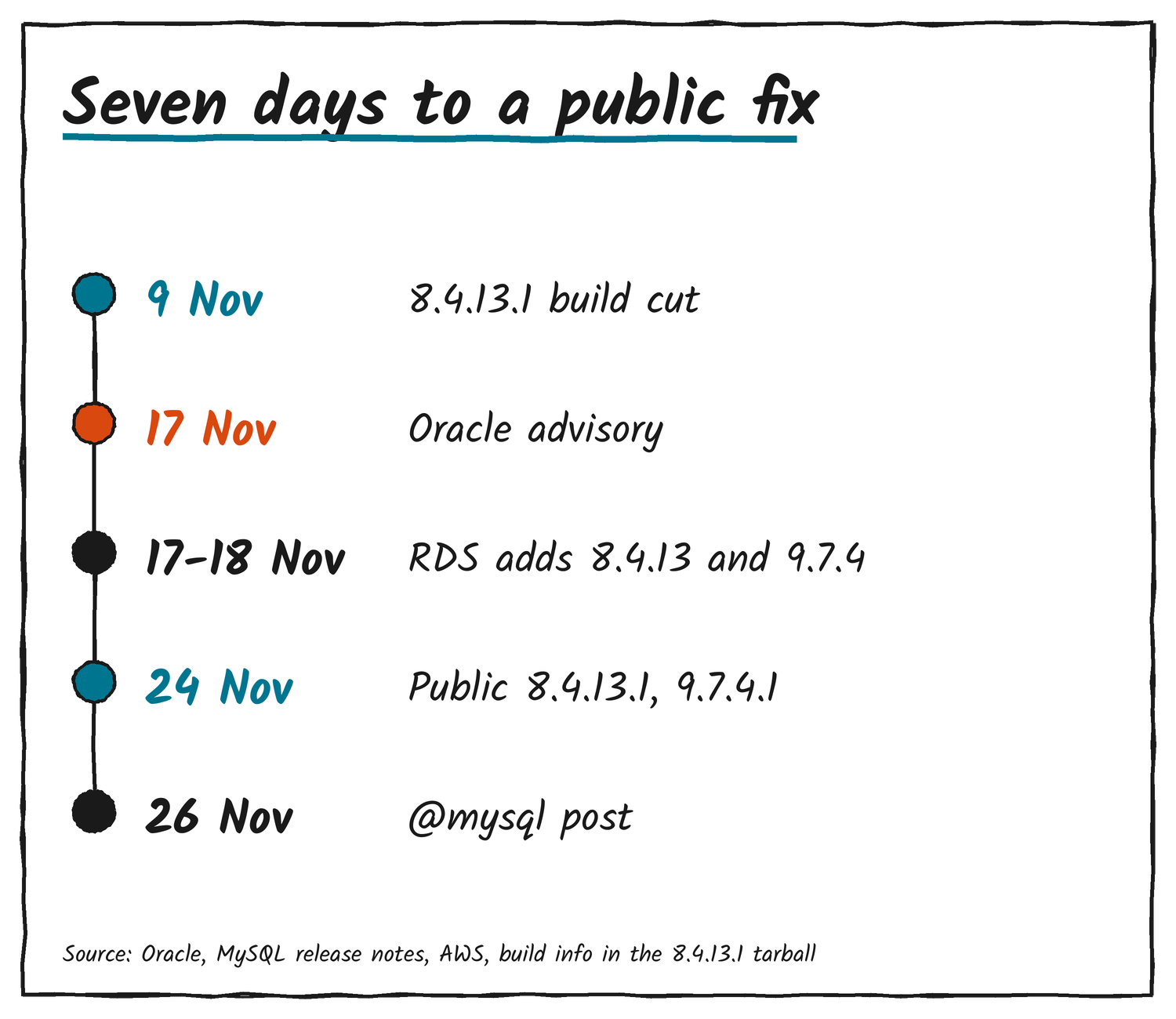
The 8.4.13.1 tarball gives a sense of how early the fix existed. Its build file records a commit dated 9 November on the mysql-8.4.13.1-release branch, eight days before the advisory. The 8.4.13 commit is dated 30 September. The CVE ID was reserved on 22 October, per TuxCare.
My reading: a window where the CVE, the version range and the component are public but the fix is not is the window patch-diffing tools work in. Google’s threat group described an exposed server running an agent that compares code before and after a patch, writes an exploit and runs it with no human involved. That is an inference, not a report of anyone exploiting this CVE. TuxCare said on 18 November that no exploitation had been publicly reported, and I have seen nothing since.
What I ran, and what I didn’t
I downloaded the 8.4.13 and 8.4.13.1 Linux tarballs from Oracle’s CDN and read them: checksums, the build metadata, the bundled documentation and strings in the binaries. I didn’t run the server or the client programs, so I can’t tell you what the CVE-2026-114952 change does or reproduce the flaw. I also couldn’t confirm which Workbench build carries the fix for CVE-2026-114122, a 3.9 local issue.
Which line gets which fix
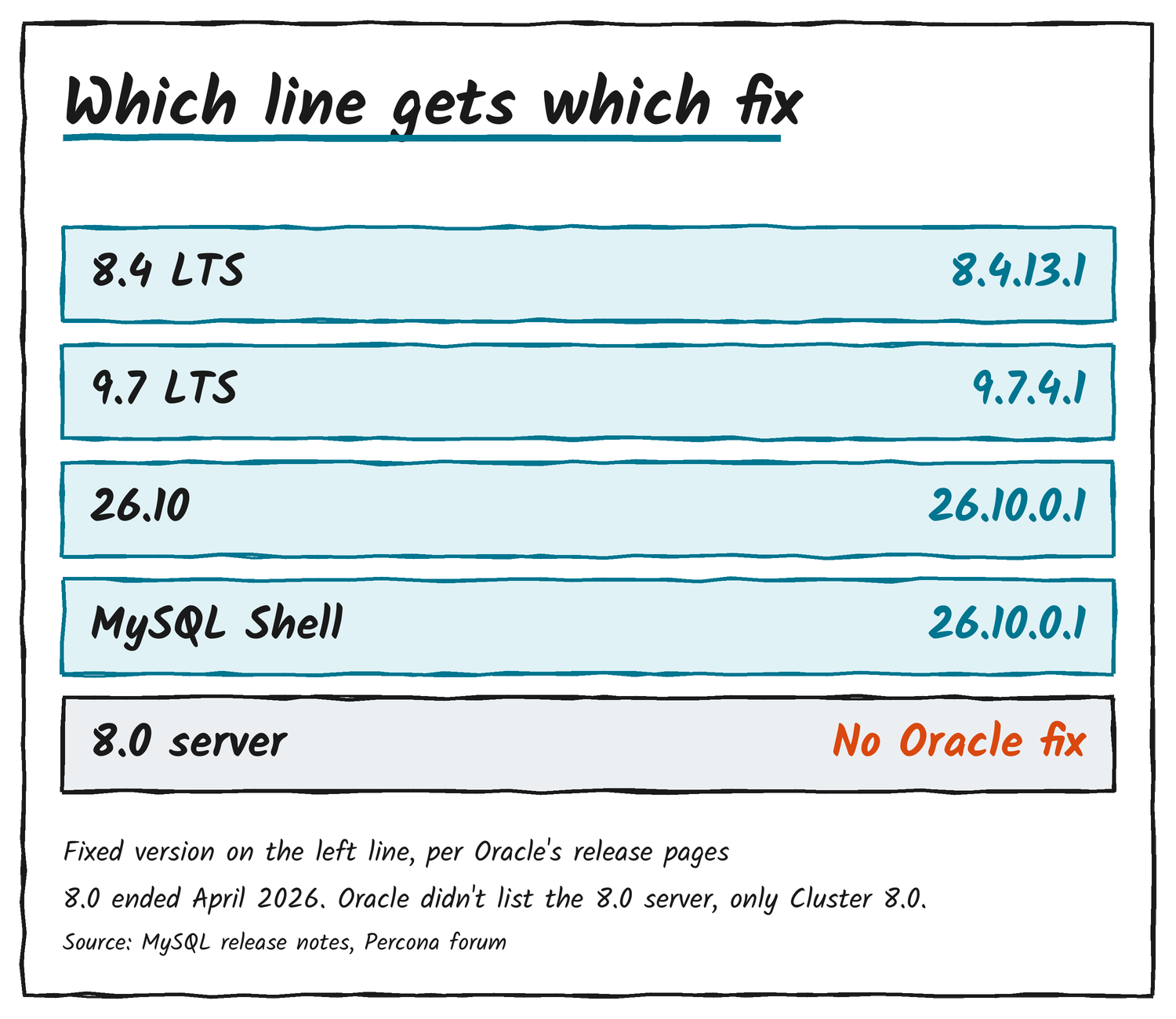
The 8.0 server is the awkward one. Community 8.0 reached end of life in April 2026, and 8.0.46 is the last release. Oracle’s list names MySQL Cluster 8.0.0 to 8.0.50 but not the 8.0 server, which means Oracle didn’t assess it. It doesn’t mean 8.0 is clear. Percona’s forum answer says that if the 8.0 server is affected, Percona Server 8.0 and XtraDB Cluster 8.0 are too, and that Oracle won’t ship further 8.0 releases. Percona sells post-end-of-life support that includes backported security fixes. TuxCare’s page makes the same point for its own extended support.
Managed services
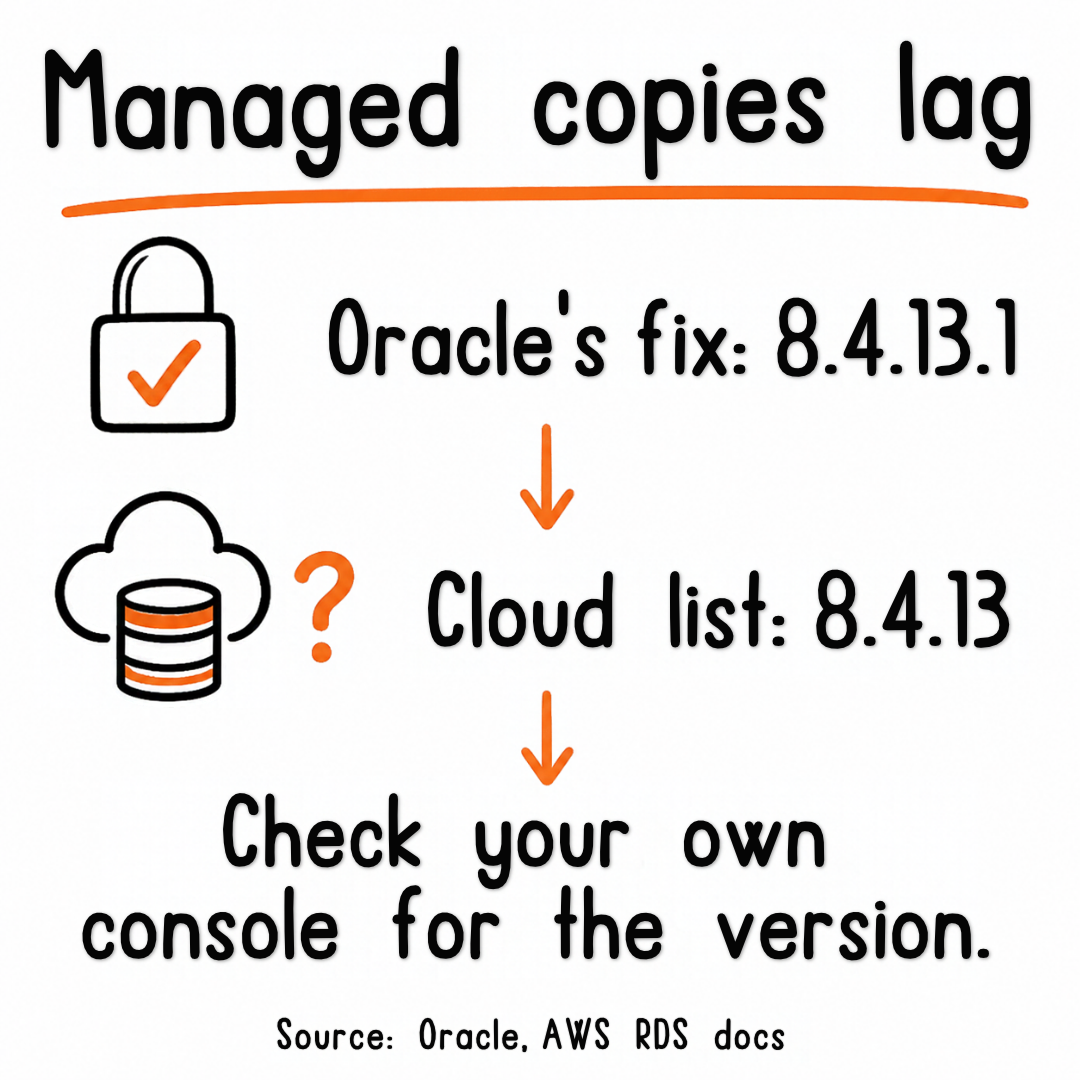
Amazon RDS says it adds minor versions within 30 days of the community release. Its version table lists 8.4.13 (RDS release 17 November, community release 20 October) and 9.7.4 (RDS release 18 November), which are the vulnerable builds. It doesn’t list 8.4.13.1 or 9.7.4.1. RDS also made 9.7 available for the first time on 18 November. For MySQL 8.0, RDS’s standard support ended on 31 July 2026, and its table lists Extended Support builds, the latest being 8.0.46-RDS.20260908. I didn’t check Azure Database for MySQL or Google Cloud SQL. TuxCare says Oracle’s own HeatWave service keeps patching MySQL 8.0.46 and later on Oracle Linux 8 until April 2027, and I haven’t verified that.
How it compares with PostgreSQL and MariaDB
| Project | Release | Date | Security fixes | Highest score |
|---|---|---|---|---|
| MySQL | November CSPU | 17 Nov | 10 | 9.8 (Shell); 9.1 in the server |
| PostgreSQL | 18.7, 17.12, 16.16, 15.20, 14.25 | 12 Nov | 52 | 8.8 |
| MariaDB | 11.4.14 | 16 Nov | 13 | 7.5 |
The counts aren’t like for like: the projects ship on different cadences and score differently. PostgreSQL fixed 52 and none scores above 8.8. Its no-login entries either need a user to open a dump or restore file (8.8 with user interaction) or score 5.3. MariaDB’s 13 run from 4.4 to 7.5. MySQL’s ten include three with no login, and the three highest sit in a bundled interpreter, a bundled library and the client programs, not in the server engine itself.
This isn’t new for MySQL’s clients. Oracle’s October update fixed three earlier client-programs flaws, CVE-2026-101770, CVE-2026-101771 and CVE-2026-101772, according to TuxCare’s timeline and Oracle’s October advisory.
What to do
- Inventory the clients as well as the servers. Any host that runs
mysql,mysqldump, backup tooling or a MySQL client library is in scope for CVE-2026-114952. - Update to the “.1” builds. 8.4.13.1, 9.7.4.1 or 26.10.0.1 for the server, and MySQL Shell 26.10.0.1.
- If you use distro or vendor packages, follow your vendor. Ubuntu and Debian showed no fix when I checked, and Percona’s 8.4.13-13 and 9.7.4-4 were still to come.
- If you use a managed service, read the engine version in your own console. RDS’s public table showed the vulnerable 8.4.13 and 9.7.4.
- If you run self-managed 8.0, treat it as possibly affected and plan the move to 8.4 or paid extended support. Oracle won’t ship an 8.0 fix.
- Until you’re patched, restrict who can reach the MySQL port, don’t point client tools at servers you don’t control, use least-privilege accounts and TLS. Percona says these reduce exposure but are not a fix, and that turning off the X plugin doesn’t help with this update.
What Oracle hasn’t said
- Which client program CVE-2026-114952 is in, and what the bug is. Red Hat and CISA label the weakness differently (CWE-306 and CWE-287).
- Whether the 8.0 server carries the same flaw.
- Any workaround. Percona says none is confirmed, and Red Hat lists no mitigation that meets its criteria.
- Why the community advisory says 26.7.0 to 26.10.0 when its own matrix says 26.10.
The next Oracle update is a CSPU on 15 December, then the quarterly Critical Patch Update on 19 January 2027.
Sources
- MySQL Community Edition Security Advisory: November 2026, 24 November 2026
- Oracle Critical Security Patch Update Advisory, November 2026, 17 November 2026, and the verbose risk matrix
- MySQL release notes: 8.4.13.1, 9.7.4.1, MySQL Shell 26.10
- Percona, “Oracle’s November CSPU and Percona for MySQL”, 24 November 2026, and the Percona forum thread
- TuxCare, “Critical MySQL Flaw Needs No Authentication and 8.0 Isn’t on Oracle’s List”, 18 November 2026. A vendor of extended support for MySQL 8.0; I’ve attributed its claims.
- CVE record, Red Hat, Ubuntu and Debian trackers for CVE-2026-114952
- Amazon RDS for MySQL versions and the RDS 9.7 announcement
- PostgreSQL 18.7 and other updates, 12 November 2026; MariaDB 11.4.14 release notes, 16 November 2026
- MySQL Community Edition Security Advisory: October 2026
- My earlier reporting: Google’s threat group
Discover more from Sulat AI & Tech News
Subscribe to get the latest posts sent to your email.