
Stats NZ’s September 2026 quarter figures put unemployment at 5.7%, up from 5.6% in June and 5.3% a year earlier. That’s the highest rate in about a decade. The release has no tech or industry split, so nothing in it says how developers, data people or AI specialists are doing. What it does show is the market they work in, and job-ad data, recruiter surveys and Australian numbers fill in the rest.
The short version is that tech hiring hasn’t collapsed, but it has changed shape. Employers are leaning on contracts, senior specialists are hard to find, graduates are applying in large numbers for few places, and pay isn’t keeping up with prices. AI shows up in a fifth of tech job ads, yet most of those ads want people who use AI, not people who build it.
- What Stats NZ reported
- Tech is a different market inside that
- Contract first, permanent later
- What counts as an AI role
- Scarce seniors, crowded graduate pool
- Pay
- Australia next door
- Immigration settings
- Sources
What Stats NZ reported
Employment was close to flat at 2,891,000 people, against 2,896,000 in June. The employment rate slipped to 66.4% from 66.7%. Underutilisation, which counts people who want more work as well as those without any, is 13.8%.
5.7%
unemployment rate, 174,000 people
13.8%
underutilisation, 438,000 people
91.3%
of paid employees in permanent jobs
+19.5%
casual employees over the year
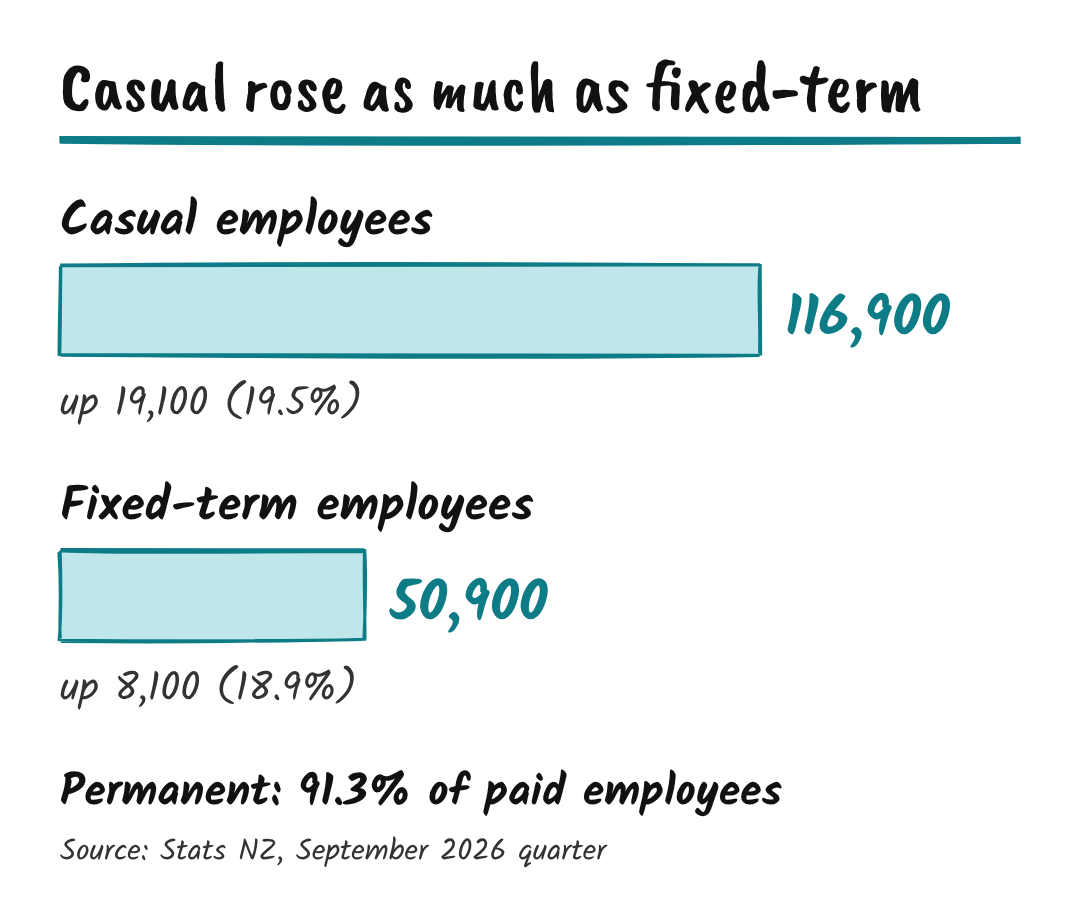
The detail that matters for tech is how people are employed. Casual employees rose by 19,100 over the year to 116,900, and fixed-term employees rose by 8,100 to 50,900. Over the quarter, part-time employment rose by 15,000 while full-time fell by 17,000, and hours actually worked dropped 1.6%.
| Measure | September 2026 quarter | For comparison |
|---|---|---|
| Unemployment rate | 5.7% | 5.6% in June, 5.3% a year earlier |
| People employed | 2,891,000 | 2,896,000 in June |
| Employment rate | 66.4% | 66.7% in June |
| Casual employees | 116,900 | Up 19,100 (19.5%) over the year |
| Fixed-term employees | 50,900 | Up 8,100 (18.9%) over the year |
| Hours actually worked | 94.7 million | Down 1.6% over the quarter |
Two limits are worth stating. The permanent share is a count of paid employees, so it says nothing about contractors who invoice through their own company. And the release has no industry breakdown, which means a rise in casual or fixed-term work can’t be pinned on tech, or cleared of it.
Tech is a different market inside that
Job-ad data is the nearest thing to a tech-specific read. SEEK’s October report had tech ads down 3.1% on the month, while about one in five of the remaining ads mention AI. MBIE’s Jobs Online series, which draws on SEEK, Trade Me Jobs and other boards, had total online ads up 2% on the year in the September quarter. That’s slower than the 7% in June and the 12% peak in March. IT was among the biggest gainers in several regions, including Waikato, Bay of Plenty and Otago/Southland, though MBIE warns that small regions swing a lot.

Demand and supply both look unsettled. Tech NZ’s Digital Skills report found two thirds of surveyed businesses had recruited, or were recruiting, for a digital tech role in the past year, and 32% found roles hard to fill. Hays says 36% of NZ tech professionals are actively looking and another 34% are open to offers, with pay the main reason to move (31%), ahead of progression (29%).
Contract first, permanent later
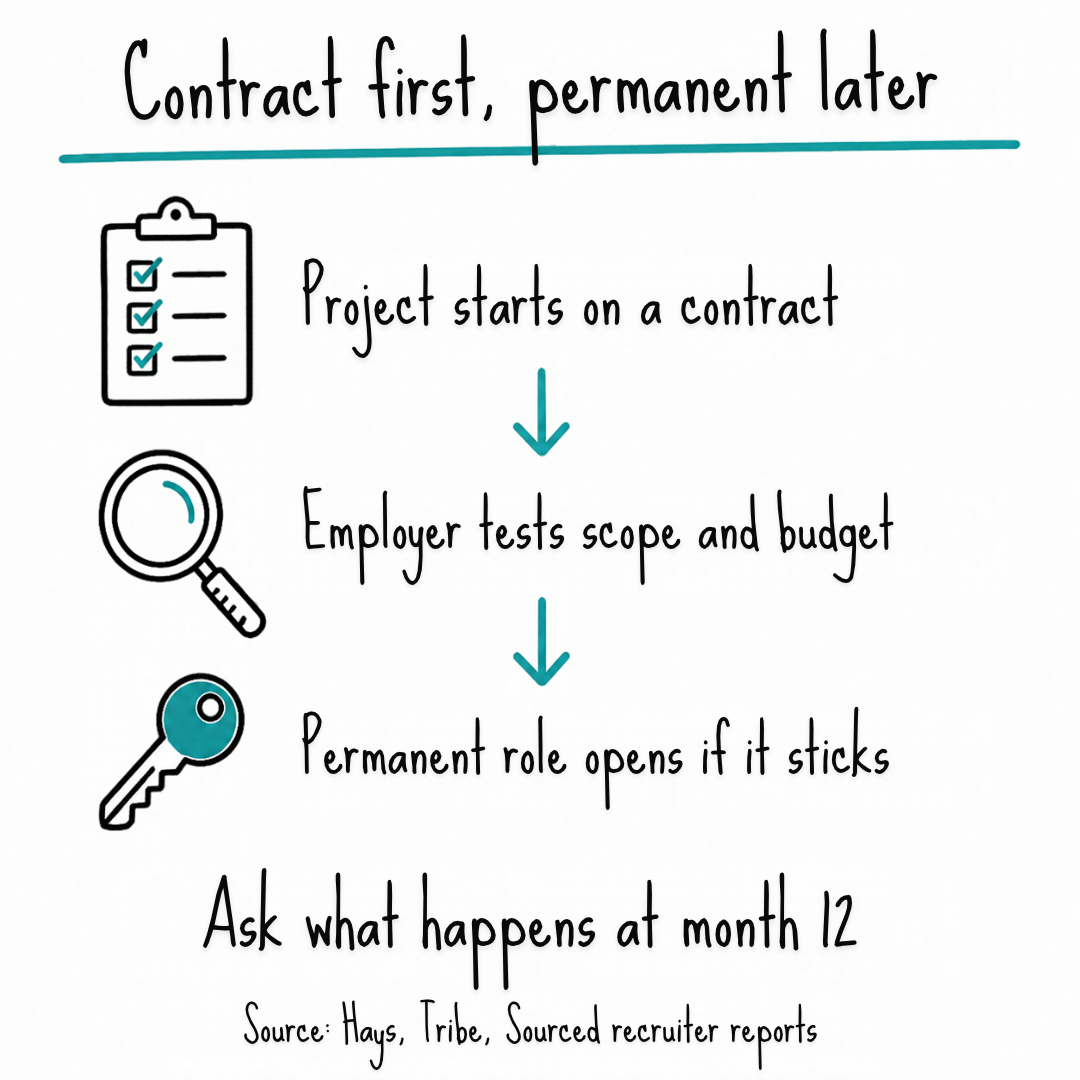
Several recruiters describe the same pattern: a project starts on a contract, the employer tests scope and budget, and a permanent role opens only if the work sticks. Tribe says contract roles are 68% of its tech briefs, up 8% on a year ago. Hays says 60% of employers bring in contractors for specialist project skills, and it names software engineering (38%) and data and analytics (30%) as the main areas.
While organisations are initially building core AI capability through permanent teams, we expect contract opportunities to grow as implementation matures and new capability gaps emerge.
Peter Marinis, Hays, IT Contractor Rates Guide FY26/27
Recruiters don’t agree on what contractors are earning. Sourced says contractor demand is up while permanent hiring stays cautious, with rates largely unchanged from last year and most contracts covering business-as-usual backfill. Younity reports placements up 26% on the year, with contractors holding out for longer contracts and higher rates. Tribe adds that the contractor pool has thinned, because many contractors moved to permanent jobs, went to Australia or left tech.
All of this comes from recruiters, who are paid on placements and have reason to talk up their own market. None of it is official data, and it should be read as direction, not measurement.
What counts as an AI role
SEEK says AI appears in 19.8% of NZ tech ads and 4.2% of all ads, ahead of Australia’s 2.6%. PwC’s NZ AI Jobs Barometer counted AI-related job ads rising from about 3,900 in 2024 to about 9,600 in 2025, with AI skills named in 2.7% of postings. It also found that in several sectors more than 99% of AI roles are for people who use AI, not people who build it. The IMF reached a similar view in its NZ assessment: AI-skill demand is rising, tilts towards AI users, and the information sector plays a smaller part here than elsewhere.
That squares with the employer side. PwC found 78% of NZ chief executives report little or no AI impact so far. Hays names AI and machine learning as the most acute contractor shortage, at 28%, with cybersecurity close behind at 26%. Employers want AI capability, but the people they’re hiring for it are a small, specialised group.
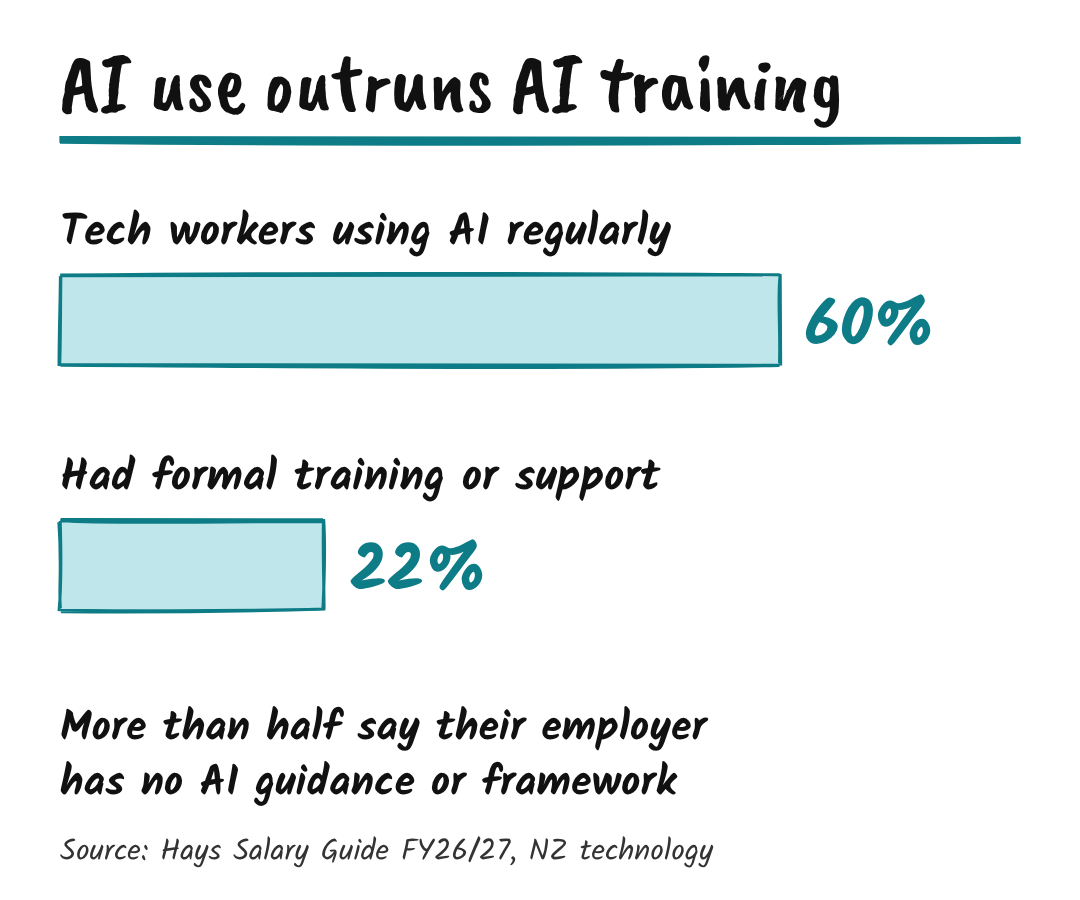
Hays finds 60% of NZ tech professionals use AI regularly, yet only 22% have had formal training or support, and more than half say their employer has no AI guidance. A job ad that mentions AI therefore often describes a skill the existing team is teaching itself.
Scarce seniors, crowded graduate pool
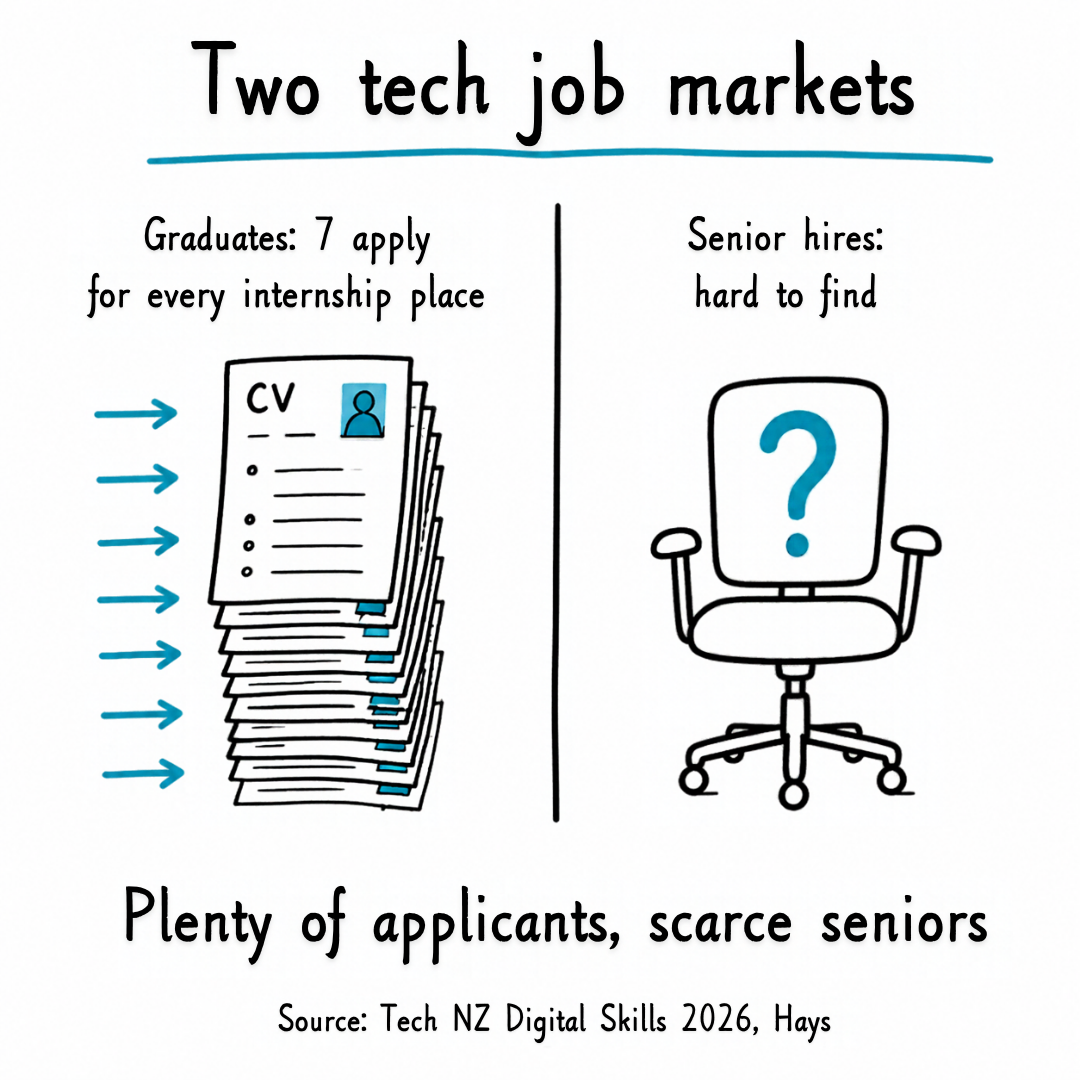
Tech NZ counts 132,336 ICT professionals from the 2023 Census and calls the skills shortage structural, with 37% of surveyed businesses struggling to find AI, cyber, gaming and other niche skills. At the other end, Summer of Tech placed 132 students in 2024 and 140 in 2025, and says about seven times more students apply than there are places. A US payroll study cited in the same report found employment of software developers aged 22 to 25 about 20% below its late-2022 peak. That figure is American, so treat it as a signal, not an NZ measure.
Regional recruiter reports fit the picture. TRA says Auckland is leading the recovery, while Wellington’s softness is structural after public sector cuts and its senior tech bench is thinning. Tribe says senior contractors are scarce even though generalist roles still draw plenty of interest.
Pay
Hays puts the average NZ tech pay rise at 3.8%, but 42% of tech workers got little or no increase. Stats NZ’s Labour Cost Index, which tracks pay for the same jobs, rose 2.1% over the year, and average ordinary-time hourly earnings rose 2.9% to $44.86. Annual inflation was 3.7%, so on the broad measure wages are losing ground.
| Role | Permanent salary | Contract day rate |
|---|---|---|
| Senior software developer | $140,000 to $180,000 | $850 to $1,150 |
| Software developer | $100,000 to $140,000 | $800 to $950 |
| Junior developer | $70,000 to $90,000 | $450 to $650 |
| Data engineer | $130,000 to $170,000 | $800 to $1,000 |
| Data scientist | $130,000 to $160,000 | $800 to $1,040 |
Australia next door
Australia’s headline rate is lower, with ABS unemployment at 4.9% in October, its highest since late 2021. Its tech market is weaker than NZ’s, though. Jobs and Skills Australia counted tech vacancies at a record low of 5,743 in October, and says software engineers and developers are no longer in shortage for the first time in five years. SEEK has Australian job ads down 6.4% on the year, where NZ’s are up 4.6%, and AI in 15.5% of Australian tech ads against NZ’s 19.8%.
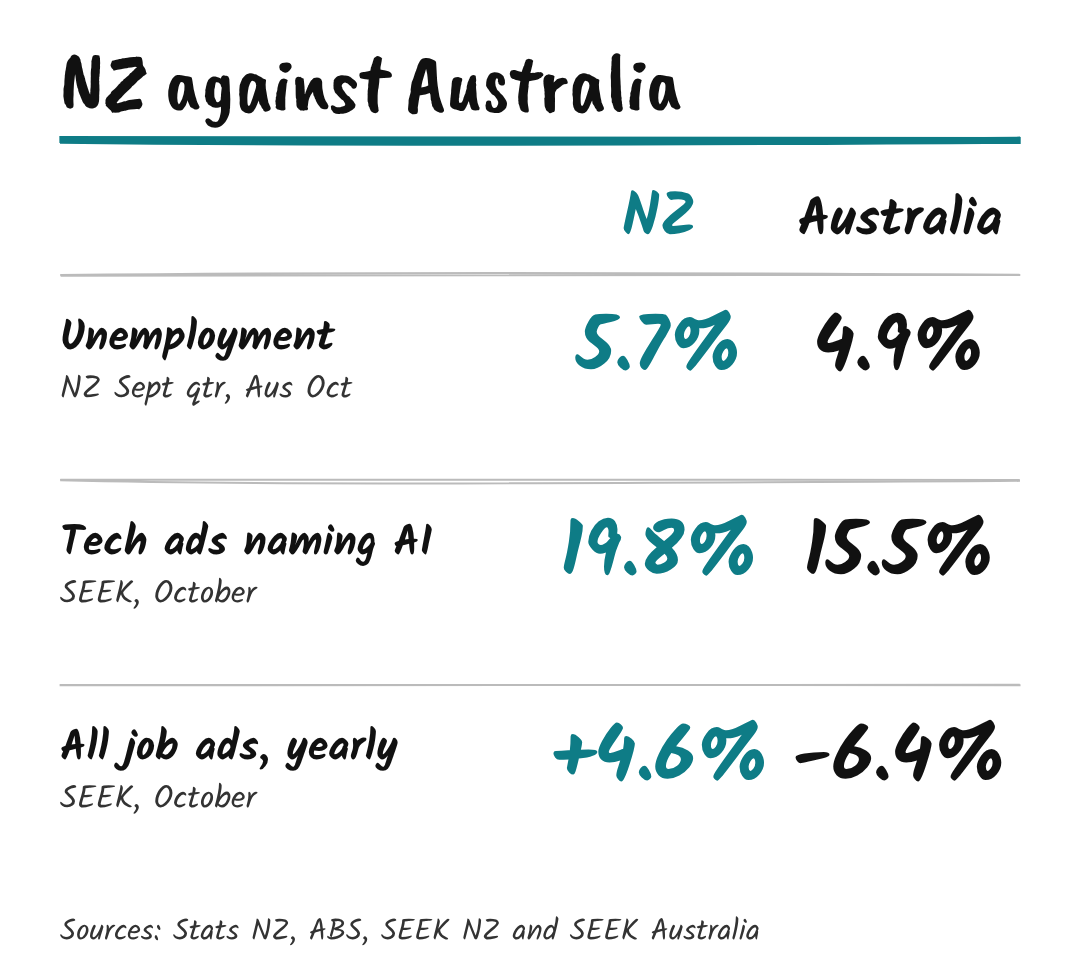
That matters because Australia is where most New Zealanders leave for. Stats NZ recorded a net loss of 37,800 NZ citizens in the year to September, and 64% of citizen departures in the year to March went to Australia. Departures of people aged 25 to 34 were 16,100, down 5%. The reasonable inference, which the data doesn’t prove, is that a weaker Australian tech market takes some of the pull out of the move across the Tasman and leaves more experienced people here.
Immigration settings
Approved visas for ICT jobs fell 67% to 729 in 2024, according to Tech NZ. Since then the median-wage requirement for Accredited Employer Work Visas was removed in March 2025, and applicants now qualify through a Green List role, pay of $70 an hour or more, two years’ relevant experience or a level 4 or higher qualification. The Skilled Migrant Category reform took effect on 24 August 2026. Green List changes from 8 March 2027 remove a set of occupations, but Immigration NZ’s list is trades roles plus telecommunications technician and career counsellor, with no software roles on it.
Net migration was a gain of 22,600 in the year to September, made up of a 60,400 gain in non-citizens and the citizen loss above.
Sources
- Stats NZ, unemployment rate at 5.7 percent in the September 2026 quarter, with Stats NZ’s consumer prices and migration releases
- MBIE Jobs Online, September 2026 quarter
- SEEK NZ and SEEK Australia employment reports, October 2026
- Hays Salary Guide FY26/27 and IT Contractor Rates Guide FY26/27
- Tribe, Sourced and Younity recruiter market reports, September and October 2026
- TRA Salary Guide 2026
- Tech NZ, Digital Skills in the Age of AI
- PwC NZ AI Jobs Barometer and the IMF’s New Zealand Selected Issues paper
- ABS labour force and Jobs and Skills Australia Internet Vacancy Index, October 2026
- Immigration NZ, Accredited Employer Work Visa, Skilled Migrant Category and Green List circulars