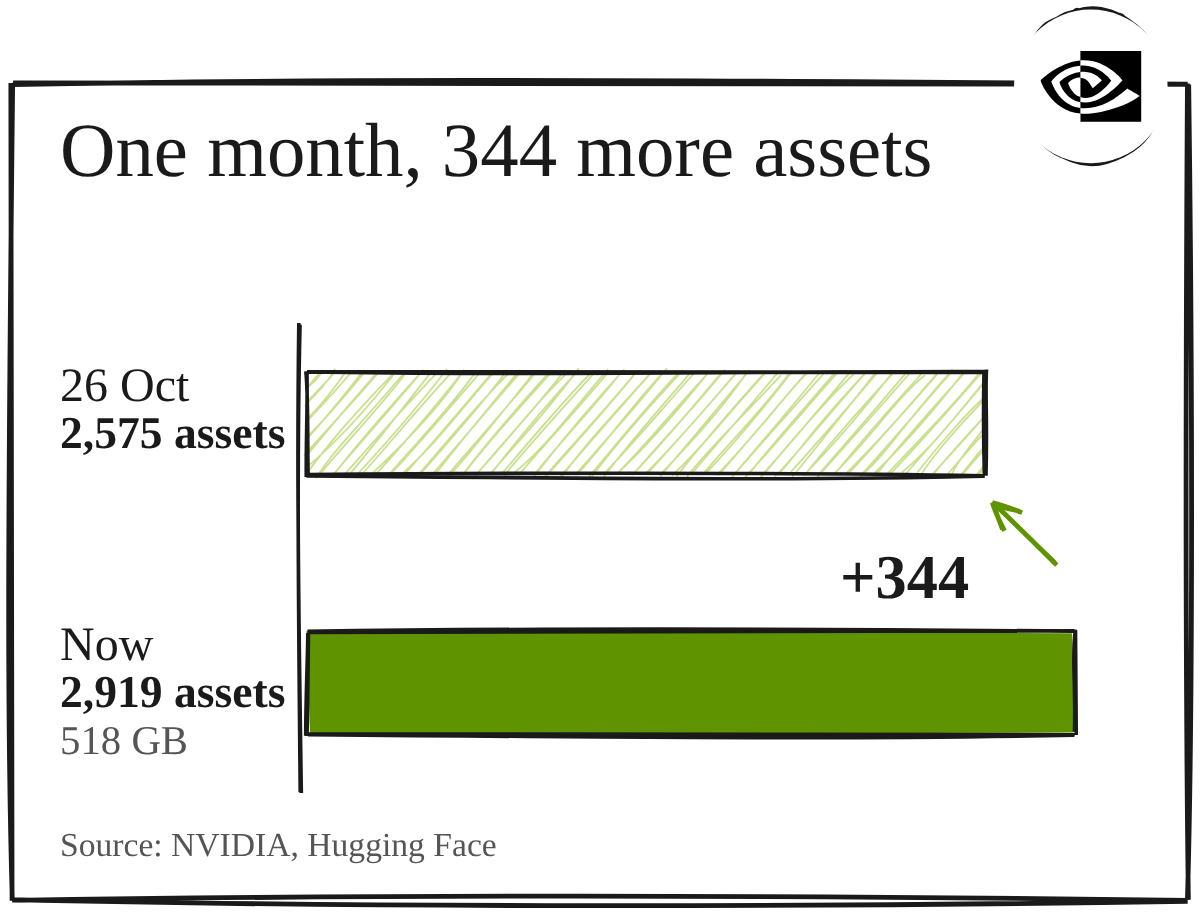
The post I was sent reads like a fresh drop, but the library it describes is more than a month old. NVIDIA and Hugging Face announced SimReady Central on 21 October 2026, and the nvidia/simready-assets dataset behind it was created on 29 June. What is current is the size: the dataset page now lists 2,919 assets and 518 GB, up from 2,575 assets and 472 GB when the first wave of social posts went round on 26 October.
The primary sources are NVIDIA’s Hugging Face announcement and the dataset page. @byteonai is an aggregator that repeats them. An earlier post from Oliver Prompts on 26 October used the same “just put” framing and drew 163.3K views, so the story has been circulating for a month.
The post says every model comes with physics settings and semantic labels. NVIDIA’s own wording is narrower: “depending on the asset and profile”. That gap matters more than the date, so I checked what the library holds, who supplies it, and what the peers look like.
2,919
assets in nvidia/simready-assets
518 GB
total file size
1.5m
downloads last month (1,515,140)
+344
assets since 26 October
- How the story unfolded
- What SimReady means
- Does every model carry the physics?
- Whose licence applies
- When an agent does the shopping
- How it compares with its peers
- What to check before you use it
How the story unfolded
The announcement said SimReady Central brings together “more than 2,000” OpenUSD assets and calls the library “free” and “ungated”. By 26 October a third-party audit had counted 2,575 asset folders in the main dataset, which matched the official count, and the site showed 472 GB. The dataset has kept growing since.
| Date (2026) | What happened | Source |
|---|---|---|
| 29 Jun | The nvidia/simready-assets dataset is created on Hugging Face | Hugging Face dataset page |
| 8 Oct to 19 Nov | Packaging dates stamped inside the asset packages | Community catalogue, computed on 23 Nov |
| 21 Oct | SimReady Central announced with more than 2,000 assets | NVIDIA on Hugging Face |
| 26 Oct | 2,575 assets and 472 GB; a viral X post says NVIDIA “just put” them online | Mushroom.cv audit; Oliver Prompts on X |
| 7 Nov | A user reports odd authored masses on three assets | NVIDIA developer forum |
| 9 Nov | An NVIDIA staff reply asks for the report to be reposted on the SimReady Central discussions page | NVIDIA developer forum |
| 13 Nov | NVIDIA publishes a robot pick-and-place walkthrough | NVIDIA on Hugging Face |
| 27 Nov | Dataset page lists 2,919 assets, 518 GB and 1,515,140 downloads last month | Hugging Face dataset page |
What SimReady means
A SimReady asset is an OpenUSD 3D model prepared with the properties a simulation needs. OpenUSD is the open scene format that began at Pixar. A plain CAD model gives you shape; a simulator also needs to know how the object should behave. NVIDIA’s SimReady Foundation supplies the specifications, profiles and validation tools. A profile groups the features an asset needs for a use case, and each feature has requirements that a validator can check.
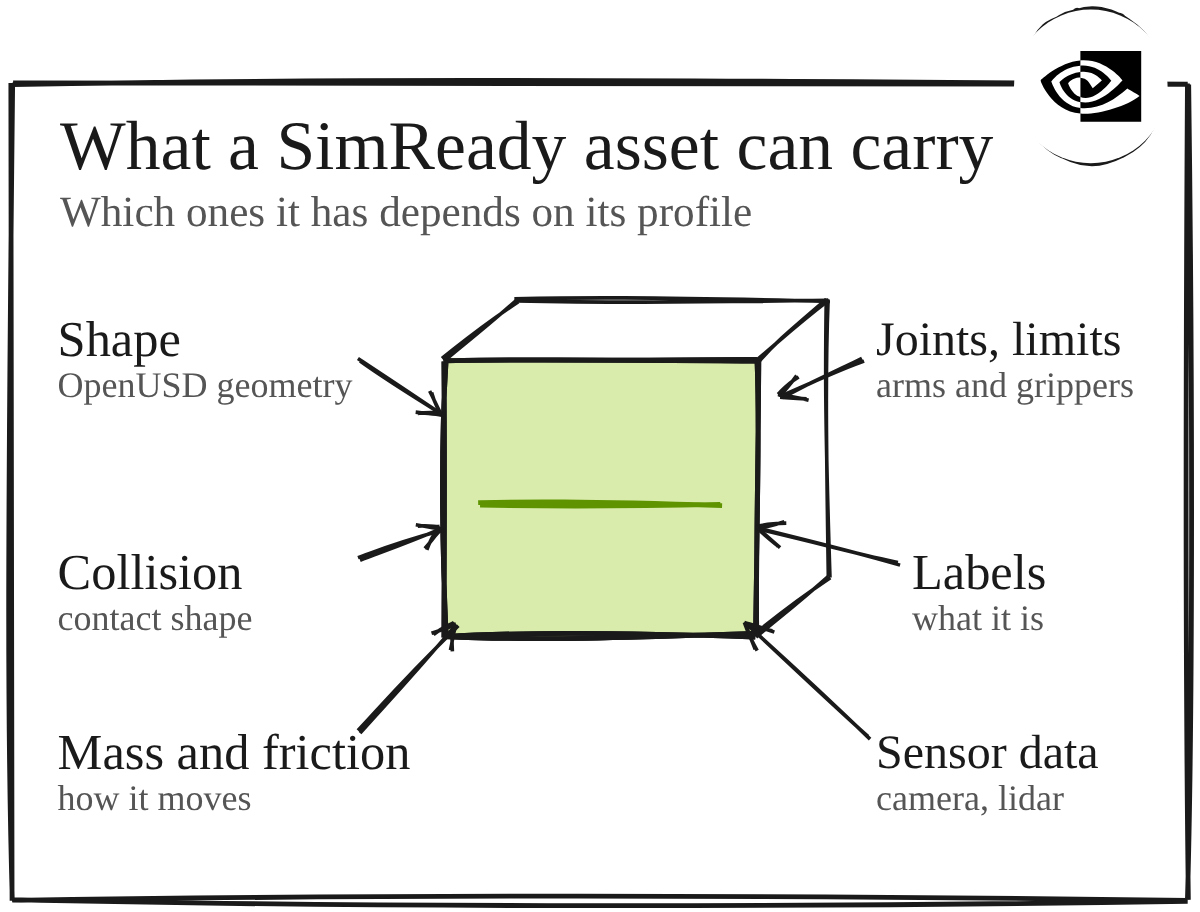
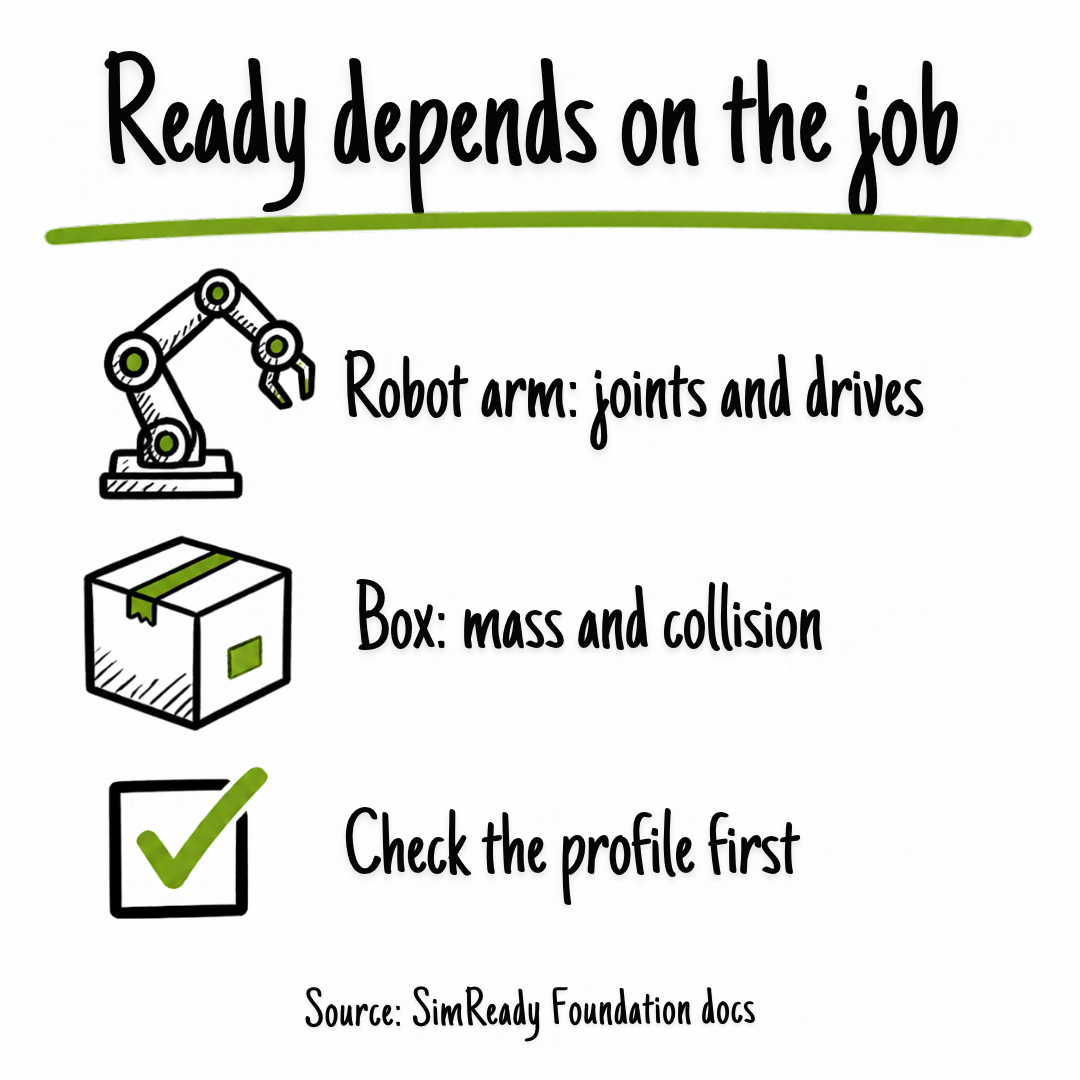
NVIDIA lists the features as collision geometry and physical properties, joint structure and limits, semantic labels, and materials and sensor attributes, always “depending on the asset and profile”. A robot arm needs joints and drives. A cardboard box needs mass and collision. Neither needs the other’s list.
The suppliers are mostly equipment makers, known as OEMs. NVIDIA names Comau, FANUC, Franka Robotics, Robotiq, Standard Bots and Universal Robots for arms and grippers, Vertiv for racks and cooling, and LG Electronics for household appliances. It also lists Palatial, which supplies the NVIDIA Robotics 1K Dataset, and ForgeCAD, an AI-assisted CAD provider. Each contributor hosts its own Hugging Face dataset; SimReady Central indexes them. NVIDIA’s own nvidia/simready-assets dataset is the biggest single collection.
Does every model carry the physics?
Mostly, not all, and “present” isn’t the same as “correct”. A community catalogue built from the repository tree on 23 November counts PhysX, MuJoCo and Newton variants on 2,911 of the 2,919 assets, so eight lack them, and lists only 5 articulated assets, or 0.2 per cent. That fits NVIDIA’s profile wording: most of the library is static objects such as boxes, food and tools, not machines with joints. The catalogue is a third-party tally, so treat the counts as indicative.
On 7 November a user from Cineshare, Pekka Varis, posted on the NVIDIA developer forum that a metadata check had flagged three assets whose authored masses looked far from the real objects. The values were identical across the PhysX, Newton and MuJoCo files, and the packages dated from around 9 October.
| Asset | Authored mass | Bounding box (m) | Reporter’s estimate of a real one |
|---|---|---|---|
| storage_shelf_basic_a01 | 3,010.833 kg | 1.27 x 2.49 x 2.42 | 50 to 300 kg empty |
| equipment_airHoseReel_retractable_a01 | 40.317 kg | 0.62 x 0.16 x 0.38 | 5 to 15 kg |
| handTool_knife_retractableBlade_a01 | 0.858 kg across three bodies | 0.160 x 0.061 x 0.026 | 0.08 to 0.2 kg |
An NVIDIA staff member replied on 9 November, thanked the reporter and asked for the report to be reposted on the SimReady Central discussions page. The thread I read has two posts, and I couldn’t confirm whether the values changed. Three odd masses out of 2,919 is a small sample, but it shows why NVIDIA’s own 13 November walkthrough tells developers to test before trusting.
A robot can look visually correct while stationary in Isaac Sim but move or interact with objects incorrectly when the simulation runs.
NVIDIA, “Build a Robot Pick-and-Place Simulation with SimReady Assets”, Hugging Face blog, 13 November 2026
The same audit that confirmed the 2,575 count is candid about its limits: it enumerated the root folders and examined one complete box package, and says that doesn’t establish library-wide quality. I haven’t found an independent audit that does. Its authors also stress that the presence of a physical field, its provenance and its accuracy are separate questions.
How to grab one asset instead of 518 GB
Each asset sits in its own top-level folder, so you can download one. This uses the Hugging Face command line and a folder name from the dataset page. I haven’t run it here.
hf download nvidia/simready-assets --repo-type dataset --include "box_corrugated_white_a10/*" --local-dir simreadyPin a revision if you need a scene to reproduce later, because the dataset changes as NVIDIA adds assets.
Whose licence applies
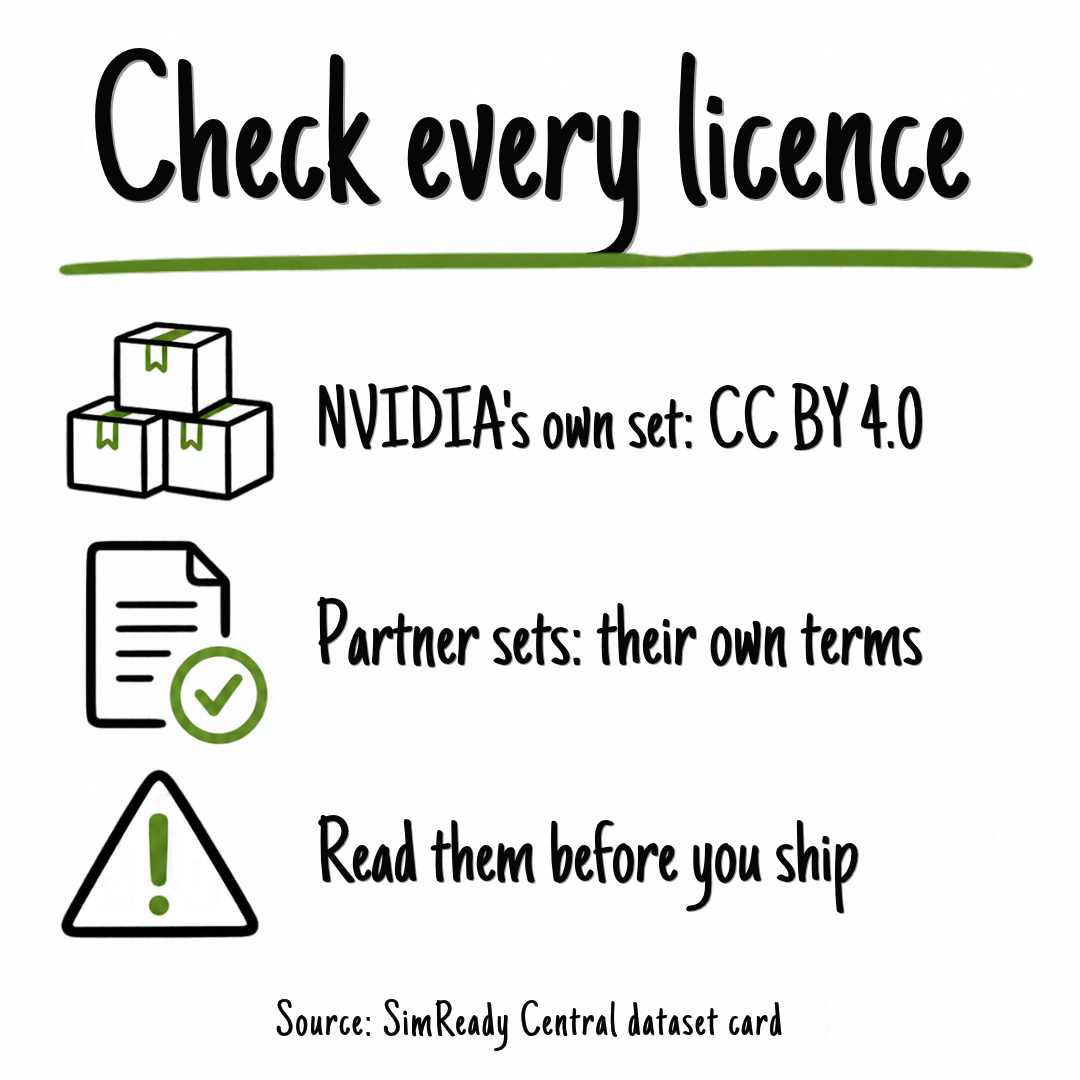
NVIDIA’s own dataset is listed as CC BY 4.0, which allows commercial use with attribution. On 26 October NewsNix reported that the repository then declared no licence at its root, even though each asset carried the full CC BY text. The page now shows cc-by-4.0.
Partner datasets are different. According to the SimReady Central library dataset card, as quoted by Cyber-Threat.net, contributors “retain ownership” and “control their releases and licenses”, and NVIDIA reviews submissions before indexing them. The service is labelled Alpha. A scene that mixes several suppliers’ assets can mix several sets of terms.
When an agent does the shopping
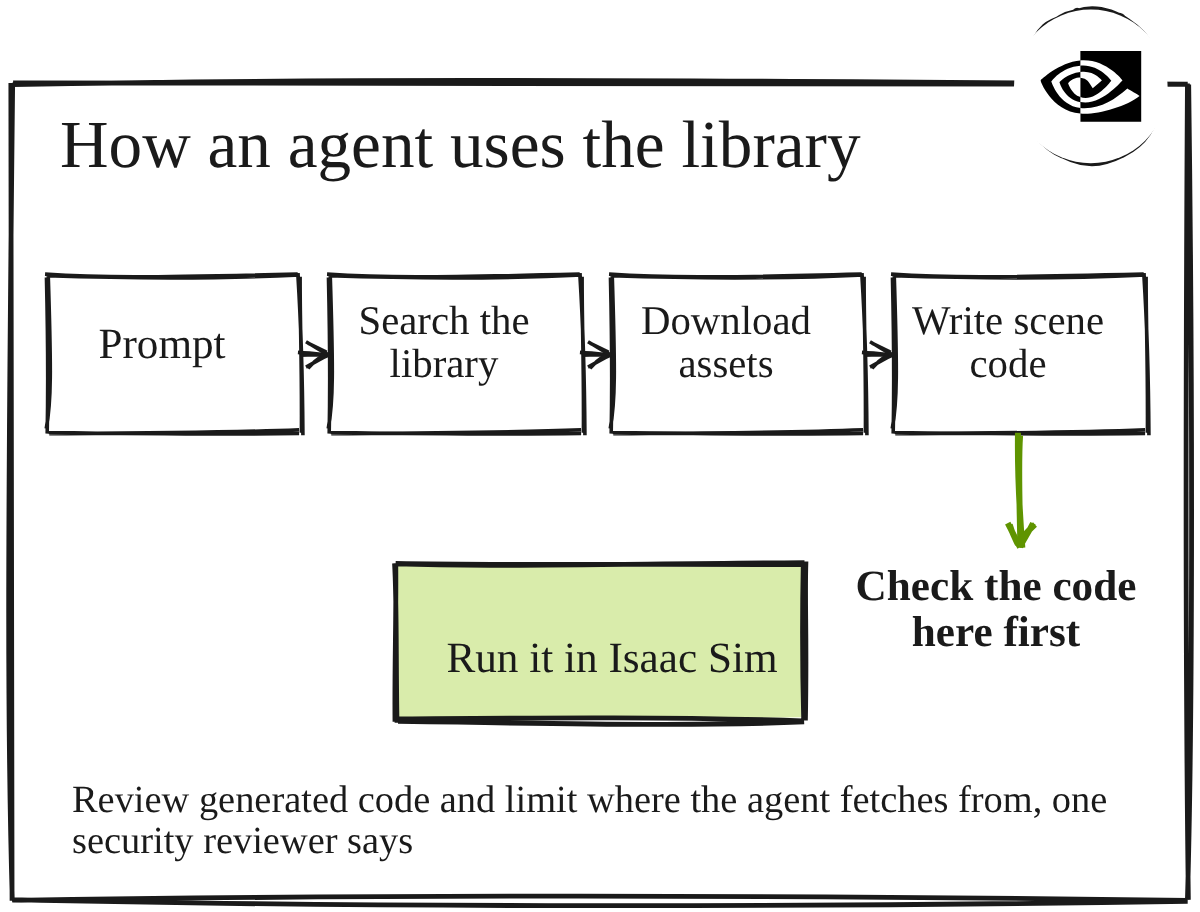
NVIDIA’s announcement pitches the library at AI agents as much as people. NVIDIA USD Search powers natural-language search, and Hugging Face has indexed USD properties and simulation metadata so an agent can find suitable assets. In NVIDIA’s examples a frontier model queries the search API, pulls assets into an OpenUSD scene, writes the Python that assembles it and renders a preview.
It works in practice. DataCenterNews reported on 23 November that AI developer Maziyar Panahi used Claude Code with Claude Opus 5.5 to assemble an intensive care unit from 13 SimReady hospital assets, then ran Microduck robots through it. The assets already included Newton physics settings, and in a run covering 256 wards, 766 of 768 Microducks stayed upright after 14 simulated seconds. NVIDIA’s Dillon Bailey and Rishabh Chadha built the pick-and-place demo with a Universal Robots arm, a Robotiq gripper and a beverage can.
The security angle is a view, not a finding. Cyber-Threat.net’s Mike Holmes wrote on 26 October that third-party 3D files opened on engineers’ machines, then wired to live building telemetry, are a new route into operational technology. He counts at least eight OpenUSD security advisories since September 2025, most for memory-safety bugs triggered by crafted files, and says there is no public report of a malicious SimReady asset. I haven’t verified the advisory count independently. The practical point is that an agent downloading and executing code against files from several suppliers deserves the same review as any dependency.
How it compares with its peers
Free 3D asset sets aren’t new either. What sets SimReady apart is the packaging around simulation: physics for several engines, a validation profile and a per-package licence record, rather than just meshes.
| Library | Size | What it adds for simulation | Licence |
|---|---|---|---|
| NVIDIA SimReady Assets | 2,919 assets, 518 GB | Profile-validated OpenUSD; collision, mass and other properties depending on profile | CC BY 4.0 |
| Objaverse (Allen Institute for AI) | 800K+ annotated 3D objects | Annotated objects at web scale; licence in each object’s metadata | ODC-By for the set; per object mostly CC BY 4.0, with about 77K under non-commercial terms |
| Google Scanned Objects | 1,030 scanned household items, 13 GB | SDF models with mass, friction, inertia and collision | CC BY 4.0 |
| ReplicaCAD (AI Habitat) | 90+ objects and 6+ articulated assets; 84 of 105 scene variations released | Convex collision, mass, friction and restitution for the Habitat simulator | CC BY 4.0 |
| PartNet-Mobility (SAPIEN) | 2,346 articulated models, 46 categories | Movable parts with kinematic annotations | Gated; non-commercial research and education |
The contrast is articulation and breadth of simulator support. PartNet-Mobility is built around moving parts but is restricted to research use. Google’s scans are real objects with measured geometry but come as SDF models for Gazebo and Bullet. SimReady’s draw is commercial-friendly licensing for its own set and one package that composes into PhysX, MuJoCo or Newton scenes, with the caveat that only 5 of 2,919 assets are articulated according to the community count.
What to check before you use it
- Match the asset’s profile to your task before you download it.
- Read each package’s licence, especially for partner datasets.
- Test joints, a small movement and contact in Isaac Sim, as NVIDIA advises.
- Sanity-check authored mass against the real object, since one forum report flags three that look off.
- Review any code an agent generates, and limit where it can fetch assets from.
Sources
- NVIDIA on Hugging Face: Announcing SimReady Central, 21 October 2026
- NVIDIA on Hugging Face: Build a Robot Pick-and-Place Simulation with SimReady Assets, 13 November 2026
- nvidia/simready-assets dataset page
- NVIDIA SimReady Foundation on GitHub
- NVIDIA developer forum: implausible authored physics:mass on three assets, 7 November 2026
- Mushroom.cv: NVIDIA SimReady audit, 26 October 2026
- NewsNix on the licence field, 26 October 2026
- Cyber-Threat.net: what SimReady means for the OT supply chain, 26 October 2026
- DataCenterNews: Nvidia shows AI agents building digital twin simulations, 23 November 2026
- Community SimReady catalogue card, computed 23 November 2026
- Peers: Objaverse, Google Scanned Objects, ReplicaCAD, PartNet-Mobility
- Oliver Prompts on X, 26 October 2026
Discover more from Sulat AI & Tech News
Subscribe to get the latest posts sent to your email.