
Express Computer interviewed Vartul Mittal and published it on 27 November. Mittal, whom the magazine calls a technology and innovation specialist, says enterprise AI pilots stall for reasons that aren’t technical: no business owner, no measured baseline and no willingness to shut a pilot down. He then names data, governance and talent as the priorities. I checked each claim against 2026 surveys. Most of them hold. One doesn’t sit well with the data: a survey of Indian technology leaders lists data quality as the top cause of failed pilots.
28%
of 10,000 firms report broad or strong AI returns
8%
say their data is fully ready for AI at scale
7%
of companies have fully scaled AI, McKinsey says
14%
of CEOs define the profit impact of every AI project
Who Mittal is, and what the interview leaves out
The interview doesn’t name his employer. His LinkedIn profile lists him as global head of enterprise IT, AI and digital transformation and an executive committee member at STL (Sterlite Technologies), a role he’s held since February 2022. A Wipro author page from earlier in his career describes him as a technology and innovation specialist there. Express Computer doesn’t mention STL or any other company in the piece, so the views are presented as his own.
What he told Express Computer
Asked what it takes to move beyond experiments, Mittal says “three factors are particularly important, and none of them is technical.” The first is ownership: innovation teams run most pilots without profit-and-loss responsibility, so business owners have to take them on. The second is a baseline, which he suggests building by spending the first two weeks documenting how the process performs today. The third is stopping what doesn’t pay. “Running fifteen pilots without shutting any down is not a strategy,” he says.
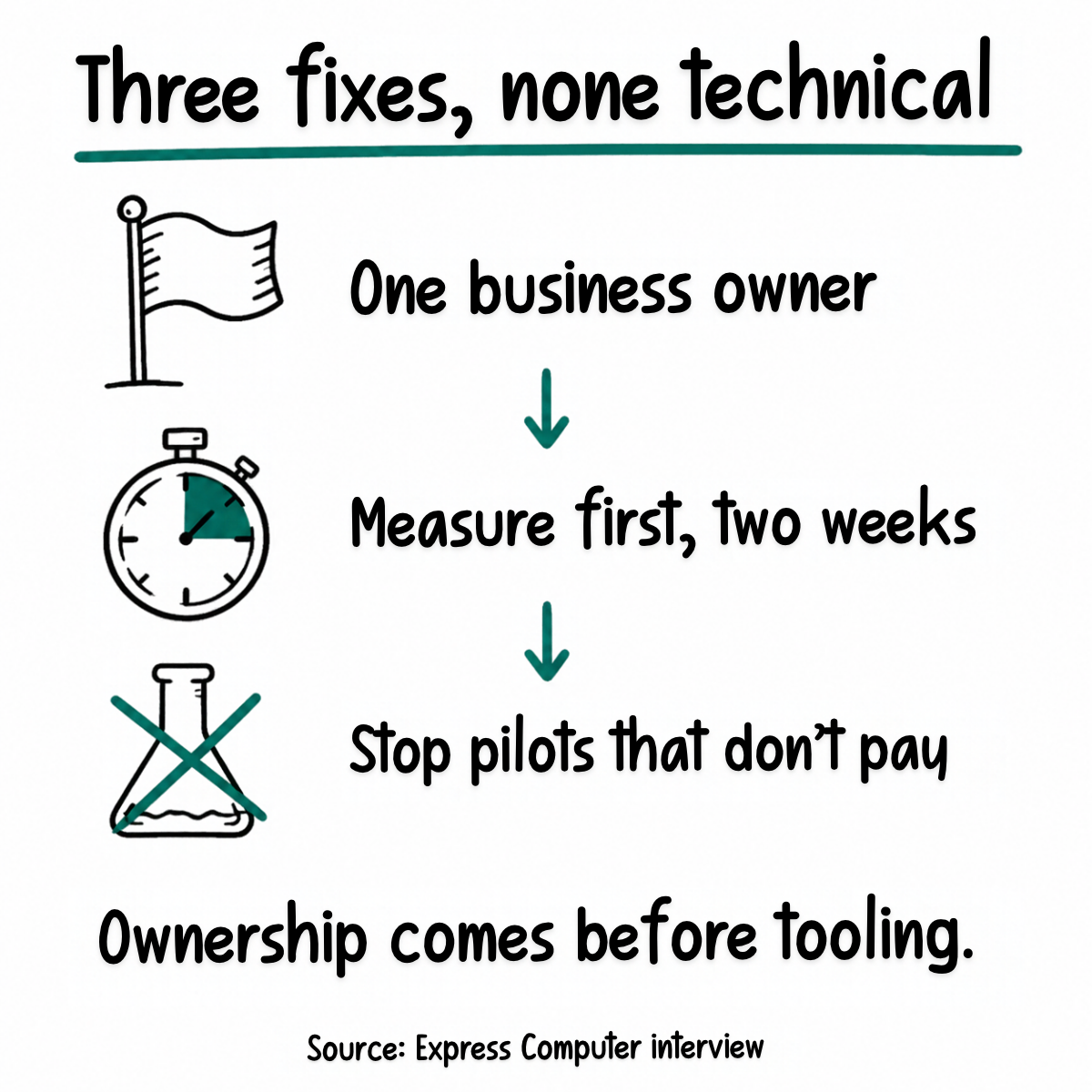
On priorities he starts with data, then governance “that enables rather than restricts innovation”, then talent. If business teams “have to wait 11 weeks to access a technology environment”, he says, they find workarounds, which leads to shadow IT and security risk. He adds a rule for the technology itself: any component that can’t be replaced or upgraded within 18 months “risks becoming a liability rather than an asset.”
His claims against the 2026 data
| What Mittal says | What the 2026 data shows | Source |
|---|---|---|
| Pilots need a business owner | 31% of Indian technology leaders name missing business ownership as a cause of failed pilots. Only 14% of CEOs define the profit impact of every AI initiative. | CIO&Leader; BCG |
| Measure a baseline and track outcomes | 57% of Indian respondents have no measurable AI return or can’t tell whether one exists. | CIO&Leader |
| Shut down pilots that don’t deliver | Economist Enterprise found AI experiments multiply “without the discipline to scale what works or kill what does not”. BCG’s most mature firms fund one multiyear programme instead of scattered pilots. | Economist Enterprise; BCG |
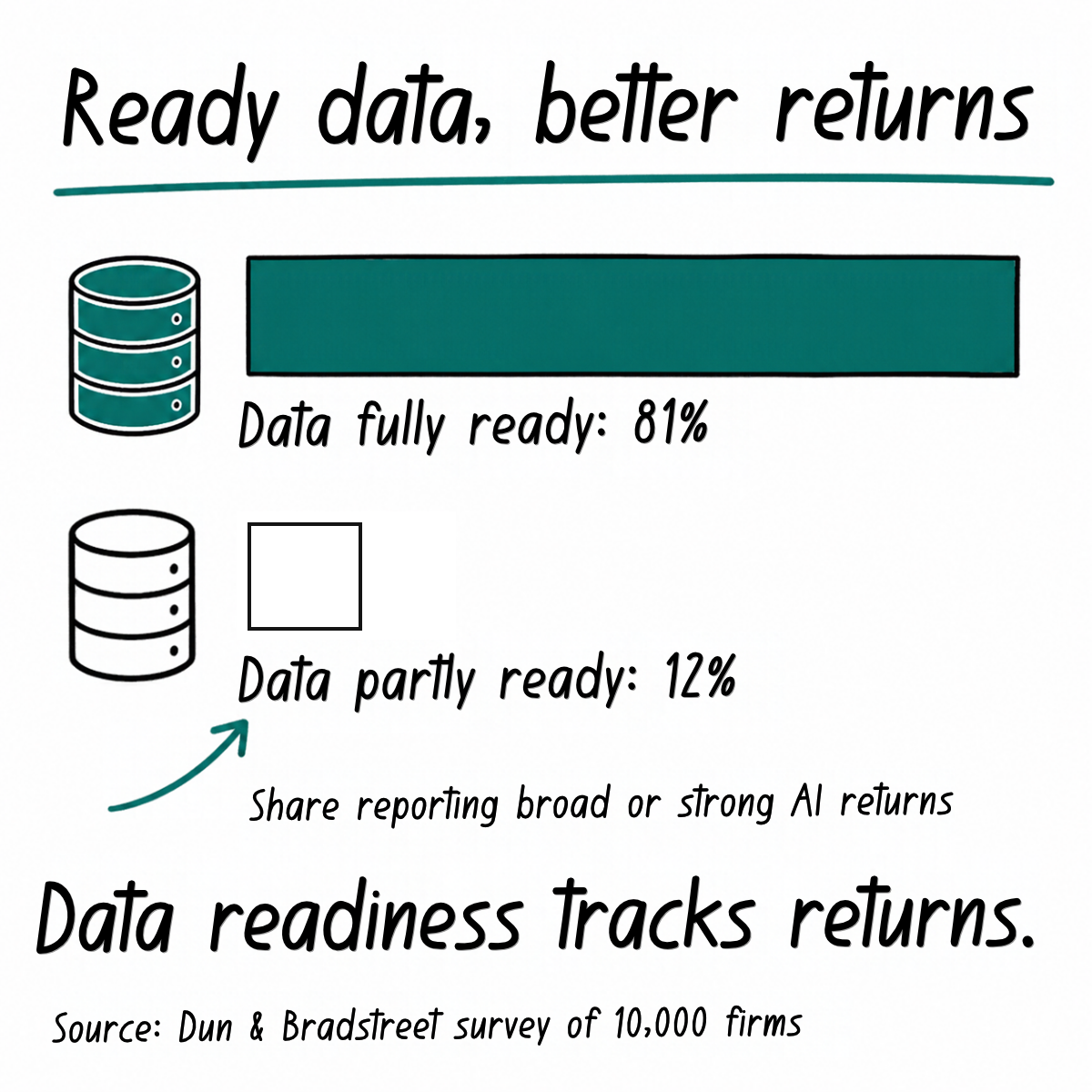
| Start with the data | 8% of firms say their data is fully ready for AI at scale. Of those, 81% report broad or strong returns, against 12% of firms with partly ready data. | Dun & Bradstreet |
| Governance has to keep pace | Fewer than two in five firms keep reviewing an AI system after it goes live. Only 5% of companies have the full set of controls for AI agents. | Economist Enterprise; BCG |
| Talent is the constraint | 55% of CEOs cite redesigning people’s work as a barrier, yet 30% include HR in AI governance against 82% who include technology. | BCG |
Where the surveys push back
Mittal’s “none of them is technical” is the line the data complicates. CIO&Leader’s survey of Indian technology leaders, run in May and June 2026, asked why pilots fail. Data quality came first at 42%, ahead of unclear ROI at 35%, integration at 32% and lack of business ownership at 31%. The same survey has data quality and readiness as the top barrier to scaling, at 56%. Mittal ranks data first among his priorities, and the interview doesn’t reconcile that with his opening line.
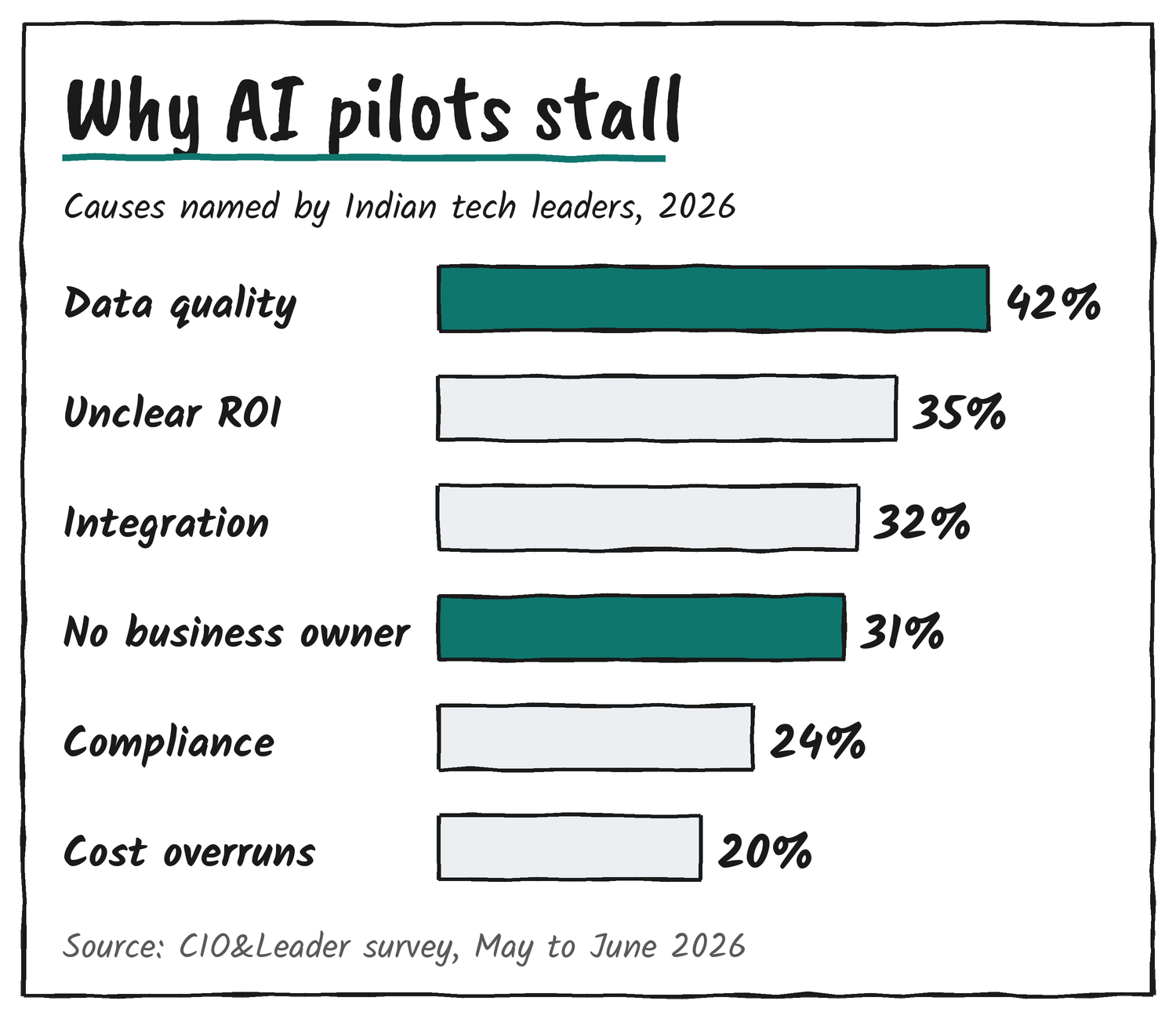
That survey has limits. It collected 317 responses from CIO&Leader’s own readership across three questionnaires, respondents chose their own survey, and the publisher says its sample leans towards banking, manufacturing and IT services. It’s a read on Indian enterprise leaders, not a census.
The data point has support elsewhere. Dun & Bradstreet’s quarterly survey of 10,000 businesses in 32 countries found 28% report broad or strong AI returns, unchanged from the previous quarter, and 44% report only pockets of return. Among firms with fully ready data, 55% report strong returns; among firms with low or no data readiness, 2% do. D&B sells business data, and it describes the link between data readiness and returns as an association, not a cause. McKinsey reaches the same place from the other side, saying data is a key reason only 7% of companies have fully scaled AI.
Agents and the accountability gap
Mittal says agentic systems, which take actions on their own instead of only recommending them, bring a governance problem: “Very few organisations have fully addressed the question of accountability when an AI agent makes an incorrect decision at scale.” BCG’s index puts a number on it. Only 5% of companies have the full set of critical controls in place, while 42% expect to give agents autonomy by 2030. Gartner forecast in June 2025 that over 40% of agentic AI projects will be cancelled by the end of 2027, citing costs, unclear business value and inadequate risk controls. CIO&Leader found 64% of its GenAI respondents already piloting or running agents in limited production.
The junior talent question
Mittal calls the talent model perhaps the most underestimated shift. As AI takes over entry-level tasks, he says, companies need a new way to grow experienced professionals, and “this remains an unresolved challenge”. Stanford’s Digital Economy Lab has payroll evidence. Using ADP data through June 2026, its researchers found employment of 22 to 25-year-olds in highly AI-exposed jobs about 19% below where it would be had it kept pace with similar workers in less-exposed jobs. Experienced workers show no gap, and the study finds no economy-wide job losses. The authors call the pattern descriptive, not proof that AI caused it. The lab’s November update has employment for that age group in the most exposed jobs down 4.2% on a year earlier in October 2026.
What the interview doesn’t show
It cites no study and no named company. The 11 weeks, the 18 months and the fifteen pilots are illustrations, and Mittal gives no source for them. His two-week baseline is a recommendation, with no evidence offered that two weeks is enough.
The numbers will move. Dun & Bradstreet repeats its survey every quarter, so its next readout shows whether the 28% shifts. Stanford and ADP update their young-worker dashboard monthly. Gartner’s cancellation forecast runs to the end of 2027.
Discover more from Sulat AI & Tech News
Subscribe to get the latest posts sent to your email.