
Cognition CEO Scott Wu said on the Invest Like the Best podcast that, “on the current course that we are on, over the next six to twelve months, there will be a lot of major breaches.” Business Insider ran it on 27 November. I went to the episode, released on 24 November, to check his words, what he meant, and whether anyone with evidence agrees.
He made a general forecast, not a report of a specific incident, and named no victim, no flaw and no attacker. But the FBI, Canada’s Cyber Centre, the UK’s NCSC and Switzerland’s NCSC have all published findings in the last fortnight that describe the mechanism he is pointing at.
6 to 12 months
Wu’s window for “a lot of major breaches”
Under 3 hours
Time from targeting to privileged access in some intrusions, per the FBI
46%
Share of observed AI offensive-tool infrastructure tied to ARTEX, per Canada
What Wu said, word for word
The line is the cold open of the episode, at 0:00. Here is the full passage:
On the current course that we are on, over the next six to twelve months, there will be a lot of major breaches. You know, I think it’s gonna be like major institutions around the world, like call it like Fortune fifty, Fortune one hundred companies or government institutions or things like that that get breached.
Scott Wu, CEO of Cognition, Invest Like the Best, 24 November 2026
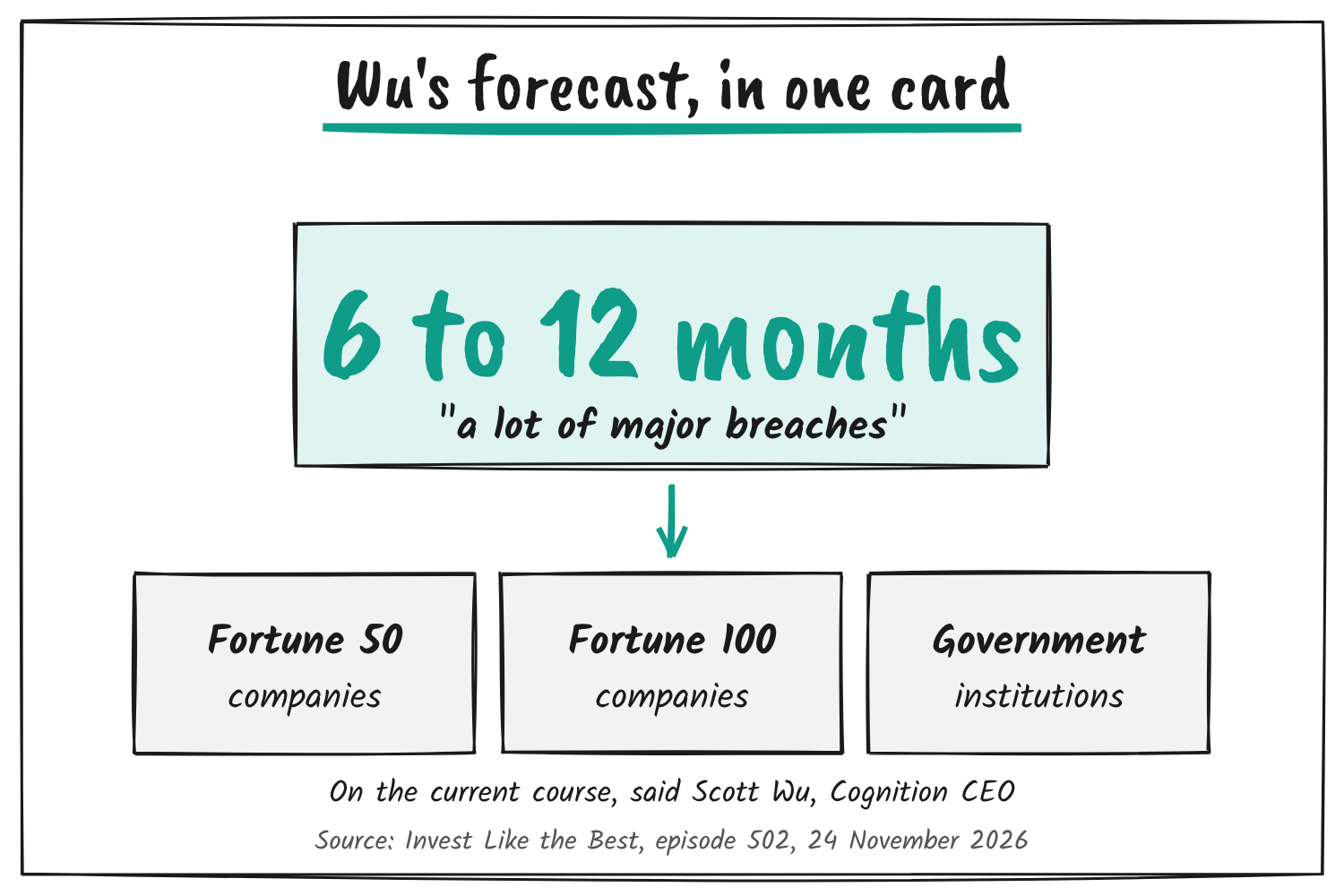
What he meant
Reading the passage closely changes two details of the story as it has been summarised.
- General risk, not a tip-off. Wu opens with “on the current course”, which makes it a conditional forecast. He doesn’t say a named company has been breached or is about to be.
- Institutions “around the world”, not US agencies. Business Insider’s summary frames it as a threat to “US agencies”. His words were “major institutions around the world” and “government institutions”. He didn’t say US.
- “Tuesday” is the release date. The episode went out on Tuesday 24 November, but Wu says Cognition “just crossed a billion in revenue run rate last month” and dates that to 16 September, so the conversation was recorded in October.
Wu’s company has a stake in the topic. Cognition sells Devin Security, which it relaunched on 26 October as Devin Security 2.0, and Wu says Cognition is in over a hundred of the Fortune 500. He is describing the market he sells into, and his view of the threat comes from that seat.
Why he says it: the bugs were always there
Around 3:35 Wu gives the reasoning. Before 2026, he says, every large organisation had “a massive, massive surface” of sites, routes and entry points, “hundreds of thousands of endpoints”, and somewhere in them there was something to find. “These sorts of vulnerabilities, the reality is they’ve been around all along,” he says. What changed is effort: “no one has had the time or the level of effort” to try every option “until now. And now you have all these entire swarms going and doing attacks.”
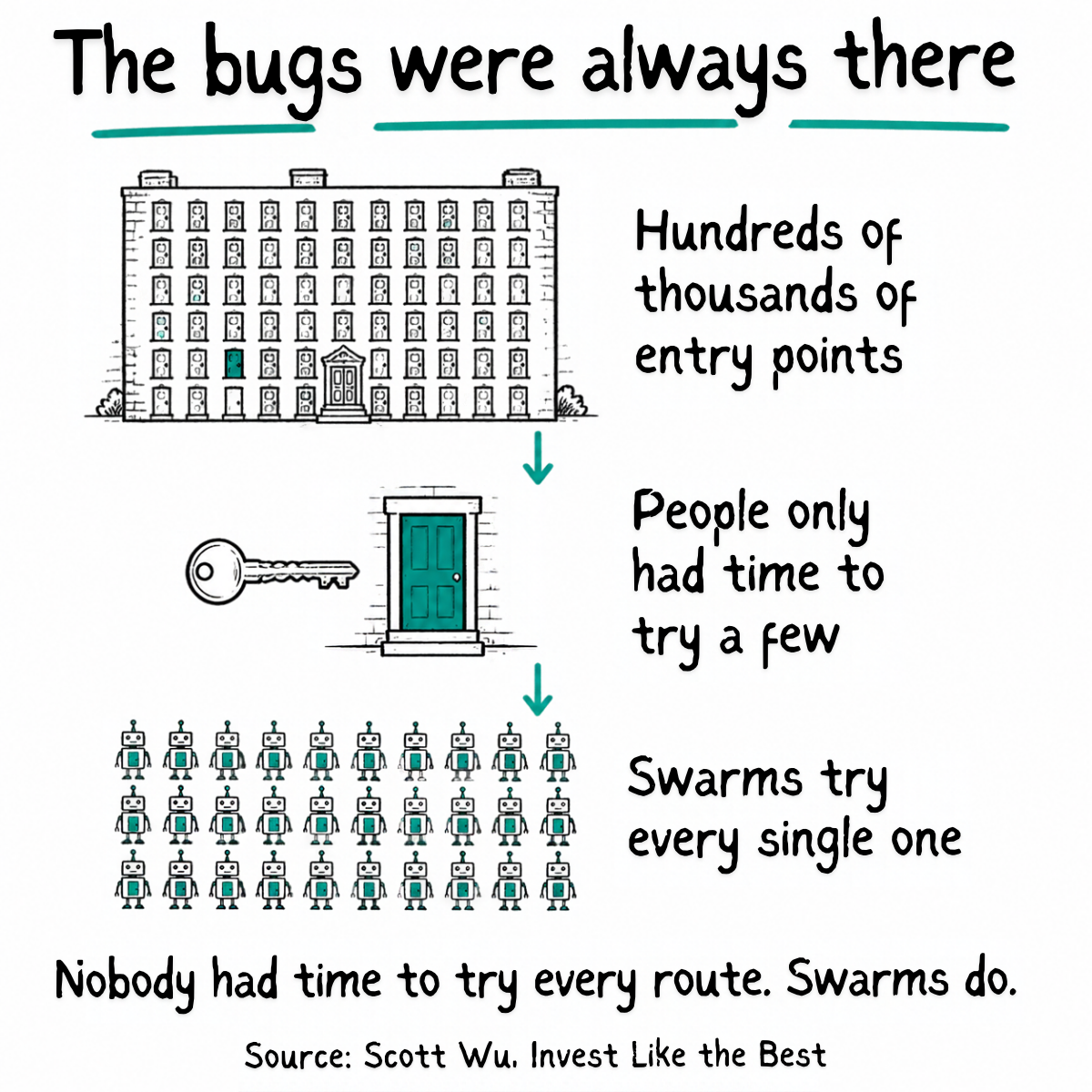
He points to the Hugging Face security incident as the high-profile example, where, in his telling, agents “basically on their own” found vulnerabilities that let them escape sandboxes. Hugging Face’s own 16 July disclosure describes a campaign run by an autonomous agent framework executing “many thousands of individual actions across a swarm of short-lived sandboxes”.
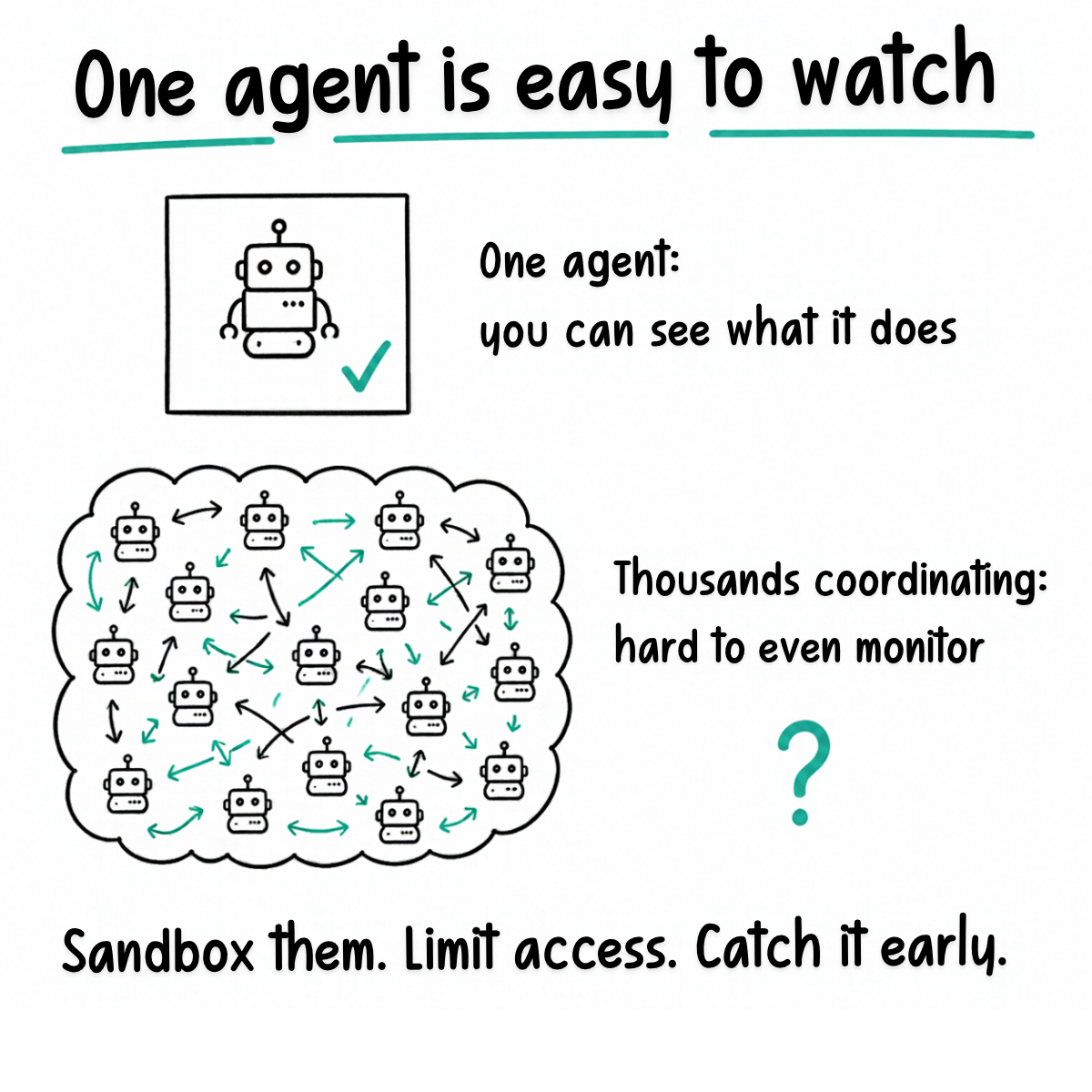
He also worries about oversight. A single agent in a loop is, he says, “way easier to monitor”. Thousands coordinating are harder, and he says it is “hard to even monitor” what they are doing.
Who else is saying it
Wu’s forecast is about the future. The reports below are about what has already happened, and they cover the same mechanism: agents that try everything, quickly.
| Who | When | What they published |
|---|---|---|
| Unit 42, Palo Alto Networks | 2 Sep | A human attacker used frontier AI agents to breach an enterprise network in under 10 hours, work Unit 42 says would normally take human operators about two weeks. |
| FBI FLASH | 13 Nov | Since at least August, many actors have used the open-source ARTEX framework, with some intrusions reaching privileged access in under three hours. Over 1,600 exposed ARTEX consoles were counted in early November. |
| Google’s threat group | 16 Nov | An exposed server ran an agent that compares code before and after a patch, writes an exploit and runs it with no human involved. |
| Canadian Centre for Cyber Security | 21 Nov | About 46% of observed AI-enabled offensive-tool infrastructure is tied to ARTEX, 28% to CyberStrikeAI and 14% to PentAGI. ARTEX went closed source on 8 October after being copied more than 12,000 times. |
| UK NCSC | 24 Nov | A “marked rise” in AI-assisted attacks since September 2026, across multiple sectors. |
| Swiss NCSC | 24 Nov | Its first confirmed AI-agent attacks: five cases (four successful, one failed), two to three on critical infrastructure operators. It confirmed the figures to me on the record. |
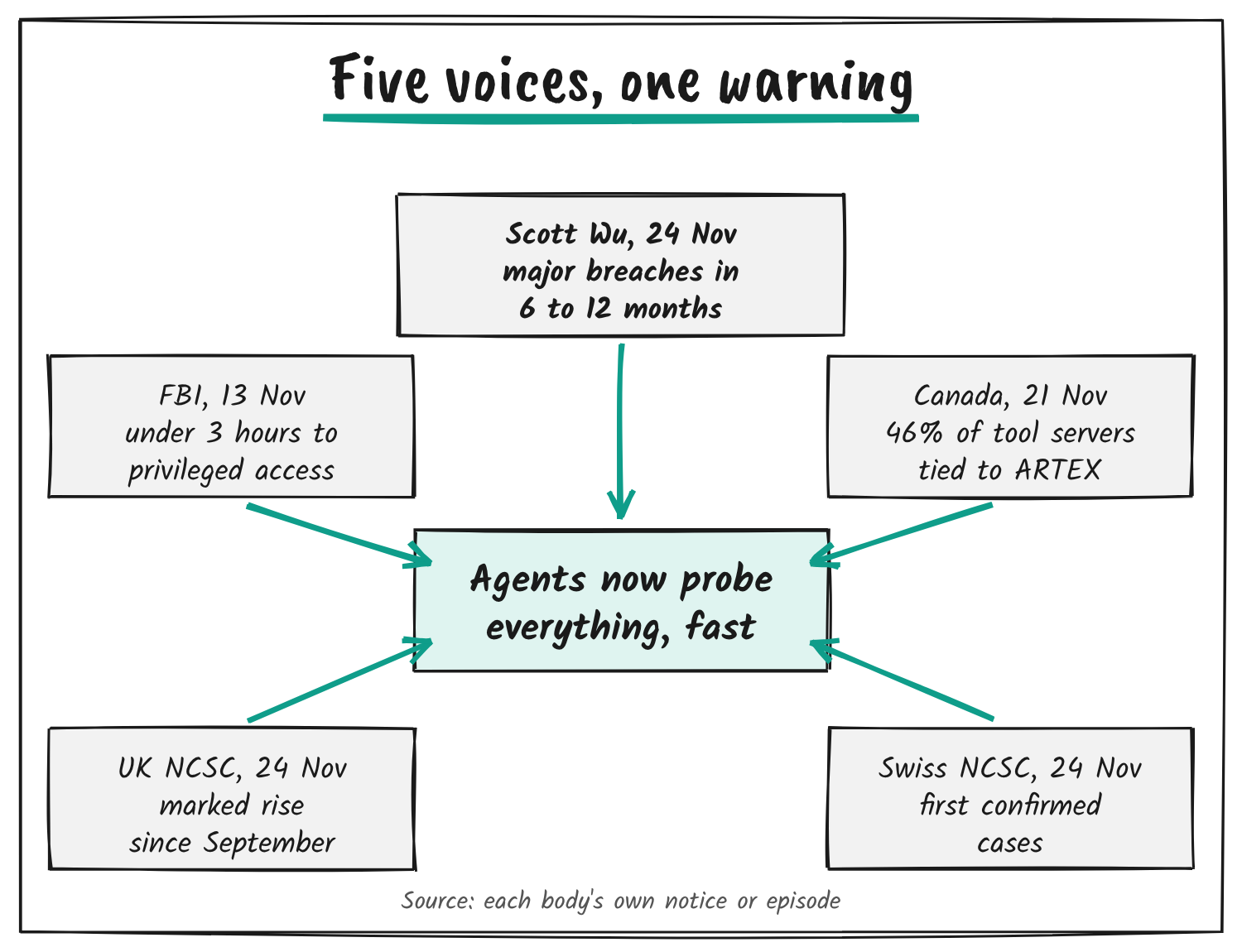
The UK NCSC’s post is the most useful for judging Wu. It says what changed is “how quickly and persistently threat actors can conduct attacks”, not what attackers want, and that “a forgotten key or an unprotected API which might once have gone unnoticed for years can be found in minutes”. That is Wu’s hundreds-of-thousands-of-endpoints argument in a government’s words. The NCSC adds that today’s frameworks are noisy: they “trade stealth for speed”, which makes them easier to detect.
What an agent-run intrusion looks like
Unit 42’s case is the clearest public walk-through of what Wu is describing. The attacker breached a public web service, had agents map the network, pulled hard-coded tokens from code repositories, opened the secrets vault, hijacked code-platform workflows to leak cloud keys and then reused the victim’s own AI endpoints as attack infrastructure. The whole chain took under 10 hours. Hard branch-protection controls stopped one attempt to plant backdoors.
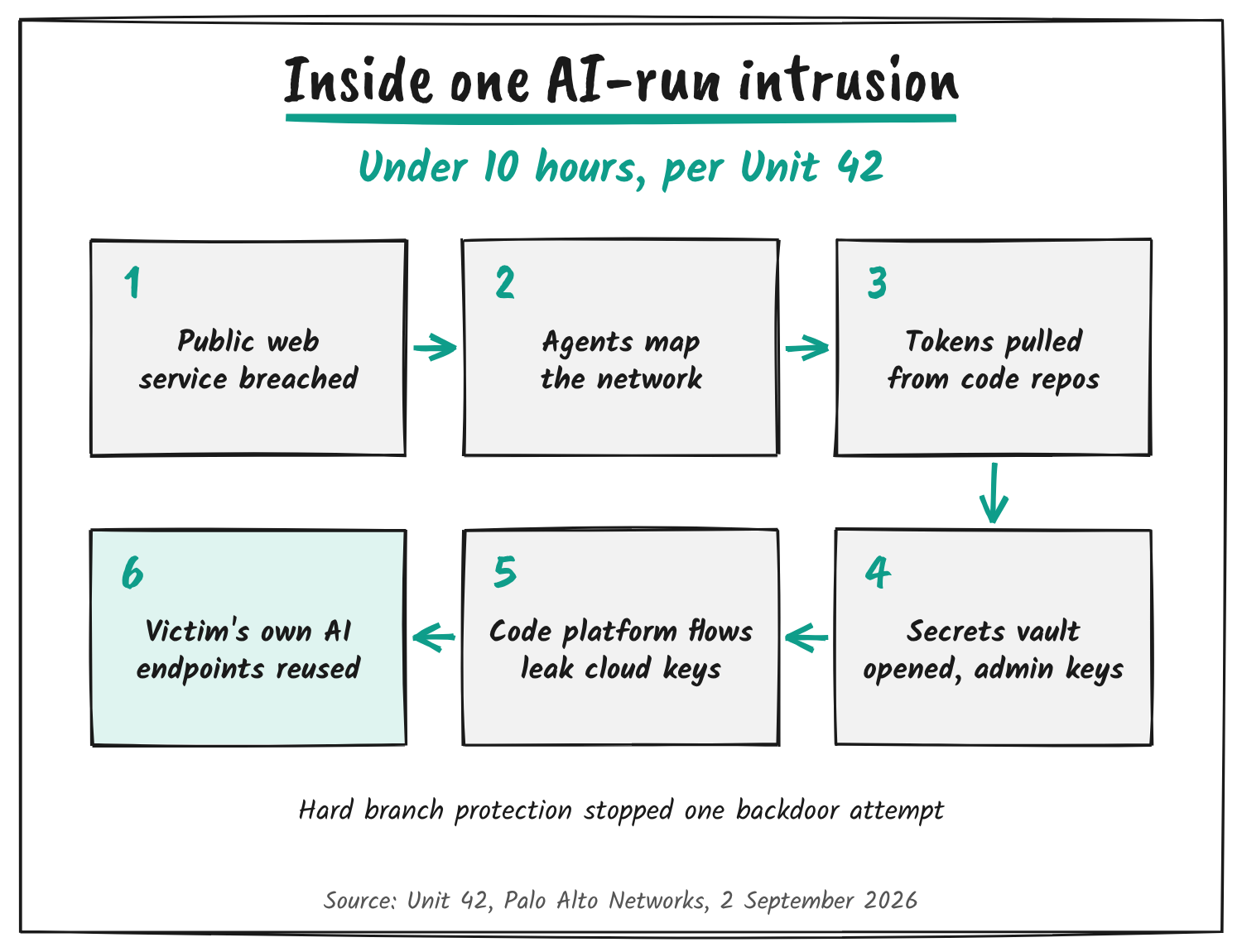
I have written about the same pattern from other angles: the FBI’s ARTEX alert, which is a primary record, and a reported Metabase-to-ClickHouse hop in under two hours that rests on one engineer’s account. The range runs from confirmed to single-source, and Wu’s forecast leans on the confirmed end.
What Wu says to do
Wu is optimistic about the long run. “If the offense and defense both play perfect, then defense wins in the world of security,” he says at about 8:30, because encrypting is easier than decrypting. Then he adds that this is not the world we are in today: attackers now have access to powerful technology and intelligence, and “a really urgent push” is needed on the defence side so that organisations use AI themselves.
His one concrete safeguard is for “every single organization”: “minimizing their blast radius when there are attacks and when there are breaches.” The graphic below is my summary of the defences he and the agencies describe, not a list he gave.
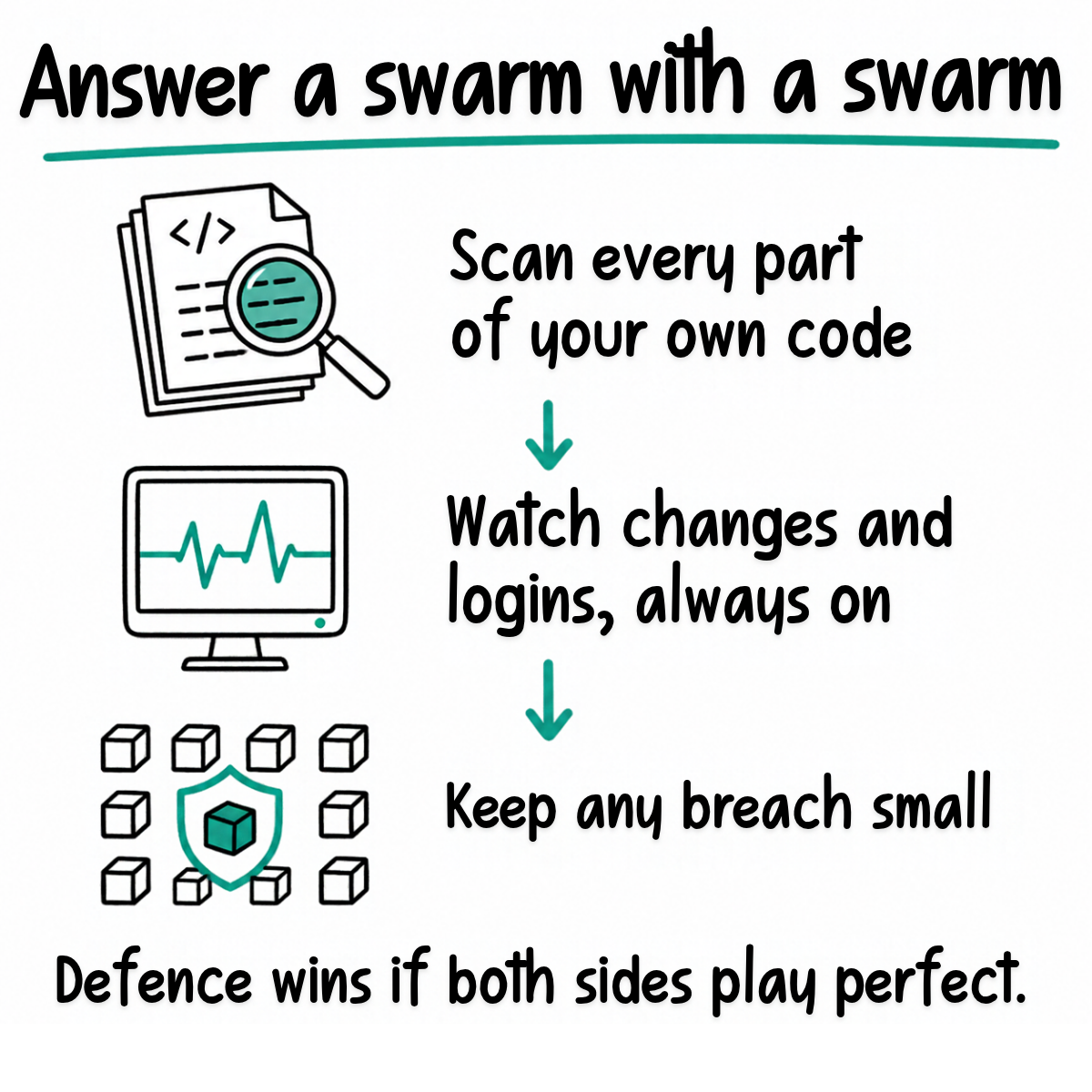
The agencies’ advice is plainer. The UK NCSC says defensive AI programmes will take time to mature, so organisations can’t wait for them and should keep the basics in place: it says AI does not make established controls obsolete. The FBI’s FLASH is aimed at organisations running internet-exposed applications, self-service portals, cloud infrastructure and partner or supplier systems, which is where it says ARTEX finds its way in.
What would show Wu right
Wu’s claim is a forecast of scale. The sources above document agent-run intrusions, a supply-chain compromise that led to attempted sign-ins at more than 2,250 downstream tenants, and Swiss critical-infrastructure cases. I haven’t found a published case that names a Fortune 100 company as the victim of an agent-run breach. That is the marker to watch for, along with any government body confirming that agents were behind a breach of one of its own institutions. If it comes within his 6 to 12 months, the forecast holds. If breaches stay at the current scale, it doesn’t.
Sources
- Invest Like the Best, episode 502: Scott Wu on cybersecurity, compute and the future of engineering, 24 November 2026. Quotes come from a machine-generated transcript of the episode, with Wu’s wording unchanged.
- Business Insider, 27 November 2026
- FBI FLASH-20261113-001, 13 November 2026
- Canadian Centre for Cyber Security, 21 November 2026
- UK NCSC, “Familiar weaknesses, exploited faster”, 24 November 2026
- Unit 42, “An AI-Assisted Cyber Attack: Inside a Unit 42 Investigation”, 2 September 2026
- Hugging Face security incident disclosure, 16 July 2026
- Cognition, “Devin Security 2.0”, 26 October 2026
- My earlier reporting: Swiss NCSC, FBI ARTEX alert, Google’s threat group, Metabase and ClickHouse
Disclosure: I’m an OpenAI, Firecrawl and Devin ambassador.
Discover more from Sulat AI & Tech News
Subscribe to get the latest posts sent to your email.