
Anthropic has a quickstart in its claude-quickstarts repository that reads a set of documents once, files what they say into linked Markdown pages, and then lets a small Claude model answer questions from those pages instead of the raw files. Anthropic calls it a knowledge wiki. On its own benchmark, Claude Haiku 5.5 answering from the wiki scored within a point of Claude Sonnet 5.5 searching the raw documents, at about 1/15 of the cost per answer. That is the claim in a post that went round on X this week, and it matches the repository.
I read the README, the notebook with its saved outputs, the four prompts, the commit history and Anthropic’s Managed Agents documentation, and I checked the post’s claims against them. The benchmark figures below are Anthropic’s own. I also ran the build myself, on a small set of documents, and what that showed has its own section. The code has been public under the MIT licence since August, and Anthropic rebuilt it on dynamic workflows earlier this month, so the post is describing the current version rather than a new release.
In this piece
- The idea
- How the build works
- What the wiki keeps
- The benchmark and the break-even
- What happened when I ran it
- Limits Anthropic states itself
- Where it sits among memory tools
- Trying it, and who it suits
The idea
When an agent searches documents, each question starts from scratch. The facts that matter most often sit between documents: two metrics with the same name, one company under three names, a figure that a later filing contradicts. A search index finds passages, and the agent has to rediscover those links on every question.
The quickstart moves that work to build time. A group of agents reads the corpus once and writes what it finds into a Claude Managed Agents memory store: a directory of Markdown files with YAML frontmatter, linked by wikilinks, where every claim carries its source. After that, analyst agents mount the store read-only, one session per question, and cite every fact. The pattern fits a slow-changing corpus that agents query repeatedly. Anthropic’s worked example is due diligence on a real take-private deal, and it names legal discovery and support over product docs as other fits.
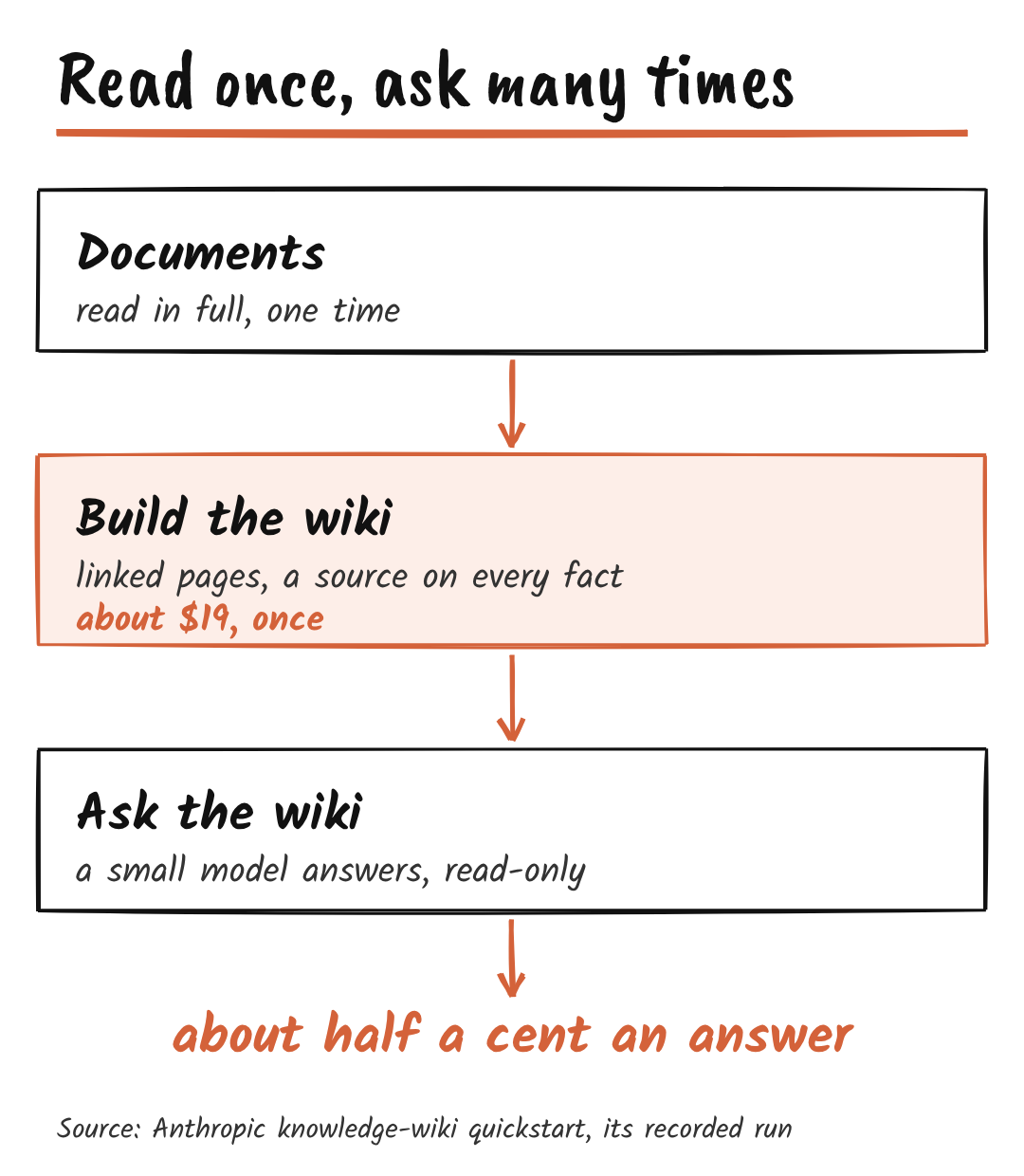
This is the pattern Andrej Karpathy described in his LLM Wiki idea file, which argues that with ordinary retrieval “the LLM is rediscovering knowledge from scratch on every question” and that a wiki’s knowledge “is compiled once and then kept current”. Anthropic’s version adds a build pipeline, a schema every agent follows and a benchmark.
How the build works
The build is one Managed Agents session running one dynamic workflow, which Anthropic added in October. A lead agent called wiki-builder writes the workflow from a single message and starts it. It never reads the documents itself. Four predefined worker agents do the work, in phases.
| Agent | Phase | What it does |
|---|---|---|
| wiki-extractor | Extract, one per batch, in parallel | Reads its batch in full and files entities, relations, metrics and open questions by the schema |
| wiki-resolver | Resolve, one | Works the top open questions the extractors flagged, checking the wiki first, then the documents |
| wiki-analyzer | Analyze, one per batch, in parallel | Re-reads its batch against the wiki, verifies claims, adds what was missed and adds red flags to a ranked file |
| wiki-organizer | Organize, one, last | Merges duplicates, repoints links, completes the index and ranks the red flags |
The recorded run used eight SEC filings, about 2.8 MB of text, split into 25 batches. That meant 25 extractors, one resolver, 25 analyzers and one organizer, all on Claude Haiku 5.5, with Claude Sonnet 5.5 as the lead. The resolver worked ten open questions, resolved nine and confirmed one unresolvable, and left 303 listed as known gaps. The result was 212 files totalling about 1.2 MB, with 1,096 memory versions written along the way. Every write is a version you can audit or roll back for 30 days.
The notebook’s cost table shows where the money goes. Of about US$16 at list price, the 25 analyzers took US$11.50 and the 25 extractors US$3.50. The resolver, organizer and lead agent together came to about US$1. The notebook’s estimate beforehand was US$25.77, so the run came in well under it. The README says the run took 23 minutes, and the workflow pass in the notebook’s output reports 17.
The lead agent’s prompt sets the failure rules. A failed extractor or analyzer is retried once. A batch that still can’t be extracted ends the run, because a wiki built from part of the documents answers as if the rest said nothing. The notebook also checks what ran against the platform’s records, so a skipped batch shows up as a failed check rather than a quietly thinner wiki.
What the wiki keeps
The extractor prompt carries the rules that matter most. It resolves aliases first, so “Squarespace, Inc.”, “the Company” and a board deck’s code name land in one file. It closes superseded facts with a valid_to date instead of deleting them. It quotes only operative language word for word. And it records “not in this document” rather than any claim that something doesn’t exist anywhere.
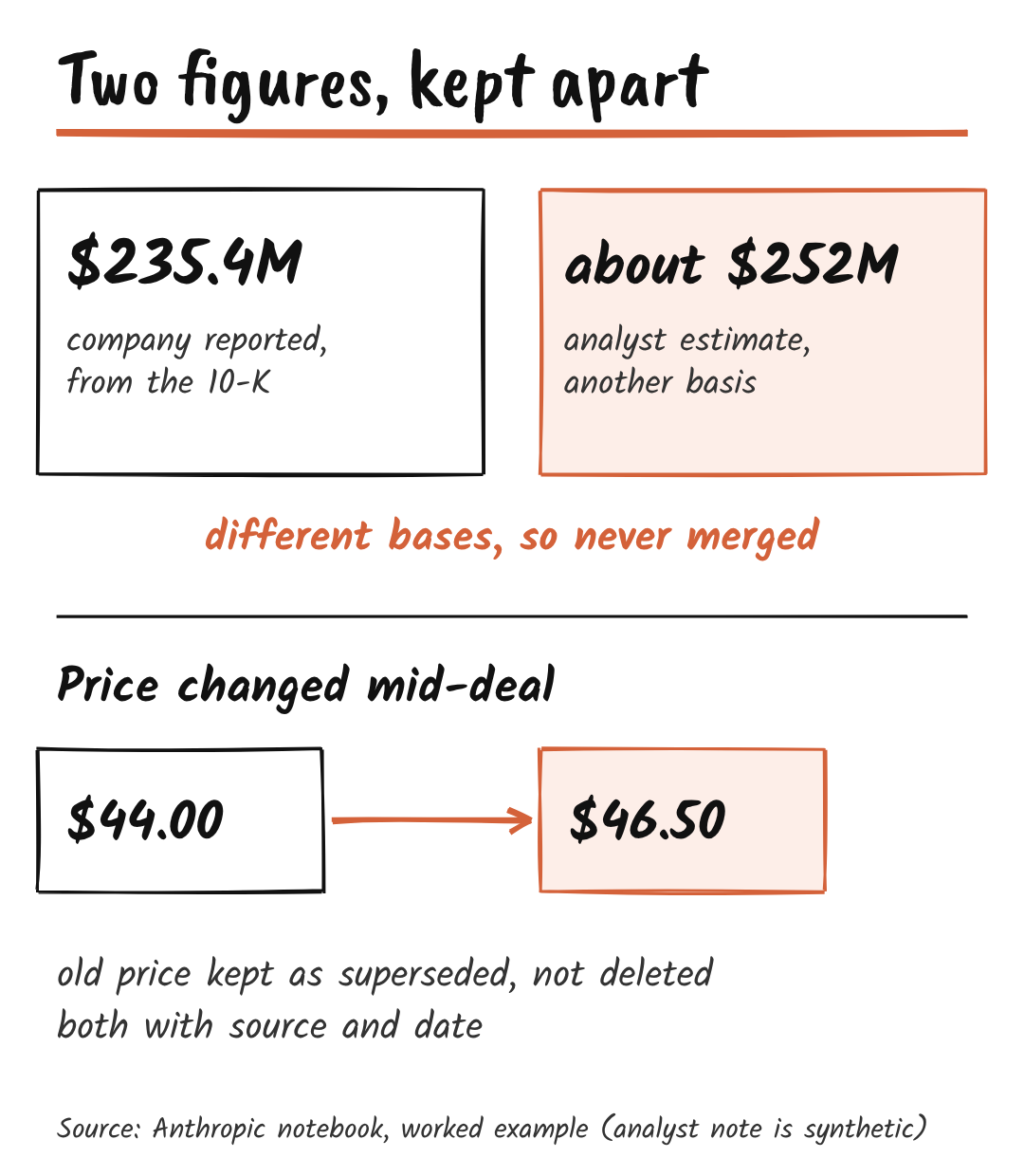
The notebook’s worked questions show the payoff. The deal’s per-share price changed in September from US$44.00 to US$46.50, and the wiki answers with US$46.50 first and records US$44.00 as superseded on the amendment’s date. For fiscal 2023 adjusted EBITDA, the company reported US$235.4 million, while a synthetic analyst note that Anthropic added to the data room estimates about US$252 million on a credit-agreement basis. The wiki files both with their own sources and bases, because the schema never merges figures on different bases. The notebook also includes a trap question about revenue for a year the data room doesn’t cover. The correct answer refuses and names the document that would be needed.
The benchmark and the break-even
Anthropic’s benchmark uses 21 questions with answer keys about the deal’s documents. Each of 27 runs extracted the documents once and consolidated them into three wikis. Each analyst model then answered the questions three times from each wiki and three times from the raw documents. Two judge models score out of 100, and the figures below are the mean over the 27 runs with a 95% interval.
| Analyst | Source | Score out of 100 | Cost per answer |
|---|---|---|---|
| Claude Haiku 5.5 | Wiki | 91.9 ± 0.7 | US$0.0056 |
| Claude Sonnet 5.5 | Raw documents | 92.8 ± 0.5 | US$0.086 |
| Claude Sonnet 5.5 | Wiki | 92.6 ± 0.6 | US$0.064 |
| Claude Haiku 5.5 | Raw documents | 88.9 ± 0.6 | US$0.0066 |
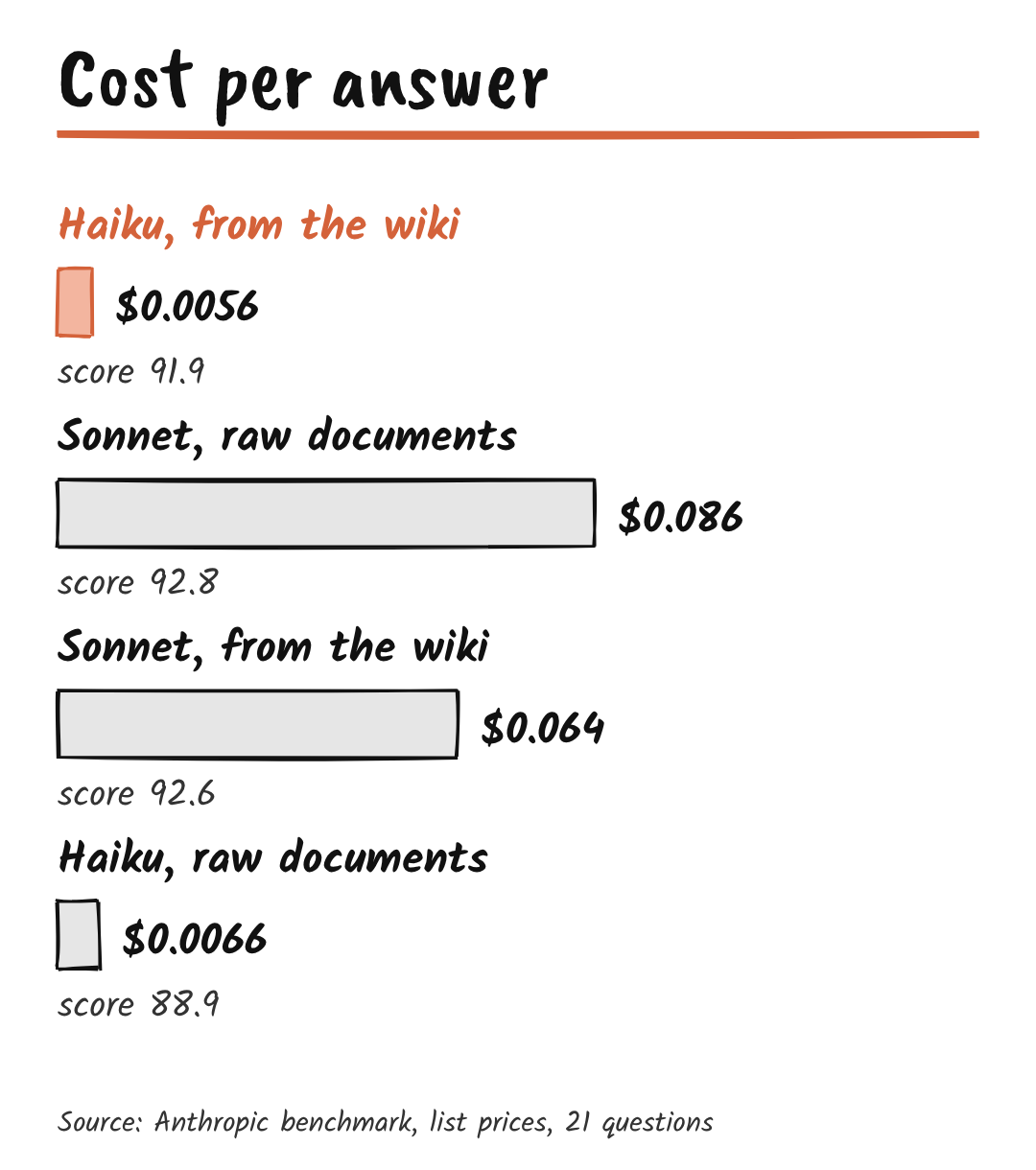
The post’s headline holds: 91.9 against 92.8 is 0.9 points, and US$0.086 divided by US$0.0056 is about 15. If you’re planning a spend, two other readings of the table matter more.
- The wiki lifts the small model, not the big one. Haiku gains about 3 points from the wiki. Sonnet scores the same with or without it, and saves about a quarter per answer (US$0.064 against US$0.086).
- The break-even depends on what you compare against. Anthropic puts the build at about US$19 on the benchmark’s average (US$4 to extract, US$15 to consolidate) and says it pays for itself after about 240 questions. That checks out: US$19 divided by the US$0.080 saved per answer is about 236. But that is against Sonnet searching raw files. Against Haiku searching raw files, the saving is about a tenth of a cent per answer, so the build takes about 19,000 questions to repay in dollars. At that point you’re buying the 3-point gain, not a saving.
What happened when I ran it
To see whether the pattern holds, I built a wiki myself on a small, clean corpus. I used seven Claude Platform documentation pages on Managed Agents (the overview, memory, dreams, budgets, workflow runs, multiagent orchestration and the release notes), saved as text. That is 405 KB, about 116,000 tokens, which the notebook split into five batches. I ran Anthropic’s notebook code and its four prompts as they come, with the same models: Claude Haiku 5.5 for the workers and Claude Sonnet 5.5 as the lead. Only the documents and the questions are mine. Managed Agents runs Claude models only, so there is no multi-vendor field here, and a build this size is a smoke test, not a benchmark.
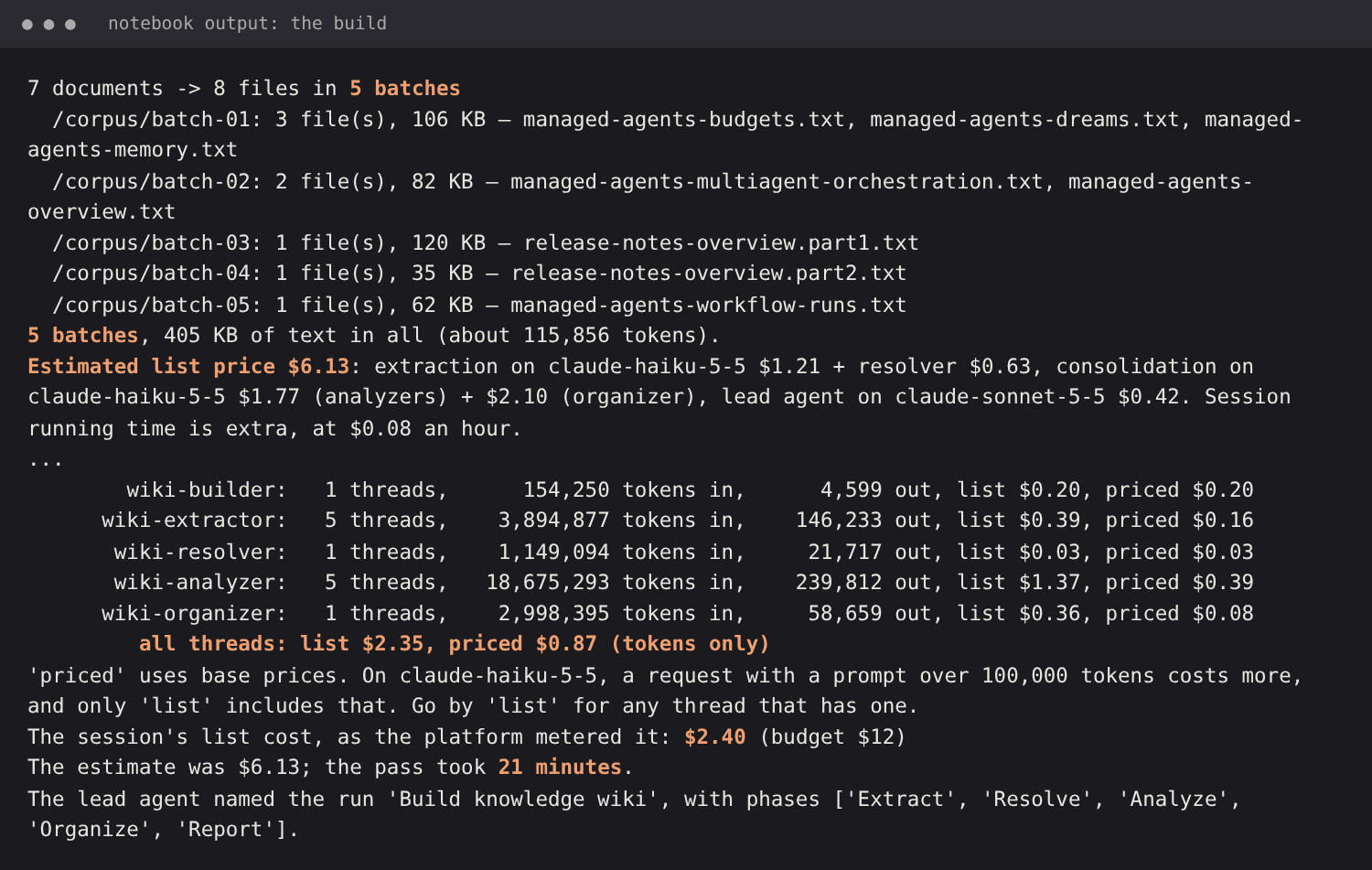
The build took 21 minutes, and the platform metered it at US$2.40 against the notebook’s US$6.13 estimate. The five analyzers were again the biggest line, about US$1.37 of the US$2.35 in thread costs, with the extractors at US$0.39. The result was 133 files: 107 entity pages, 8 relation files, 6 metrics files and 8 open-question files, plus an index, a schema and a ranked escalations file. The lint found one dangling link, one alias claimed by two pages and one leftover file named .tmp-check in the entities folder. No document went unfiled.
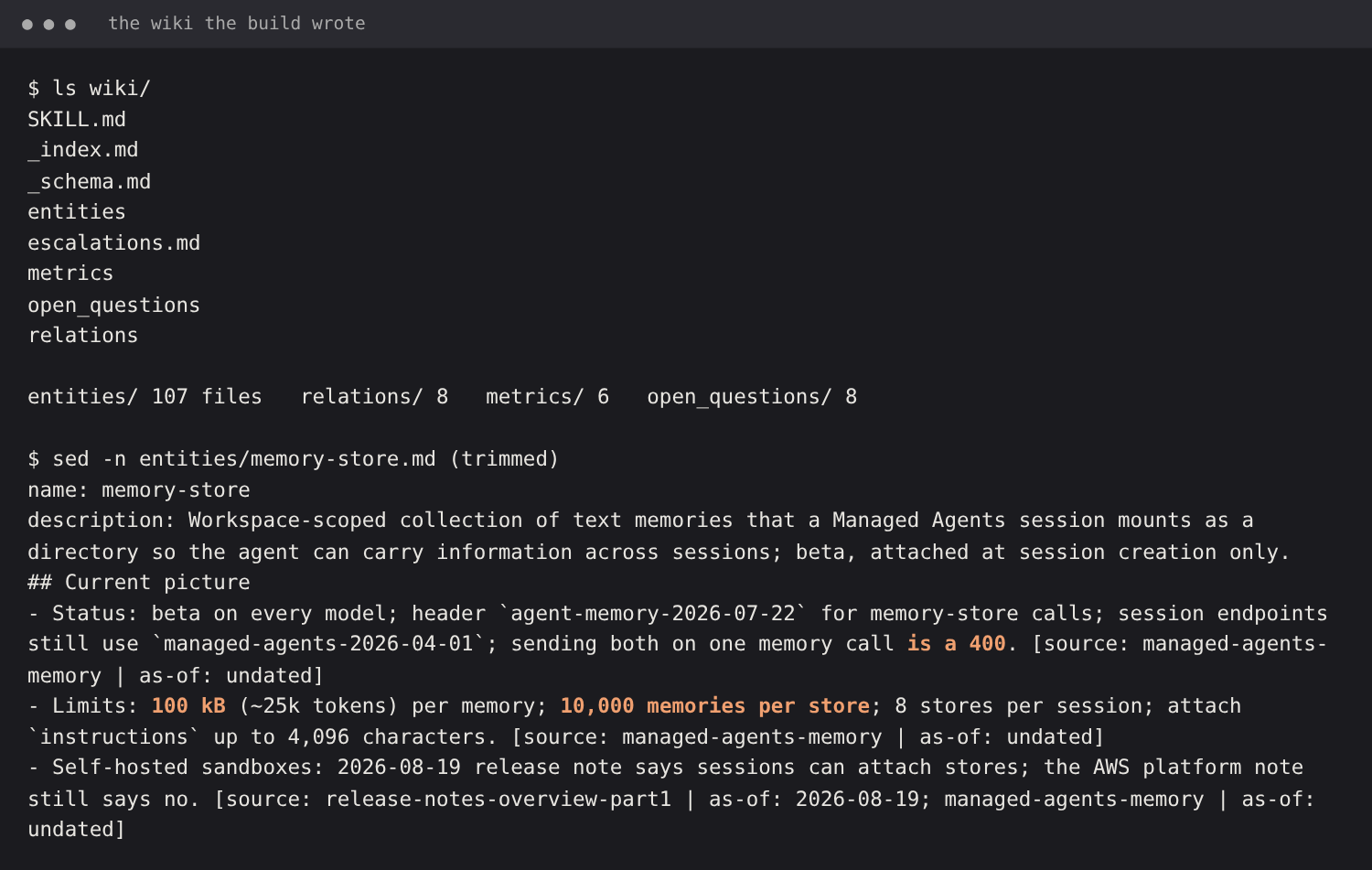
The escalations file is the part I would read first. It ranked 20 items, 14 of them still open, and they are real catches in the documents rather than noise. One is a conflict over whether Claude Opus 4.8 can act as an advisor, where an example on one page uses it and a later release note records its rejection. Another notes that the dreams page never says whether Haiku 5.5 is a supported model. A third is a conflict over attaching memory stores to self-hosted sessions, where the memory page says no and a release note says yes. The memory-store page records that one as unreconciled instead of picking a side.
The six questions
I wrote six questions before I ran anything and did not change them afterwards. Three are lookups (L1 to L3) and three need more than one page or the release notes (X1 to X3). I put each to three analysts, once each, as fresh sessions with file tools only: Claude Haiku 5.5 answering from the wiki, Claude Sonnet 5.5 searching the raw text files, and Claude Haiku 5.5 searching the raw files. The two raw arms used the notebook’s own baseline prompt. The questions, word for word:
- L1: “What is the maximum size of one memory in a memory store, and how many memories can one store hold?”
- L2: “How many threads can one workflow run have working at once?”
- L3: “What does a Managed Agents session cost per hour of running time, apart from tokens?”
- X1: “Which beta header do session calls, memory store calls and dream endpoints each need, and what happens if two of them are combined?”
- X2: “Which Claude models do dreams support?”
- X3: “Which Managed Agents features are not eligible for zero data retention or HIPAA, and is there any exception?”
All three analysts got all six right against my keys: 100 kB and 10,000 memories, 64 threads, US$0.08 an hour, the three beta headers with a 400 when the memory and managed-agents headers are sent together, the ten models dreams support, and not eligible for zero data retention or HIPAA with a self-hosted exception for zero data retention only. That is 18 of 18, so on this set there is no accuracy gap to report.
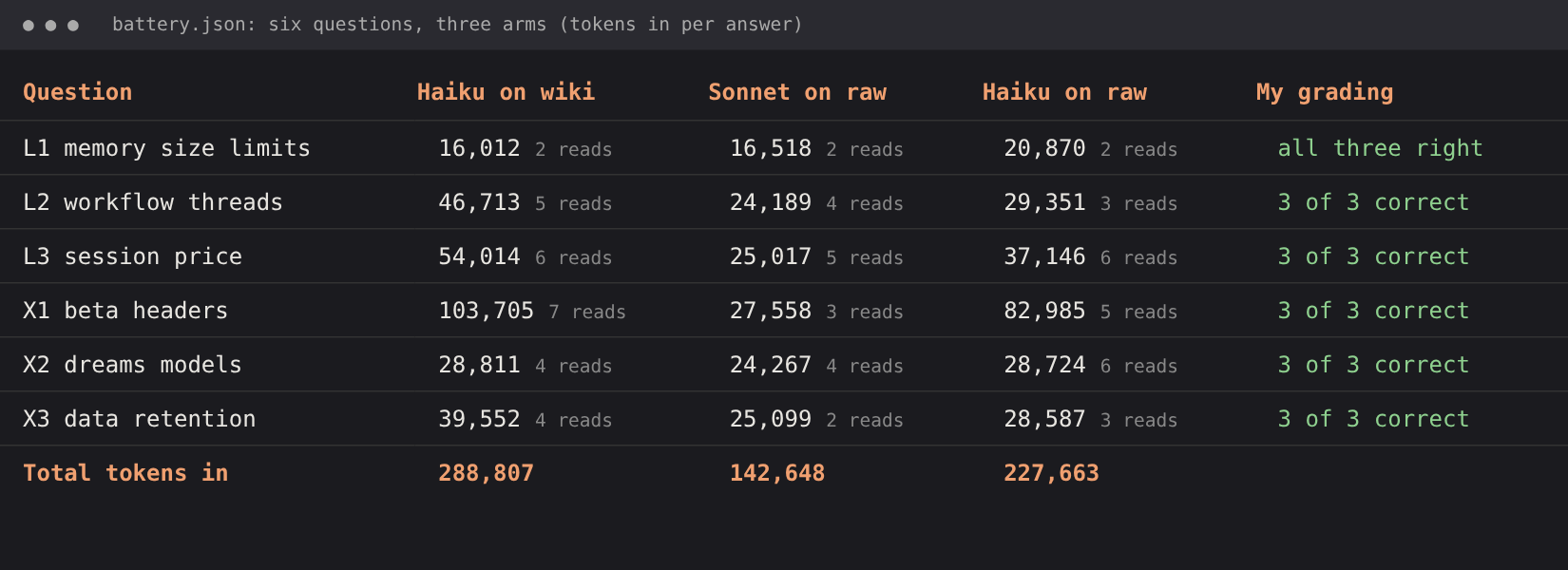
The cost went the wrong way for the wiki. Haiku on the wiki read about 289,000 tokens across the six answers, against about 228,000 for Haiku on the raw files and about 143,000 for Sonnet on the raw files. The wiki arm spent the most on the header question, 103,705 tokens over seven reads, where Sonnet reached the same answer in three reads and 27,558 tokens. The platform’s meter rounds each answer to the nearest cent, which put Sonnet’s six answers at about 15 cents and hides the Haiku arms, so I can’t give you a reliable per-answer dollar figure for those two.
The wiki’s answers were more careful. It cited a page and an as-of date on every claim, said when a source was undated, and on the thread limit added that an open question remains on whether the limit is the same on every plan. On the dreams question it was the only arm to say outright that no Haiku model is supported, which matches the gap its own build had flagged.
My reading is that the pattern works as described and was cheap to build, but on a 405 KB corpus where a text search finds the answer in two to six reads, there was nothing for the wiki to save. That fits Anthropic’s own advice that it doesn’t suit a small set. It does not test Anthropic’s claim, which is about megabytes of documents and questions that cut across them. I asked each question once where Anthropic asks three times, and six questions can’t separate analysts that are all right. A fair test needs a corpus several times larger and questions where the raw files disagree with each other.
Limits Anthropic states itself
The benchmark is Anthropic’s own, on one corpus, scored by judge models Anthropic chose, and it ran with an earlier wording of two prompts. The notebook is candid about the rest:
- About 5% of the lines filed to the busiest entity page lose content, because agents write straight onto shared pages and sometimes overwrite each other. Anthropic accepts that because a shared page is where disagreements between documents get flagged.
- The recorded run’s lint found 30 dangling links and 6 names claimed by more than one file. Anthropic says some dangling links are normal, since many point at documents the data room lacks.
- In Anthropic’s testing, extraction, query answers, judging and even its own answer keys made false “not disclosed” claims at times, so it tells you to treat absence claims as hypotheses and check a “Not in the wiki” answer against the documents.
- A file in a memory store is capped at 100 KB, so on a larger corpus the main company’s page and the red-flags file have to be split.
- New documents need a new build run. The wiki doesn’t update itself.
Data handling is the other constraint. Managed Agents sessions aren’t eligible for zero data retention or HIPAA, and a session keeps what its agents read until you delete it. Managed Agents is in beta, and Anthropic charges token rates plus US$0.08 for each hour a session runs. The notebook treats documents as untrusted input: the agents hold file tools only, in an environment with no network, and every prompt says that what an agent reads is data, not instructions. Office files from a counterparty should be converted in a container or to text first. A build on Sonnet throughout would cost about US$62 instead of US$16, and the notebook stops before creating any agent if its estimate is over your budget.
Where it sits among memory tools
Most agent-memory tools remember conversations. This one is built for a fixed set of documents, and the other tools in the space make different bets.
| Tool | How it stores knowledge | Notes |
|---|---|---|
| Anthropic Knowledge Wiki | Linked Markdown in a memory store, sources and conflicts on each fact | Built once from documents by a workflow; needs Managed Agents |
| Karpathy’s LLM Wiki | LLM-maintained Markdown wiki between you and your raw sources | An idea file to hand to your own agent, not a product |
| Graphiti (Zep) | Graph of entities and time-stamped facts | Facts carry valid and invalid times and trace to a source episode; needs a graph database |
| Mem0 | Extracted facts in a vector store | Dropped graph memory from its open-source v3 rewrite in April |
| Letta | Memory the agent edits itself | Letta Code keeps memory as Markdown in a git-backed file system |
| Cognee | Knowledge graph built from documents and chat | Version 1.6.1 runs locally without a model provider |
Anthropic’s closest sibling is its own dreaming work. Dreams, a research preview in Managed Agents, read a memory store alongside past session transcripts and write a reorganised copy. The dreaming cookbook builds the same analyzer-then-organizer pattern as a dynamic workflow over agent transcripts. On about fifty long sessions, roughly 12 MB of text, it cost about US$8 and took about ten minutes. The Knowledge Wiki notebook points to it as the way to keep a wiki current: run it on your analysts’ exported sessions against a copy of the store, then read the copy before switching analysts over.
Trying it, and who it suits
The folder needs Python 3.11 or later, the anthropic Python SDK at version 2.0 or later, and an Anthropic API organisation with Managed Agents, which the README says is on by default. The fetch script pulls the filings from SEC EDGAR and asks for a contact in the user agent. The README’s steps:
cd managed-agents/knowledge-wiki
pip install -r requirements.txt

export EDGAR_USER_AGENT="your-name your-email"

python3 fetch_data_room.py --tier=core
jupyter lab distill_documents_into_knowledge_wiki.ipynb
The default core tier is the recorded run. The quickstart tier is cheaper, though the notebook warns that on it the cross-filing questions come back unanswered on both sides, so you’d swap in your own questions. To use your own documents, set COOKBOOK_DOCS to a folder of text files that each start with a source line, then rewrite the prompts that name the deal. The notebook lists which ones.
It suits a team whose agents field the same kinds of question over a document set that rarely changes, where a wrong figure is costly and the question count is in the hundreds or more. It doesn’t suit a corpus that changes daily, a small set that fits comfortably in one prompt, or material that can’t sit in a service that isn’t zero-data-retention eligible. Test it on your own questions, and ask each more than once, before planning on the saving. The notebook says as much.
What to watch
- Whether anyone reruns the benchmark on a larger corpus. My own build was small, and the only large-corpus figures are Anthropic’s, from one deal’s filings.
- Whether the dreaming cookbook’s nightly run proves a workable way to keep a wiki current as documents change.
- Whether the savings grow with corpus size, as Anthropic expects because a raw search has more to read. It hasn’t published a larger run.