

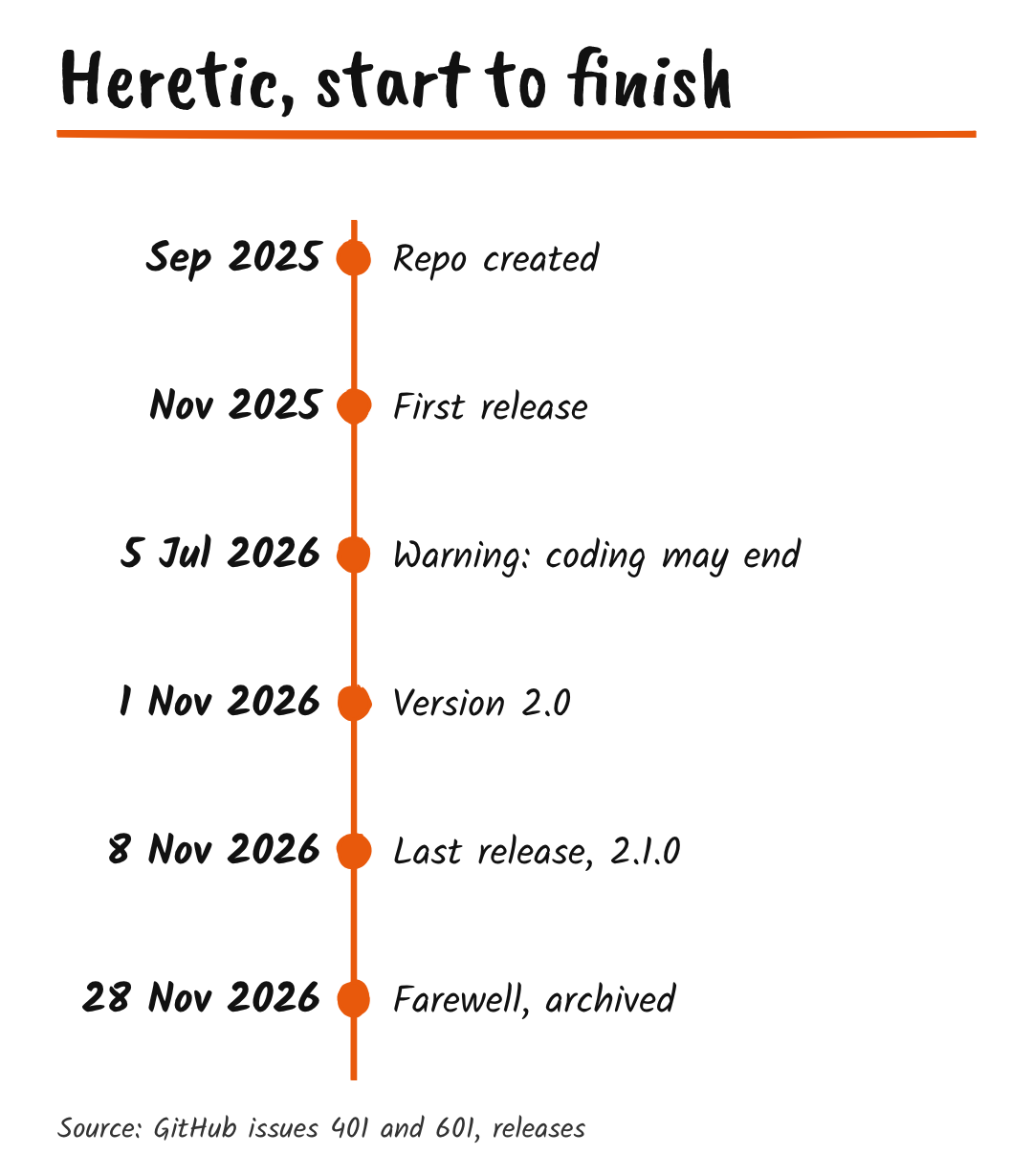
Philipp Emanuel Weidmann, who goes by p-e-w, has archived Heretic, the open-source tool that strips refusals out of language models. The repository went read-only on 28 November 2026 with a pinned farewell post, and he named no successor.
“I am archiving this repository to preserve it in its current, high-quality state, and to prevent issue and pull request spam from turning it into a trash pile,” he wrote in the farewell issue. “I am deliberately not naming a successor, nor am I suggesting any particular infrastructure. The future of Heretic is now in the hands of all of you.”
He hasn’t said why. The post gives no reason, and we won’t guess at one. It follows a July warning in issue 401, where he wrote that “at some point in the not-too-distant future, I expect to find myself permanently unable to develop software.”
What Heretic does
Heretic edits a model’s weights after training, with no further training run. Its default job is refusal suppression: you point it at an open model, and it returns a version that stops declining requests. The project also ships configuration presets aimed at other behaviours, including slop, humour, sycophancy, emotions and terse responses.
It is licensed AGPL-3.0, the repository was created in September 2025, and the first release came that November. The author’s README says a run on a single RTX 3090 takes roughly half an hour to 40 minutes for a model the size of Qwen3-4B, with optional 4-bit quantisation for bigger ones.
How it works
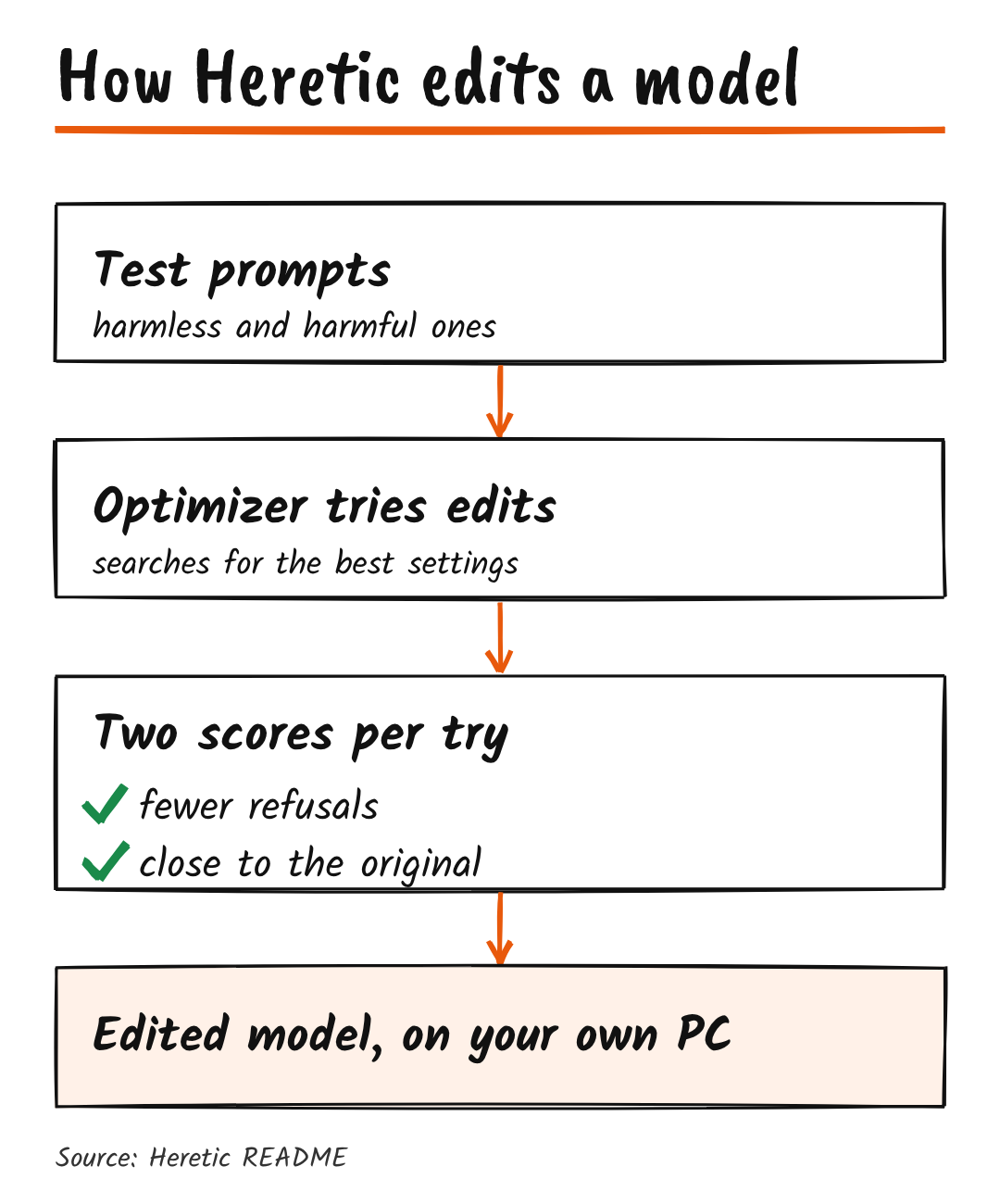
Heretic runs a search. It tries edits to the model, scores each one on two things (how often the model still refuses, and how far its behaviour has drifted from the original, measured as KL divergence), and uses an Optuna TPE optimizer to find the best trade-off. The aim is a model that refuses less but still behaves like itself.
Two editing methods sit underneath. Classic directional abliteration comes from Arditi and colleagues, who found that refusal in 13 chat models, up to 72B parameters, is mediated by a single direction in the model’s activations. Remove that direction and refusals drop. Heretic’s default since version 2.0 is Arbitrary-Rank Ablation (ARA), which doesn’t use refusal directions at all and instead optimises matrices with PyTorch hooks and L-BFGS. A preprint on ARA is listed as coming soon.
What still works and what stops
Nothing disappears. The code stays readable, version 2.1.0 (released 8 November) is the final release, and community models already on Hugging Face are unaffected. What stops is maintenance: no fixes, no releases, no new issues or pull requests.
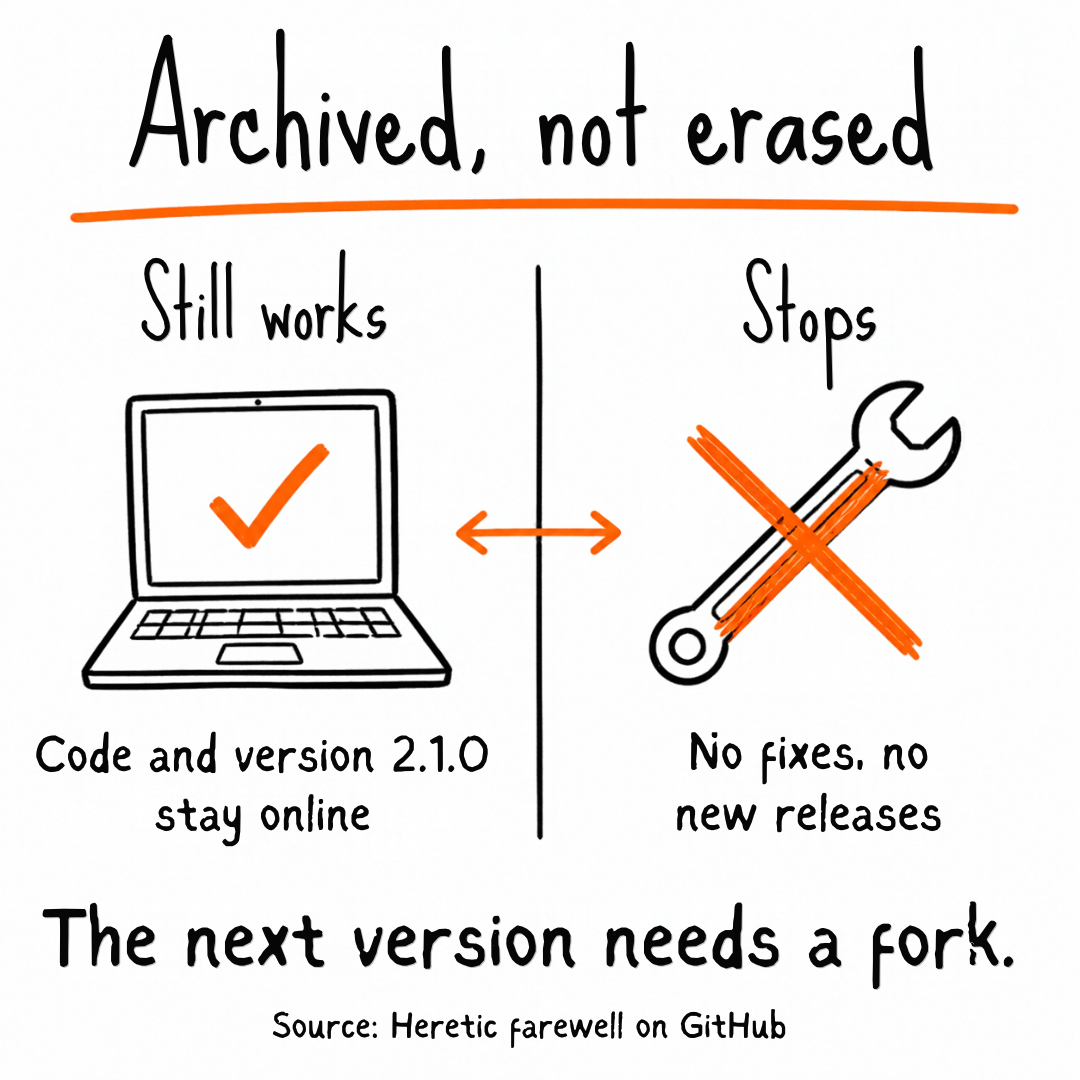
Anyone who wants a next version has to fork it, and the AGPL-3.0-or-later licence allows that. Weidmann told contributors to organise themselves on Discord, Matrix or elsewhere rather than point them anywhere. The README also describes “Heretic Grimoire”, small reproducibility manifests (about 9 KB each) that record how a model was made, and a heretic-org group on Hugging Face. A Codeberg mirror is labelled official and read-only.
The version 2.0 release on 1 November also changed the configuration format and removed research features. Weidmann named Lophius, a separate research workbench of his at lophius.org, as the intended home for those.
How much of the uncensored scene it carried
A 10a Labs paper counted 3,471 original uncensored models on Hugging Face between January 2024 and March 2026. In October 2025 there were no Heretic models in that count. By November there were 132, which was 55.5% of the month’s new originals, and Heretic accounted for 54% of new originals in the first quarter of 2026.
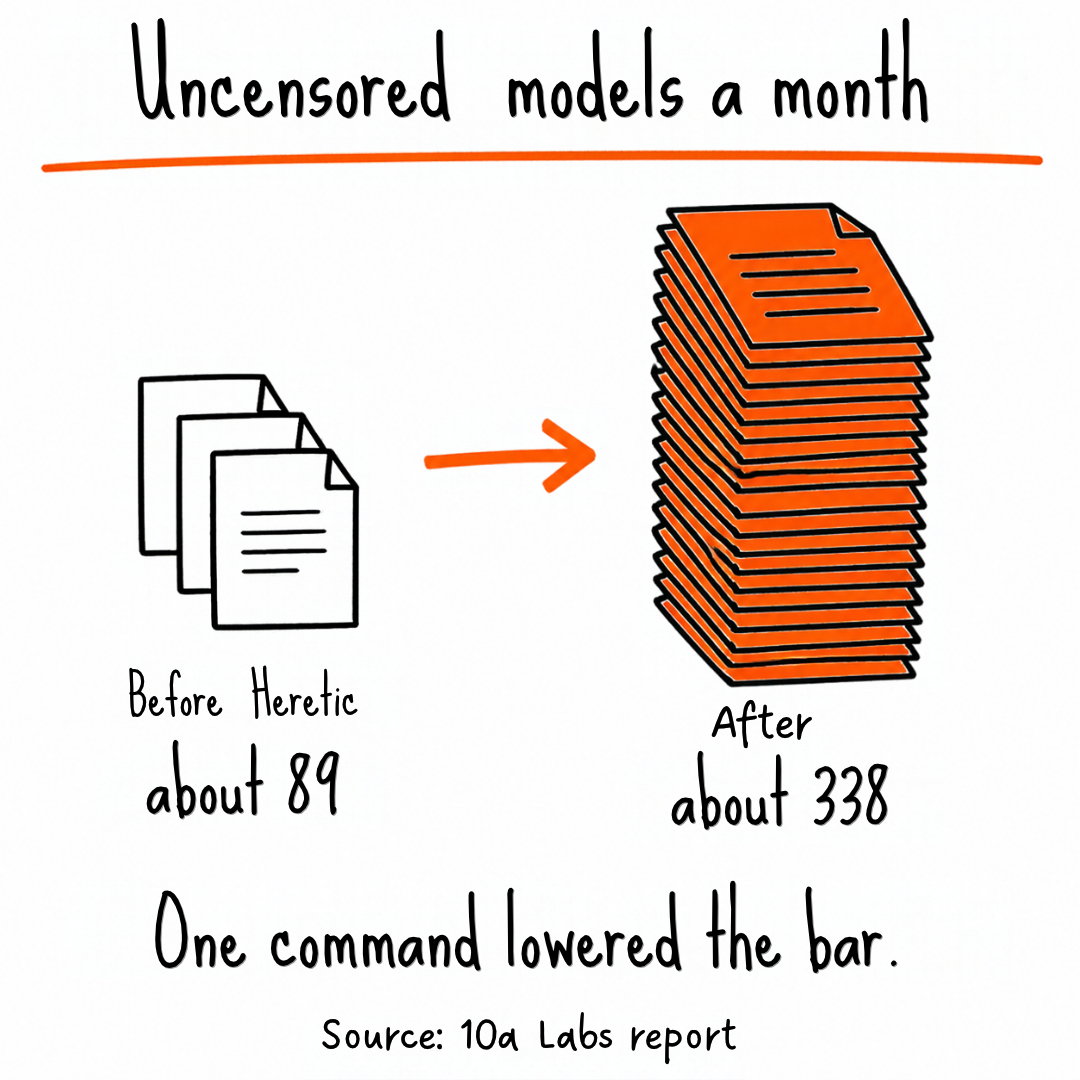
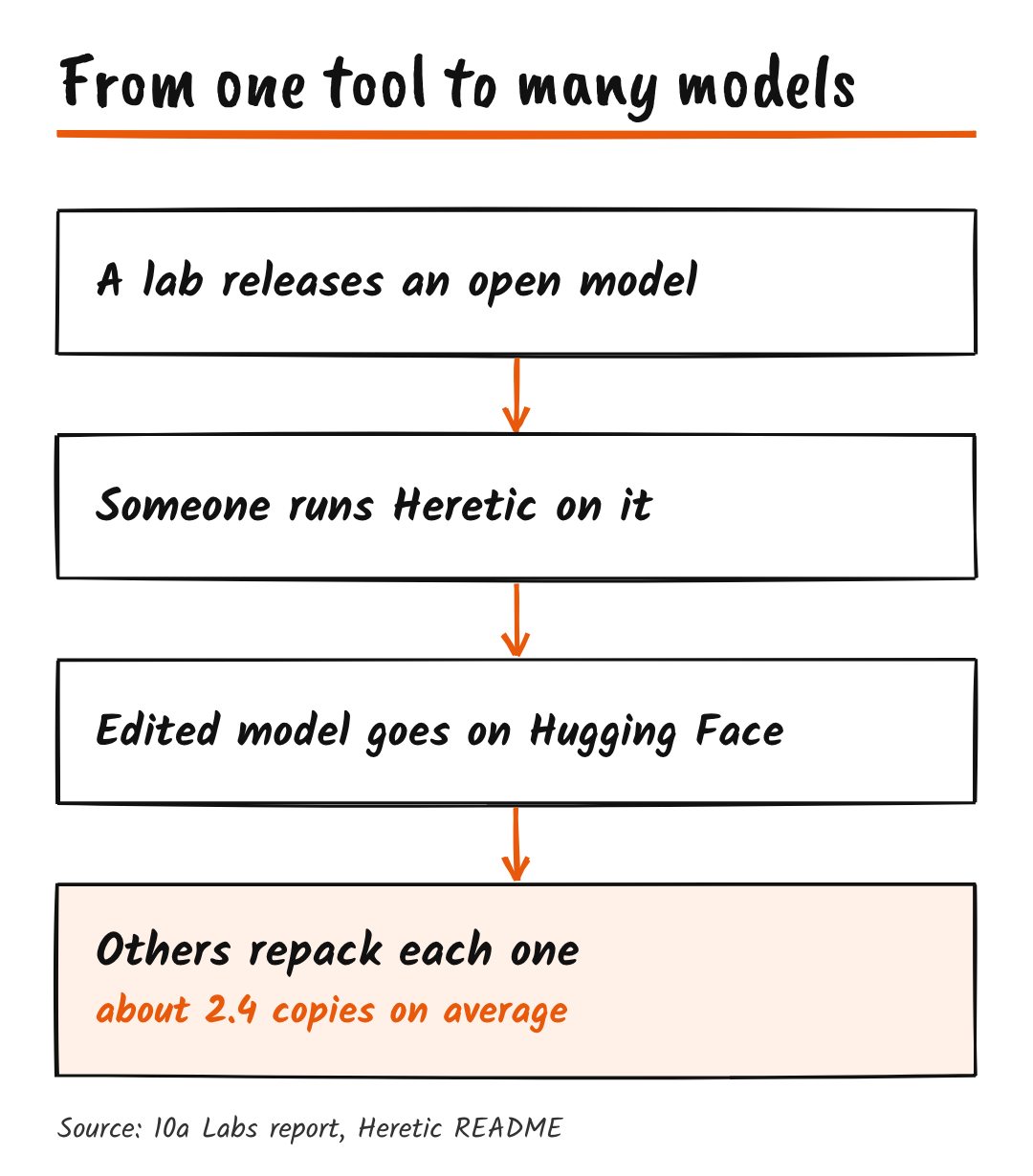
The pace of new uncensored models went from about 89 a month to about 338 a month, and the number of people producing them grew from about 640 to over 1,055. Each original is repackaged on average 2.4 times, and three redistributors account for 52% of those copies. The paper also notes that growth in GitHub applications of this kind began in mid-2025, before the Heretic surge.
Why researchers and policy groups watch it
Tech Against Terrorism, which tracks extremist use of AI, runs a CT-AI benchmark. Its July 2026 pilot found two abliterated open models complied with 89% and 100% of requests. A later report, as covered by WIRED, found abliterated versions of new open-weight releases now appear in under three days on average, against more than 24 days in 2024.
There are limits to that picture. Adam Hadley, writing in a West Point Combating Terrorism Center commentary, notes that abliteration is not a clean excision and degrades model performance. Hugging Face has objected to treating “abliterated” as a synonym for harmful. Weidmann frames it differently. His farewell says “AI will be the lens through which you see the world, not just a tool for getting things done,” and calls the fight to shape that lens yourself “nothing less than the fight for the humanity in you.”
The wider field
Heretic wasn’t the first tool of its kind, and its README credits earlier ones: AutoAbliteration, FailSpy’s abliterator.py, wassname’s Abliterator, ErisForge, remove-refusals-with-transformers and deccp. Heretic’s approach differs in that an optimizer searches for the settings rather than leaving that to the user.
The README also says Weidmann wrote all of his commits by hand until November 2026, and that independent comparisons favour Heretic. Both are his claims, and we haven’t checked them independently.
Timeline
The tool is finished, the code is public, and the models it made are out there. The open question is whether a fork picks up the work, and nobody has said they will.