Bland has unveiled Tofu-1, a speech-to-speech model for phone calls that listens while it speaks. Bland says 92 percent of people in its internal listening tests couldn’t tell the voice was AI, and access is limited to a research preview that teams request on Bland’s page.
Isaiah Granet, Bland’s co-founder and CEO, announced it on X on 13 November. He said the highest-stakes calls “rarely happen in good conditions: from moving cars and hospital rooms, over weak signal, with several people talking at once.” Bland’s own post adds that every sound in its launch video, the caller, the agent and the background, was generated by Tofu-1.
What Tofu-1 does differently
Bland says most voice systems turn speech into text, pass the text to a language model and turn the reply back into speech. Each step drops part of the call, it says: who was speaking, who they were speaking to, whether they hesitated and whether they’d finished. Tofu-1 works from the audio itself.
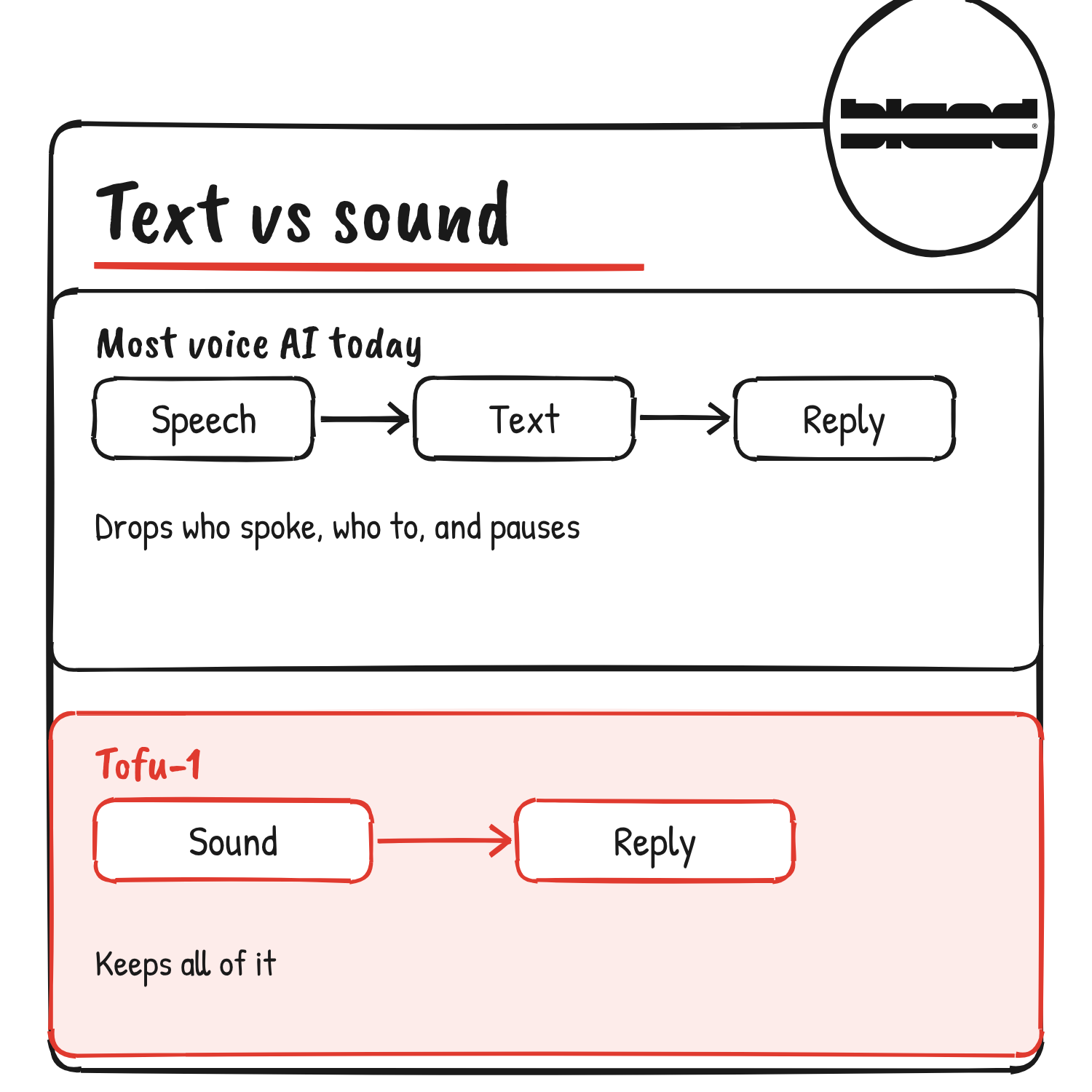
Bland groups the model’s abilities into four:
- Understands audio. It tells speakers apart, recognises who a phrase is meant for, and separates speech from a crying child, a television, traffic, hold music and keypad tones. Bland says it also hears hesitation, frustration and urgency.
- Generates whole scenes. It produces several speakers, overlapping voices and the room around them.
- Listens while it speaks. Callers can interrupt or correct it mid-sentence. Bland says a short “right” means keep going, while “No, that’s not right” means stop, and the model has to tell them apart mid-sentence.
- Thinks while it talks. Conversation and reasoning run side by side, so the call keeps moving during a lookup. If a caller corrects a date mid-lookup, the answer has to use the new date, and Bland says Tofu-1 doesn’t say something is done until it is.
The TV test
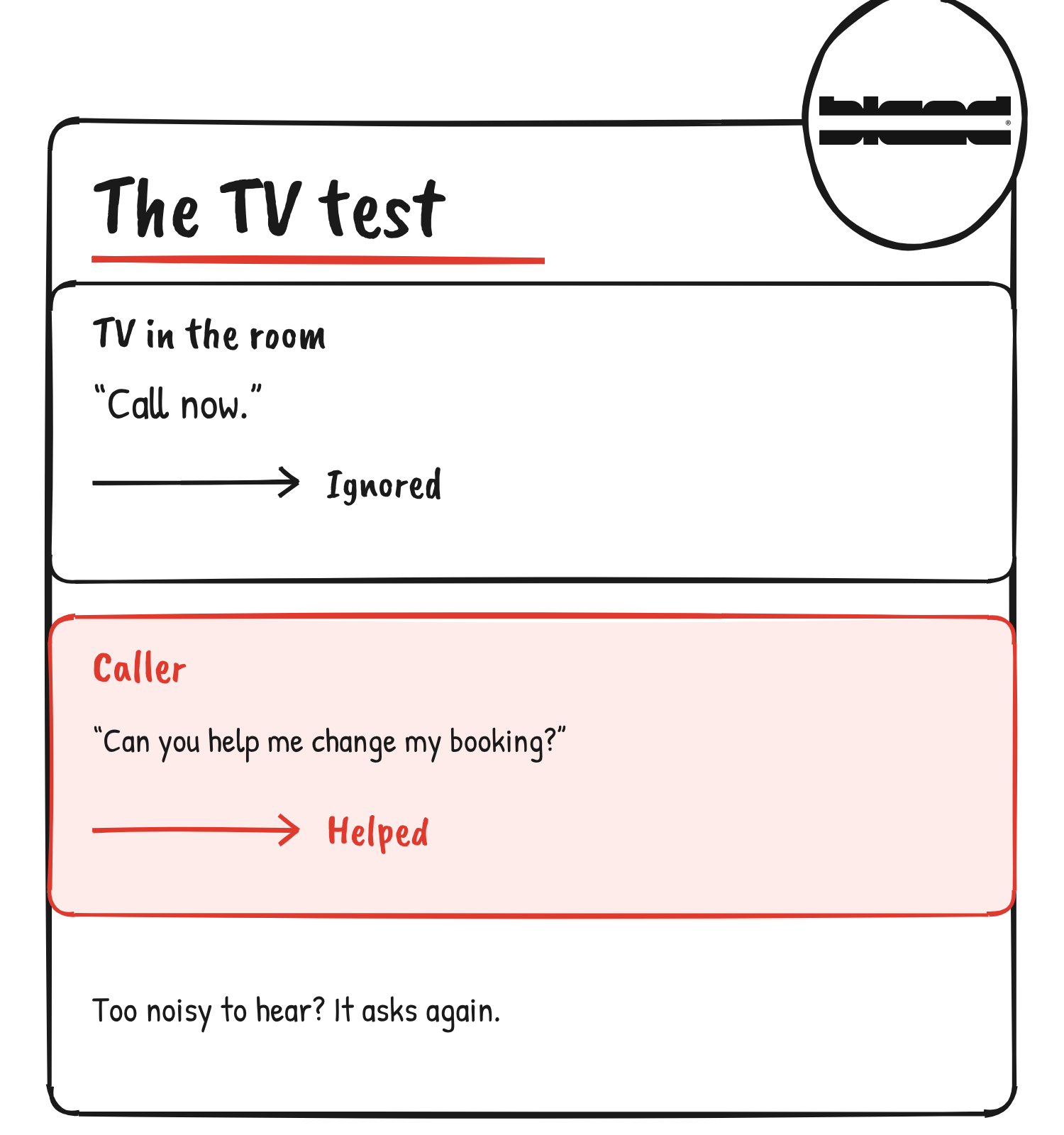
Bland calls its hardest case the TV Test: can the model follow the caller while ignoring speech that belongs to a different scene? Noise removal doesn’t solve it, Bland says, because a television isn’t noise. It’s clear speech from the wrong source, and it’s often louder than the caller. If the background makes the caller impossible to understand, Bland says Tofu-1 should say so and ask them to repeat themselves or move somewhere quieter, not guess.
How Bland tests it
Bland says it turns phone workflows into practice environments, each with the instructions an agent must follow, the systems it would use and the records those systems keep. Every task is proven solvable before it counts. A run passes only if the records match the correct outcome, the model followed policy, and a failure Bland has seen before didn’t return.
Bland lists five failures that disqualify a model: saying a task succeeded when the system failed or was never asked, committing a wrong ID, email, spelling or number, acting before a required verification step, speaking its internal reasoning aloud, and inventing an ability it doesn’t have. It says it reports results separately for hearing, timing, accuracy and completion. The page publishes no scores for Tofu-1; its scoring tables are labelled illustrative.
The first version supports English and Spanish over standard phone lines. The page carries three audio samples, including a 90-second clip with Tofu-1 as one speaker and Bland’s current model as the other. Tofu-1 follows Bland Speech v3, the text-to-speech model Bland released on 4 August.
The 92 percent figure
Bland’s security section opens with the number: “In our internal listening tests, 92 percent of people could not tell that Tofu-1’s voice was AI.” Bland says that’s the result it set out to get, and the reason the section exists. It doesn’t say how many people took part or how the tests were run.
Bland lists five risks it says a human-sounding voice makes worse: impersonation, a synthetic voice passing a voiceprint check at a bank or support line, scam calls that respond in real time, fabricated recordings of conversations that never happened, and people not realising they’re speaking with an AI. “We do not think a voice alone should settle any of these anymore, whether or not Tofu-1 is ever involved,” the page says.
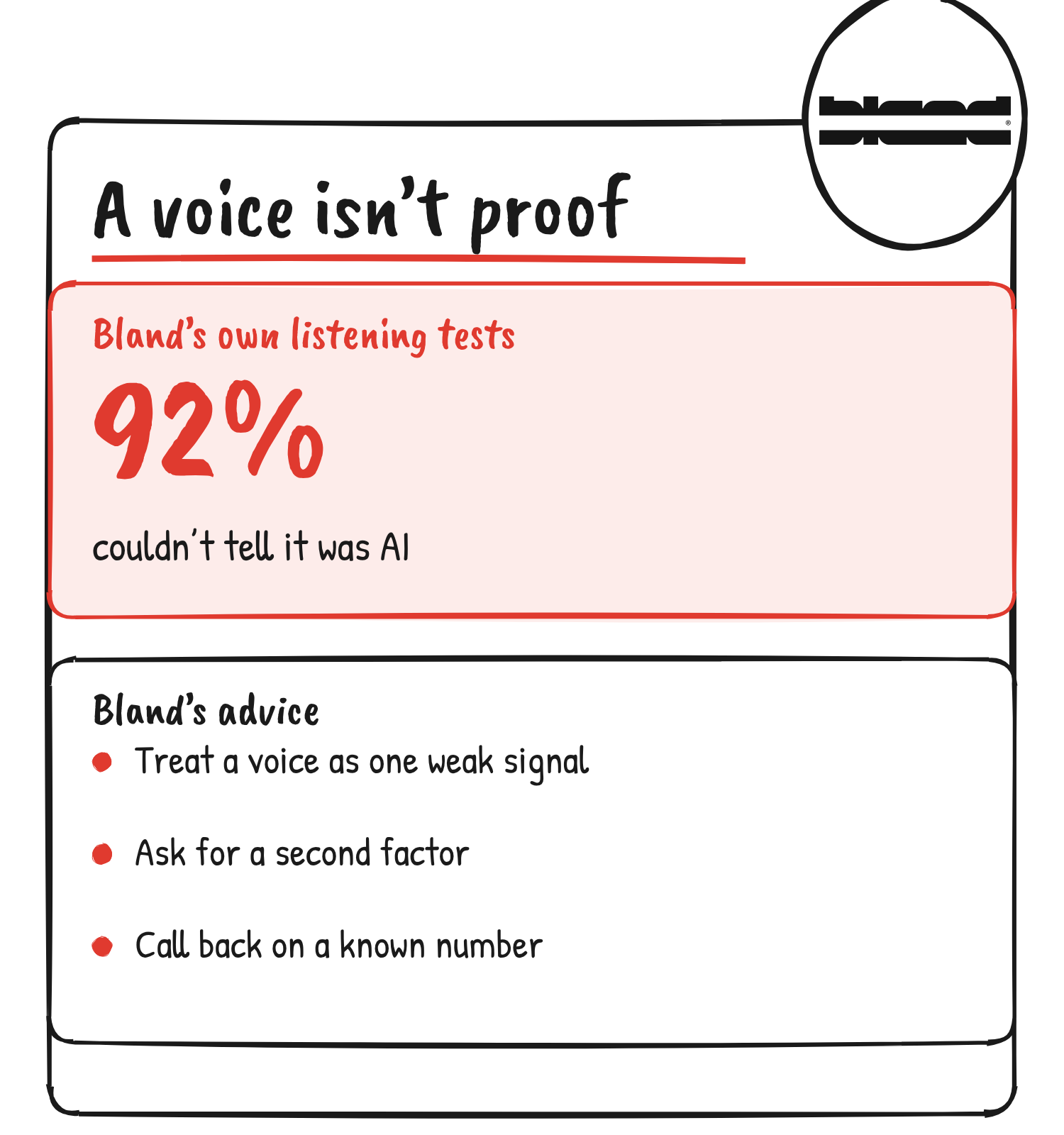
For organisations, Bland recommends treating a voice match as one weak signal, requiring a second factor for high-risk actions such as a code sent to a device already on file, confirming unexpected requests by calling back on a number you already have, making an internal check for payment and access requests routine, and telling staff and customers that a familiar voice isn’t proof.
Who can use it
Bland says the research preview is open to a limited number of teams with real phone workflows. It reviews each request against the use it describes and emails applicants as access becomes available. Three uses are off limits: impersonating a real person without their consent, getting around identity checks, and misleading people about whether they’re speaking with an AI.
Bland is keeping the specifics of its safeguards private, and says it’s developing disclosure and detection alongside the model, with the aim of making Tofu-1 speech identifiable as AI. It hasn’t announced pricing or a general release date. Requests go through the form on Bland’s Tofu-1 page.
Discover more from Sulat AI & Tech News
Subscribe to get the latest posts sent to your email.