
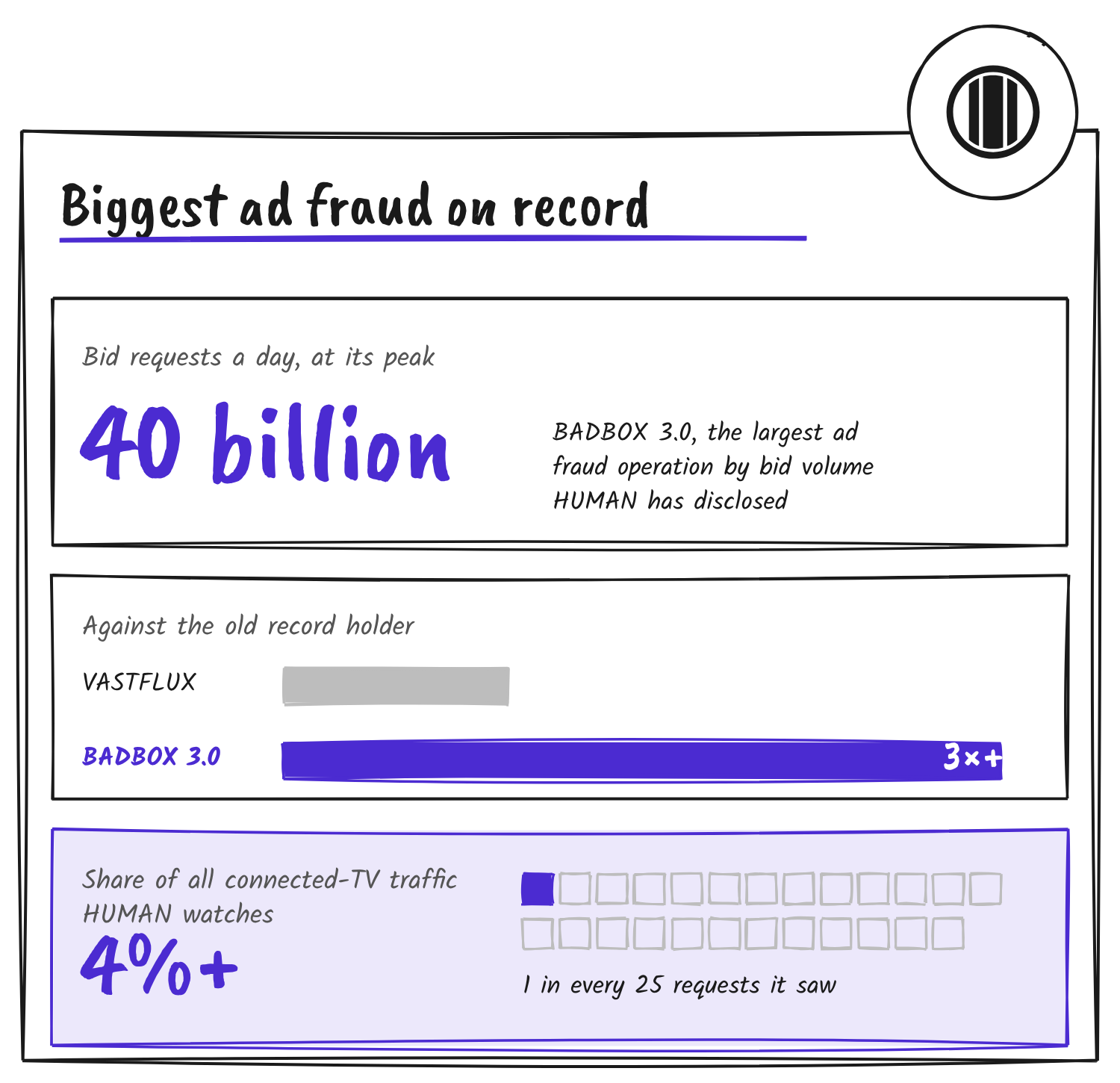
HUMAN Security says BADBOX 3.0, a botnet hidden inside cheap Android TV boxes, sent about 40 billion ad bid requests a day at its peak. HUMAN’s Satori threat research team published its findings on 18 November 2026, calls the operation the largest ad fraud scheme by bid volume ever publicly disclosed, and says it has disrupted it.
That peak was more than three times the previous record holder, VASTFLUX, and bigger than the last five years of Satori’s published investigations combined. At its height, BADBOX 3.0 made up more than 4% of all connected TV traffic that HUMAN’s platform observed. A bid request is an invitation for advertisers to bid on a chance to show an ad, so the figure counts requests, not ads watched or money paid. The report doesn’t give a total for infected devices.
What the boxes did
The affected hardware is low-cost, off-brand streaming boxes built in mainland China and sold internationally. They run the Android Open Source Project rather than Android TV OS, and they aren’t Google Play Protect certified.
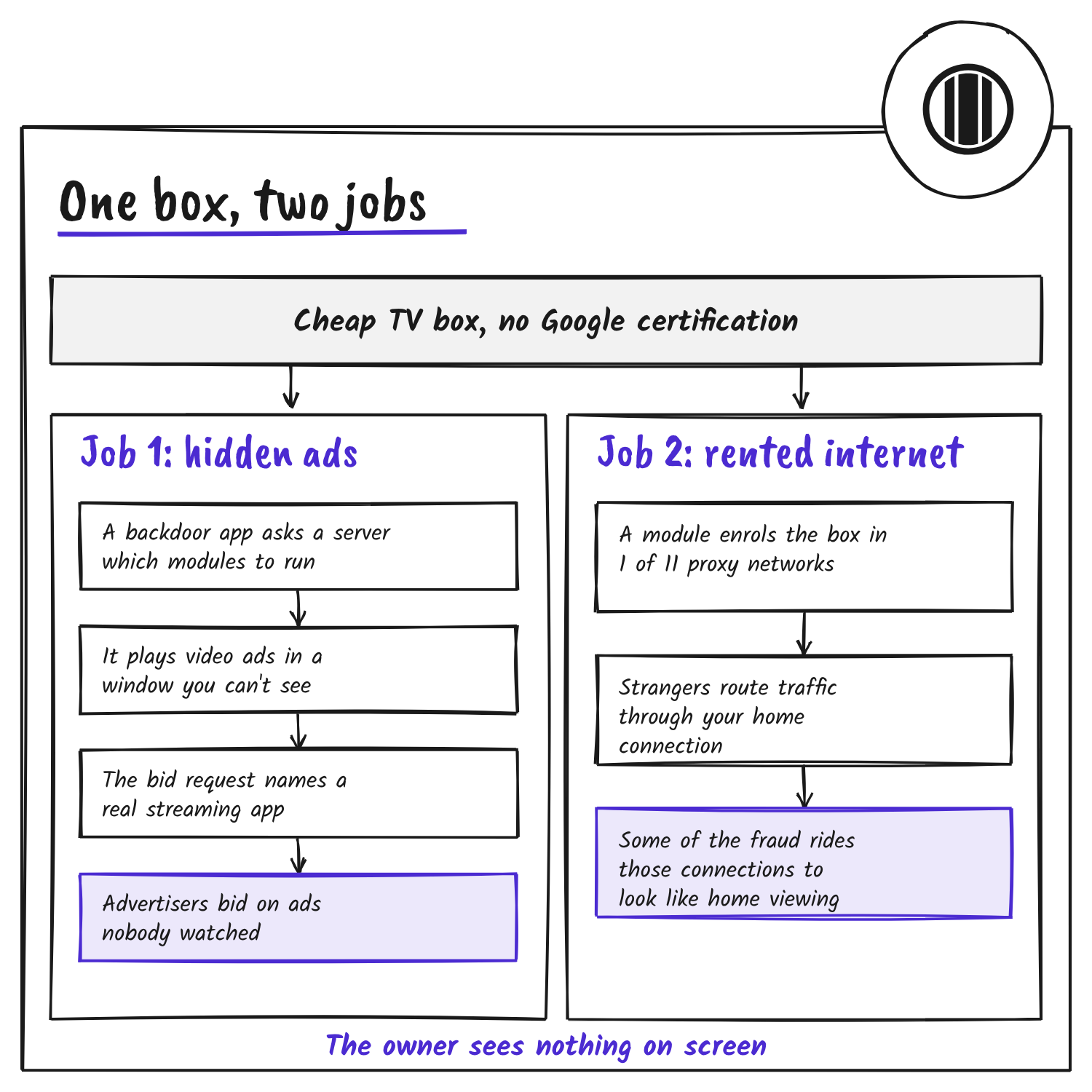
HUMAN traced the operation to a backdoor packaged as a system app. It has two hardcoded endpoints: one returns a list of modules to load, and the other handles logging. Following the first led to public code repositories holding a catalogue of fraud modules, some of which HUMAN recognised from BADBOX and BADBOX 2.0.
The ad fraud modules load real video ad kits and play the ads in a hidden window, so the screen looks normal to the owner. The bid requests then carry the name of a well-known streaming app. HUMAN says those apps never run on the infected boxes, and most of the boxes probably don’t have them installed. The malware contacts the same ad servers the real apps use and gets similar ads back, so buyers downstream see what looks like an ad slot inside a premium app on a home connection.
Some of the fraud needed no device at all. HUMAN also saw spoofed server-side ad insertion requests, which claim a server stitched an ad into a viewer’s stream when no such device exists and no ad was ever loaded.
The second job: renting out home internet
The same modules enrol each box in one of 11 residential proxy networks without its owner’s knowledge or consent. A residential proxy sells access to a home IP address. The owner pays for the bandwidth and someone else sells the connection.
Ten of the networks are commercial services: Pawns, Earn, Packet, GaGa Node, HoneyGain, Repocket, Bright, Cashraven, MystNodes and Infatica. HUMAN’s report doesn’t say whether those services knew where the devices came from. The eleventh, PXYEDGE, is run by the threat actors themselves.
HUMAN assesses that PXYEDGE is IpMoYu under a new name. IpMoYu is the proxy network exposed in the BADBOX 2.0 research, and the two share infrastructure, the same proxy module lineage and the same task servers. The pxyedge[.]com domain was registered on 15 March 2026 with no advertising and reports about 200,000 nodes. HUMAN measured unique connections peaking at about 340,000. Researchers at Nokia reached similar conclusions on their own.
The two jobs feed each other. For one impersonated app, about 40% of requests overall and 80% of US requests came from addresses flagged as residential proxy exits, which makes the fraud read as ordinary home viewing.
Where the code came from
The older of the two code repositories was created in late November 2023, within weeks of the original BADBOX disclosure. It got its last update in January 2026, the same day the second one was created. The module manifest’s version counter reached the mid-500s by early 2026, and the module class names imitate Android system packages with a com.google.system.* pattern. HUMAN says antivirus coverage of the newer modules was effectively absent when it analysed them.
Delivery is built to survive takedowns. Each module has backup download locations on other hosting platforms, some are mirrored on a free open-source CDN, and the operators run their own GitHub proxy on Cloudflare Workers to get around network blocks. One month of CDN statistics for a single repository’s mirror showed 367,023 requests and about 482.7 GB served. HUMAN says that covers one repository and one backup route, so real infections sit well above it.
HUMAN links the catalogue to TXCZ, a Chinese electronics manufacturer, through several independent connections. The command server’s URL structure matches a TXCZ-branded website, and a TXCZ domain hosts payloads and serves the hidden-ad settings. A launcher app named com.shzhtxcz.txbox comes preinstalled with system permissions on TXCZ boxes, modules check for TXCZ-specific device properties before they run, and one repository sits under an account name that includes TXCZ. In a repository’s deleted files, HUMAN also found a list of active TXCZ devices by model and firmware version.
| Chapter | Year | Scale HUMAN reports |
|---|---|---|
| BADBOX | 2023 | More than 74,000 infected devices observed |
| BADBOX 2.0 | 2025 | More than 10 million devices across 222 countries and territories |
| BADBOX 3.0 | 2026 | About 40 billion bid requests a day at peak, no device total given |
What’s been disrupted, and what hasn’t
On 2 November, Google led a takedown of XCPE, a separate backdoor that Google says Chinese manufacturer Videostrong built into more than 1.3 million streaming boxes, BleepingComputer reported. Google also took down command servers used by more than a dozen related malware families, cutting off at least 10 million more compromised devices, and revoked Videostrong’s licence to make Android TV devices with Google apps. HUMAN took part, and says the XCPE takedown included command domains that ran parts of BADBOX 3.0.
On top of that, one BADBOX 3.0 malware repository has been taken down, and HUMAN says its systems now filter the fraudulent ad traffic. The boxes themselves are still in homes. HUMAN says the supply chain of low-cost uncertified devices is intact, and that the operators will adapt.
Adaptation should be expected, because adaptation has followed every prior disclosure in this family.
HUMAN Satori report
Play Protect certified Android devices undergo rigorous security testing to keep users safe and we encourage users to ensure that their device is certified and built with Android TV OS.
Shailesh Saini, Director of Android Security & Privacy Engineering & Assurance, Google, in HUMAN’s press release
What box owners can do
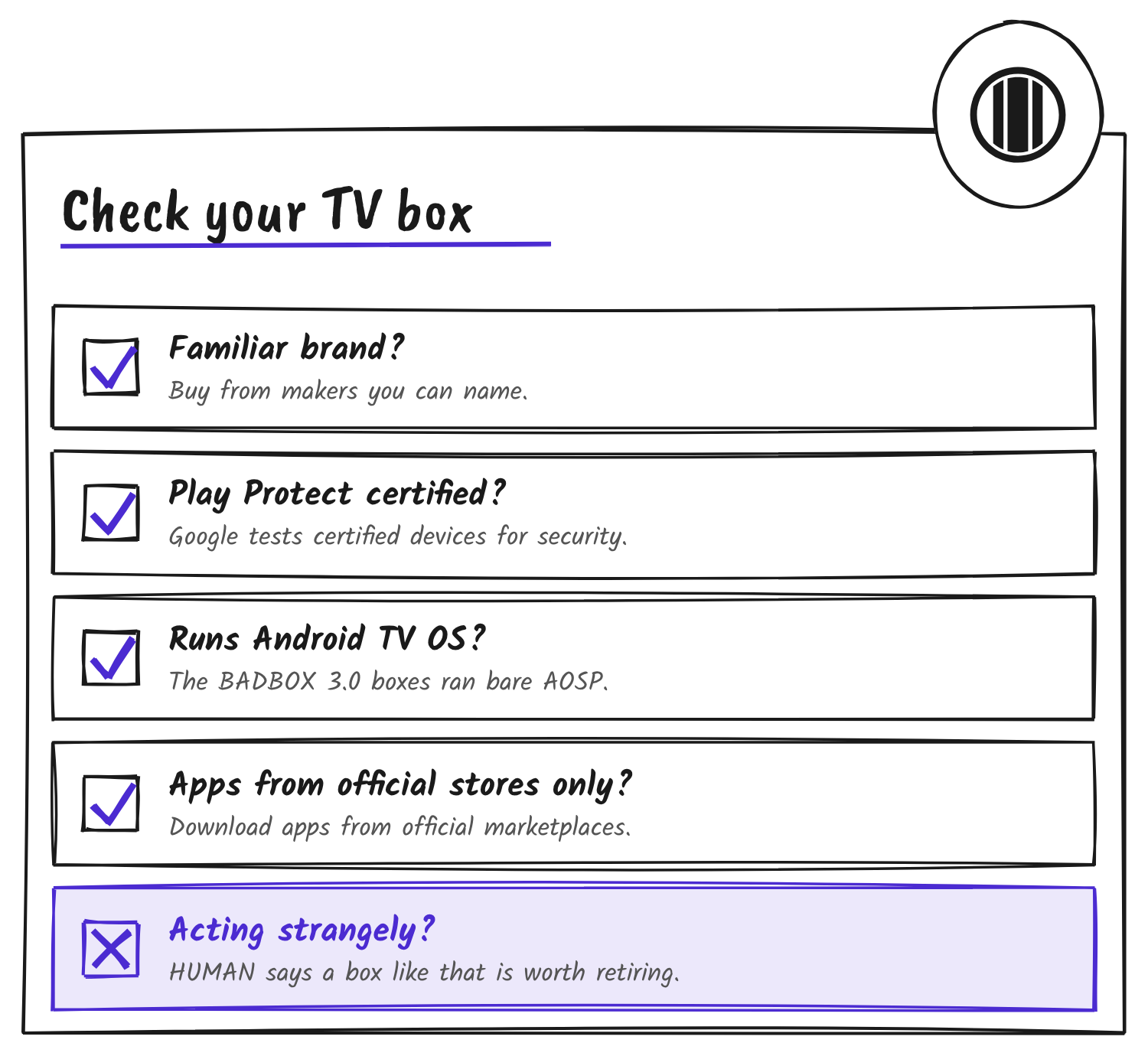
HUMAN’s advice is the same as for earlier BADBOX chapters. Choose devices from familiar brands, check that the device is Play Protect certified, download apps only from official marketplaces, and treat a device that behaves strangely as worth retiring.
Cleaning an infected box is harder. For XCPE, Google says the malware reinstalls itself from the /oem/ partition if it’s removed, so the fix is clean firmware or taking the box off the internet. HUMAN’s report doesn’t give removal steps for BADBOX 3.0 boxes.
What ad buyers and network teams can check
HUMAN lists four tells in the bid traffic. A handful of cheap uncertified device models sent nearly all their requests to one family of apps. A high share of the addresses were residential proxy exits. Requests claiming to come from different apps shared the same IP addresses. And volume surged at nearly the same hour every day, with nearly all traffic under one app’s name reporting a browser identifier from an internal test build. The apps actually sending the requests also don’t appear in the impersonated apps’ sellers.json or app-ads.txt files.
Network teams can search DNS logs for these defanged indicators from HUMAN’s report. Its full list adds more IP addresses.
api.drgdj[.]top
file.drgdj[.]top
gh.drgdj[.]top
api.shzhtxcz[.]com
pxyedge[.]com
Sources: HUMAN’s Satori report and press release, and BleepingComputer’s reports on BADBOX 3.0 and the XCPE takedown.
Discover more from Sulat AI & Tech News
Subscribe to get the latest posts sent to your email.