
Kalshi posted on 21 November, US time, that the Cloudflare CEO “warns the world could face two years of widespread tech outages as AI accelerates cybersecurity threats”. The post has no link. The quote behind it is Matthew Prince telling Reuters on 22 October that he expects “a couple years where every single week it’s going to feel like the sky is falling”. He was talking about a flood of software vulnerabilities. Reuters attributes its forecast of more disruption to seven cybersecurity professionals, and Prince’s own quotes in that story are about the flaws and how the clean-up ends.
Prince has said “two years” three times since, to Reuters, Nikkei Asia and WIRED. Here’s what he said each time, what he’s basing it on, and what the outage record shows. The WIRED and Nikkei pieces are paywalled, so I’ve used the passages those outlets publish, and I read the Reuters story in full.
- What Kalshi posted
- What Prince said, and when
- What he’s basing it on
- What has landed since
- What the outage record shows
- The experts who disagree
- What Cloudflare sells
- Sources
What Kalshi posted
The post is 30 days behind Prince’s Reuters interview. Crypto Briefing ran the same story the same day under the headline “Cloudflare CEO warns AI could fuel two years of tech outages”, and it dates the interview to around 23 October. Its line that the November outages at Microsoft and United “were linked to rushed patching of vulnerabilities uncovered by AI” goes further than the record, which I come to below.
30 days
from Prince’s Reuters interview to Kalshi’s post
2 years
the horizon in all three of his interviews
1 million
attempted attacks a minute on Cloudflare’s network, per Nikkei Asia
17
PHP security advisories published on 19 November
What Prince said, and when
Prince spoke to Reuters on Thursday 22 October, a day after the PHP flaws forced government websites in Europe offline. Reuters’ Raphael Satter and AJ Vicens wrote that he knew of “a bunch of additional severe vulnerabilities that are present in other pieces of critical software” and predicted busy months ahead. He said he’d seen anecdotal evidence of compromises linked to the PHP bug. He also told Reuters the deluge of AI-driven discoveries would be a net positive in the end, and compared it to slaying the monsters in a haunted house.
The reality is, we’re going to get a lot of this stuff cleaned up.
Matthew Prince, to Reuters, 22 October
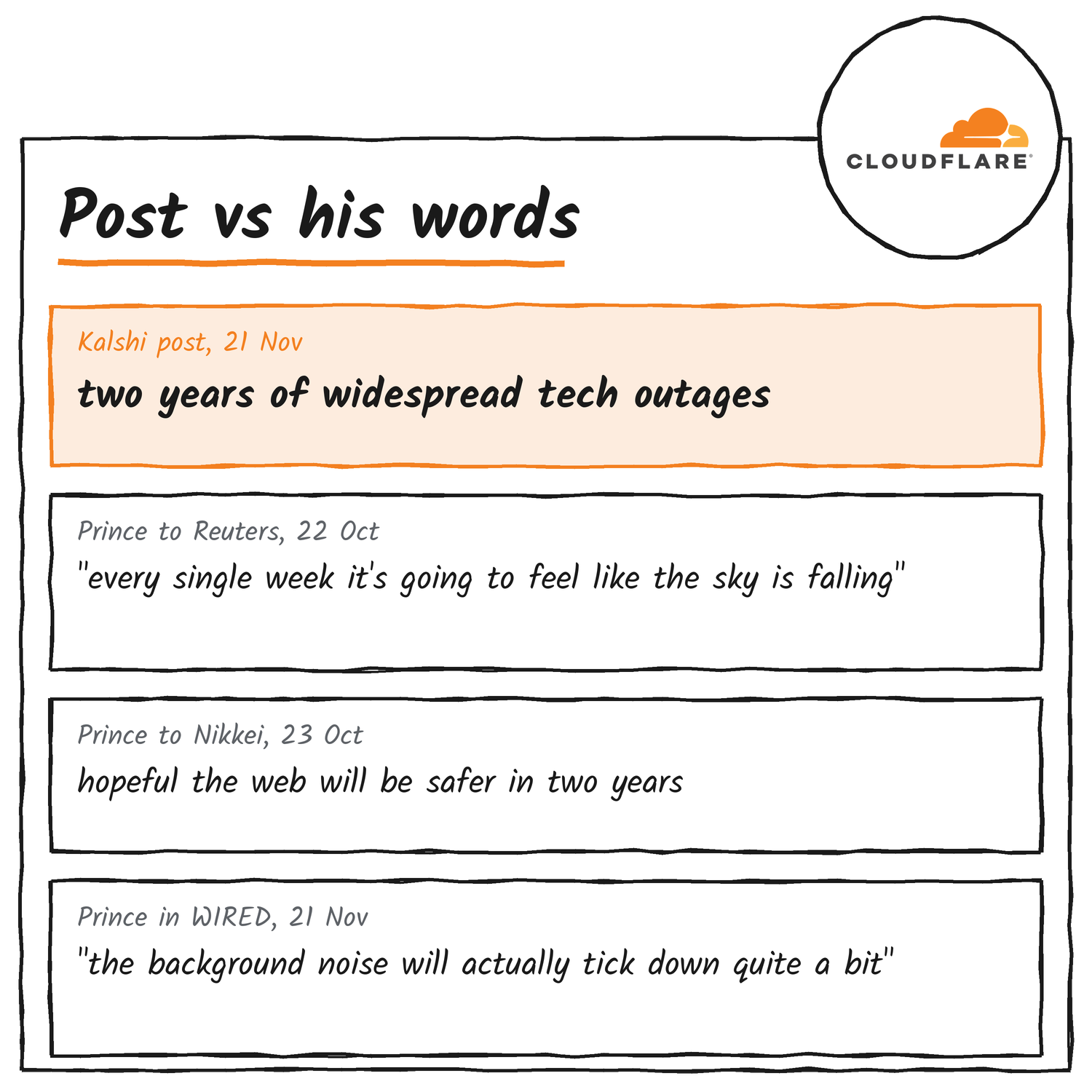
He told Nikkei Asia the next day that internet vulnerabilities on the same scale as the PHP flaws will emerge, and that he was nevertheless hopeful the web will be safer in two years. Nikkei’s photo caption says he’s detecting 1 million attempted attacks every minute across Cloudflare’s network.
WIRED’s 21 November piece, “The Outages Are Just Getting Started”, quotes him saying “it’s going to feel like the sky is falling for two years”. It adds that he expects AI to help defenders get on top of common vulnerabilities, so that “these new threats and new security vulnerabilities won’t happen as often, and the background noise will actually tick down quite a bit”. The outage framing is WIRED’s, and I took that piece apart in my report on its patching thesis.
| Outlet | When | Prince’s words | What the passage covers |
|---|---|---|---|
| Reuters | Interview 22 Oct, published 23 Oct | “a couple years where every single week it’s going to feel like the sky is falling” | New flaws surfacing weekly, and a net positive once cleaned up |
| Nikkei Asia | Interview 23 Oct, published 25 Oct JST | Hopeful the web will be safer in two years (Nikkei’s paraphrase) | More PHP-scale flaws will emerge |
| WIRED | 21 Nov | “it’s going to feel like the sky is falling for two years” | Defenders get on top of common flaws and the noise falls |
What he’s basing it on
Cloudflare sees a large slice of web traffic, and Prince used it. Late on 21 October, US time, he posted figures on the PHP2Shell flaws: thousands of exploit attempts in the 10 hours before the public announcement, tens of thousands in the 45 minutes after it, hundreds of thousands within two hours, and millions by the time he posted. Reuters carried the same figures. The Register reports that Amazon spotted attackers going after the flaws on 17 October, four days before disclosure. Cloudflare switched its firewall rules on for every customer, free plans included, about nine hours before the flaws were public, The Next Web reports.
On 24 October he quote-posted a note from OpenAI president Greg Brockman about a remote code execution flaw, found in a widely deployed compression library and then in coordinated disclosure. Prince wrote that it was “maybe as bad or worse than the PHP ones” and told readers to “get used to lots of patching”.
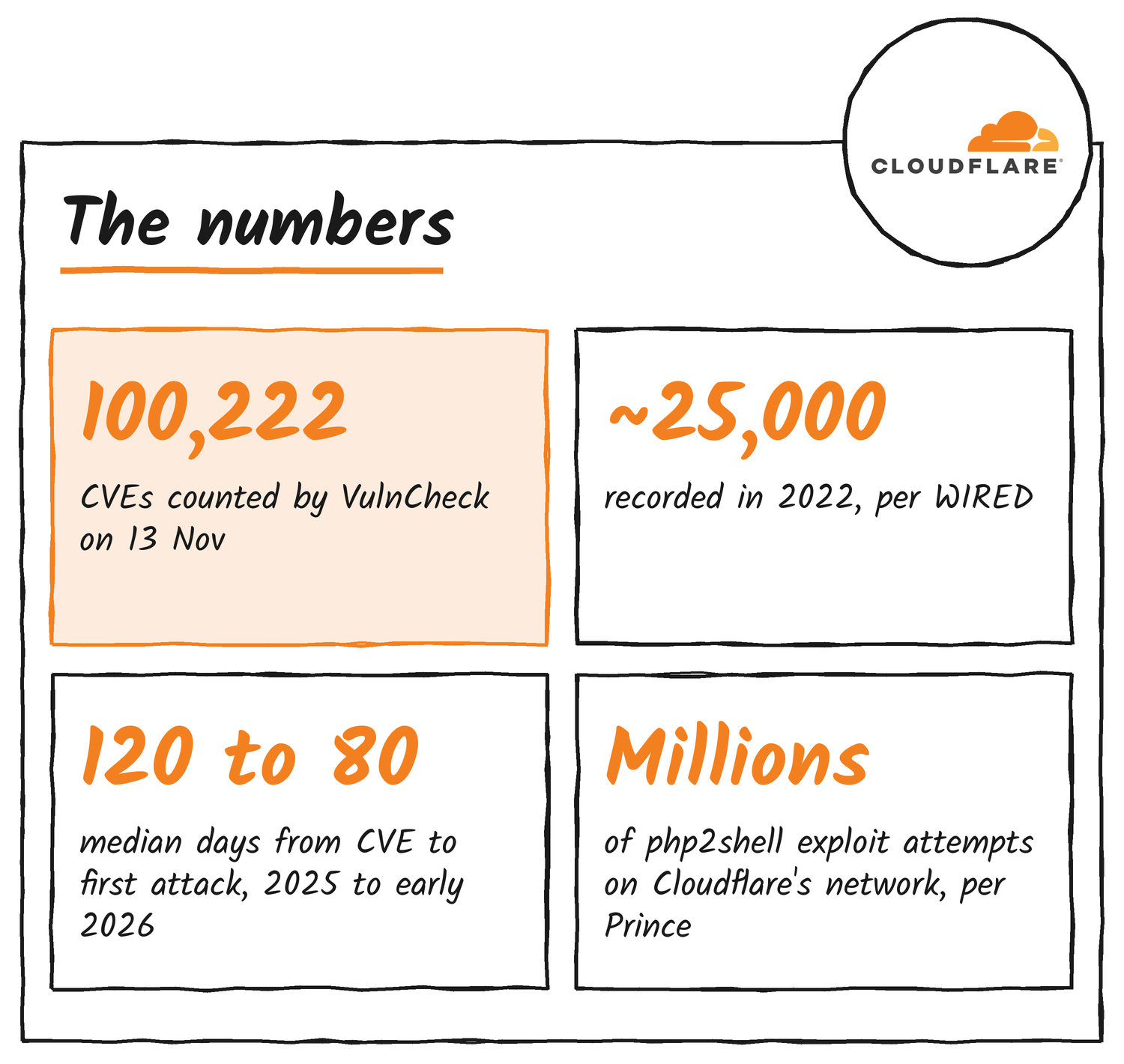
The wider numbers back the direction. The Register reported that VulnCheck counted 100,222 CVEs by 13 November, and WIRED puts 2022 at about 25,000. The Register also cites VulnCheck data showing the median time from a CVE’s publication to its exploitation fell from 120 days in 2025 to 80 days in the first half of 2026. I set out the numbers in more detail in the patching report.
What has landed since
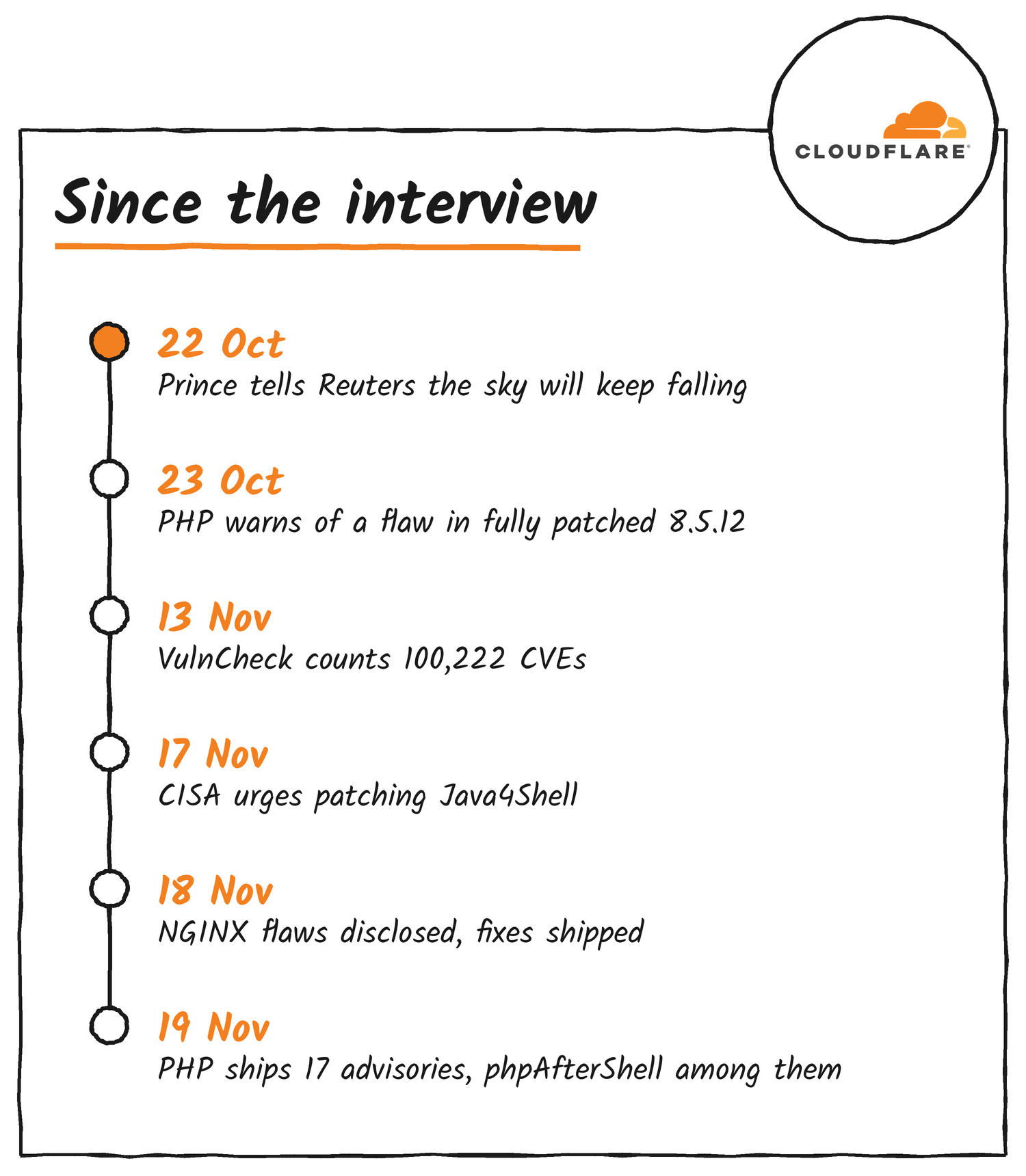
On 23 October PHP published an advisory for CVE-2026-115560, a session upload progress flaw that affects fully patched releases including 8.5.12, according to Cloudflare’s PHP2Shell post. On 17 November CISA urged immediate patching of Java4Shell, CVE-2026-114938, a memory-corruption flaw in the HotSpot JVM’s Base64 decoder that allows unauthenticated remote code execution. On 18 November F5 released NGINX 1.31.9 and 1.30.7 for two HTTP/2 flaws, CVE-2026-123633 and CVE-2026-123007. JFrog says several teams found them independently, many with AI-assisted code analysis. On 19 November PHP shipped fixes for 17 advisories, among them phpAfterShell, which depthfirst disclosed.
Prince’s forecast is weekly. The timeline shows the disclosures I verified with dates, and it isn’t a week-by-week count. Cloudflare’s own WAF response to the latest PHP release is in my report on its rules.
What the outage record shows
Reuters’ “more disruption” meant the PHP-style outages. Some operators felt they couldn’t patch before attackers moved, so they took sites offline until they were safe. The November outages at Microsoft, the FAA, Chase, United, the NSA and Apple are a separate record, and the organisations name different causes.
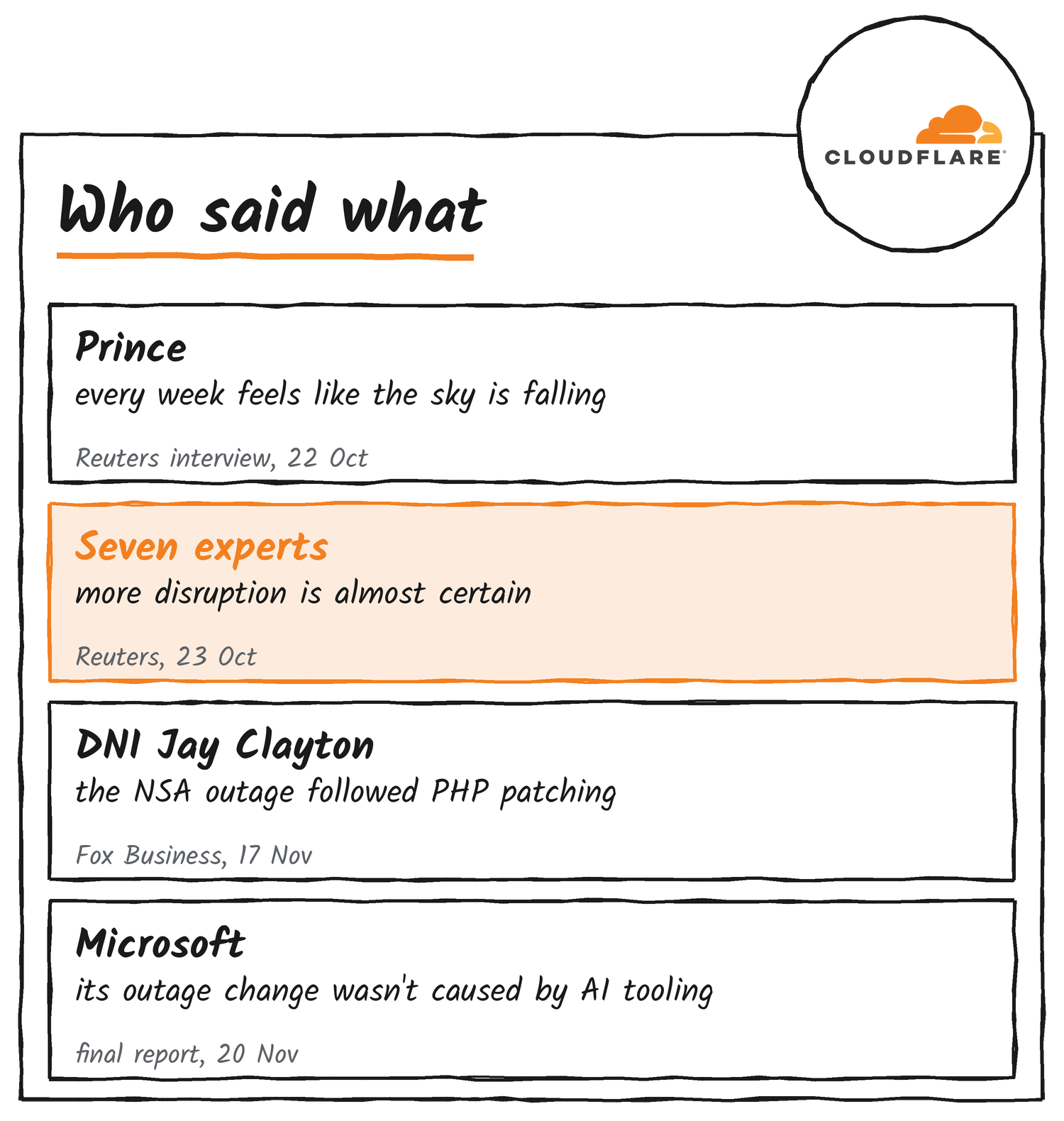
Director of National Intelligence Jay Clayton told Fox Business on 17 November that systems taken down for patching weren’t coming back as expected, and he tied the NSA’s outage to patching after a PHP flaw. Microsoft’s final report on its 12 November outage blames a latent Windows gateway defect from a July change and says the change “was not caused by AI tooling”. Chase says a software bug in on-premise hardware, Apple says an internal update, and the FAA and United haven’t named a cause. That’s why Crypto Briefing’s line that the Microsoft and United outages were linked to rushed AI-driven patching doesn’t match the record.

The experts who disagree
Reuters’ seven professionals agreed that defenders’ timelines are shrinking and split on what follows. Daniel Stenberg, the lead developer of curl, argued that the flaws AI models find tend to be exotic bugs that are hard for criminals to use. Ramy Rahman of ArmorCode said “more disclosed vulnerabilities do not automatically mean more successful attacks.” Esteban Borges, head of research at Hunt.io, said that as of 2 p.m. Eastern on 22 October the criminals he tracked appeared to have failed to build a working tool for the PHP bug.
The number of vulnerabilities has certainly exploded, but the number of vulnerabilities that you need to care about has remained somewhat constant.
Joe Slowik of Dataminr, to WIRED
WIRED relays VulnCheck’s figure that about 1,500 flaws this year, roughly 1.5% of the total, are known to be exploited, against 300 in CISA’s catalogue. Prince’s own account sits on the other side of Borges’s: he told Reuters he’d seen anecdotal evidence of compromises.
How I checked the quote
I read Reuters’ 23 October story in full through a syndicated copy, and matched the quotes in the table to the passages Nikkei Asia and WIRED publish. Kalshi’s post is one sentence with no link, so I couldn’t trace its source. Crypto Briefing’s version was published the same afternoon, US time, and carries the same headline framing.
What Cloudflare sells
Prince runs a company that sells defences against these flaws. Its WAF has blocked the PHP exploits for every customer, free plans included, and on 3 September Cloudflare announced a Vulnerability Discovery and Remediation service in early access through Cloudflare Managed Defense, built on OpenAI’s Daybreak models including GPT-5.6 Cyber. In that release Prince said: “If your security team is manually fighting AI-driven attacks, you’re losing.”
Prince hasn’t given a count or a length for outages. The two years is his estimate of how long weekly disclosures last, and in every interview above he says it ends with fewer of them. Of the November outages, only the NSA’s has been tied to patching by an official, and Clayton is the only official who has done it.
Sources
- Kalshi on X, 21 November
- Reuters, “AI-discovered bugs may soon trigger fresh disruptions, cyber experts say”, 23 October
- Nikkei Asia, “More PHP-scale dangers lurk on the internet, CloudFlare CEO says”, 25 October JST
- WIRED, “The Outages Are Just Getting Started”, 21 November
- Matthew Prince on X, PHP2Shell exploit attempts
- Matthew Prince on X, “Get used to lots of patching”
- Cloudflare, PHP2Shell protections post
- Cloudflare press release, 3 September
- The Register, attacks began before disclosure, 22 October
- The Next Web, Cloudflare sees millions of exploit attempts, 23 October
- CISA alert on Java4Shell, 17 November
- JFrog Security Research on the NGINX flaws, 18 November
- Cloudflare Radar Zero Wire on the 19 November PHP release
- Crypto Briefing, 21 November
Discover more from Sulat AI & Tech News
Subscribe to get the latest posts sent to your email.