
Ladybird, the browser built on an engine written from scratch, is now in alpha. The Ladybird Browser Initiative released version 2026.47.7 for Apple silicon Macs and Linux on 23 November (US time), and Andreas Kling’s announcement says it arrives as a rolling channel that updates itself.
The post is plain about the state of things. Some sites won’t work, the browser will crash, and Ladybird makes no security promises yet. This piece covers what’s in the download, how the engine is built, how it scores against Chrome, Firefox and Safari, who pays for it, where it sits among the other browser engines, and what the release changes for readers, developers and the sites they visit.
- What shipped
- How the engine is built
- How it scores
- Security and the maintainers-only rule
- Who’s behind it
- Who pays for it
- Where it sits among the engines
- What the alpha changes
- What to watch
What shipped
The download page offers a macOS disk image and several routes for Linux. The release manifest lists the files, and the table sets them out.
| Platform | What you get | Notes |
|---|---|---|
| macOS | Disk image, 71.8 MB | Apple silicon only; macOS 14.4 or later |
| Linux, Flatpak | Flatpak bundle, marked recommended | x86-64 and ARM64; works on most distributions |
| Linux, Ubuntu | apt repository | Ubuntu 24.04, 26.04 and 26.10; amd64 and arm64 |
| Linux, Fedora | rpm repository | Fedora 44 and 45; x86-64 and aarch64 |
| Linux, archive | Standalone archive | Doesn’t update automatically |
| Source | Tarball, 54.0 MB | Plus source archives for 11 LGPL libraries, including FFmpeg 9.0.2 and parts of Qt 6.11.3 |
Intel Macs aren’t covered, because the macOS build is arm64 only. Windows isn’t in the alpha either. The project’s FAQ says its continuous-integration system already builds and tests the JavaScript engine on Windows, that its full-time engineers are focused on macOS and Linux, and that Windows support comes at a later stage. Mobile isn’t a current focus.
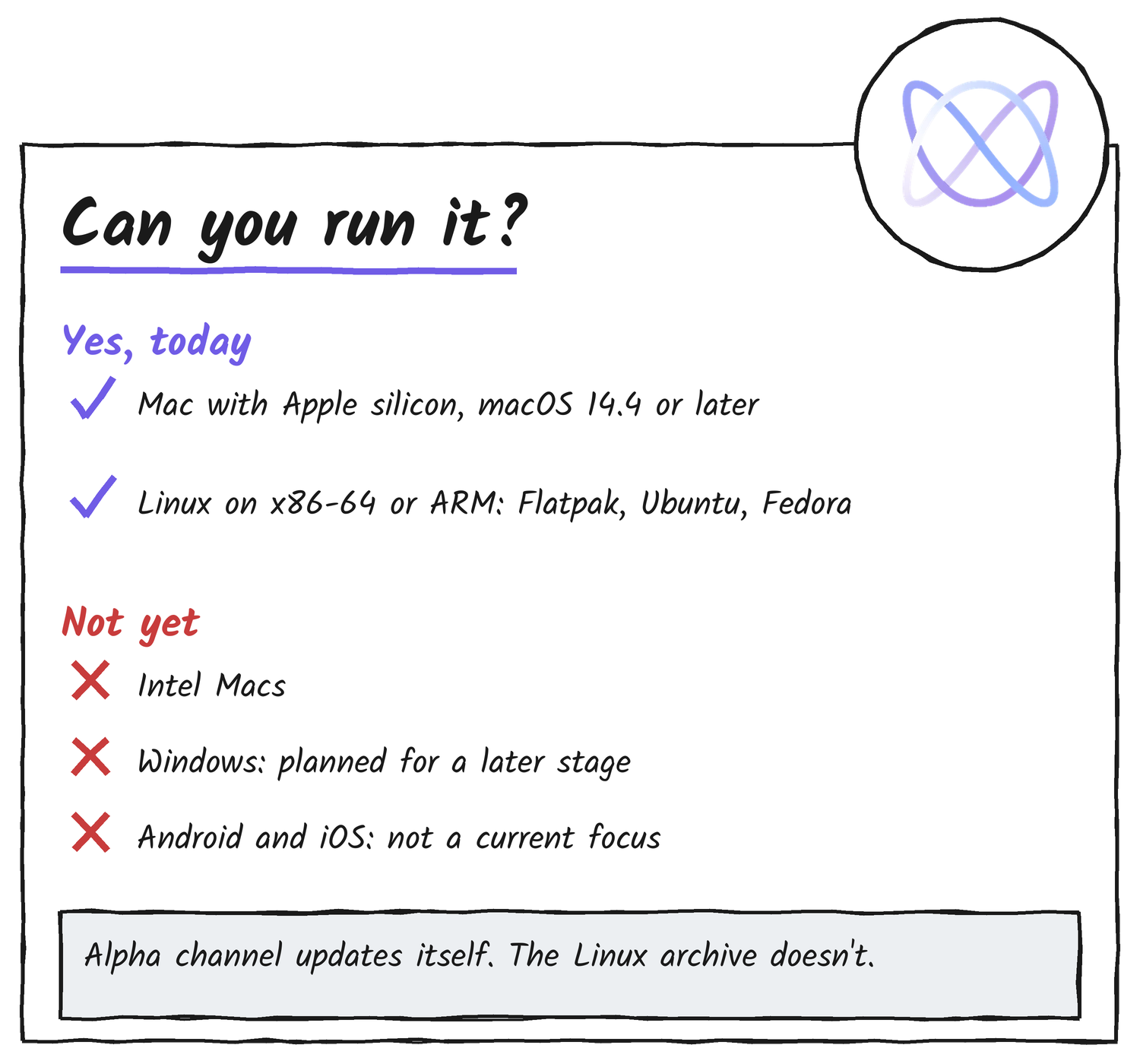
The alpha is a rolling channel. Kling calls the automatic updates “the part I’m most excited about”, because anyone who wanted to try Ladybird until now had to build it from source. The browser has a built-in broken-site reporter and a crash reporter that shows the report before it’s sent. It supports WebDriver for automated testing and the Firefox DevTools protocol, so developers can inspect pages with tools they already use.
Ladybird improves quickly, and until now you had to build it from source to see that.
Andreas Kling, Ladybird’s founder and president, in the alpha announcement
The privacy policy, updated on 14 November, sets out what leaves the machine. Crash reports are optional, carry build, system and stack-trace details, and are kept with the submitting IP address for up to 93 days. A site-compatibility report includes the page URL and a screenshot unless the user removes it, and an accepted report is published on GitHub without the IP address. Update checks send the Ladybird version and platform, and downloads and updates come through Cloudflare. Filter lists such as EasyList and search suggestions contact other services only when the user turns them on.
How the engine is built
Ladybird’s GitHub release notes say HTML, CSS, the DOM, layout, JavaScript and WebAssembly are all implemented from scratch, with no Chromium, WebKit or Gecko code. The FAQ adds that since the fork from SerenityOS the project uses third-party libraries for common jobs such as image, audio and video formats, encryption and graphics. The alpha’s library archives show FFmpeg and Qt, and the project’s 2024 newsletters record Skia, HarfBuzz, curl and OpenSSL arriving.
Processes and sandboxes
Documents from different sites run in separate renderer processes, and image decoding and network connections happen out of process for each site. Helper processes run in sandboxes, which became the default in June: seccomp and Landlock on Linux, Seatbelt profiles on macOS, according to the June newsletter. A separate compositor process handles GPU work, so the renderer needs no direct GPU access, and September added a media process for audio and video decoding.
JavaScript, WebAssembly and a JIT
LibJS, Ladybird’s JavaScript engine, gained an optimising JIT compiler on Linux and macOS in October, on both x86-64 and AArch64. The team had resisted one. The October newsletter explains that making the interpreter twice as fast “would only turn a 300ms hang into a 150ms hang”, so it built a JIT, and it calls the design “deliberately boring”: speculative optimisation based on runtime type profiling, as other engines do.
A new WebAssembly engine with its own interpreter and JIT replaced the old C++ one. It adds exception handling and GC, and scores about seven times higher on the JetStream 3 Wasm workloads both engines can run. Both interpreters are written in flap, a small language and compiler the team built in July.
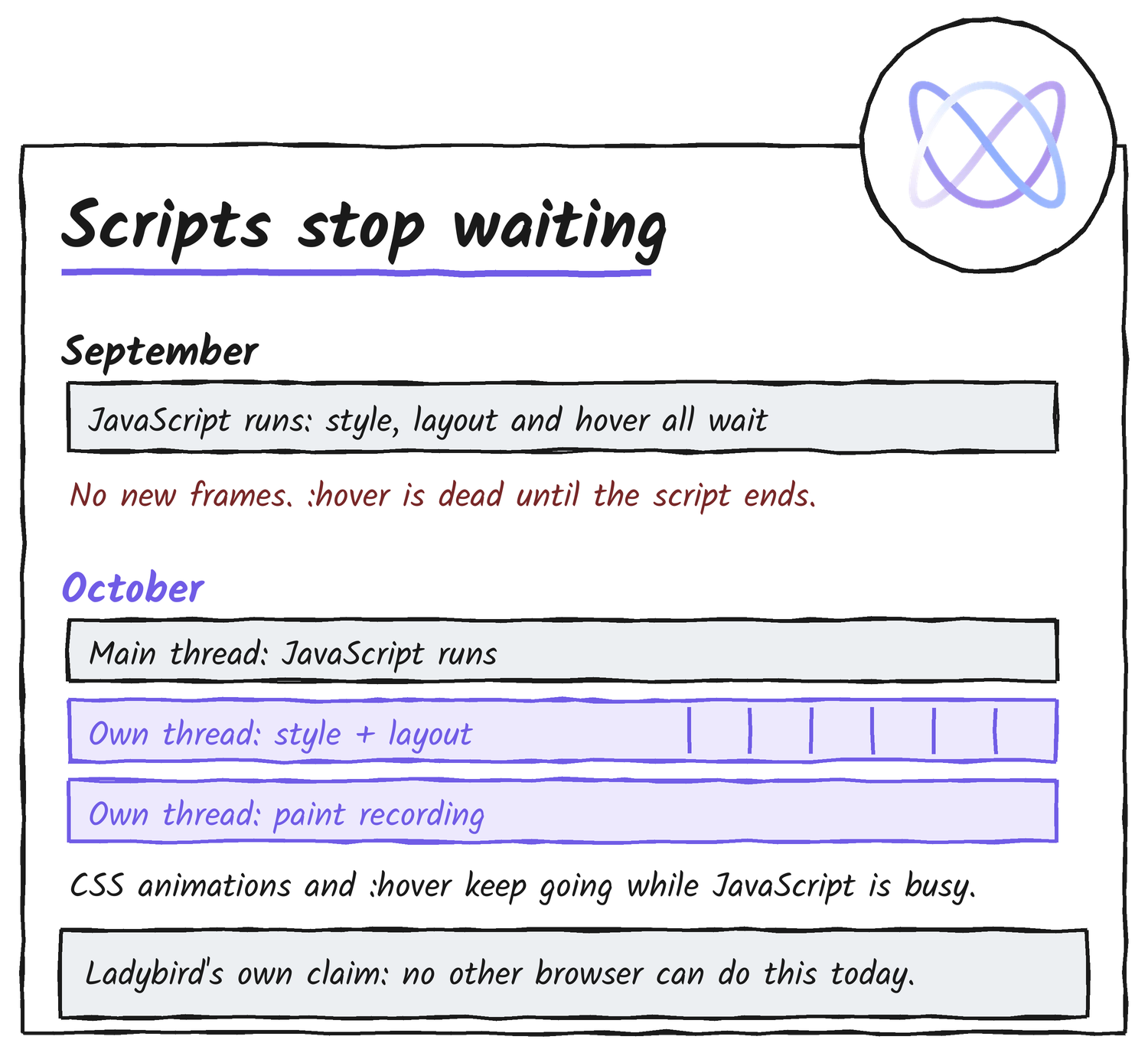
Style and layout off the main thread
Browsers normally run JavaScript, style and layout one after another on a single main thread. In October Ladybird moved style and layout to their own thread and paint recording to another, so CSS animations and :hover keep working while a script runs. The newsletter says “As far as we know, no other browser can do this today.” That’s Ladybird’s claim, and the newsletter backs it with side-by-side videos against Chrome.
Rust, with AI help
Ladybird began as C++ inside SerenityOS. On 23 February the project said it was adopting Rust as its C++ successor, after exploring Swift and dropping it because the C++ interop “never quite got there” and platform support outside Apple’s ecosystem was limited, according to Kling’s post. The first target was the lexer, parser, AST and bytecode generator of LibJS. Kling used Claude Code and Codex to translate about 25,000 lines in roughly two weeks, with byte-for-byte identical output required from the C++ and Rust pipelines. The post reports zero regressions across 52,898 test262 tests and 12,461 Ladybird regression tests.
This was human-directed, not autonomous code generation. I decided what to port, in what order, and what the Rust code should look like.
Andreas Kling, in Ladybird’s Rust announcement, 23 February
Rust has spread since. The July newsletter reports much of the style and layout pipeline in LibWeb moving to Rust, which lets style sit in immutable shared values that parallel restyling can use, and the August newsletter says CSS parsing and the painting pipeline followed. The May newsletter lists the HTML parser in Rust. C++ remains the main language, and the FAQ says subsystems are being ported incrementally.

How it scores
Ladybird tracks its progress against the Web Platform Tests, the shared suite browser makers use to check standards support. At the end of October its newsletter reported 2,184,722 passing subtests, a gain of 75,650 on the month, and said Ladybird passed Safari Technology Preview on 26 October.
2,184,722
Web Platform Tests subtests passed, end of October
97%
of Chrome’s 2,244,397, by my arithmetic
3.4x
Speedometer 3 score from early August to the end of October on its Linux runner
| Browser | Subtests passed | Share of Chrome’s total |
|---|---|---|
| Chrome | 2,244,397 | 100% |
| Firefox | 2,189,315 | 97.5% |
| Ladybird | 2,184,722 | 97.3% |
| Safari Technology Preview | 2,172,990 | 96.8% |
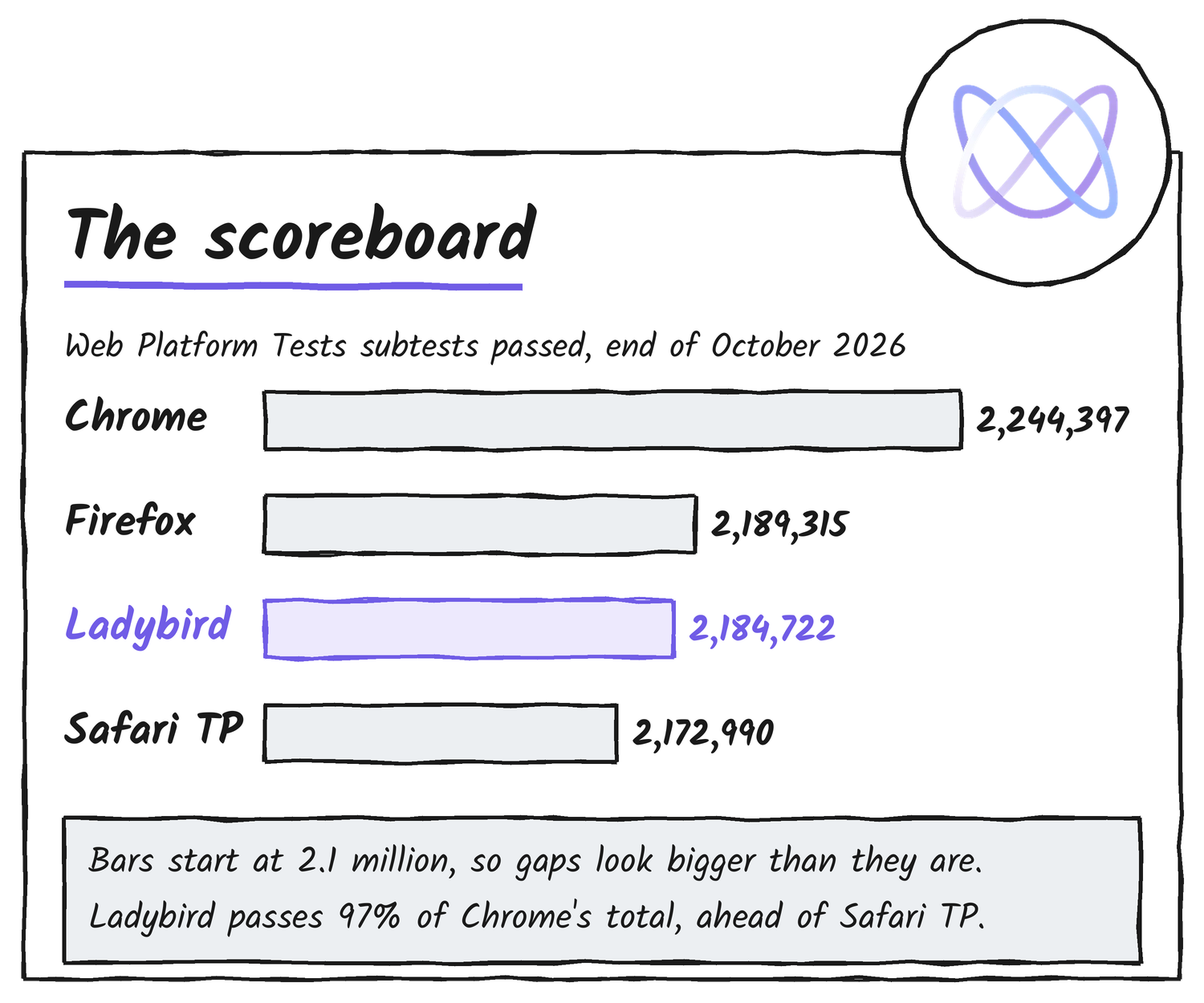
The count measures standards coverage, not how many sites work. The gain also arrived in a rush: the score rose from about 2.12 million on 22 October to about 2.18 million on 27 October after the team pointed AI coding agents at the suite and asked them to fill in missing functionality. The biggest gains for the month were about 30,000 subtests in /css and 10,000 in /editing.
| Month end | Subtests passed | Gain on the month |
|---|---|---|
| June | 2,078,912 | 3,366 |
| July | 2,079,020 | 108 |
| August | 2,088,677 | 9,657 |
| September | 2,109,072 | 20,395 |
| October | 2,184,722 | 75,650 |
Speed and memory
Speed is where the gap shows. Ladybird runs benchmarks continuously against its main branch and tracks the results on a public page, linegodown.lol, according to the August newsletter, which called its scores “still modest numbers next to the mature engines”. The figures below come from its Linux runner.
| Benchmark | Start of August | End of August | End of September | End of October |
|---|---|---|---|---|
| Speedometer 2 | about 47 | about 64 | 84 | 156 |
| Speedometer 3 | about 2.5 | about 3.9 | 5.9 | 8.6 |
An outside tester found the same gap. Sam Allen of Dot Net Perls built Ladybird from source on 17 November, found it rendered most pages he tried, and reported it typically slower than Brave and Firefox: on Speedometer 3.1, Brave was about three times faster. He plans to use it for logged-out browsing.
Memory has been a weak spot. The September newsletter describes background tabs on Politico reaching 11 GB after four hours and El País reaching 15 GB after 20, because pages that reloaded themselves kept every replaced document alive; the fixes landed that month. When a user raised memory use in early November, the team’s reply was that there’s still work to do, PiunikaWeb reported.
Security and the maintainers-only rule
We want security nerds to hack it!
Andreas Kling, in the alpha announcement
The announcement says a new browser gets hacked over and over, that this is part of the process, and that the alpha makes no promises about security. It asks researchers to report flaws through the project’s SECURITY.md file.
In September the team spent a week with Trail of Bits engineers through Patch the Planet, a programme sponsored by OpenAI. The engineers used a swarm of OpenAI’s frontier models to find security issues and reported everything they found, according to the September newsletter. They also crafted a few full exploit chains. The week left Ladybird with “a considerable security backlog” and sharpened its security model, which has to hold even when a malicious page takes over its renderer. The fixes the newsletter lists:
- The network process now handles cookies for HTTP responses and WebSocket handshakes, and the browser terminates any renderer that asks for HttpOnly cookies.
- macOS helpers got tighter service and file access, plus the hardened runtime.
- Linux helpers can no longer connect to arbitrary UNIX sockets in the user’s session, Landlock restrictions apply before GPU-driver threads start, and helpers refuse to start without Landlock by default.
- Cross-site iframes can live in separate processes, though normal browsing still isolates at the top level and embedded frames stay with their containing page.
The other security decision came in June. On 5 June Ladybird said it would stop accepting public pull requests, so that only maintainers introduce code changes, and closed every open one. The announcement says AI tools have changed the economics of contributing: “a pull request no longer tells us as much as it used to about the person submitting it”. Bug reports, reductions, website testing, standards discussion and security reports still count, and the code stays open source.
Who’s behind it
| Date | What happened | Source |
|---|---|---|
| June 2019 | Kling’s first LibHTML commit for SerenityOS, the start of what became Ladybird’s engine | W3C session notes |
| July 2022 | The browser is renamed Ladybird in a live-coded video about a Linux interface | W3C session notes |
| September 2022 | Spun off from SerenityOS as a cross-platform project | W3C session notes |
| 3 June 2024 | Kling forks Ladybird into its own repository and steps down as SerenityOS’s lead | Ladybird |
| 1 July 2024 | The Ladybird Browser Initiative is announced as a US 501(c)(3) non-profit | Ladybird |
| August 2024 | FUTO announces a US$200,000 grant | W3C session notes |
| May 2025 | The newsletter reports the non-profit is officially tax-exempt | Ladybird |
| 23 February 2026 | Rust adopted as the C++ successor language | Ladybird |
| 5 June 2026 | Public pull requests closed; maintainers only | Ladybird |
| 26 October 2026 | Passes Safari Technology Preview on Web Platform Tests | Ladybird |
| 23 November 2026 | First alpha released | Ladybird |
Kling’s record before this, as the 2024 announcement lists it, is Apple’s Safari, Nokia’s WebKit browsers and KHTML. He started SerenityOS in 2018 and the browser grew out of it. The organisation page names Kling as president, Tim Flynn as secretary and Mike Shaver as treasurer, with Jelle Raaijmakers as chief operating officer. Chris Wanstrath, the GitHub co-founder who was secretary and treasurer in the 2024 announcement, isn’t on that list now.
Who pays for it
Ladybird says it’s funded entirely by donations and sponsorships, and its home page lists “no monetization” as a founding choice: no default search deals, crypto tokens or other ways of earning from users. The 2024 announcement put it in writing.
Our non-profit will not pursue corporate deals or revenue outside of unrestricted donations.
Andreas Kling, announcing the Ladybird Browser Initiative, 1 July 2024
The launch money was a US$1 million donation from Wanstrath and his family, per the W3C session notes, plus the US$200,000 FUTO grant. FUTO is now a platinum sponsor alongside Shopify and Cloudflare. Gold sponsors are the Human Rights Foundation and Proton VPN, and silver includes 37signals, CodeRabbit and the individual backers Mitchell Hashimoto and Paul Copplestone. Bronze includes JetBrains, Sourcegraph and a sponsor listed as Anonymous Chromium Developer.
| Tier | Price per year | Sponsors listed | At list price |
|---|---|---|---|
| Platinum | US$100,000 | 3 | US$300,000 |
| Gold | US$50,000 | 2 | US$100,000 |
| Silver | US$10,000 | 6 | US$60,000 |
| Bronze | US$5,000 | 12 | US$60,000 |
| Copper | US$1,000 | 17 | US$17,000 |
| Total | 40 | US$537,000 |
That total isn’t Ladybird’s revenue. It leaves out the US$1 million launch gift, individual donations through Donorbox and anything given above a tier’s price. The FAQ says all sponsorships are unrestricted donations, that board seats aren’t for sale and that sponsors have no say in the technical roadmap. It describes a small full-time engineering team whose size is stable for now, and says the project strives to keep 18 months of runway at all times. Sponsorships run for one year.
Where it sits among the engines
Three engines handle almost every page. Statcounter puts worldwide page views for October 2026 at 68.79% for Chrome, 16.59% for Safari, 5.36% for Edge, 2.57% for Firefox, 2.16% for Opera and 2.05% for Samsung Internet. Adding the Blink-based browsers gives Blink 78.4%, against 16.6% for WebKit and 2.6% for Gecko. That grouping is my arithmetic.
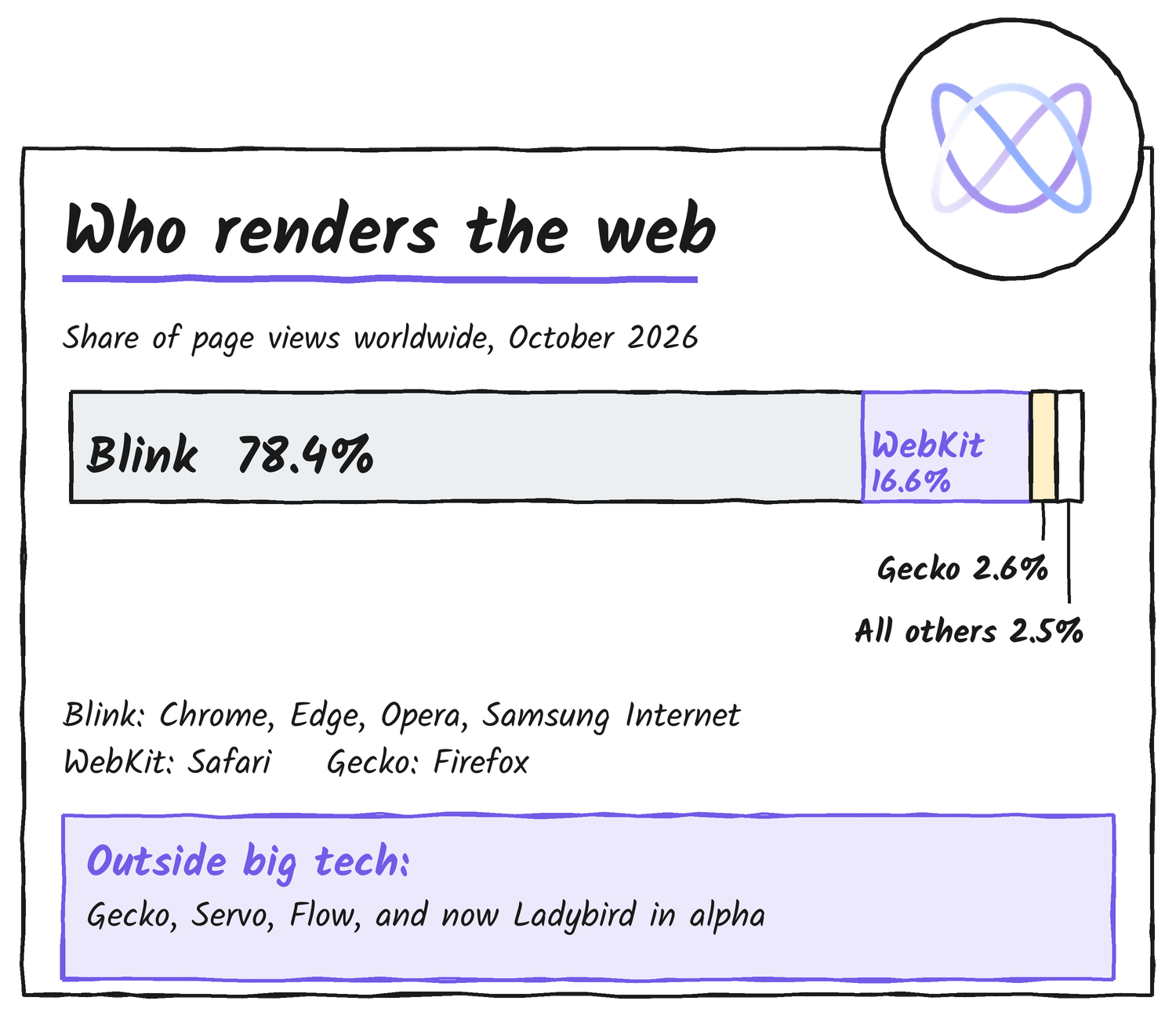
| Engine | Steward | Where it ships | Status |
|---|---|---|---|
| Blink | Chrome, Edge, Opera, Samsung Internet | 78.4% of page views | |
| WebKit | Apple | Safari and, in practice, every iPhone browser | 16.6% of page views |
| Gecko | Mozilla | Firefox | 2.6% of page views |
| Servo | Linux Foundation Europe project | Embeddable engine in Rust; servoshell test browser | v0.1.0 on crates.io on 13 April 2026; US$8,144 a month in recurring donations |
| Flow | Ekioh, Cambridge, England | Set-top boxes and embedded devices; proprietary | Beta; a preview reached 90% of Web Platform Tests in April 2025 |
| Ladybird | Ladybird Browser Initiative, US non-profit | Desktop browser, BSD 2-Clause licence | First alpha, 23 November 2026 |
Mozilla calls Gecko “the last major browser engine not developed by a big tech company”. Its 20 November post says Apple’s conditions for non-WebKit engines on iPhones in the EU and Japan remain unworkable, and that nearly three years after the EU rules “not one developer has been able to launch a non-WebKit browser on iOS”. Apple’s published conditions require an engine to pass 90% of Web Platform Tests, measured against the highest number of subtests executed by any browser on the wpt.fyi front page, and 80% of Test262. Ladybird’s 97% of Chrome’s passing subtests isn’t that measure, and the project isn’t aimed at iPhones: its FAQ says mobile isn’t a current focus.
Servo, the Rust engine that began at Mozilla Research, now runs under open governance at Linux Foundation Europe. It targets embedding, and its first crates.io release on 13 April came with a long-term-support version. It embeds Mozilla’s SpiderMonkey JavaScript engine, where Ladybird writes its own. Servo’s funding is smaller too: US$8,144 a month in recurring donations, which pays for CI servers, an Outreachy intern and maintainer work. Ekioh’s Flow, a proprietary engine, was one of the six engines in active development that the W3C session notes counted in 2024, with Flow at 88% of Web Platform Tests then.
Search money is the other pressure on browser independence. Judge Amit Mehta’s September 2025 remedies ruling in the US search case lets Google keep paying browser makers for default search placement as long as the deals aren’t exclusive, so Mozilla can keep receiving Google’s payments, It’s FOSS reported. Ladybird’s site says it takes no default search deals at all.
What the alpha changes
- Web developers get another engine to test against, and the announcement asks them to report what breaks. WebDriver and the Firefox DevTools protocol are in.
- Sites with bot checks meet a new browser. Ladybird’s newsletters report passing Google reCAPTCHA in July 2025 and Cloudflare Turnstile in May 2026. Cloudflare is also a platinum sponsor and delivers the downloads.
- Users get private windows and browser profiles (July), an inline PDF viewer built on pdf.js (April), tab search and pinned tabs, light, dark and force-dark modes, and a content blocker with EasyList and other filter lists that update daily, per the newsletters.
- Linux distributions get packages: apt for Ubuntu, rpm for Fedora and a Flatpak that the download page marks as recommended.
What to watch
- The roadmap. The repository’s FAQ lists an alpha in 2026, a beta in 2027 as a downloadable app for Linux and macOS, and a stable release for general use in 2028. The README and FAQ still call Ladybird pre-alpha software you build yourself, so they haven’t caught up with the release.
- Windows and Intel Mac builds, neither of which the alpha includes.
- The security backlog from the Trail of Bits week, and the first reports against the alpha through SECURITY.md.
- The score gap. At the end of October Ladybird trailed Chrome by 59,675 subtests and Firefox by 4,593. The November newsletter, due at month end, will carry the first post-alpha numbers.
- Money. Sponsorships run for one year, and the project says it keeps 18 months of runway.
Check the release yourself
The release manifest is a public JSON file. It lists each download with its size and SHA-256 checksum. The macOS disk image should hash to d3647babc442aca475354b19158045cd5b5f40f4be92fe55762be8eb90727ed8.
curl -s https://download.ladybird.org/releases.json
shasum -a 256 ladybird-2026.47.7-macOS-arm64.dmgSources
- Ladybird is now in alpha, Andreas Kling, 23 November 2026
- Download page and release manifest
- Ladybird 2026.47.7 release notes on GitHub
- Ladybird newsletters: June, July, August, September and October
- Ladybird adopts Rust, with help from AI and Changing How We Develop Ladybird
- Announcing the Ladybird Browser Initiative, Ladybird forks from SerenityOS and the W3C session notes
- Ladybird privacy policy and organisation page
- Statcounter, October 2026
- Mozilla, 20 November 2026 and Apple’s alternative browser engine conditions
- Servo: 0.1.0 release and September report
- Dot Net Perls, 17 November 2026, PiunikaWeb, 5 November 2026 and It’s FOSS, 3 September 2025
Discover more from Sulat AI & Tech News
Subscribe to get the latest posts sent to your email.