The California DMV ranks eighth among all merchants in a16z’s chart of agent-facilitated spending, ahead of Disney and Apple, and it is one of only four public bodies in the top 50. Olivia Moore, an a16z partner, flagged it on X as “an amazing indicator of agent adoption by market”, with California about three times Washington State and five times Fairfax County. The chart is real and her ratios hold. What it can’t tell us is how many people are behind the spend.
The numbers come from the YipitData card panel that a16z used in its agent buying study. It tracks agent-facilitated purchases from 8 September to 11 November, leaves out Amazon and can’t tell Muse apart from Instinct. a16z publishes no dollar figures. Each bar is relative, and each merchant is ranked within a 257-merchant extract, so every figure below is a rank or a ratio, not money.
What the chart shows
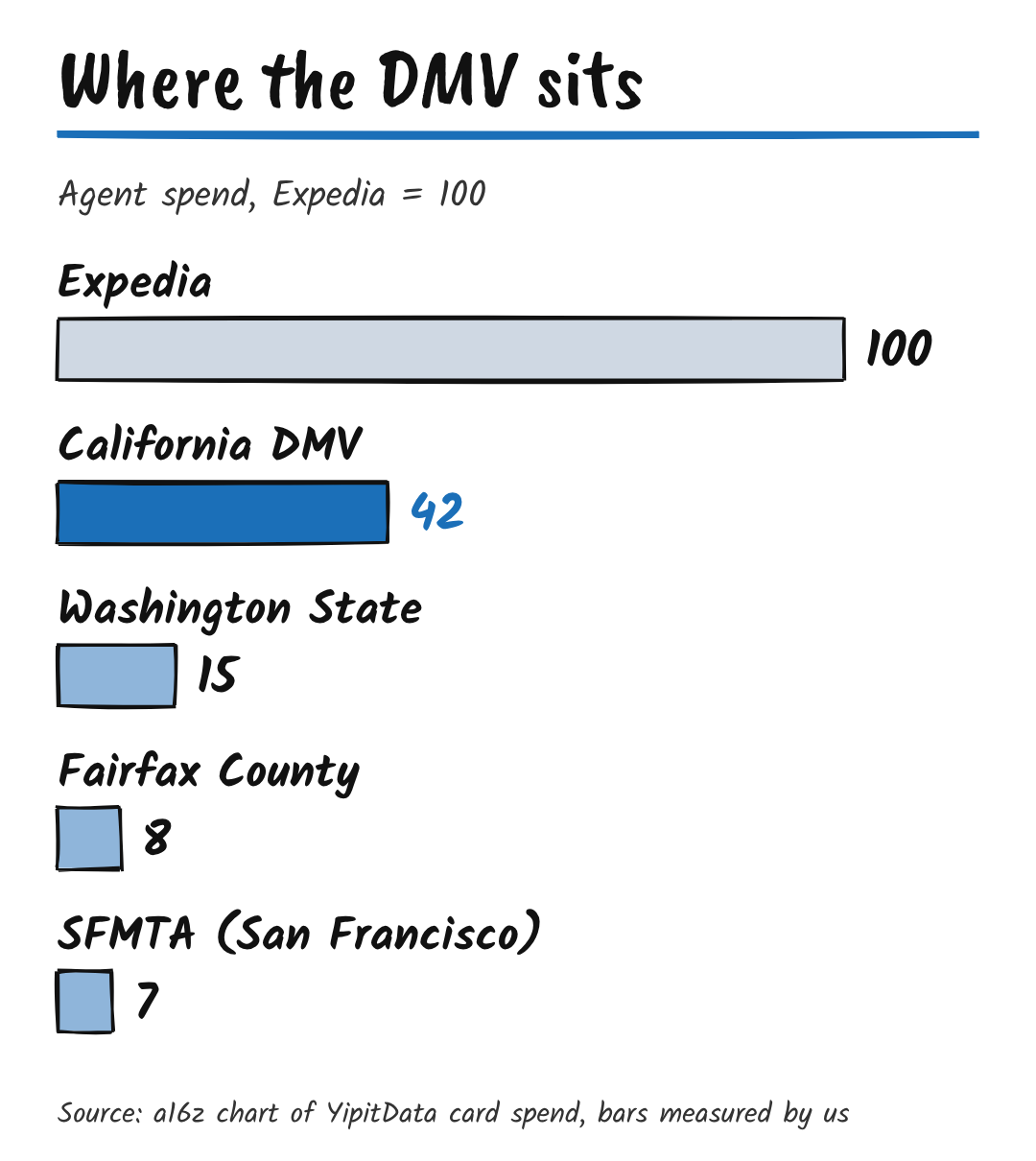
I measured the bars on a16z’s spend chart against Expedia, the top merchant. The California DMV comes out at about 42% of Expedia’s bar, Washington State at about 15%, Fairfax County at about 8% and SFMTA, San Francisco’s transport agency, at about 7%. That puts California at roughly 2.8 times Washington and 5.3 times Fairfax, which matches Olivia’s “about 3x” and “5x”.
8th
California DMV, by agent spend
15th
California DMV, by agent transactions
22nd
Washington State, by agent spend
38th
Fairfax County, by agent spend
The transactions chart tells a different story. California is 15th there, and neither Washington nor Fairfax makes the top 50. SFMTA is 36th, and the US Postal Service (20th) and Recreation.gov (46th) are the only other public bodies. Eighth by spend and 15th by transactions suggests the DMV’s average payment is larger than most on the list. The chart doesn’t say what the payments are for.
One naming point: the chart’s label is “Fairfax County”, not a DMV. Virginia’s DMV is a state agency, so I can’t tell from the chart what the county’s spend is for, although Olivia’s post calls it a DMV.
Why the DMV form suits an agent
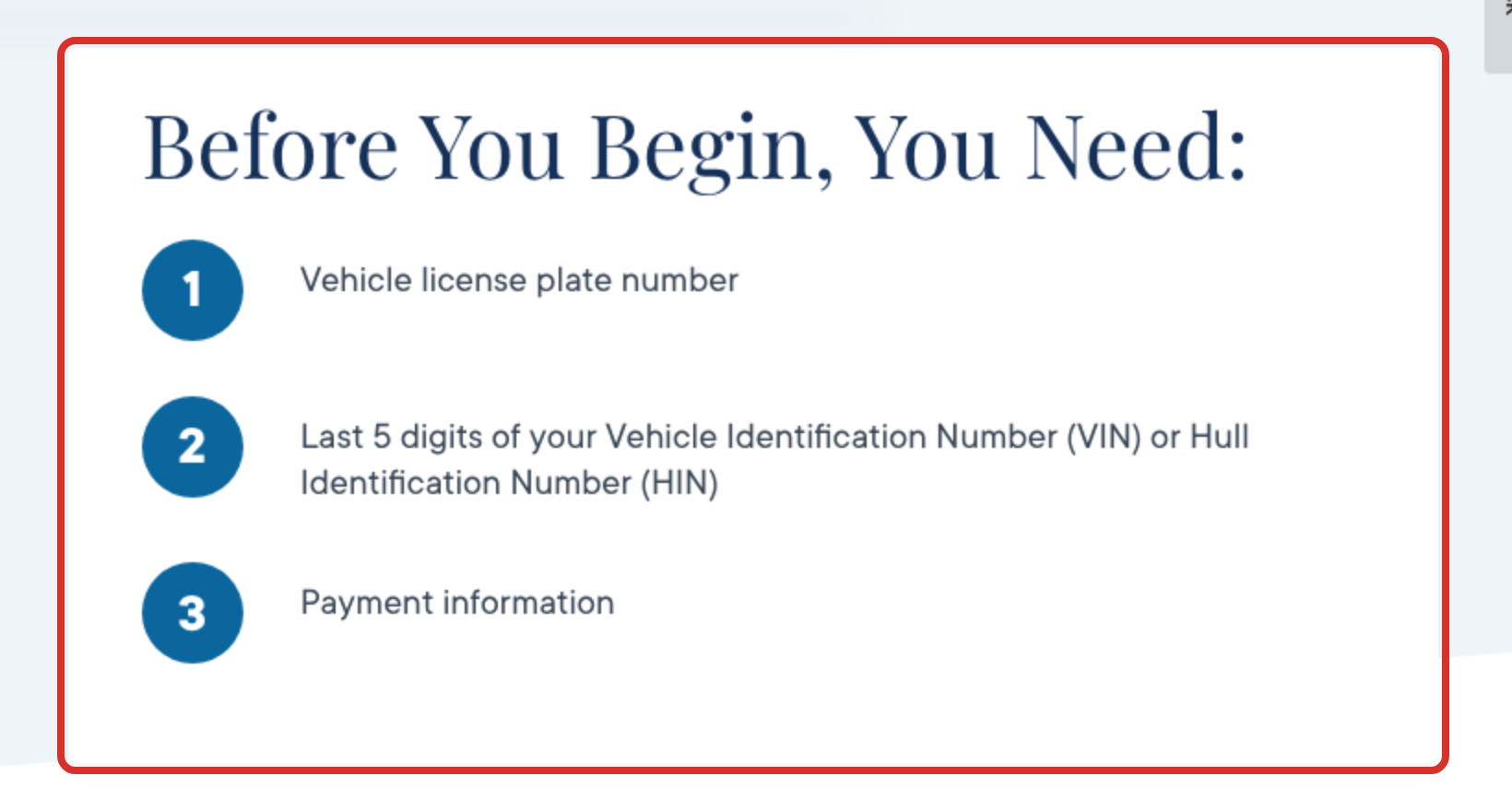
The first a16z study found that agents reached the end of the checkout form in 81% of runs on stores with guest checkout, and every run on a store that needed a logged-in account stopped early. California’s renewal page is built for the first case. Before you begin, it lists three things: the plate number, the last five digits of the VIN or hull number, and payment information. There’s no account to create and no password to hold.
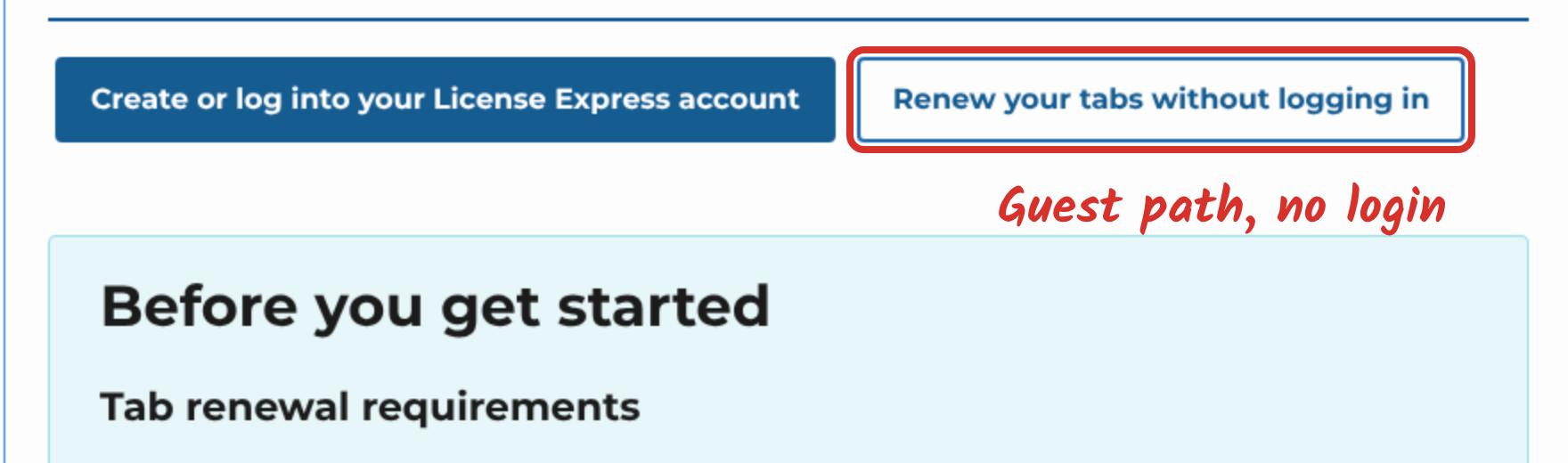
Washington’s Department of Licensing offers two buttons on its tab-renewal page: one to log in to a License Express account, and one to renew without logging in. The guest route is there, though it sits second.
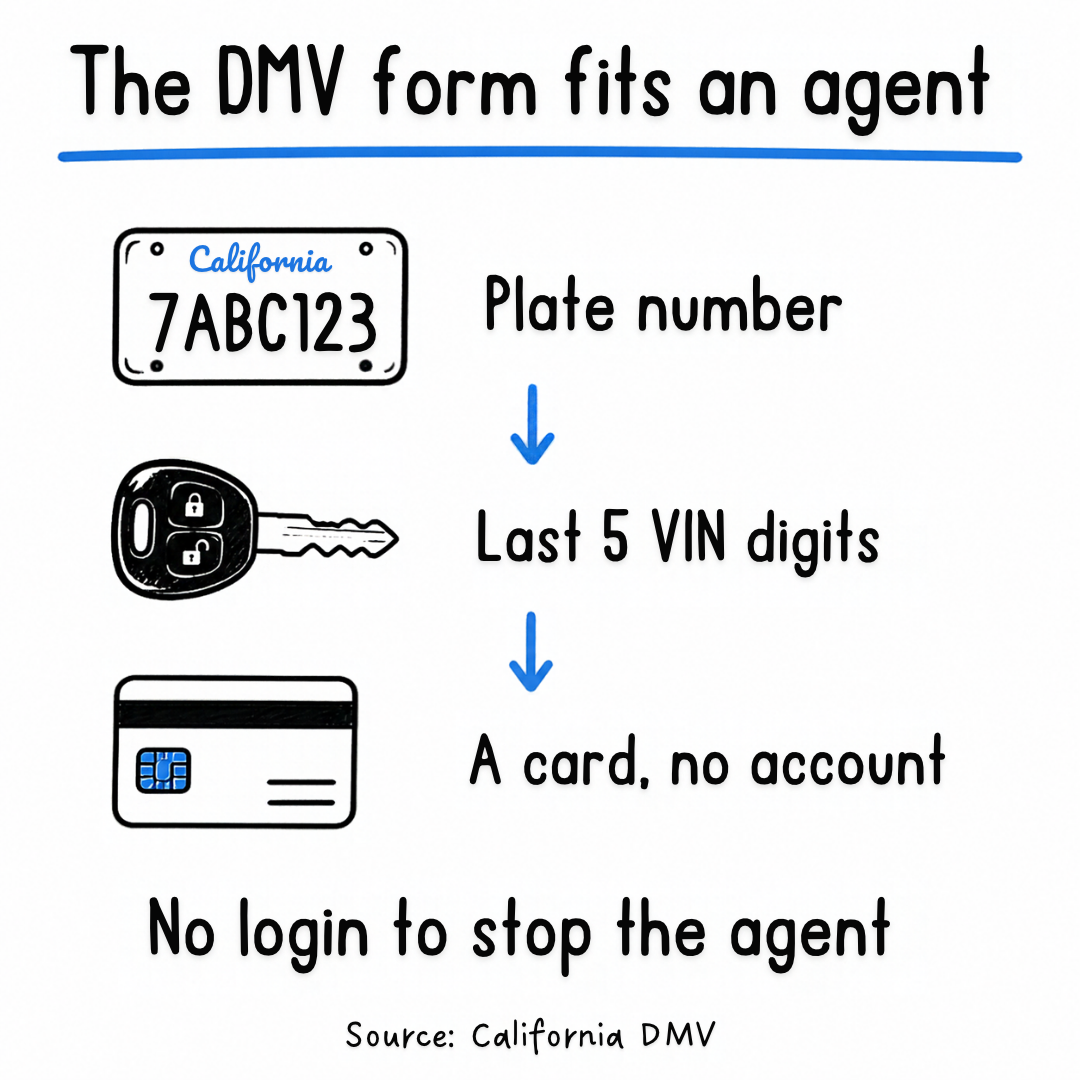
Payment is the other half. Muse, Grok Bot and Instinct pay through Stripe’s Link, using a saved method or a single-use virtual card, as I covered in the piece on Link’s agent spend. A government site that takes a card with no login lets that route work end to end. Card fees show the cost of using it:
| Office | Card service fee | Free option |
|---|---|---|
| California DMV | 1.95% | ACH or e-check |
| Fairfax County | 2.35% | ACH or e-check |
| Washington State | 3% | ACH or e-check |
Washington’s higher fee and its login-first layout come with a lower bar. That points the same way as the study, but it isn’t proof. Several other states also offer short renewal flows, so the form alone can’t explain why California is the one that shows up.
Adjusting for population
California has far more people than Washington or Fairfax County, so raw spend favours it. Using Census Bureau 2025 population estimates, Washington’s bar works out at about 1.8 times California’s per resident, and Fairfax County’s at about seven times. If the spend is residents paying their own bills, agent use per person is higher in the smaller places.
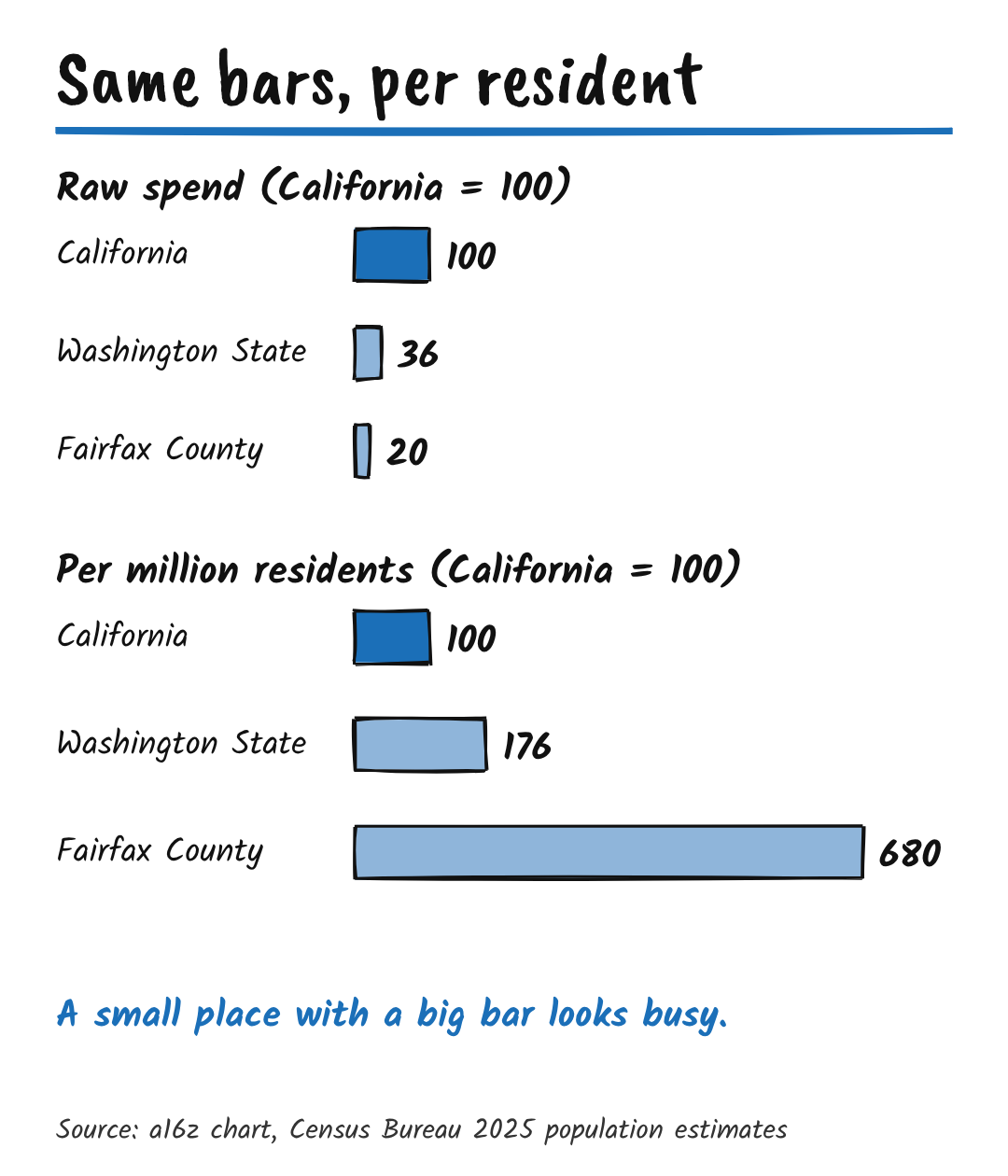
That “if” matters. The right denominator is agent users in each place, and nobody publishes that. Fairfax County is a small base, so a few heavy users could move its bar. A small place with a big bar looks busy. I’d treat the per-resident view as a corrective to the raw one, not as a ranking.
Where it sits on the list
The top ten by spend reads Expedia, Booking.com, Best Buy, American Airlines, eBay, United Airlines, Walmart, the California DMV, Disney and Apple. Travel takes four of those places, which fits what the a16z study said about agents gravitating to aggregators and marketplaces. The DMV is the only public body among them. The other public names are further down: SFMTA 44th by spend, and by transactions the US Postal Service and Recreation.gov. The pattern fits agencies that take a plain card payment against a short list of identifiers.
How early this is
Expedia’s bar is more than twice the DMV’s, and the top of the list is airlines, travel sites and electronics stores. Stripe’s Link data, which I wrote up after Black Friday, shows retail now leads and a third of that day’s agent shoppers were making their first agent purchase. A government renewal landing in the top ten says agents are being handed errands, not only shopping lists. It doesn’t say the errand is common.
It also sits beside the new liability terms. Wells Fargo and other US banks now make customers answer for what an agent does, which I covered in their terms from 24 November. A fee-bearing payment to a state agency is exactly the kind of low-risk, well-defined task someone will hand over first.
What to watch
- Other agencies. The next a16z or YipitData cut will show whether the DMV is one case or the start of a government category.
- Guest flows. Washington’s second button and California’s three-item list are what the study says agents need. Agencies that copy them may appear on the chart.
- Dollar figures. Until someone publishes amounts or order counts, “eighth” is a rank inside a card-panel sample, not a market size.
Sources: Olivia Moore on X, a16z, How Agents Buy, California DMV, Vehicle Registration Online Renewal, Washington DOL, Renew or replace vehicle tabs, US Census Bureau, 2025 population estimates.