Cloudflare’s chief technology officer, Dane Knecht, posted on 29 November that the company plans for all scenarios as the risk of a cryptanalysis breakthrough changes, whether it comes from “a nation state or frontier AI lab.” He didn’t claim a break has happened. He set out what Cloudflare has already done and what it’s still building.
The post landed in the middle of the rumours I covered in an earlier piece and in Coinbase’s response. This one explains Cloudflare’s plan in plain English, with a few explain-it-like-I’m-twelve sections, and says what the plan doesn’t answer.
What Knecht said
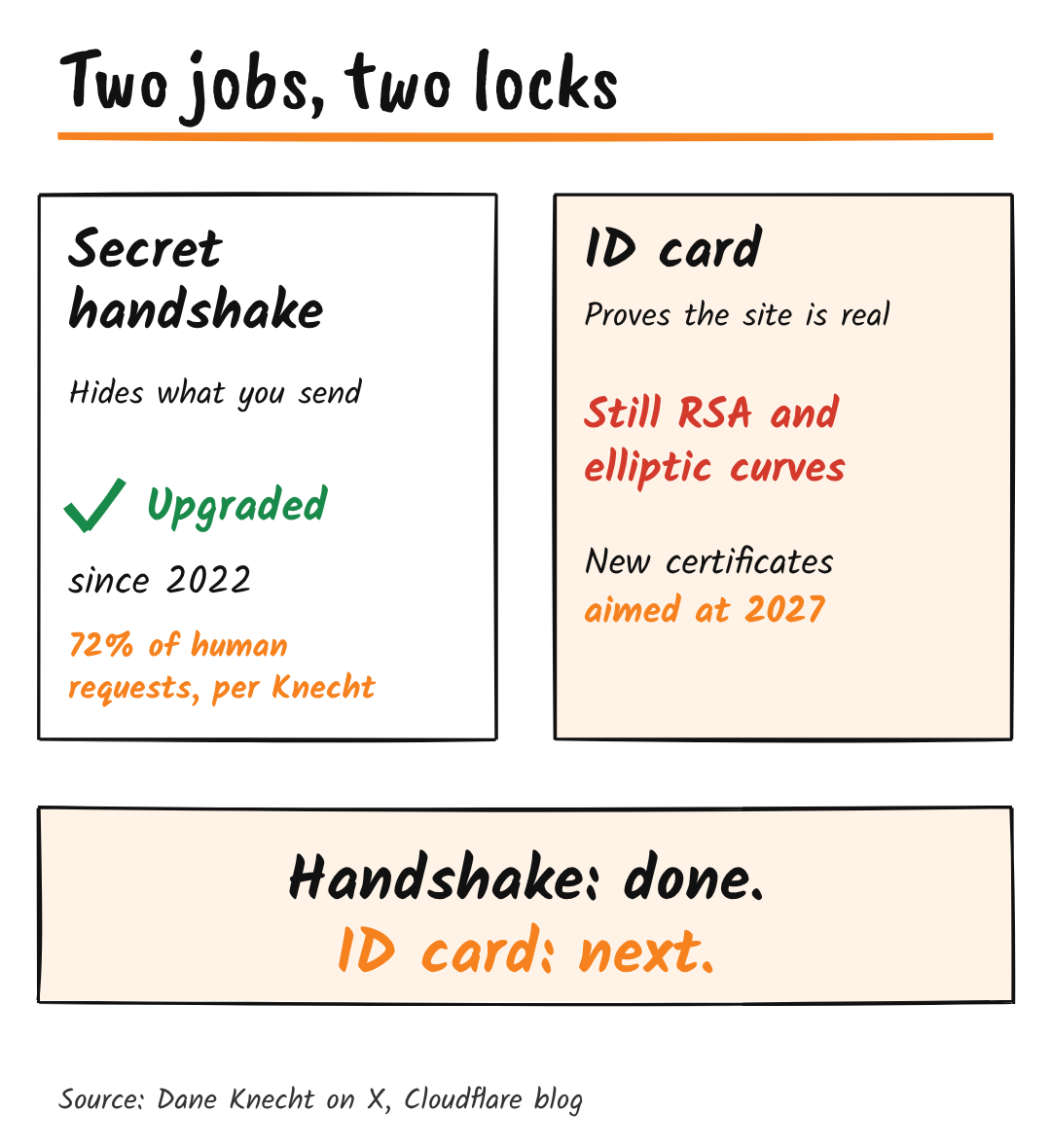
He makes three points. Cloudflare turned on post-quantum key agreement in 2022 for every website and API behind it, and over the last twelve months 72% of human HTTPS requests used it. That defends against attacks that “harvest encrypted data now for decryption later.” But the web’s certificate system “still relies on RSA and elliptic curve signatures that, if cracked, would let attackers impersonate servers and decrypt secure connections.” And to fix that, Cloudflare is working with Google and others to move to Merkle Tree Certificates and post-quantum cryptography, “with a goal of 2027 for initial deployments.”
A Polymarket post that appears in the same thread says Elon Musk has heard from multiple people that a frontier AI lab may have cracked 2048-bit RSA. I haven’t found a post from Musk himself, and Knecht doesn’t mention it. Treat it as a rumour.
72%
Human HTTPS requests to Cloudflare using post-quantum key agreement over twelve months, by Knecht’s count
2022
When Cloudflare switched on post-quantum key agreement for sites behind it
2027
Cloudflare’s goal for initial deployments of the new certificates
ELI12: two locks on every secure connection
When your browser opens a secure page, it does two separate jobs. First it agrees a secret key with the site, so nobody listening in can read the traffic. Second it checks the site’s ID card, called a certificate, to make sure it’s talking to the real site and not an impostor.
Knecht’s post is about both jobs, and they’re at very different stages. The secret handshake has been upgraded. The ID card hasn’t.
The handshake is mostly done
The upgrade Knecht describes is a hybrid key exchange called X25519MLKEM768. It runs a classic method, X25519, alongside a newer one, ML-KEM, and mixes the results into one session key. An attacker would have to break both. Cloudflare switched it on in 2022 while it was still an IETF draft, and Cloudflare says it was finalised as RFC 10024 this year.
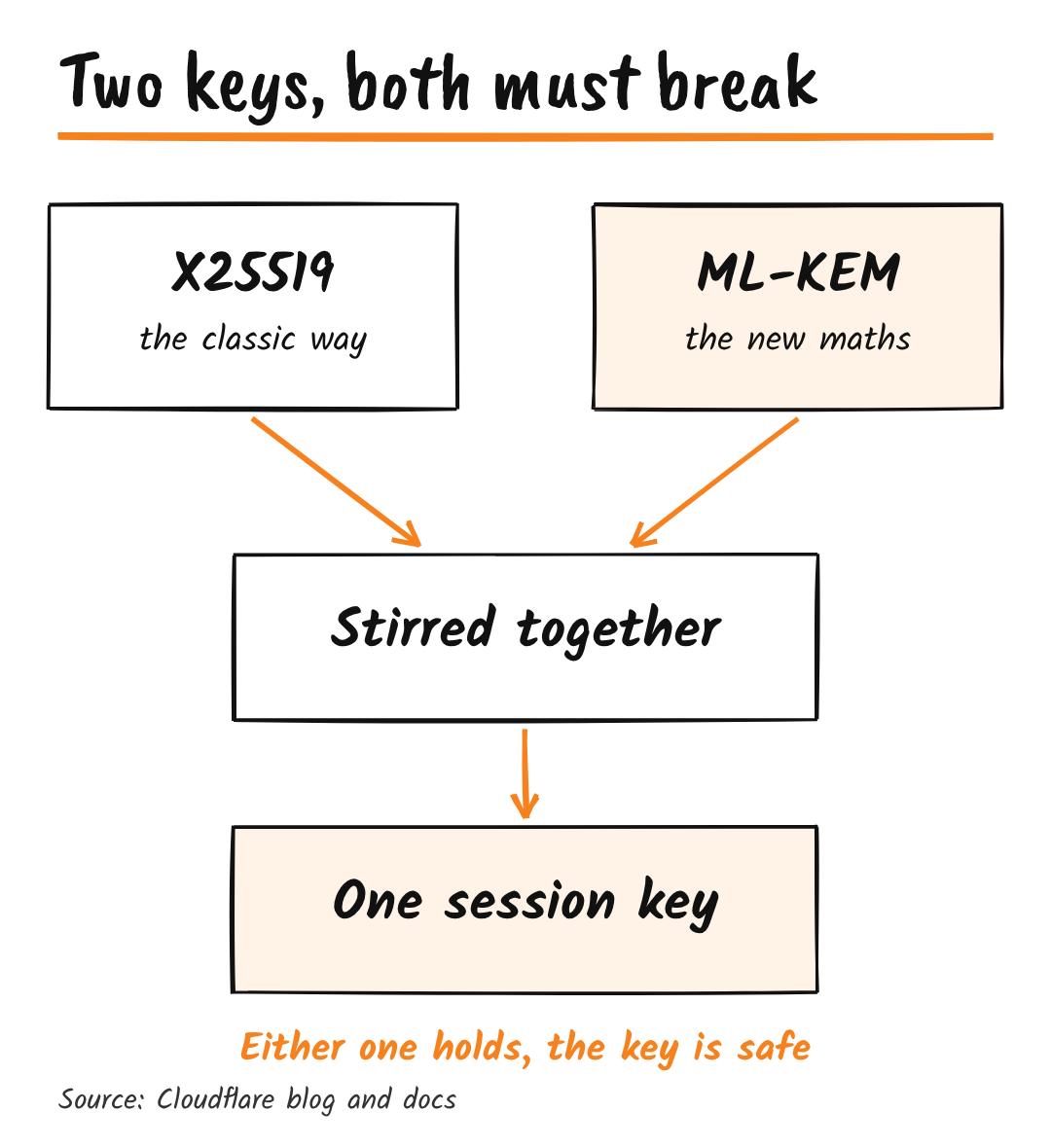
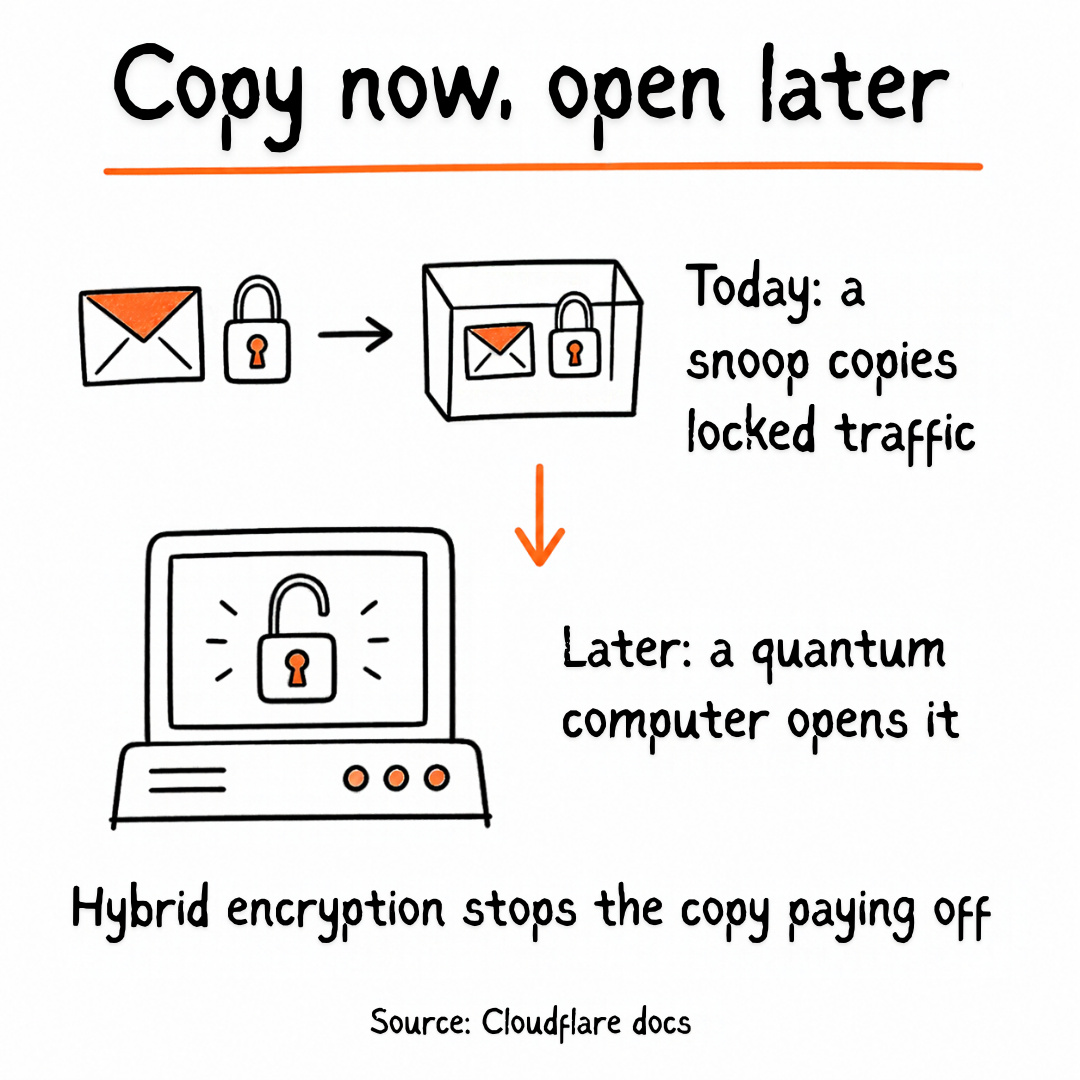
The reason to do it early is “harvest now, decrypt later.” Cloudflare describes it as an adversary collecting encrypted traffic today and storing it until a powerful quantum computer can open it. Think of someone photocopying your locked letters now, planning to pick the lock in ten years. If the letters still matter then, the copy pays off. Hybrid encryption means the copy is useless, because the key was never exposed to a single weak lock.
Cloudflare says most of its products are now protected this way and that it’s working on the rest. Knecht adds that it’s pushing for adoption on the services that sit behind its network too, since a connection is only as protected as both ends.
The ID card is the hard part
Certificates are signed with RSA or elliptic-curve signatures. If either is cracked, an attacker can forge a certificate and pose as a real site. Cloudflare’s roadmap post, published in April, puts the stakes bluntly: if a quantum computer is far off, post-quantum certificates “do not add any value, only effort,” but if one is close, “broken authentication is catastrophic.” That’s why it moved its target for being fully post-quantum, including authentication, to 2029.
You can’t just swap bigger post-quantum signatures into today’s certificates. Cloudflare says doing that at internet scale would cause “unacceptable performance degradation.” Every handshake carries a chain of signatures, and the new ones are much larger.
ELI12: Merkle Tree Certificates
Today, every site gets its own signed ID card. With Merkle Tree Certificates, the certificate authority puts a whole batch of sites on one list, builds a tree of hashes over the list, and signs the top of the tree once. A site then proves it’s on the list with a short trail of hashes, called an inclusion proof, instead of carrying its own heavy signature chain.
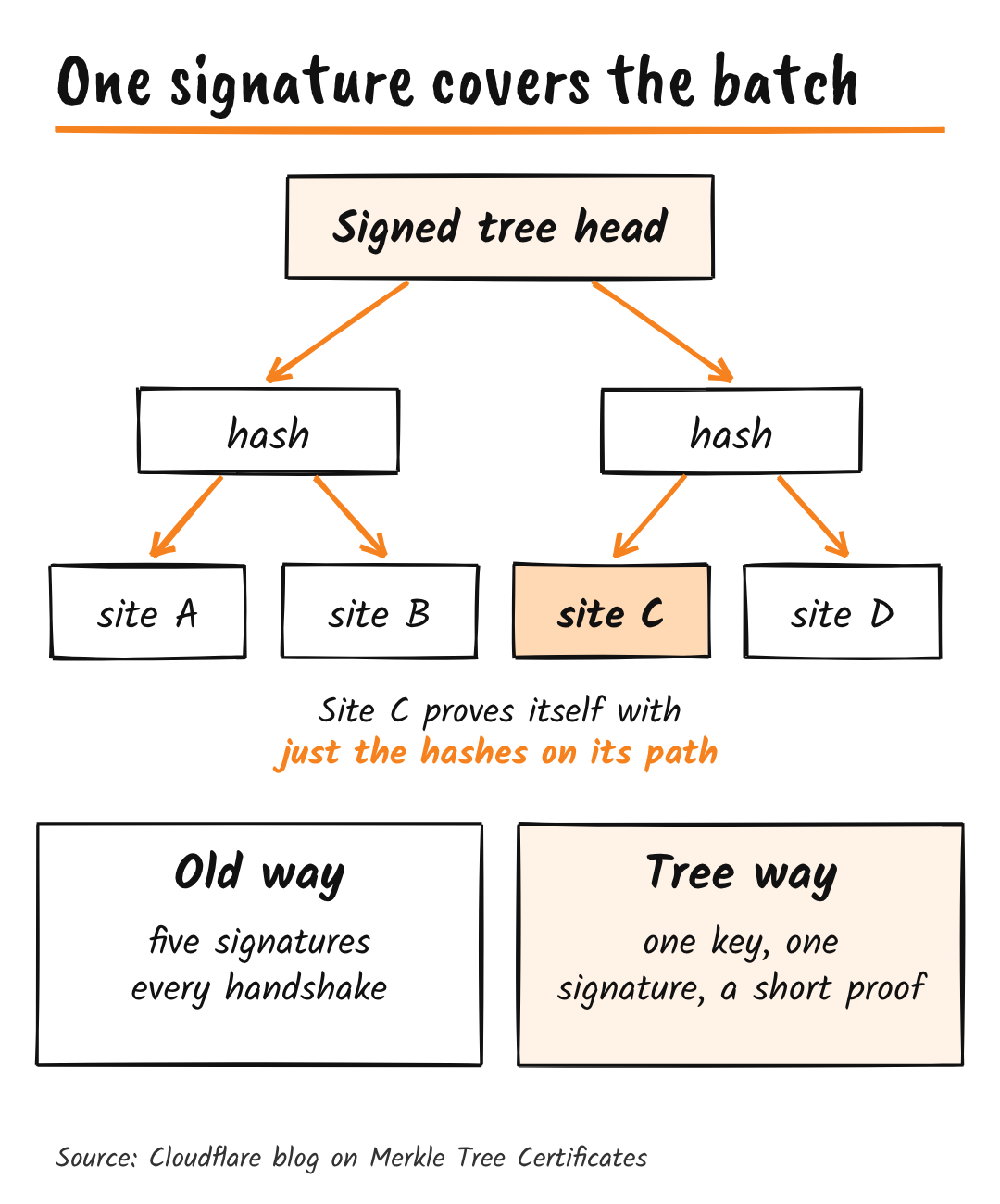
The design comes from the IETF PLANTS working group. Cloudflare says it tested it with Chrome this year, serving billions of these certificates for some sites on its free plan to half of Chrome Beta users. In the common case, it says, a handshake needs one public key, one signature and a proof under 1kB. That works because browsers get the signed tree heads separately, in updates, rather than in every handshake. It wound the experiment down in August.
Cloudflare has also said it’s becoming a certificate authority. In September it said that authority will issue these certificates, target early 2027 for entry into Chrome’s new Quantum-resistant Root Store, and offer standard issuance free. Chrome’s draft policy requires at least two cosignatures on each tree, one of them from an independent mirror. Cloudflare says it still has to apply and pass Chrome’s evaluation first.
| When | Cloudflare milestone |
|---|---|
| Mid-2026 | Post-quantum authentication (ML-DSA) on connections from Cloudflare to origin servers |
| Early 2027 | Cloudflare’s certificate authority targets Chrome’s Quantum-resistant Root Store |
| Mid-2027 | Post-quantum authentication for visitors connecting to Cloudflare, using Merkle Tree Certificates |
| Early 2028 | Post-quantum authentication across its Cloudflare One security suite |
| 2029 | Cloudflare fully post-quantum secure |
A rumour and a plan
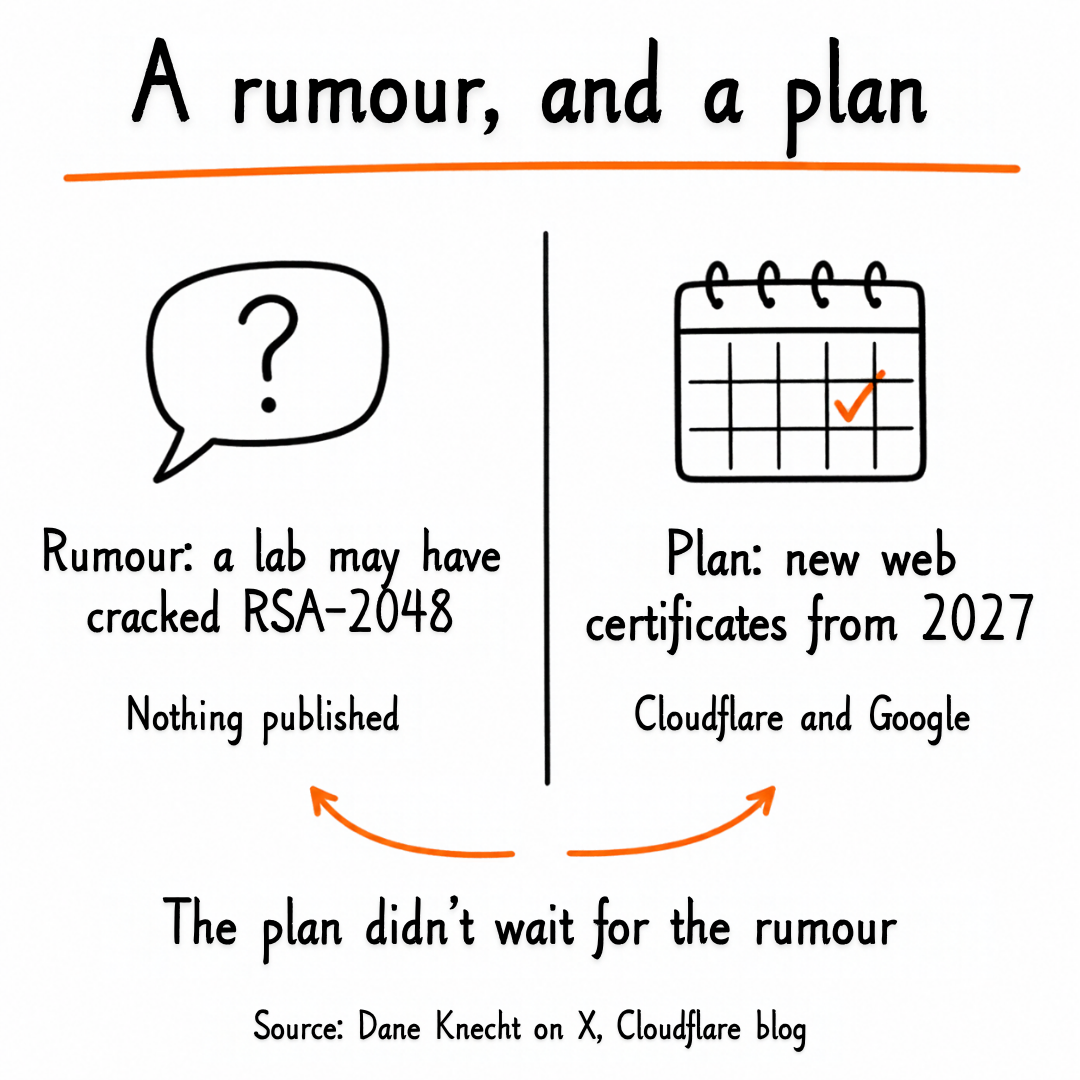
The plan isn’t a reaction to the rumour. Cloudflare’s roadmap is from April and its certificate authority announcement from September, both months before this week’s talk, and both are driven by quantum computing progress. Google moved its own migration target to 2029 for the same reason. What’s new in Knecht’s post is the framing: he adds AI-accelerated attacks to the list of reasons to move.
If a factoring break were real, it would hit RSA keys, and RSA certificates are the exposed part today. The key agreement Cloudflare has deployed pairs X25519, which isn’t a factoring problem, with ML-KEM, so that half of the connection doesn’t depend on RSA. The new certificates are meant to use different maths too: Cloudflare names ML-DSA, a post-quantum signature standard, for its first authentication work.
What the plan doesn’t give is speed. The 2027 target is for initial deployments. Browsers have to accept Cloudflare’s authority, sites have to take up the new certificates, and Cloudflare itself says moving authentication “will take years, not months.” Until then the web’s ID cards stay RSA and elliptic-curve, and nothing I’ve found shows anyone has published a break of either. Coinbase’s own read, covered here, is that it has seen no actionable information behind the rumours.
What to watch
- Whether Chrome accepts Cloudflare’s certificate authority into its Quantum-resistant Root Store, which Cloudflare targets for early 2027.
- Progress on the IETF PLANTS draft, and whether other authorities and browsers join in.
- The cryptanalysis result Scott Aaronson says the labs will soon release, covered in our factoring piece.
Sources: Dane Knecht on X, 29 November 2026; Cloudflare, post-quantum roadmap, April 2026; Cloudflare, building a post-quantum certificate authority, September 2026; Cloudflare, charting its post-quantum migration, September 2026; Cloudflare docs, post-quantum cryptography; IETF PLANTS, Merkle Tree Certificates draft; RFC 10024.